
April 23, 2026
Anchor Store
An anchor store is a large, well-known retailer that drives significant customer traffic to a shopping center, mall or digital marketplace. These stores occupy prime retail space and attract visitors who then spend at surrounding smaller retailers. In ecommerce, the concept extends to high-profile brands that draw shoppers to online platforms.
Drishti, Manager - Digital Marketing

Table of Contents
- What Is an Anchor Store?
- How Do Anchor Stores Work in Traditional Retail?
- What Is an Anchor Store in E-commerce Marketplaces?
- Why Are Anchor Stores Essential for New E-commerce Platforms?
- What Are the Key Features of Successful Anchor Stores?
- What Is the Difference Between Traditional and E-commerce Anchor Stores?
- How Do Digital Marketplaces Attract Major Anchor Stores?
- Build a Thriving Marketplace with Flipkart Commerce Cloud
Anchor Store
Anchor stores shape foot traffic patterns and commercial success across retail properties worldwide. Architect Victor Gruen codified the modern shopping center concept in the 1950s, establishing the anchor tenant as the primary traffic driver.
Since that period, anchor stores have influenced how mall owners plan retail layouts and attract smaller tenants to fill surrounding retail space. Today, this concept extends to digital marketplaces and ecommerce platforms globally.
What is an Anchor Store?
An anchor store is a large well-known retailer that drives customer traffic to a shopping center, mall or marketplace. These stores typically occupy significant retail space and sit at strategic positions such as corners or opposite ends of shopping complexes.
Anchor stores attract thousands of visitors who browse and spend at smaller surrounding retailers within the same retail property. A major department store creates a destination effect that the entire shopping mall relies on to sustain footfall and commercial viability.
Common examples include department store chains such as Macy's, Nordstrom, Neiman Marcus and Saks Fifth Avenue. Anchor stores can also have large retail store formats like Walmart and Home Depot. These stores carry a wide range of products and generate significant foot traffic.
How Do Anchor Stores Work in Traditional Retail?
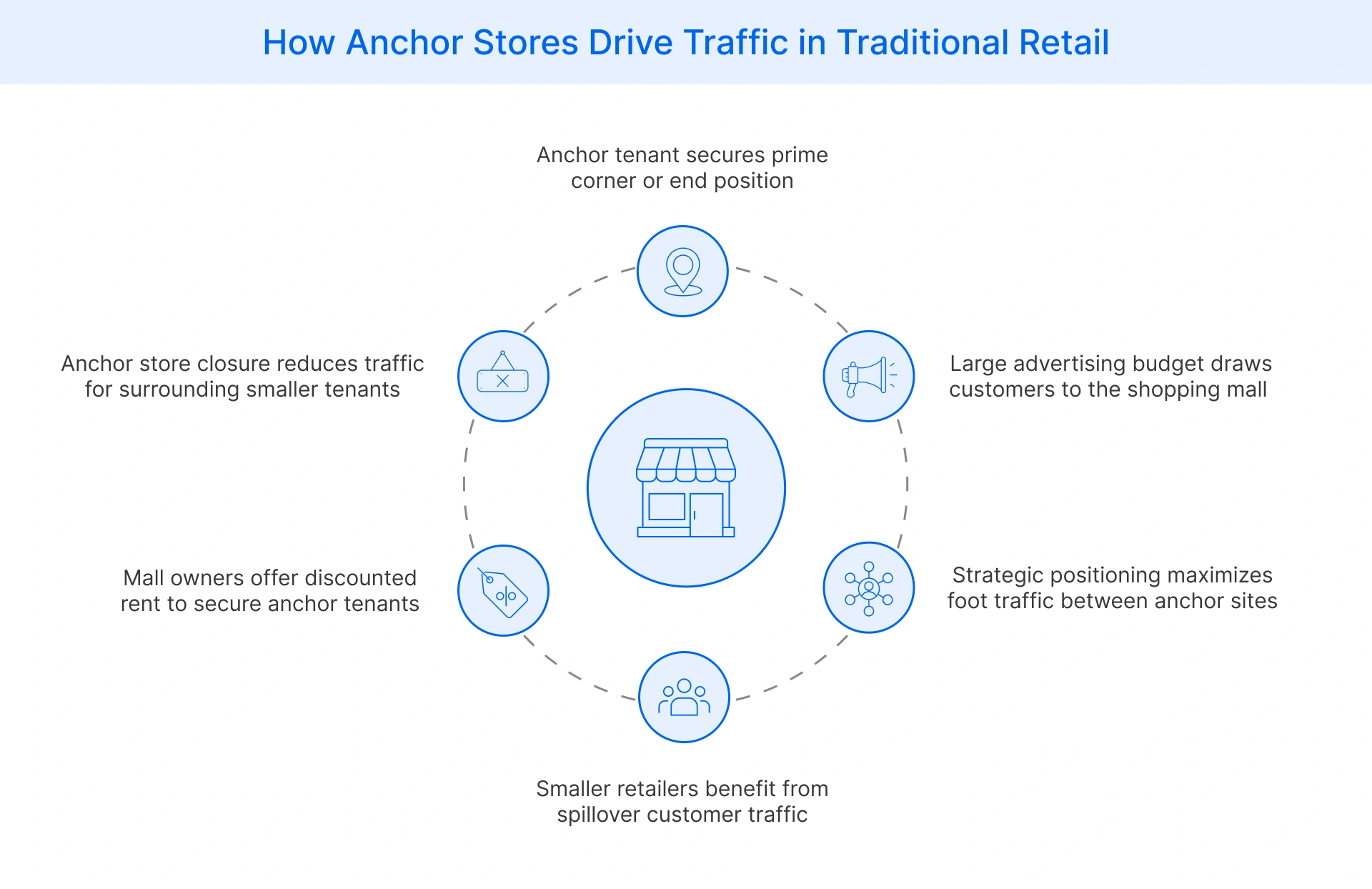
Anchor stores function through deliberate placement and incentive structures that benefit mall owners, anchor tenants and smaller retailers.
- Strategic Positioning: These stores are placed far apart to maximize customer traffic between them. Shoppers walking between anchor sites pass through the retail center, increasing visibility and sales for all smaller shops along the route.
- Pre-Opening Commitments: Mall developers often secure anchor tenant agreements before construction begins to attract financing and additional tenants. The presence of a confirmed major retailer makes the property more attractive to smaller businesses evaluating prime retail locations.
- Brand-Led Traffic Generation: Their large advertising budgets and strong brand recognition help draw shoppers to the entire shopping center. These retailers invest in seasonal campaigns that consistently bring customer traffic to retail parks and surrounding smaller stores.
- Spillover Benefits for Smaller Retailers: Smaller retailers near anchor stores enjoy foot traffic that these major retailers generate without additional marketing spend. Shoppers visiting a department store frequently discover adjacent smaller stores and make unplanned purchases, increasing revenue across the retail location.
What Is an Anchor Store in E-commerce Marketplaces?
In digital marketplaces, an anchor store is a high-profile brand or major retailer that attracts customers to the online platform. These prominent retailers occupy featured positions on marketplace homepages, replicating the strategic positioning of physical retail space.
Digital anchor stores also signal platform legitimacy to both consumers and prospective sellers. When a world-class brand lists on a marketplace, it communicates that the platform meets high standards for serious retail business.
Why Are Anchor Stores Essential for New E-commerce Platforms?
New digital marketplaces face significant challenges in building trust and attracting consistent traffic, and anchor stores address both challenges at once.
- Build Immediate Credibility: Well-known brands lend legitimacy and trust to new marketplaces that lack established reputations with shoppers.
- Attract Customer Traffic: Shoppers visit platforms to buy from recognized brand names and then discover other sellers while browsing. This customer traffic generation effect mirrors foot traffic patterns in traditional retail and reduces dependence on paid acquisition for initial visitor volume.
- Draw Additional Sellers: Smaller merchants want to join marketplaces where major brands already sell because guaranteed traffic reduces their entry risk. The presence of anchor stores makes the platform an attractive proposition for small retailers evaluating their digital retail options.
- Increase Platform Valuation: Anchor store partnerships demonstrate market viability to investors and stakeholders evaluating the platform's growth potential. These partnerships signal that the marketplace can attract and retain major retailers, which strengthens the case for continued investment and expansion.
What Is the Difference Between Traditional and E-commerce Anchor Stores?
Traditional anchor stores occupy thousands of square feet and generate foot traffic through physical presence in commercial real estate. E-commerce anchor stores drive web traffic through brand search volume and homepage placement on digital platforms. Both formats serve the same core purpose of generating traffic and credibility for surrounding smaller retailers.
Let’s have a look at the key differences between these two formats:
|
Basis of Difference |
Traditional Anchor Stores |
E-commerce Anchor Stores |
|
Location |
Physical space in malls or shopping centers |
Digital presence on online marketplaces |
|
Space Requirements |
Occupy 30%+ of physical retail space |
Featured prominently on homepage and search results |
|
Traffic Generation |
Draw foot traffic through physical presence |
Drive web traffic through brand search and recognition |
|
Rent Structure |
Discounted base rent plus revenue sharing |
Lower commission rates or preferential fee structures |
|
Customer Flow |
Customers walk past smaller retailers |
Customers discover other sellers through browsing and recommendations |
Caption: Comparing Traditional Anchor Stores and E-Commerce Anchor Stores
How Do Digital Marketplaces Attract Major Anchor Stores?
Digital marketplace operators use a combination of financial incentives and technical support to attract major retailers as anchor stores.
- Offer Competitive Commission Structures: Platforms provide lower fees or revenue-sharing models that make the marketplace financially attractive. A big retailer with high sales volumes requires a favorable commercial arrangement to justify listing alongside smaller merchants.
- Provide Premium Placement: Platforms feature anchor stores prominently on homepages, search results and marketing campaigns to guarantee high visibility. This positioning mirrors the retail space advantages that shopping mall developers offer major retailers through traditional commercial leasing.
- Ensure Technical Integration: Platforms offer API connections for inventory management, order processing and customer data that simplify operations for major retailers. Anchor stores with large product catalogs need reliable technical infrastructure before committing to a new platform.
- Guarantee Marketing Support: Platforms co-invest in advertising campaigns that promote both the anchor store and the marketplace to shared audiences. This shared investment reduces cost for the anchor retailer while generating platform-wide brand awareness.
- Enable Brand Customization: Platforms allow anchor stores to maintain brand identity through customized storefronts and branded product pages. Luxury department store chains and global brand names require this control to protect their standards and deliver a consistent shopping experience.

Build a Thriving Marketplace with Flipkart Commerce Cloud
Building a successful digital marketplace requires infrastructure to attract and support anchor stores while enabling smaller retailers to grow alongside them. Flipkart Commerce Cloud (FCC) provides a comprehensive Digital Commerce Solution with plug-and-play components that have been scale-tested across billions of daily transactions for retailers worldwide.
FCC's Discovery and Conversion suite covers composable storefronts, smart search, personalization, cart and checkout, promotion management and omnichannel CRM to drive product visibility and purchase completion across every visit. FCC's Seller Ecosystem and Supply Chain Management solutions give anchor stores and smaller merchants self-serve tools for onboarding, listings, order management, warehouse management and settlements from a single unified dashboard.
Retailers across fashion, electronics, grocery and furniture verticals use FCC to launch and scale marketplace operations. Our platform integrates with existing tech stacks and delivers measurable growth from day one.
Book a demo to see how FCC powers marketplace growth at scale.
FAQ
Anchor stores remain relevant in ecommerce because traffic generation and credibility transfer apply directly to digital marketplaces. Major retailers serving as digital anchor stores attract shoppers and help smaller merchants reach wider audiences. The rise of online shopping has shifted where anchor stores operate, rather than eliminating their value.
An anchor store is a large well-known retailer that drives customer traffic to a shopping center, mall or digital marketplace. These stores occupy prime retail locations and attract visitors who then spend at surrounding smaller retailers. They play a crucial role in shaping the commercial success of every retail environment.
An anchor store is also called an anchor tenant in commercial real estate contexts. Other terms include destination retailer, key tenant and major retailer depending on the market. In retail parks and high-street environments, large-format traffic-driving stores are sometimes referred to as anchor stores.
A store qualifies as an anchor store when it generates significant foot traffic and carries strong brand recognition. It must attract a large customer base on its own and draw shoppers from surrounding smaller stores. Long-term lease or platform commitments also distinguish anchor tenants from regular retailers.
Shopping malls, shopping centres, strip malls, retail parks and lifestyle centers all include anchor stores as primary traffic drivers. Downtown retail districts in cities such as New York also feature large department store chains as anchor tenants. Digital marketplaces represent the growing category where this concept applies online.
Anchor stores generate significant foot traffic that flows to surrounding smaller retailers, increasing visibility and sales. Smaller tenants pay higher rents for retail space near anchor stores because the spillover traffic justifies the premium. When an anchor store closes, surrounding smaller businesses experience a sharp decline in customer visits.