
December 11, 2025
What Is Marginal Cost Pricing? Definition, Formula, and Examples
Marginal cost pricing is a pricing method that sets a product's price equal to the cost of producing one additional unit. It covers variable costs only, which makes it the price floor retailers use for clearance, excess capacity, and perishable stock.
Drishti, Manager - Digital Marketing

Table of Contents
- What is marginal cost pricing?
- What is the marginal cost pricing formula and calculation?
- Why Marginal Cost Is a Price Floor, Not a Break-Even Price?
- What is the difference between marginal cost pricing vs. average cost pricing?
- What are real-world examples of marginal cost pricing?
- What are the advantages and disadvantages of marginal cost pricing?
- When should you use the marginal cost pricing?
- How does the FCC help with marginal cost pricing?
Marginal Cost Pricing: Definition, Formula & Examples
Marginal cost pricing is a pricing method that sets the price of a product equal to the cost of producing or supplying one more unit. That cost covers variable inputs only, such as materials, packaging, payment processing, and pick-and-pack labor, which makes the resulting price a floor rather than a full-recovery price.
Retailers reach for this method when inventory has to move. The strategy helps retailers maintain market competitiveness by aligning prices with production costs. It provides a calculated approach to handling price-sensitive customers without compromising the company's long-term financial stability.
This article covers the marginal cost pricing definition, the formula and worked calculations, real-world examples across airlines, software and retail, the legal limits on below-cost selling, and the conditions where the marginal cost pricing method works or fails.
Key takeaways
- Marginal cost pricing meaning: price equals the change in total cost divided by the change in quantity, which is the cost of the next unit.
- The output is a price floor for incremental units, not a break-even price, because it excludes fixed costs like rent, salaries, and technology.
- Marginal cost pricing fits excess capacity, perishable stock, seasonal clearance, and category entry, and fails as a permanent catalogue-wide policy.
- Businesses with high fixed costs and near-zero variable costs, such as airlines, SaaS, and streaming, use it most aggressively.

What Is Marginal Cost Pricing?
Marginal cost pricing is a practice where retailers set prices equal to the cost of producing an extra unit. This strategic approach ensures that revenue covers the variable costs associated with that specific item for the customer.
This method often ignores fixed costs, such as rent, and focuses solely on variable costs, such as raw materials. You can use this technique to maximize capacity and maintain production levels during slower periods, ensuring operational efficiency. It allows your company to remain competitive by matching the marginal cost of producing goods directly to consumer demand.
What is the marginal cost pricing formula and calculation?
The formula for calculating marginal cost is:
Marginal Cost = Change in Total Cost/Change in Quantity
Let’s understand this calculation by considering a scenario where you run a large shoe factory.
Imagine you currently produce 100 pairs of shoes, which creates a total production cost of $5000. You decide to increase production to 101 pairs, which raises the total cost to $5020.
You calculate the difference to find that the specific cost of that single addition is $20. Divide this additional cost by the additional unit of output, which is 1 unit.
In this case, the marginal cost of that one extra pair is $20, which becomes your break-even price point.
Why Marginal Cost Is a Price Floor, Not a Break-Even Price?
The $20 figure is the price floor for that pair, not the break-even price. Break-even requires covering average total cost, which adds fixed costs like rent and salaries to the variable cost of the unit. Selling at exactly $20 leaves zero contribution. Selling at $24 contributes $4 toward fixed costs the business has already committed.
Marginal cost is not constant. It usually falls as volume rises and specialization improves, then climbs once overtime, expedited freight, or capacity ceilings enter the calculation. Step costs, such as leasing a second warehouse bay, break the formula's assumption entirely. Recalculate marginal cost at each volume band instead of reusing a single figure across the season. Track the gap between standard and actual input cost, measured as purchase price variance, because a rise in purchase cost lifts the floor immediately.
What is the difference between Marginal cost pricing Vs. Average cost pricing?
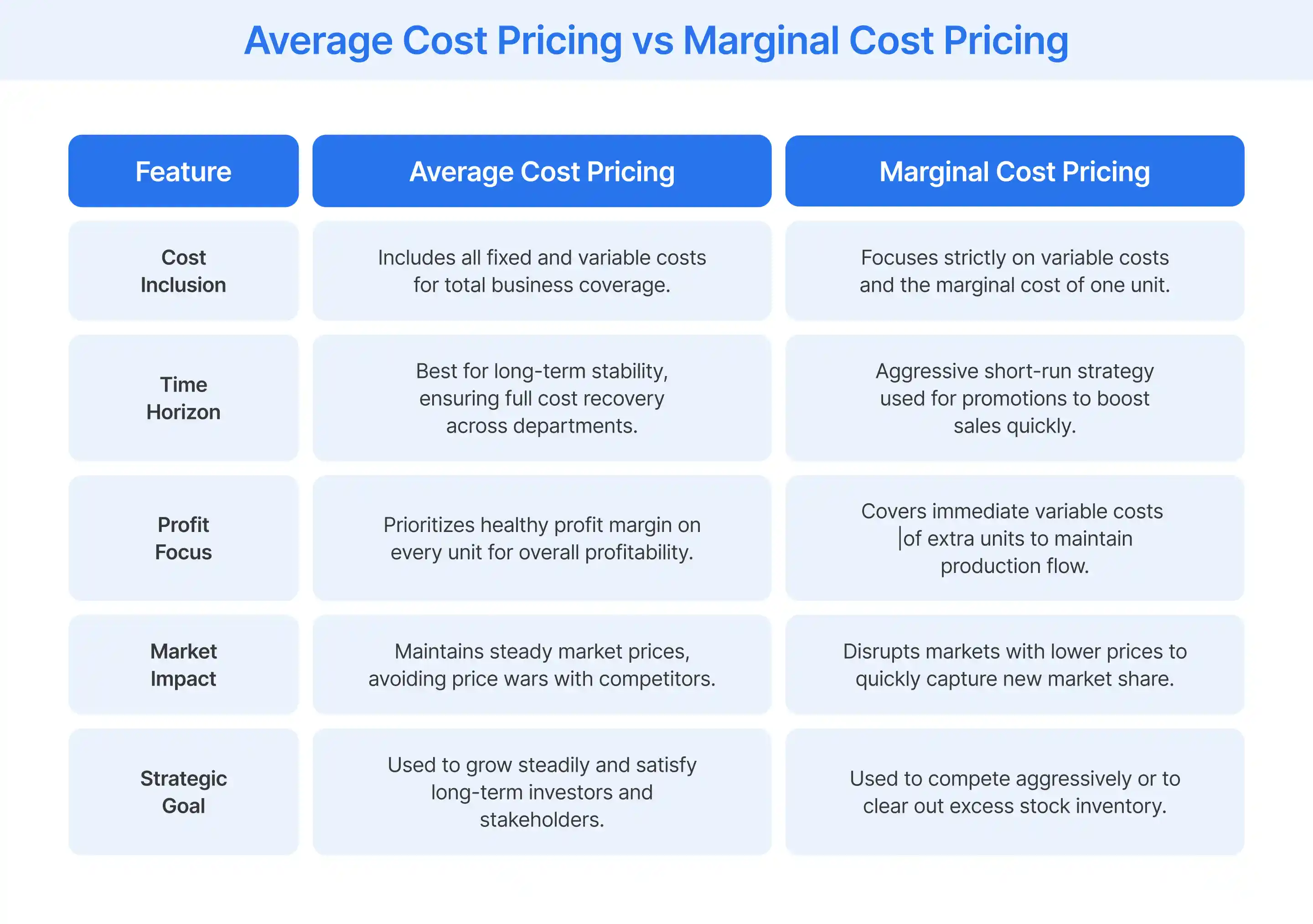
Marginal cost pricing prices the next unit, while average cost pricing prices every unit. Marginal cost pricing counts only the variable cost of one additional unit. Average cost pricing divides total cost, including fixed overheads, across all units produced.
Average cost pricing accounts for every expense required to run the business, including overheads like rent and salaries. On the other hand, marginal cost pricing strategies focus entirely on the direct costs of creating one more unit for the market.
This distinction determines whether you are pricing for long-term stability or short-term market penetration for your business.
What are real-world examples of Marginal cost pricing?
Real-world examples of marginal cost pricing include airline seat sales, SaaS license discounts, retail clearance markdowns, and off-peak utility tariffs. Each involves high fixed costs, low variable costs, and capacity that expires if it goes unsold.
These examples illustrate how different industries use this concept to manage inventory and capitalize on excess capacity.
- Airlines: Carriers know that an empty seat earns zero revenue, so they lower prices to fill seats immediately. The marginal cost per passenger is low, covering fuel costs effectively even without paying for the plane. This strategy works because the ticket price contributes to variable costs even if it excludes fixed expenses.
- Software (SaaS): Tech companies often sell licenses at discounts to gain market power quickly in a crowded digital marketplace. The marginal cost of producing one more digital copy is near zero, enabling massive user acquisition. This allows them to acquire users without significantly increasing their variable expenses or production costs.
- Retail Clearance: Retailers often slash prices on seasonal items like winter coats in summer to clear valuable warehouse space. Selling the item at a low price is better than storing it, as it recovers some production costs. This frees up valuable warehouse space for new inventory and ensures efficient resource allocation for the upcoming season.
- Utilities and Regulated Markets: Regulators sometimes require a natural monopoly, such as an electricity grid or water utility, to price at marginal cost because it maximizes output and consumer access. Marginal cost sits below average total cost in these industries, so the firm runs at a loss and needs a subsidy or a two-part tariff to stay solvent. This is the clearest illustration of the model's core limitation.
What are the advantages and disadvantages of Marginal cost pricing?
Here are the key benefits and challenges associated with using marginal cost pricing for your business:
Advantages
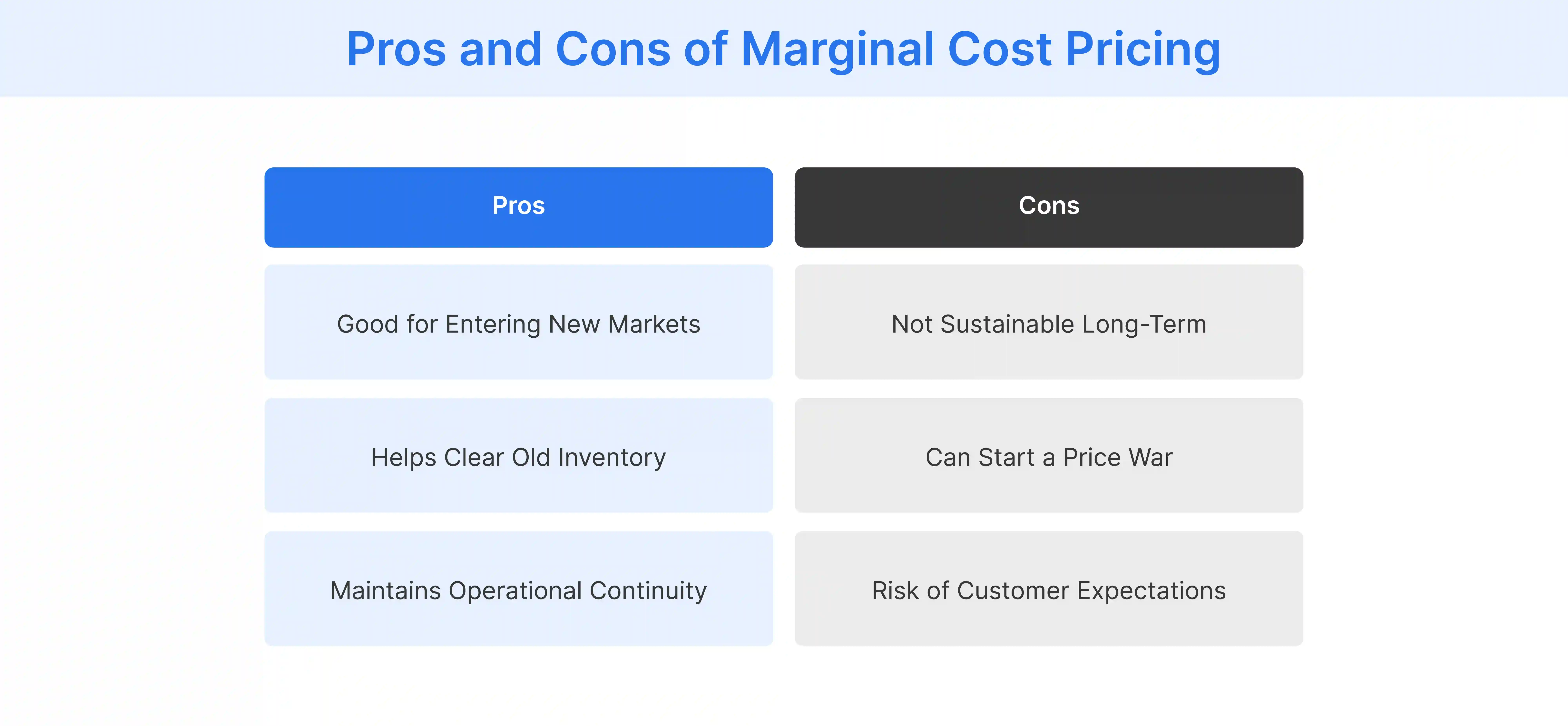
- Supports entry into price-led categories: you can attract price-sensitive shoppers by pricing below direct competitors in categories where price is the deciding factor. This builds initial volume and category traction without heavy marketing spend.
- Helps Clear Old Inventory: It lets you sell perishable goods or outdated stock quickly before they lose all value. You generate additional revenue from items that would otherwise be total losses and occupy expensive space.
- Maintains Operational Continuity: You can maintain steady inventory turnover by stimulating sales during low-demand periods to avoid stagnation in your supply chain. This prevents costly stock accumulation and ensures your warehouse and sales teams remain productive throughout the cycle.
Disadvantages
- Does not fund fixed costs: You cannot cover your fixed costs like rent, salaries, technology, and warehousing, as they continue regardless of volume. Relying on marginal cost pricing across the catalogue leaves those costs unpaid and produces a loss even when every individual sale looks profitable.
- Can Start a Price War: Aggressive pricing often forces competitors to lower their rates to protect their market share. This race to the bottom hurts the profit margins of every player in the industry and devalues brands.
- Risk of Customer Expectations: Shoppers may refuse to pay the regular price of a product later after seeing the discounted pricing structures. They might delay purchases in anticipation of discounts, which permanently damages your ability to command premium prices.
When should you use Marginal cost pricing method?
Use the marginal cost pricing method when demand is highly elastic, when goods are perishable or seasonal, when capacity is idle, and when you need an entry price for a new category. Avoid it on core catalogue lines that have to fund fixed costs.
You should deploy the marginal cost price when:
- Demand is Highly Elastic: This works best when customers are highly price-sensitive and respond quickly to potential discounts. A small price drop leads to a massive increase in units sold during events. This significantly boosts your total revenue because the volume increase offsets the lower profit margin per unit.
- You Have Perishable Goods: It is essential for items that lose value over time, like food or event tickets, in the market. You must sell them before they expire because earning any marginal revenue is better than earning zero revenue. This approach minimizes losses on goods that cannot be stored for sale at a later date effectively.
- You Have Excess Capacity: Use this when your factory or team is underutilized to maximize the potential of your assets. Producing more units lowers the average variable cost per item and spreads your overheads across a larger volume. This efficient resource allocation allows you to maximize productivity without incurring high additional fixed costs for the business.
When not to use Marginal cost pricing?
Do not price at marginal cost when the Stock keeping unit(SKU) carries stable full-price demand, when the discount would breach Minimum Advertised Price(MAP) or supplier agreements, when the category has few competitors and a cut invites immediate retaliation, or when fixed costs are rising and no other line is funding them.
How does FCC help with Marginal Cost Pricing?
Retailers often struggle to implement marginal cost pricing manually because variable costs fluctuate constantly with complex supply chain changes. You risk setting prices below the actual recovery threshold if you rely on static spreadsheets for these critical calculations.
At Flipkart Commerce Cloud (FCC), we transform this strategy using our advanced pricing solutions to ensure precision at every scale of your business operations. Our platform utilizes scale-tested algorithms to analyze demand elasticity and calculate the exact optimal price point above your variable costs.
You can configure our rule-based pricing engine to automatically set your marginal cost as a hard price floor. We integrate real-time competitive intelligence to adjust your rates dynamically without ever breaching your profitability guardrails or compromising your margins.
Our platform also features an advanced output simulator that allows you to test pricing scenarios before they go live. You can predict the exact impact on revenue and margin to ensure your clearance strategy delivers the expected financial results.

FAQ
Marginal cost pricing is most useful during periods of low demand or excess inventory when you need to clear stock. It helps maintain production levels when standard pricing strategies fail to generate sufficient sales volume for your business. You can use this strategy to recover variable costs without worrying about fixed expenses in the short run.
Firms use marginal cost pricing to convert idle capacity and aging stock into contribution rather than write-offs. Any price above variable cost helps recover fixed costs already committed, so a discounted sale beats no sale. Retailers apply the marginal cost pricing method during clearance, off-season dips, and category entry.
In perfectly competitive markets, firms are price takers, so market price already sits near marginal cost and output expands until marginal cost equals price. In concentrated retail markets, pricing at marginal cost mainly buys volume and invites competitor retaliation, which is why retailers apply it selectively.
Marginal cost pricing is profitable at the contribution level, not the net level. Each unit sold above variable cost adds margin, but the price ignores fixed costs like rent and salaries. Flipkart Commerce Cloud's rules engine holds that floor so discounts stay above the recovery threshold.
Marginal cost pricing fails to cover fixed costs once it moves from surplus units to the core catalogue. Fixed costs stay constant regardless of volume, so total contribution must exceed them. Businesses with high fixed and near-zero variable costs, such as airlines and SaaS, reach that limit fastest.
Short-run marginal cost counts only variable inputs such as materials and hourly labor, because leases and contracts cannot change quickly. Long-run marginal cost treats every input as variable, including warehouse space and plant size. Long-run figures show whether prices can cover total cost across a full cycle.
Marginal cost pricing is most relevant in industries with high fixed costs and low variable costs: airlines, hotels, software, streaming, and utilities. It also fits retail categories holding perishable or seasonal stock. Flipkart Commerce Cloud supports these price floors across millions of SKUs and hundreds of categories.
Relying on marginal cost pricing might result in completely ignoring your operational overheads like rent and payroll, which puts your long-term solvency at risk. You cannot grow if your revenue only covers the cost of the item itself. It also trains shoppers to wait for discounts, which makes it impossible to restore premium pricing later.