
February 20, 2026
Choke Price
The choke price is the exact point where consumer demand for a product drops to zero. It represents the theoretical limit where the cost outweighs the benefit for every potential buyer in the market.
Drishti, Manager - Digital Marketing

Table of Contents
- What is Choke Price?
- How Do You Calculate Choke Price?
- What Factors Influence the Choke Price?
- What is the Difference Between Demand Choke Price and Supply Choke Price?
- Why is Understanding Choke Price Important for Retailers?
- Real-World Examples of Choke Price in Action
- Optimize Your Pricing Strategy with Flipkart Commerce Cloud
Choke Price
The choke price is the market value at which the total demand for a product exactly equals zero units. It serves as a critical theoretical limit for economists analyzing consumer behavior or market elasticity.
Financial analysts use this metric to determine the maximum potential price a specific market segment might tolerate. Calculating the exact choke price helps construct accurate demand schedules for various industries and commercial sectors worldwide.
- It marks the precise intercept on the vertical axis of a standard demand graph where the quantity demanded becomes zero.
- Companies utilize this data point to understand the absolute upper ceiling for their pricing strategies and revenue.
- The value differs significantly between distinct market segments based on their specific purchasing power and preferences.
- Economists calculate this particular figure to estimate the total consumer surplus available in a specific market.
What is Choke Price?
The choke price is the price at which demand for a product drops to zero. At this level, you will find that no consumer is willing to purchase the good or service you offer.
It represents the lowest price at which the quantity demanded equals zero for a particular item. You can view this as the intercept on the price axis, where your potential sales volume drops to zero.
How Do You Calculate Choke Price?
You can calculate this specific value by solving the linear demand equation derived from your market data.
Formula: Q = a - bP
Here:
- Q = Quantity demanded by consumers at a given price
- a = The demand intercept (maximum quantity demanded when price is zero)
- b = The slope of the demand curve (rate at which demand falls as price rises)
- P = Price of the product
To find the choke price, you must set Quantity (Q) to zero. Then, solve the equation for Price (P) to determine the exact value where demand stops
Let’s consider an example to understand the process better.
A retailer selling wireless headphones estimates a demand function of Q = 200 − 4P based on historical sales data.
Step 1: Set Q to zero: 0 = 200 − 4P
Step 2: Rearrange: 4P = 200
Step 3: Solve for P: P = 200 / 4 = ₹50
The choke price for these headphones is ₹50. At this price point, no consumer is willing to purchase the product. The retailer must price below ₹50 to generate any sales volume.
What Factors Influence the Choke Price?
Several economic factors directly impact where this price ceiling sits for your specific products and services.
- Consumer Income: An increase in consumer wealth often raises the choke price as buyers can afford to pay more using their extra income. When your customers have higher disposable income, they become much less sensitive to higher prices.
- Available Substitutes: If many similar products exist, the choke price will be lower because customers can easily switch. This is especially true in commodity pricing, where shoppers have numerous alternatives that offer comparable value.
- Brand Loyalty: Strong brand preference creates a higher choke price because customers value the specific brand over others. Loyal buyers accept higher prices before they stop purchasing because they perceive your brand as superior to competitors.
- Necessity vs. Luxury: Essential items typically have a higher choke price compared to non-essential luxury items or services. Changes in market conditions also play a role, as consumers can tolerate higher costs for goods they need for daily survival, whereas they can easily delay discretionary purchases.
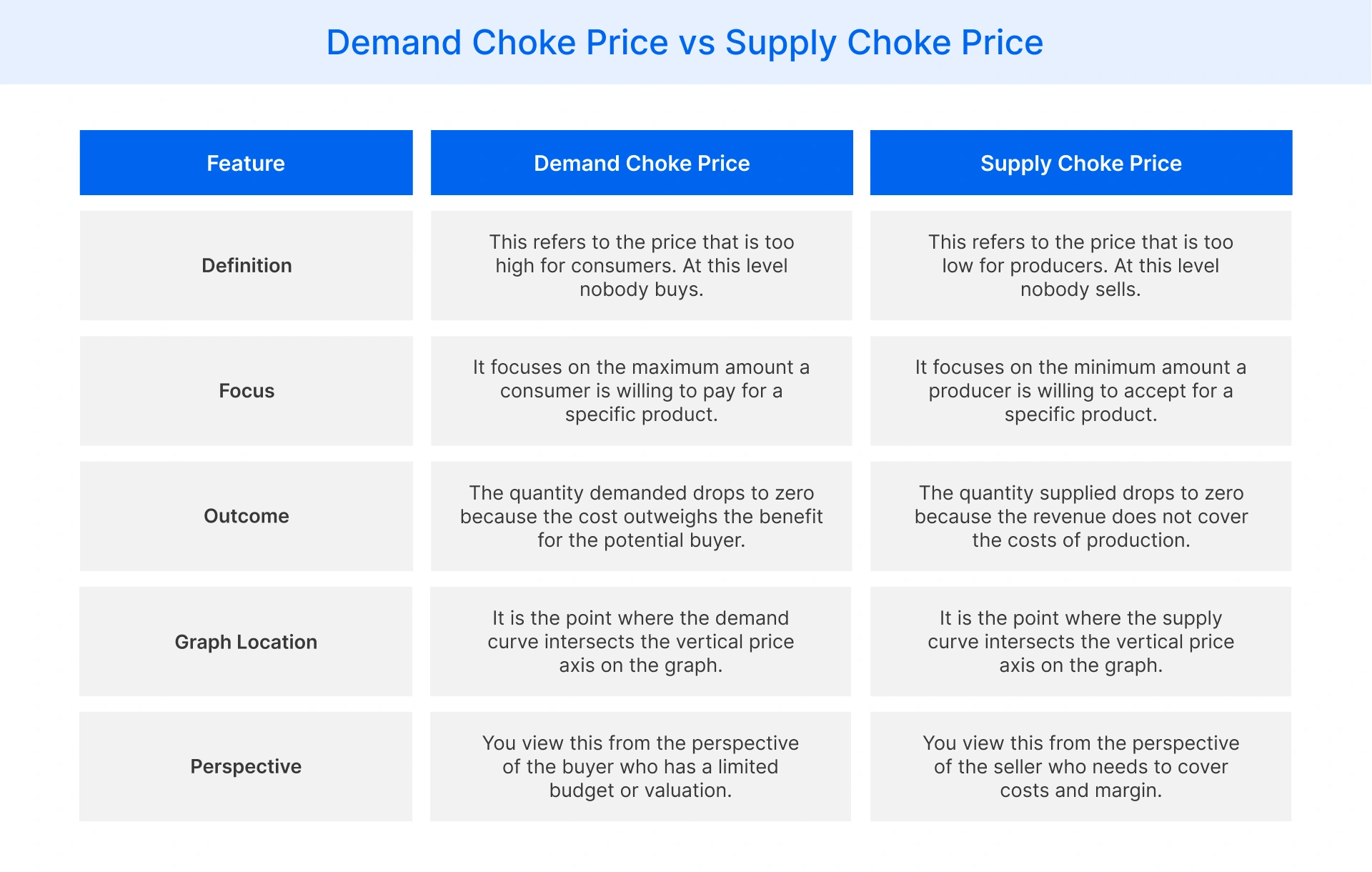
What is the Difference Between Demand Choke Price and Supply Choke Price?
This economic concept applies to both sides of the market transaction but affects buyers and sellers differently. You must distinguish between the price that deters customers from buying and the price that discourages production or sales efforts.
Why is Understanding Choke Price Important for Retailers?
Identifying choke price helps you make informed decisions to protect your retail business from significant losses.
- Avoid revenue loss: It prevents businesses from setting prices that drive demand for their inventory or services to zero. You avoid the critical mistake of pricing your inventory out of reach, resulting in zero revenue from sales.
- Better price positioning: Retailers can position their products safely below the choke point to ensure consistent sales volume. You can set a competitive price that maximizes margin while maintaining a steady flow of daily customer orders.
- Inventory management: It helps predict when inventory will stop moving due to pricing errors or market shifts. You can adjust your stock levels or pricing strategy before unsold goods accumulate in your warehouse or storage.
- Promotional planning: Marketers can calculate how much discount is needed to move away from the choke price effectively. You can design effective sales campaigns that bring prices down to attractive levels for your target buyers.
Real-World Examples of Choke Price in Action
Examining practical scenarios helps you visualize how choke price functions in everyday commerce and trading.
- Ride-Sharing: When surge pricing is too high, passengers choose to wait or use public transport instead. The price at which they stop booking is the choke price. You see demand vanish instantly when the cost exceeds the ride's urgency or value.
- Airline Tickets: If a flight to a vacation spot becomes too expensive, travelers choose a different destination or date. Leisure travelers have a threshold beyond which they abandon their travel plans due to high costs. Airlines must manage fares carefully to stay below this threshold.
- Subscription Services: Users cancel subscriptions when the monthly fee exceeds the value they perceive from the content library. Streaming platforms face a choke price where the cost outweighs the entertainment utility for the subscriber. You lose revenue when price hikes push customers past their limit.
Optimize Your Pricing Strategy with Flipkart Commerce Cloud
Understanding demand limits is critical to your success in a competitive market. We help you find the price that maximizes profit without reaching the choke point where customers stop buying your products.
Flipkart Commerce Cloud empowers retailers to master this balance with accurate data-driven insights and analytics. We provide the advanced technology you need to understand market shifts and react before your competitors change their prices.
The FCC Pricing Manager uses machine learning for precise demand forecasting and smart, dynamic pricing. You can monitor competitor prices and analyze historical data to protect your margins and maintain sales volume effectively.
Schedule a demo to see how we can safeguard your bottom line and boost revenue.

FAQ
The reservation price is the maximum amount a specific individual is willing to pay for a product. Choke price is the point where the aggregate market demand drops to zero. You must distinguish between individual willingness and the market-wide ceiling where no transactions occur.
Yes, the choke price changes as economic conditions and consumer preferences shift over time. Factors such as inflation, income growth, or new product substitutes can raise or lower this threshold. You should monitor these external variables to adjust your pricing limits accordingly.
No, the choke price is a market aggregate derived from the behavior of many consumers. Different customer segments have different price sensitivities and willingness to pay for the same item. You will find that luxury buyers have a higher limit than budget shoppers.
If you price a product above the choke price, you will generate zero sales revenue. At this level, the cost exceeds the valuation of every potential customer in the market. You must lower the price immediately to stimulate demand and restart transactions.
Inflation typically raises the nominal choke price as the general price level of goods increases. Consumers expect to pay more for goods and services when the value of currency decreases. However, you must ensure that wage growth keeps pace with these price increases.