
December 11, 2025
What Is Competitor Price Index: What It Is & How to Calculate It?
The Competitor Price Index is a metric that retailers use to benchmark their pricing against the competition. It measures how your price point compares to the market average or to specific rivals, helping you adjust strategies for maximum profitability.
Drishti, Manager - Digital Marketing

Table of Contents
- Introduction
- What Is Competitor Price Index?
- Why You Should Track CPI?
- How to Calculate Competitor Price Index
- Strategies to Improve Your Index
- Challenges in Measuring CPI
- Deploy FCC’s Pricing Manager for Competitor Price Index Data
What Is Competitor Price Index: What It Is & How to Calculate It?
Pricing often acts as a constantly moving target within the unpredictable modern retail ecosystem. Retailers who set higher prices without justification risk losing significant sales volume to rivals offering a better deal. Conversely, sellers who set lower prices without proper analysis might burn capital and unnecessarily erode their profit margins.
The Competitor Price Index (CPI) acts as a reliable compass that helps businesses navigate these complex market conditions effectively. This metric tells a company exactly where it stands in the market relative to the current competitor prices.
- It transforms raw market research data into a clear metric that reveals the actual market position of a brand.
- Retailers gain valuable insights into whether they are leading the pack or falling behind on critical price changes.
- Teams use this data to execute pricing adjustments that align seamlessly with consumer expectations and financial goals.
- This metric empowers product managers to defend their market share against the aggressive competitor pricing strategies.
What Is Competitor Price Index?
The Competitor Price Index is a quantitative metric that compares your prices directly with those of similar products sold elsewhere. It is a vital tool for understanding how your value offer compares with the market average.
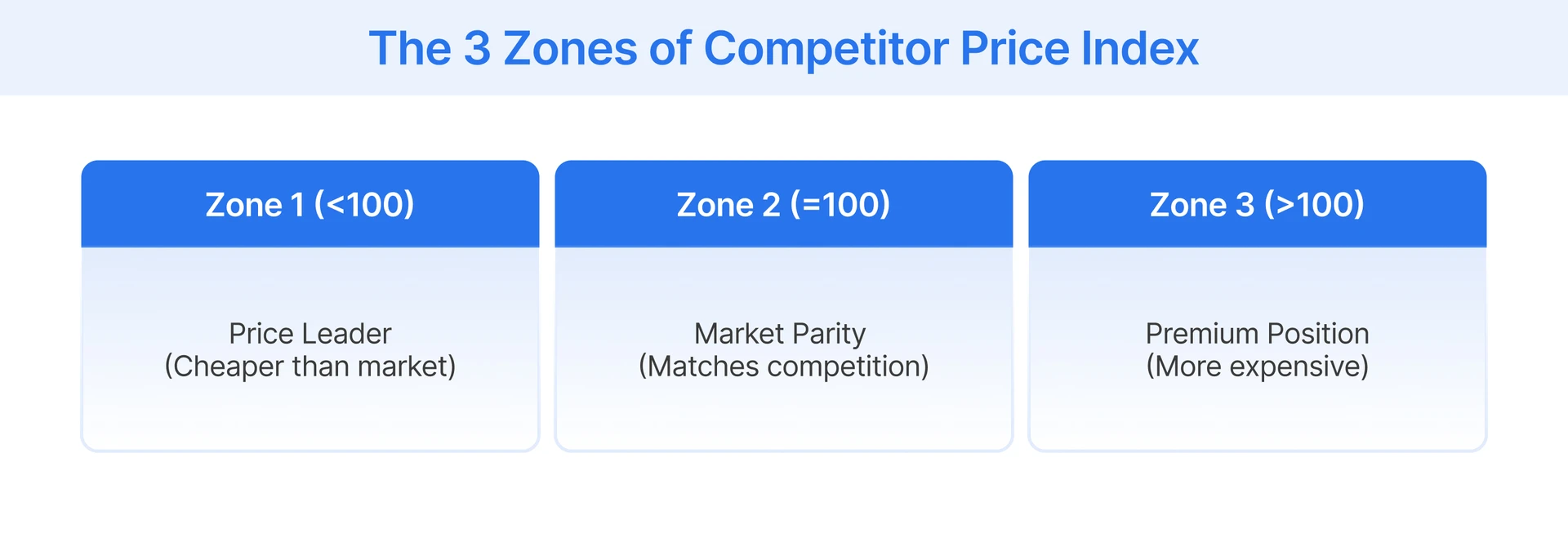
A CPI of 100 is the baseline that indicates parity.
- Over 100: Your pricing is higher than the competition and you might need to justify this with improved product quality.
- Under 100: You are cheaper than the competition and might be sacrificing margin to gain volume or attract different customer segments.
- Exactly 100: You are priced identically to the reference competitors and your value proposition must rely on factors other than cost.
This metric turns vague worries like ‘I feel like we are too expensive’ into hard facts for the team. You can confidently state that you are exactly 12% more expensive than Amazon for consumer electronics products.
Why You Should Track CPI?
Tracking this index allows you to respond to market changes proactively rather than reacting late to price wars.
- Protect Your Margins: You might be pricing significantly lower than the market expectations require for your specific category of goods. Raising prices to match the index can recover lost profit margins without hurting conversion rates because you remain competitive.
- Win the Buy Box: In competitive pricing analysis, beating the competitor price index of key rivals is often necessary to win visibility. A favorable index ensures you appear as the best option on comparison sites and drive up your sales metrics.
- Spot Market Trends: Regular tracking highlights broader shifts in market conditions before they impact your bottom line or quarterly revenue. You can identify when a competitor launches aggressive marketing campaigns or lowers costs across specific product categories to steal customers.
How to Calculate Competitor Price Index?
Calculating this metric requires accurate data collection and a clear understanding of which rivals constitute your direct competition.
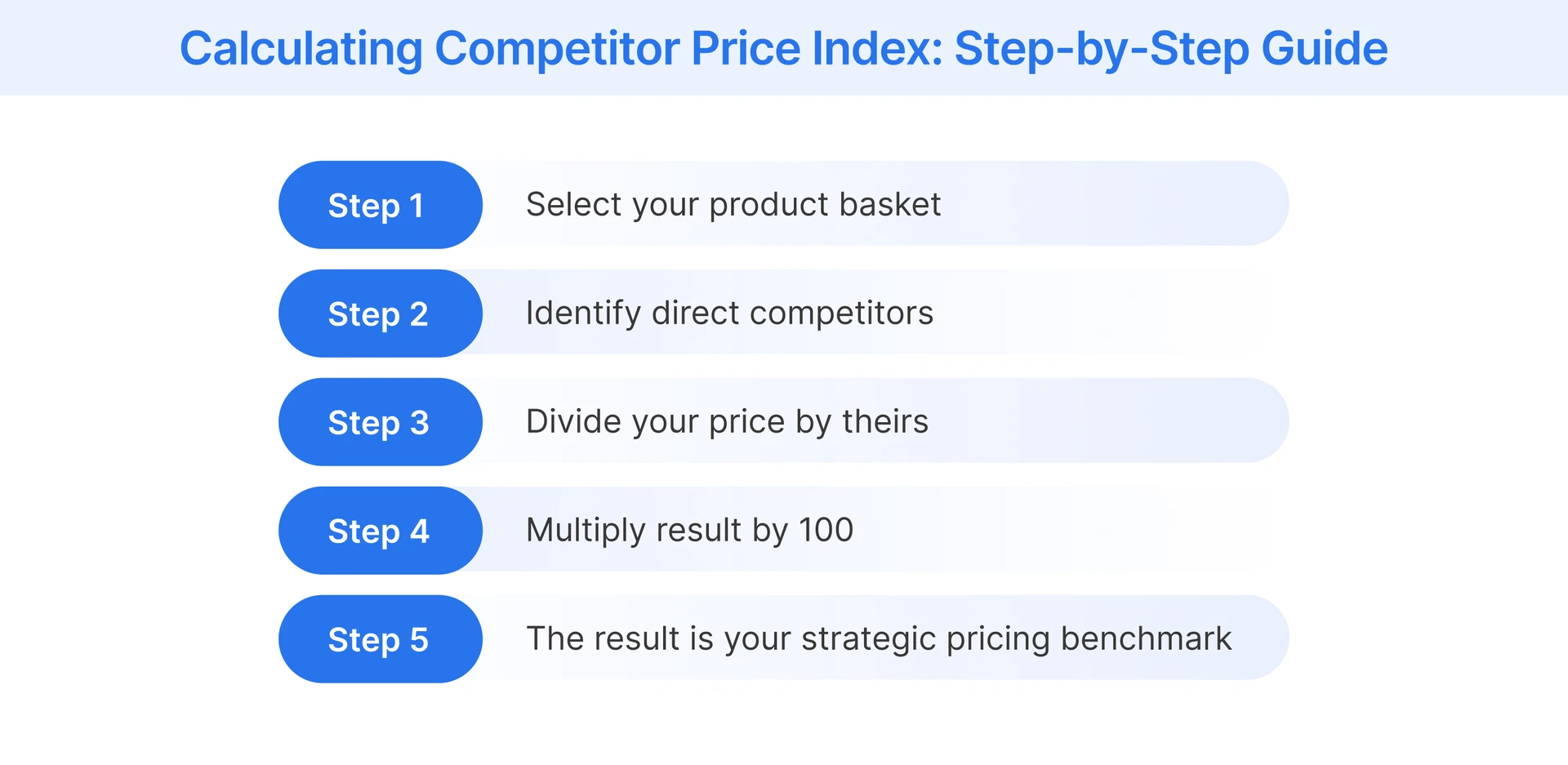
To find the CPI for a single item, divide your price by the competitor’s price and multiply by 100.
CPI = (Your Price / Competitor Price) x 100
For example, if you sell a blender for $110 and your rival sells it for $100, your CPI is 110.
However, evaluating a single item rarely gives the full picture. To understand your actual market position, CPI is typically calculated across a broader ‘basket’ of products, allowing you to derive a weighted average for the entire brand.
Strategies to Improve Your Index
You can refine your pricing model by applying specific tactics based on the data derived from your index calculations.
Don't Match Everyone
You do not need to beat every competitor in the market to succeed with your pricing strategy. Focus your competitor price tracking on key rivals or the number of competitors that actually impact your sales data.
Segment Your Portfolio
- Key Value Items (KVIs): These require a highly competitive price index because shoppers notice the cost of these common goods. You must maintain competitive price points on items like milk or iPhones to drive traffic and shape customer perceptions.
- Long Tail Items: You can afford a higher index on these SKUs because they are niche and harder to find. Customer experience often matters more than price here which allows you to secure higher margins without risking the target market.
Dynamic Pricing
Use the index to trigger automatic changes within your business operations to maintain an edge over the competition. If your CPI drops below 95, you might have scope to raise prices slightly without upsetting your customer base.
Challenges in Measuring CPI
While powerful, maintaining an accurate index presents hurdles that can complicate your strategic pricing decisions and analysis.
- Matching Products: Ensuring you are comparing identical items is difficult when product quality or packaging varies between different retailers. Mismatched data leads to a flawed competitive price analysis and might cause you to make incorrect strategic decisions.
- Real-Time Changes: Prices fluctuate on a daily basis in a dynamic business environment driven by algorithms and automated tools. If your data is outdated, your index becomes immediately obsolete and fails to reflect the current market state.
- Stock Availability: A competitor with a low price but zero stock should not impact your index or your pricing decisions. Including out-of-stock items in your calculation skews the market demand picture and might force you to lower prices unnecessarily.
Deploy FCC’s Pricing Manager for Competitor Price Index Data
Pricing is never a ‘set it and forget it’ task for modern retailers operating in a digital world. It is an active battle for attention and margin that requires a powerful tool to manage effectively. The Competitor Price Index gives you the data you need to fight smart and win the market.
Calculating this manually for thousands of SKUs is impossible for most teams due to the sheer volume. This is where Flipkart Commerce Cloud (FCC) steps in with a solution designed to handle this complexity at scale. Our Pricing Manager automates the entire process to ensure your positioning of your brand remains optimal without manual fatigue.
The system tracks competitor moves in real-time and adjusts your prices to keep you in the sweet spot. It accounts for stock availability and utilizes pricing decisions based on demand elasticity and game theory algorithms. You can rely on accurate data to inform your past analysis and future planning for the business.
Stop crunching numbers and start optimizing strategy with a solution designed for scale and high-volume transactions. Our tool handles the heavy lifting of data matching and calculations with impeccable accuracy. This allows your team to focus on competitive advantage and driving revenue growth across all your channels.

FAQ
You should monitor your competitor price index frequently, ideally on a daily or weekly basis depending on the industry. High-volume retailers often check it in real-time to ensure they catch price changes instantly and adapt their pricing strategy.
The Competitor Price Index measures your prices against other retailers to gauge your competitiveness in the market. The Consumer Price Index is an economic indicator that tracks inflation and the average cost of goods for a consumer.
Focus on your most relevant competitors rather than the whole market to get accurate and actionable data. You must also segment your products into categories like KVIs and long-tail items to apply different pricing rules.
Common types include the Fisher, Paasche and Laspeyres indexes which are used in various economic and business contexts. These differ based on how they weight the quantities of goods in the basket for the calculation.