
April 29, 2025
What Are Digital Coupons?
Digital coupons are electronic discount codes or offers that consumers can redeem during online or in-store purchases.
Drishti, Manager - Digital Marketing

Table of Contents
- What are Digital Coupons?
- How do Digital Coupons Work?
- What are the Different Types of Digital Coupons?
- How to Reduce Cart Abandonment Using Digital Coupons?
- What are the Advantages of Using Digital Coupons for Businesses?
- What are the Best Practices for Implementing Digital Coupons?
What Are Digital Coupons?
Digital coupons are electronic discount offers that consumers can redeem during online or in-store purchases. Unlike traditional paper coupons that require physical clipping and handling, digital coupons exist entirely in electronic format, making them accessible through websites, emails, mobile apps, and social media platforms.
Retailers deploy these promotional tools to stimulate immediate sales, clear excess inventory, and introduce new products to targeted customer segments. Here are the key purposes of these coupons:
- Digital coupons serve as powerful incentives that encourage consumer action while simultaneously collecting valuable shopping behavior data.
- With seamless integration with point-of-sale systems and e-commerce platforms, these coupons allow businesses to track redemption rates and measure campaign effectiveness accurately. Industry research shows digital coupons achieve an average redemption rate of 7% or higher.
- These electronic discounts help establish ongoing relationships with customers through personalized offers that enhance both online and in-store shopping experiences.
What is a Digital Coupon Marketing & How Does it Work?
Digital coupon marketing is a strategic promotional approach that uses electronic discount offers to drive customer acquisition, increase sales, and build brand loyalty across multiple channels. This marketing methodology combines data-driven targeting, multi-channel distribution, and performance analytics to deliver personalized incentives that motivate specific customer behaviors while generating measurable business results.
The entire digital coupon marketing workflow operates through a systematic process that begins with campaign creation and ends with redemption analysis, incorporating multiple technological components that ensure smooth delivery and application of discounts across various shopping channels.
Distribution
Retailers distribute free digital coupons through multiple channels to reach customers where they already spend time.
- Email marketing campaigns deliver personalized coupon offers directly to customer inboxes based on previous purchase behavior.
- Mobile apps push notifications about relevant discounts when customers enter store proximity using geolocation technology.
- Social media platforms enable targeted coupon distribution through sponsored posts, influencer partnerships, and interactive campaigns.
- Retailer websites prominently display coupon banners and pop-ups at strategic moments during the browsing experience to maximize visibility and conversion potential.
Activation
Activation occurs when customers take specific actions to claim digital coupons for future use.
- You can activate offers by clicking email links that automatically apply discounts to your online shopping cart.
- Mobile applications allow you to save coupons to your rewards account with a simple tap or swipe gesture.
- Digital wallets store activated coupon information securely for convenient retrieval during checkout.
Some retailers require an account login to activate personalized offers, enabling better tracking of customer engagement with promotional content.
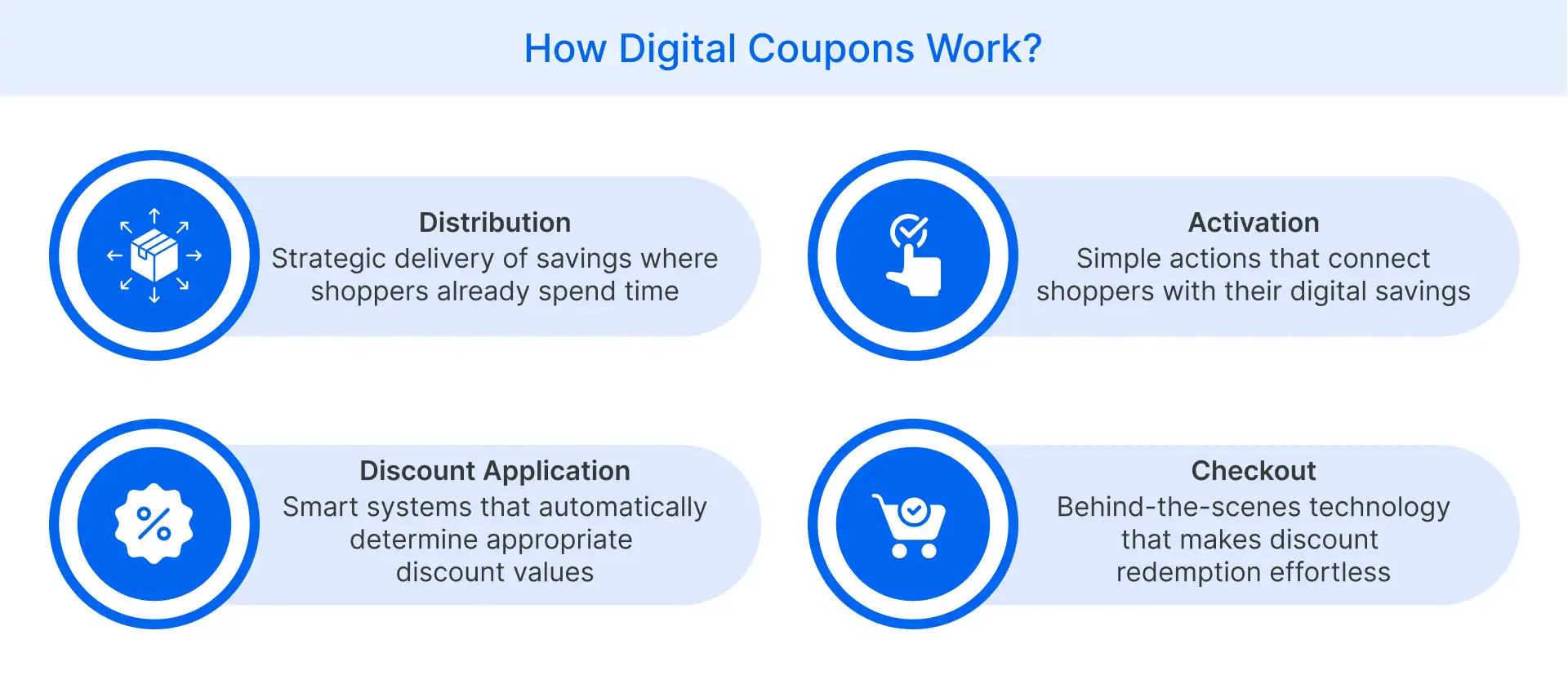
Discount Application
Digital coupon systems calculate percentage discounts by applying specified reduction rates to qualified product prices at the individual item level.
- Fixed amount deductions subtract predetermined values from overall purchase totals when minimum threshold requirements are met.
- Buy-one-get-one configurations automatically identify qualifying product pairs and apply corresponding discounts to the lower-priced item.
- Tiered promotional structures increase discount percentages incrementally as customers add more qualifying items to their shopping carts.
Checkout
Modern point-of-sale systems scan digital coupon barcodes directly from customer mobile devices and instantly verify validity against central databases. E-commerce platforms automatically detect applicable saved coupons and present them as selectable options during the checkout process. API integrations enable real-time communication between coupon management systems and payment processors to ensure accurate discount application.
What are the Different Types of Online Digital Coupons?
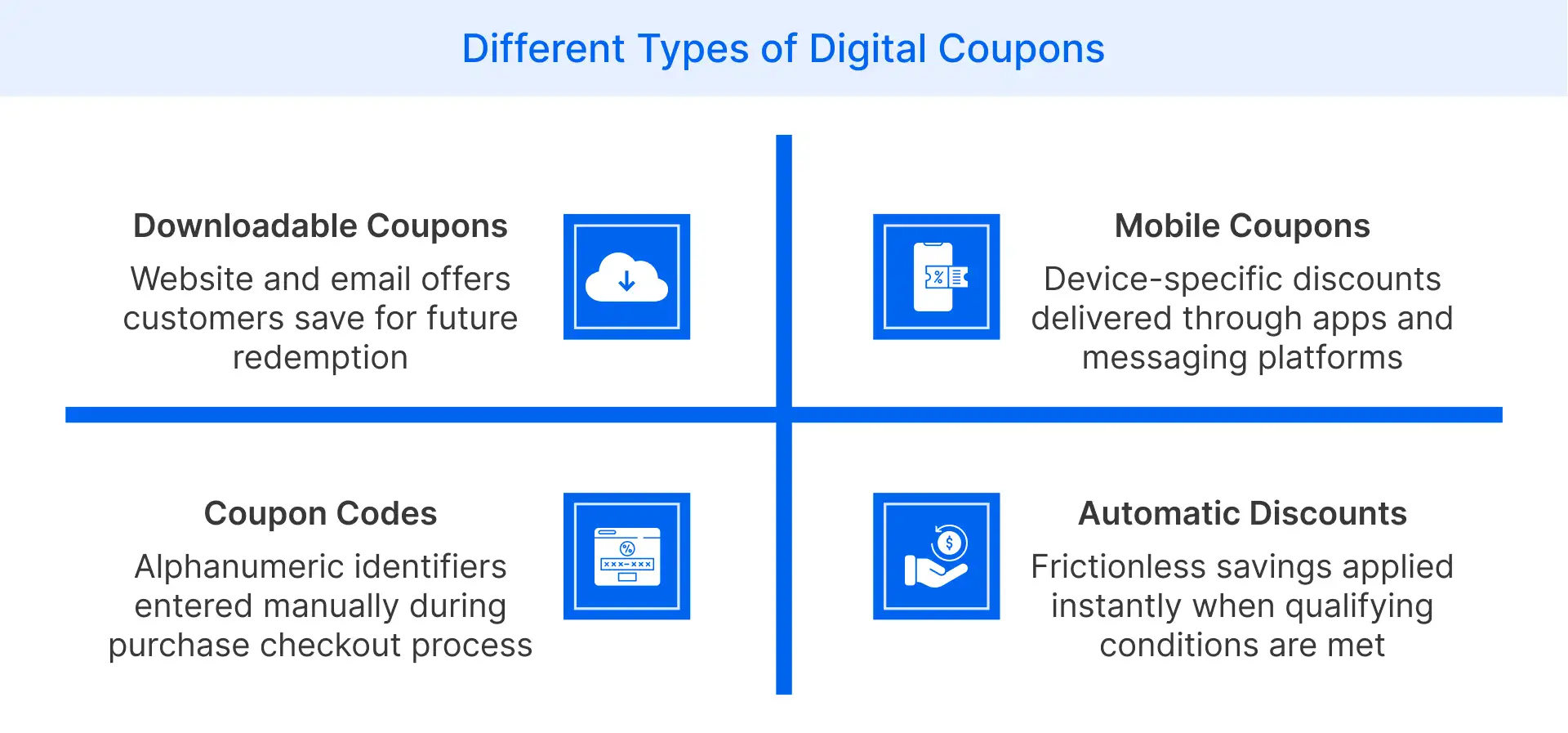
Retailers implement several distinct digital coupon formats, each with unique distribution methods, customer interaction requirements, and tracking capabilities for varied marketing objectives.
Downloadable Coupons
You can offer downloadable digital coupons on your website or through email campaigns with distinct identification markers. These savable or printable offers enable customers to redeem discounts at their convenience. The embedded tracking codes provide valuable analytics on customer demographics, redemption patterns, and campaign effectiveness for optimizing your promotional strategies.
Mobile Coupons
Mobile-specific digital coupons deliver instant value through SMS messages containing time-sensitive offers directly to customer devices. Your branded retail apps can house personalized coupon collections that refresh automatically based on customer preferences. Integration with mobile wallets places your offers alongside payment methods, creating seamless checkout experiences that eliminate friction during redemption.
Coupon Codes
Your marketing team can distribute alphanumeric coupon codes across diverse media channels including television, radio, social platforms, and print materials. These versatile digital coupons work universally across your online and in-store environments without requiring specialized technology. You can structure code patterns to identify specific campaigns, customer segments, or promotional periods for detailed performance tracking.
Read More: What Is a Discount Code?
Automatic Discounts
You can program your e-commerce and point-of-sale systems to apply automatic digital coupons when customer transactions meet predefined criteria. These frictionless discounts activate based on loyalty tier status, purchasing frequency, cart value thresholds, or product category combinations. Your customers experience seamless savings without coupon hunting, while your systems capture valuable data about promotion effectiveness.
What Are the Advantages of Using Digital Coupons for Businesses?
Strategic implementation of digital coupons delivers the following business benefits:
- Enhanced Customer Acquisition: You can attract new customers through strategically placed digital coupons that reduce first-purchase barriers. First-time buyer discounts create compelling reasons for prospects to choose your brand over competitors while remaining cost-effective through precise targeting capabilities.
- Improved Measurability: Your digital coupon campaigns provide comprehensive performance metrics that paper coupons cannot match. You can track impressions, click-through rates, redemption percentages, and average order values in real-time, enabling data-driven decisions about promotional effectiveness and return on investment.
- Streamlined Inventory Management: You can utilize digital coupons to accelerate sales of specific products requiring inventory reduction. Targeted promotions for seasonal items, products approaching expiration dates, or merchandise being phased out help maintain optimal stock levels while converting potential losses into revenue, ensuring smooth order fulfillment operations.
- Personalization Capabilities: Your digital coupon systems can deliver individualized offers based on customer browsing patterns, purchase history, demographic characteristics, integrating seamlessly with your merchandising strategy. This personalization dramatically increases redemption rates compared to generic promotions while simultaneously strengthening customer perceptions of your brand’s relevance to their needs.
- Cost Efficiency: You will significantly reduce promotional expenses by eliminating printing, distribution, and handling costs associated with physical coupons. Digital delivery channels scale efficiently regardless of audience size, allowing testing of multiple offer variations without incremental production expenses while maintaining consistent brand presentation.
What Are the Best Practices for Implementing Digital Coupons?
Digital coupons work synergistically with dynamic pricing strategies to maximize both customer acquisition and profitability. Here are some use strategies you can follow to maximize the benefits from the implementation of digital coupons:
- Segment Your Audience: Before designing your digital coupon offers, define specific customer segments based on purchase behavior, loyalty status, and demographic profiles. Create tailored promotions for different segments rather than broadcasting identical discounts to your entire customer base.
- Set Clear Objectives: Establish specific goals for each digital coupon campaign, whether focused on new customer acquisition, increased purchase frequency, or higher average transaction values. These defined objectives will guide your offer structure and distribution channel selections.
- Create Compelling Offers: Develop digital coupon values that provide meaningful incentives without unnecessarily sacrificing margins. Balance discount percentages against minimum purchase requirements to ensure profitability while still motivating customer action.
- Implement Strategic Timing: Schedule your digital coupon distributions to align with customer purchase cycles and complement your broader promotional calendar. Consider shopping behaviors, seasonal patterns, and competitive activities when determining optimal release timing.
- Monitor and Optimize: Track key performance indicators throughout your digital coupon campaigns and adjust strategies based on real-time data. Test multiple variations, including different discount structures, visual presentations, and distribution channels, to continuously improve results.

Conclusion
Digital coupons have transformed from simple discount mechanisms into sophisticated marketing tools that drive business growth across multiple dimensions. You can leverage these electronic incentives to acquire new customers, build loyalty, manage inventory, and collect valuable customer data.
The flexibility of distribution channels enables you to reach shoppers through their preferred platforms at optimal decision-making moments. As retail continues to evolve toward seamless omnichannel retail, your strategic implementation of digital coupons will become increasingly vital for maintaining competitive advantage and delivering personalized value to customers.

FAQ
Coupons benefit online businesses by serving as a powerful catalyst for immediate sales growth, customer acquisition, and the clearing of stagnant inventory. These digital incentives also help increase the average order value when implemented as tiered discounts that reward higher spending thresholds. For brands working with FCC, the primary advantage lies in the ability to collect granular data on consumer preferences and redemption patterns, which can then be used to refine future marketing strategies and build deeper long-term loyalty with the audience.
The disadvantages of digital coupons primarily center on the potential for reduced profit margins and the risk of devaluing a brand's products in the eyes of the consumer. If promotions are offered too frequently, shoppers may become conditioned to wait for a discount rather than purchasing at the full retail price, which can lead to unpredictable revenue streams. Additionally, poorly managed campaigns can attract one-time bargain hunters who have no intention of returning, making it essential to use the sophisticated targeting and control tools from FCC to ensure that discounts are reaching the most valuable and loyal customer segments.
People get their coupons from a wide variety of digital sources including retailer-specific mobile apps, email newsletters, and direct SMS marketing messages. Many savvy shoppers also rely on third-party coupon aggregator websites, browser extensions that automatically search for promo codes, and social media platforms where influencers share exclusive deal links. Integrated commerce platforms like those managed by FCC often help bridge these channels by ensuring that a single cohesive promotional message is delivered to consumers wherever they are most active in their digital journey.
Digital coupons are not always automatically applied, as their redemption often depends on the specific rules of the promotion and the technology used by the retailer. While many modern platforms now offer auto-apply features that trigger a discount once cart conditions are met, other campaigns require the manual entry of an alphanumeric promo code or the digital clipping of a voucher within a loyalty app. Using the advanced checkout automation provided by FCC allows retailers to offer a more seamless experience where the best available savings are automatically presented to the shopper, significantly reducing friction and abandonment during the final purchase steps.
Digital coupons eliminate physical handling requirements while providing distribution flexibility across multiple channels. You can track redemption patterns precisely, modify offers instantly, and target specific customer segments with personalized discounts. Your customers benefit from convenient storage, automatic application, and elimination of forgotten coupon frustration.
You should implement unique, single-use identification codes and automated validation systems to verify legitimate redemptions. Set clear usage limitations including expiration dates, minimum purchase requirements, and non-stackable provisions. Your point-of-sale systems can detect suspicious redemption patterns and flag potential abuse for investigation.
You need to monitor redemption rates alongside new customer acquisition percentages attributable to coupon offers. Track average order values to determine if coupons increase transaction sizes beyond discount amounts. Measure repeat purchase behavior from coupon-acquired customers and calculate overall campaign ROI by comparing discount costs against generated revenue.
You can offer exclusive digital coupons as loyalty program enrollment incentives and ongoing membership benefits. Create tiered discount structures providing progressively valuable offers based on customer loyalty status. Your integrated systems can automatically present relevant coupons based on individual member purchase history and preference patterns.