The Benefits of Price Bundling
How to Implement Successful Bundled Pricing

FAQ
Businesses that can benefit from a bundle pricing strategy include retailers, software-as-a-service (SaaS) providers, and service-based companies like telecommunications or hospitality firms. For instance, an electronics-store can bundle laptops with cases and software, while a hotel might package room-stays with spa treatments and breakfast-buffets to increase the total-booking-value.
Bundle pricing primarily impacts average order value (AOV) and revenue by increasing AOV, as the bundled price point is higher than the price of a single core item. This strategy also increases total revenue by encouraging customers to purchase additional, lower-demand items they might not have originally sought out, essentially trading a lower profit margin on the included item for a higher total transaction value.
Yes, bundle pricing generally makes buying easier and more convenient for customers because it simplifies the decision-making process by presenting a complete solution to a problem and reducing the number of individual purchases required. The convenience lies in the perceived value and the time saved from selecting and calculating the price for each complementary item separately.
Yes, bundle pricing can affect brand image or perceived value of products in both positive and negative ways. When done well, it enhances the brand image by positioning the company as a convenient, value-oriented provider of complete solutions. If done poorly, however, particularly if the discount is too deep or the quality of the bundled items is poor, it can negatively impact perceived value, making the products appear cheap or low-quality.
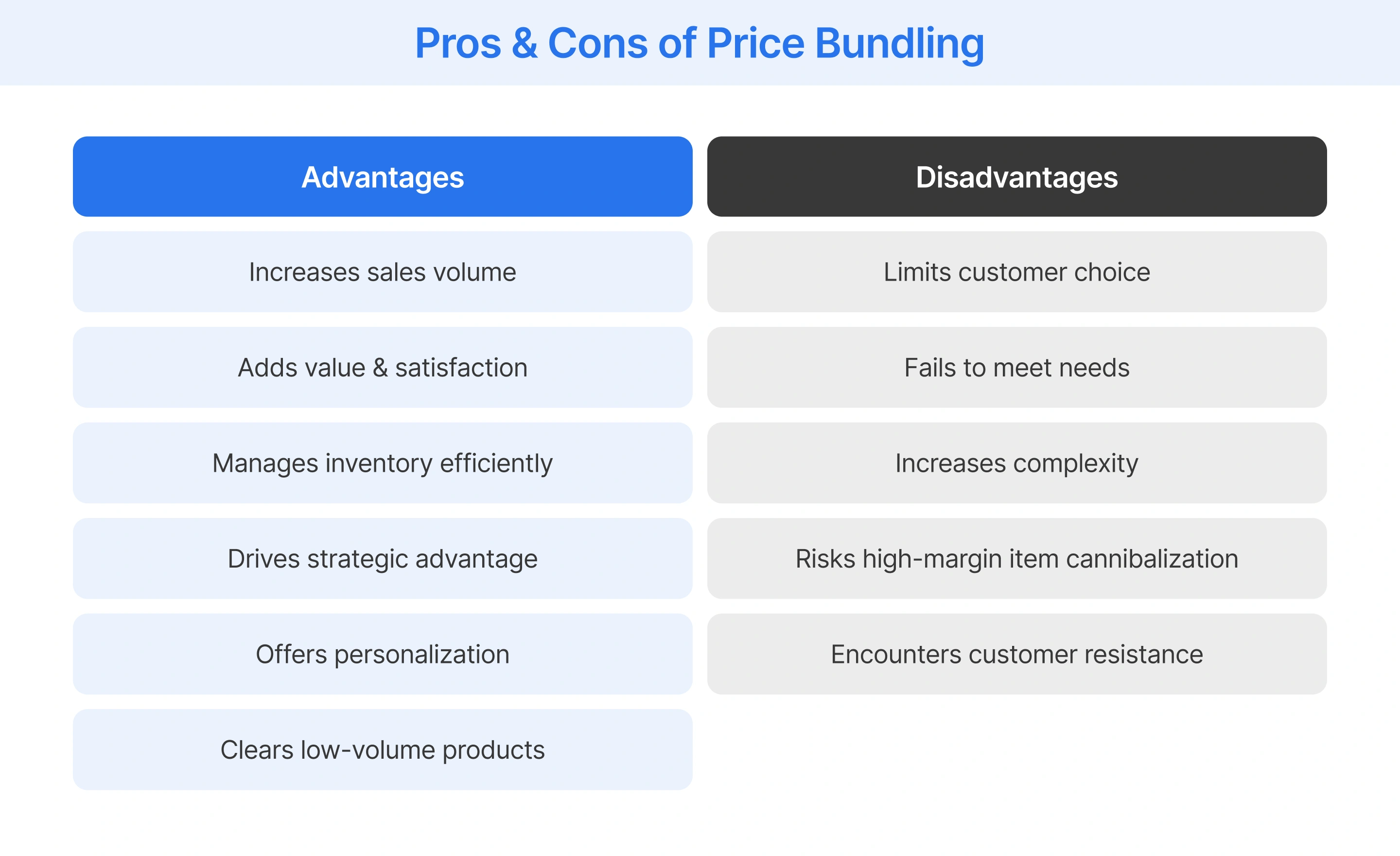
A business should avoid using bundle pricing when the bundled items have very different values or appeal to completely different audience-segments, as this can lead to "value dilution" where the lower-value item drags down the perceived worth of the whole-set. It should also be avoided if the margin-loss from the discount is not offset by the increase in sales-volume, or if it risks cannibalizing the sales of more profitable individual-products.
The key metrics a business should monitor to evaluate the success of a bundle pricing strategy are Average Order Value (AOV), Gross Margin of the bundle versus the individual items, Bundle Sell-Through Rate (the percentage of total sales that are bundles), and the Take Rate (the percentage of eligible customers who purchase the bundle), all tracked alongside the sales volume of the individual, unbundled items.
Yes, bundle pricing makes buying easier and more convenient by simplifying the decision-making-process and providing a curated-solution for a specific need. Instead of researching and selecting multiple individual components, a customer can purchase a single "all-in-one" kit, which reduces cognitive-load and ensures that all items in the package are compatible and functional together.
More Blogs
See how retailers and brands are winning with FCC
Everything About Price Skimming Strategy Explained
Read More
What is a High-Low Pricing Strategy?
Read More
Ultimate Guide To Dynamic Pricing Strategy In 2026
Read More
Retail Pricing Strategies: Winning with Promotion Pricing in Competitive Markets
Read More
Ad Tags: Enhancing Ad Serving Efficiency in Large-Scale Campaigns
Read More