
June 30, 2025
What is Catalog Management?
Catalog management is the strategic process of organizing, maintaining, and enriching product information across all sales channels. This ensures accurate, consistent, and appealing data presentation, crucial for an effective online retail presence.
Drishti, Manager - Digital Marketing

Table of Contents
- What is Catalog Management?
- Why is Ecommerce Catalog Management Critical for Business Success?
- What Challenges Do Businesses Face When Managing Product Catalogs?
- How to Select a Catalog Management Software for E-commerce
- Benefits of Effective Catalog Management
- Catalog Management Best Practices
- Why Choose FCC Catalog Management Software?
What is Catalog Management?
Catalog management is the systematic process of organizing, maintaining, and optimizing product information to ensure customers receive accurate and detailed product descriptions across all digital touchpoints. It forms the backbone of successful ecommerce operations by centralizing product data management and enabling seamless multichannel selling.
Here are the key aspects of catalog management in e-commerce:
- Product Information Organization: Creating structured categories and taxonomies for efficient product discovery and navigation.
- Data Standardization: Ensuring consistent product details, specifications, and attributes across all channels.
- Digital Asset Management: Handling product images, videos, and other visual content for enhanced customer engagement.
- Inventory Synchronization: Maintaining real-time product availability information to prevent overselling and stockouts.
- Price Management: Coordinating pricing strategies and promotions across different sales channels and marketplaces.
Why is Ecommerce Catalog Management Critical for Business Success?
Effective e-commerce product catalog management offers significant advantages to retailers:
- Well-organized catalogs help customers find products quickly through intuitive navigation and robust search functionality, reducing frustration and cart abandonment.
- Maintaining uniform product information across all sales channels builds customer trust and prevents confusion caused by conflicting details or specifications.
- Centralized catalog management reduces the time and resources needed to update product information.
- Accurate product information improves conversion rates by helping customers make informed purchase decisions.
- Businesses with well-managed catalogs can launch products faster and adapt to market demands more quickly.
What Challenges Do Businesses Face When Managing Product Catalogs?
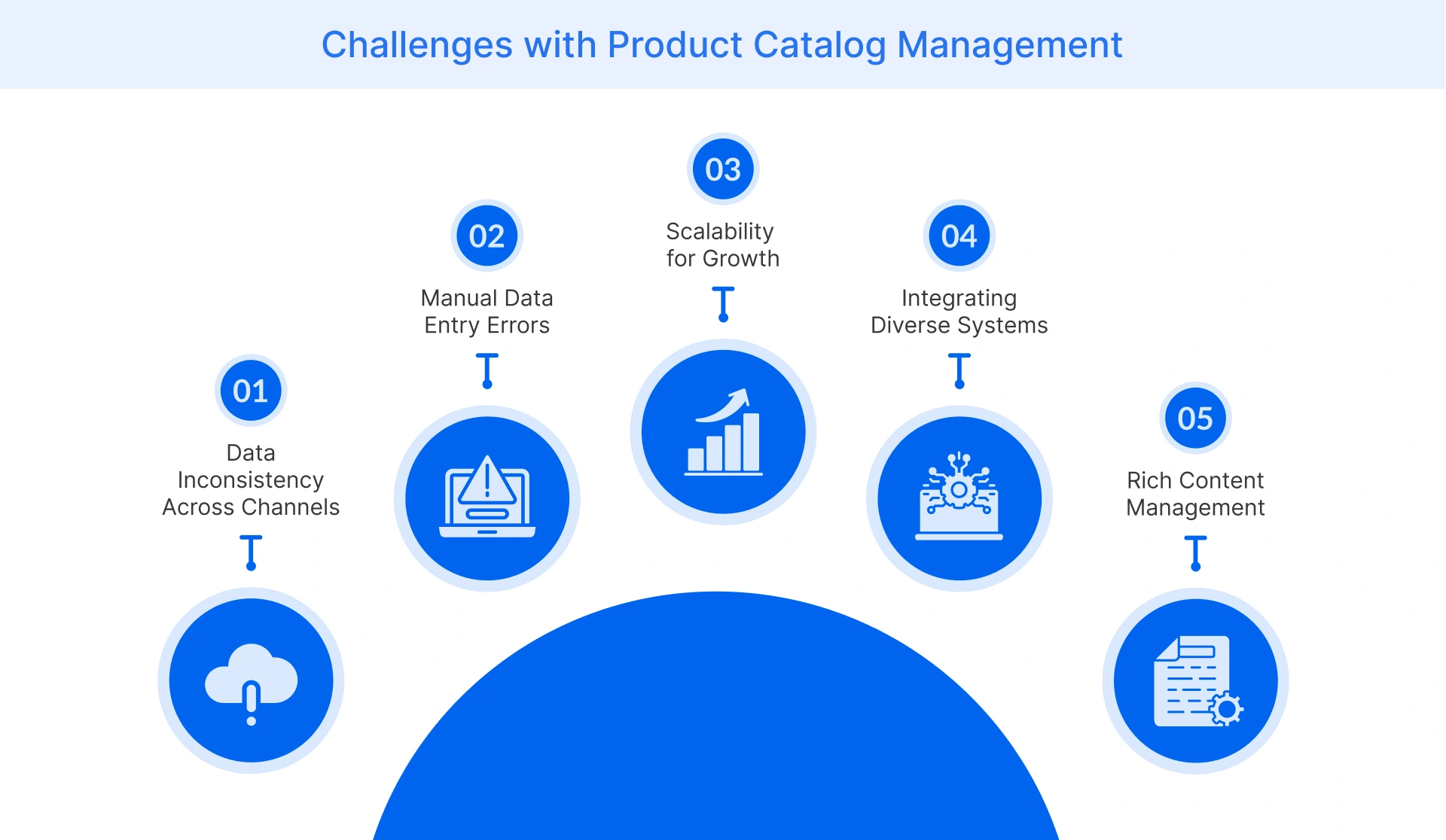
Retailers commonly encounter these challenges when managing their product catalogs:
- Data Inconsistency Across Channels: Ensuring uniform product information across websites, marketplaces, and social media is a significant hurdle. Discrepancies confuse customers and can lead to returns or dissatisfaction.
- Manual Data Entry Errors: Reliance on manual input for large catalogs vastly increases the risk of mistakes, such as incorrect pricing, wrong descriptions, or missing attributes, requiring constant correction.
- Scalability Issues: As businesses grow, managing an expanding product line becomes increasingly complex. Existing systems may struggle to efficiently handle increased data volume and product variations.
- Integrating Diverse Systems: Syncing product data between various platforms (e.g., ERP, CRM, e-commerce) is often difficult. A lack of seamless integration creates data silos and inefficiencies.
- Rich Content Management: Manually ensuring all products have high-quality images, videos, and detailed descriptions can be challenging without automation or dedicated tools.
How to select a catalog management software for e-commerce
Here’s how to choose catalog management software:
Assess Your Business Requirements and Catalog Complexity
Begin by evaluating your catalog size, product types, and attribute complexity. Consider how many SKUs you manage, their variation structure, and the richness of product data required for your industry, as these factors will determine the sophistication level needed in your solution.
Evaluate Multichannel Capabilities and Integration Options
Select a catalog management system that seamlessly connects with your existing tech stack and sales channels. The ideal catalog management solution should integrate with your ecommerce platform, ERP system, and various marketplaces while supporting data synchronization across all customer touchpoints.
Prioritize Scalability and Performance Features
Choose a solution that can grow with your business without performance degradation. A robust catalog management software should handle increasing product volumes, support peak season traffic surges, and accommodate expansion into new markets or categories without requiring a complete system replacement.
Consider Workflow Automation and Collaboration Tools
Look for features that streamline product information workflows and team collaboration. Effective catalog management solutions should offer approval processes, task assignments, and role-based permissions that enable your team to work efficiently while maintaining data governance standards.
Analyze Data Enhancement and Enrichment Capabilities
Select software with robust tools for improving product content quality. The solution should facilitate bulk editing, data validation, content scoring, and enrichment suggestions to help you create compelling product information that drives conversions.
Evaluate Total Cost of Ownership and Return on Investment
Calculate the complete investment beyond just license fees. Consider implementation costs, training requirements, ongoing maintenance, and potential customization needs against the expected benefits in operational efficiency, error reduction, and increased sales performance.
Benefits of Catalog Management
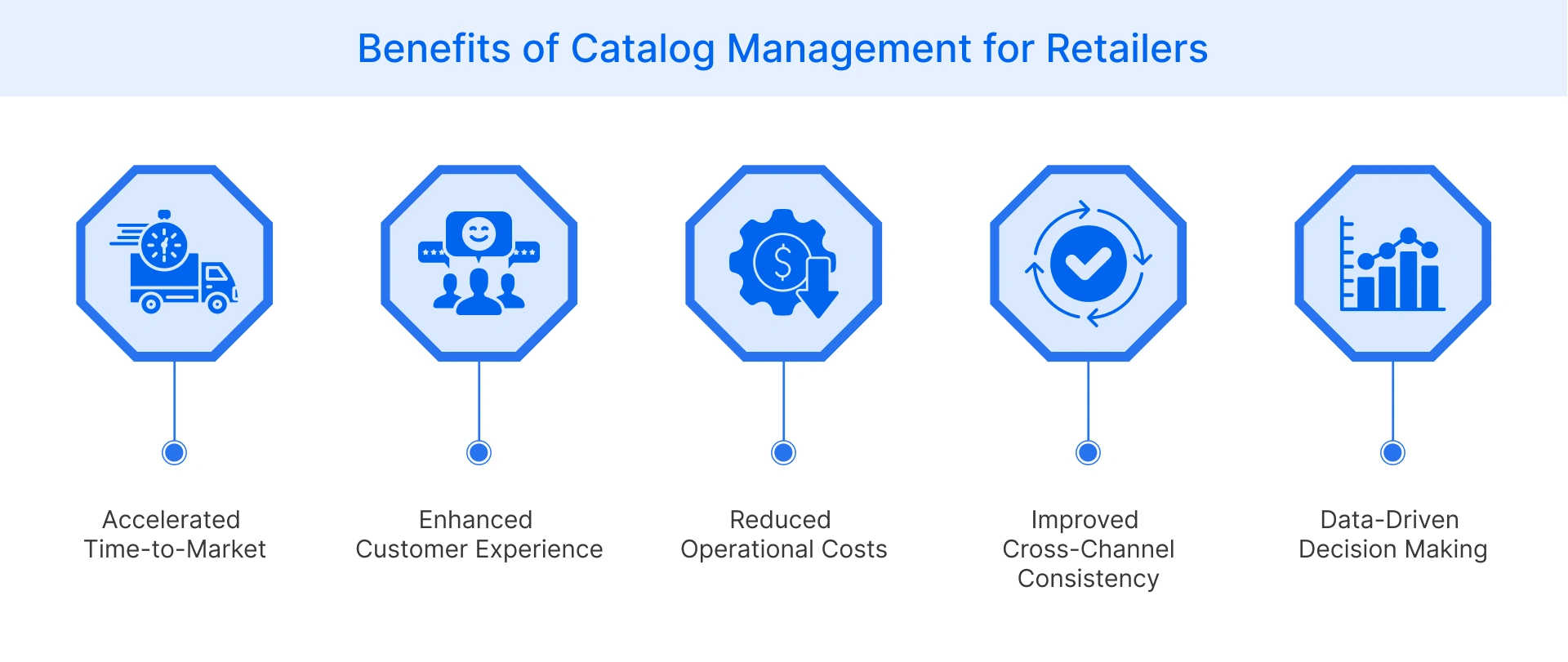
Implementing proper catalog management provides retailers with numerous advantages that directly impact both customer experience and business performance metrics.
- Accelerated Time-to-Market: Streamlined catalog management processes enable businesses to add new products to their online stores significantly faster. This allows them to capitalize on trends and meet customer demands before competitors.
- Enhanced Customer Experience: Well-organized product catalogs with rich, accurate information help customers find exactly what they need quickly. This reduces friction in the buying journey and increases conversion rates across all digital touchpoints.
- Reduced Operational Costs: Centralized catalog management eliminates redundant data entry tasks and minimizes error correction efforts. It allows teams to focus on strategic initiatives rather than spending hours on manual data maintenance.
- Improved Cross-Channel Consistency: Unified catalog management ensures customers receive identical product information regardless of whether they shop on your website, mobile app, or third-party marketplace, building trust through consistent experiences.
- Data-Driven Decision Making: Advanced catalog management systems provide valuable insights about product performance. This allows retailers to identify trends, optimize assortments, and make inventory decisions based on concrete data rather than assumptions.
Catalog Management Best Practices
Optimizing catalog management processes is essential for long-term success. Retailers should adopt these proven strategies to enhance product data quality and efficiency.
- Establish Clear Data Governance: Define standards and processes for all product data. This ensures consistency, accuracy, and accountability, from initial entry to final publication across all channels.
- Enrich Product Information: Go beyond basic details by adding comprehensive descriptions, high-quality images, and videos. Rich content educates customers and significantly enhances their shopping experience.
- Develop a Robust Product Taxonomy: Create a logical and intuitive categorization system for all your products. A well-structured taxonomy improves navigation, search functionality, and overall product discoverability for your customers.
- Automate Data Workflows: Utilize software to automate tasks like data import, validation, and distribution. Automation minimizes manual errors and speeds up the entire catalog management process, ensuring efficiency.
- Regularly Audit and Update: Conduct periodic reviews of your product catalog to ensure data remains accurate and current. Identify and correct outdated information or broken links to maintain a pristine catalog.
Why Choose FCC Catalog Management Software?
Flipkart Commerce Cloud's (FCC) catalog management software offers retailers a powerful, integrated solution for handling complex product data. It simplifies the often-daunting task of organizing, enriching, and distributing product information across various sales channels. This comprehensive tool provides businesses with the efficiency and accuracy needed to excel in competitive e-commerce markets.
The software delivers significant benefits, including faster product onboarding, enhanced data quality, and improved customer experiences. By centralizing product information, businesses reduce manual effort, minimize errors, and ensure consistency across all touchpoints.
Integrating FCC's solution involves optimizing data feeds, standardizing product attributes, and leveraging automation for content updates. Its robust features support scalability, enabling businesses to manage growing product assortments and expand into new markets seamlessly. The software ensures that all product data is optimized for discovery and conversion.

FAQ
For B2B, catalog management often involves complex pricing tiers, detailed technical specifications, and custom product configurations, catering to recurring bulk orders and long-term relationships. B2C catalog management focuses on appealing visuals, simplified descriptions, and personalized recommendations, targeting individual consumers for transactional purchases.
Product Information Management (PIM) centralizes all product data, including descriptions, images, and specifications, making it the backbone of effective catalog management. PIM systems ensure data consistency and accuracy across multiple sales channels. This streamlines updates and enriches product content, improving overall catalog quality and efficiency.
Measuring ROI for catalog management improvements involves tracking key metrics. Look at reduced data entry errors, faster new product launches, decreased product returns, and improved conversion rates. Higher customer satisfaction and increased average order value also indicate a positive return on investment from your catalog efforts.
Effective catalog management integrates seamlessly with other critical systems like your warehouse management system and supply chain software. This integration ensures that stock levels are accurately reflected across all channels and that product information is synchronized with fulfillment operations. When designed to address your specific needs, these connections create a streamlined ecosystem that improves operational efficiency and customer satisfaction.