What is Incrementality measurement

Beyond the Click: Why Incrementality Measurement is Crucial for Retail Media

By Flipkart Commerce Cloud

Retail media has become a buzzword amongst advertisers, retailers, and brands, and for good reason. With Retail Media Networks (RMNs) providing access to first-party shopper data, brands are able to create targeted ad campaigns and engage customers through personalized interactions. This has made RMNs a strategic avenue when it comes to brand visibility and multi-channel sales. But, with brands spending millions of dollars on ads, it is becoming increasingly important to monitor the return on investments (ROI).

The absence of a standard approach to measuring retail media success can make it difficult for retailers like you to inform the brands about the actual performance of ad campaigns running on various platforms. To address this challenge, you must focus on ‘incrementality measurement,’ an important method that enables the measurement of true value created by any marketing strategy. 

In this blog, we will explore the key aspects of incrementality measurement and how you can use it to enhance your retail media network. Let’s start.

What is Incrementality?

Incrementality is the measure of additional value created by any business strategy. In the context of the retail industry, the concept of incrementality can be explained as the actual increase in sales volume owing to specific advertising campaigns. Due to higher purchase intent in retail media, incrementality is a useful method for brands and retailers to measure campaign success. It helps differentiate between customers who would have purchased the product anyway and those who made the buying decision after seeing the ad. This distinction is crucial because it measures the true impact of promotional efforts.

As a retailer, you must also keep incremental conversions at the center of your ad offerings, as it will help brands understand the benefit of using your retail media to drive their sales.  In fact, 74% of brands now consider true incrementality as the primary metric to analyze the potential of retail media networks.

ROAS is a popular metric for measuring campaign success, but it can be misleading. ROAS helps determine the total sales or engagement that a campaign creates instead of the additional sales or engagement. So, even if a campaign shows a high ROAS, it might not be bringing in any extra sales or engagement. 

Benefits of Incrementality Measurement
Key Benefits of Incrementality Measurement

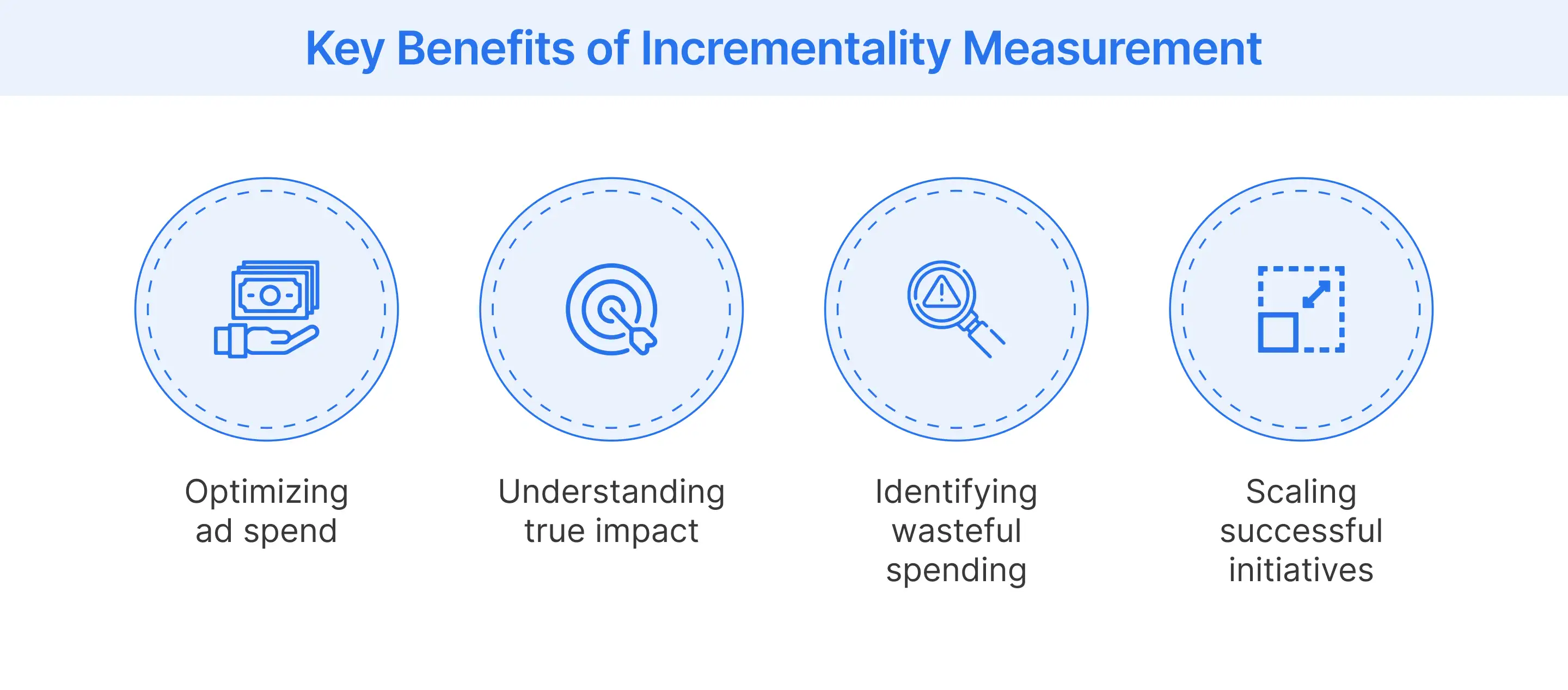
Incrementality is often considered the north star of marketing as it helps understand the true impact of ad campaigns across media channels. Here are some key benefits that you can provide to brands advertising on your retail media with incrementality measurement:

  • Optimizing Ad Spend: With incrementality measurement, you can help brands identify which campaigns are driving additional sales on your platform. These insights can help them allocate their ad spend effectively, ensuring that the investment is directed toward campaigns that truly drive growth.
  • Understanding the True Impact of Campaigns: Incrementality goes beyond direct clicks and conversions to measure the actual value created by advertising efforts. By providing this data, you can help advertisers understand the true impact of their campaign performance on customer behavior.
  • Identifying Wasteful Spending: By differentiating between customers who would have purchased anyway and those influenced by ads, incrementality can help advertisers avoid wasteful spending. This can help them with the efficient use of their marketing budget on your platform.
  • Scaling Successful Initiatives: You will have a clear knowledge of campaigns that are driving incremental sales. This way, you can help brands scale successful initiatives and maximize their return on investment on your platform.

How To Measure Incrementality?

There are two primary methodologies for measuring incrementality, i.e., the Control Group Method and the Attribution Model Method. By understanding these methods, you can provide advertisers with an accurate picture of their efforts.

Control Group Method

This method provides a clear and direct measurement of the incremental value generated by a specific campaign. The first step of this incrementality testing approach involves dividing the audience into two groups, i.e., the test group, which is exposed to the campaign, and the control group, which is not. By comparing the behavior of the test group to the control group, brands can determine the incremental impact of the campaign. For example, if the test group that saw the ad had a higher conversion rate than the control group, the difference in conversion rates would be the incremental impact of the ad. You can combine incremental lift with other measurement models like Marketing Mix Modeling (MMM) to optimize your marketing efforts. 

Attribution Model Method

An attribution model is a statistical model that decides how to give credit for conversions to different steps in the entire process. In the retail industry, the attribution model helps brands estimate the effect of various marketing channels on sales or engagement. For example, a retailer might use a last-click attribution model, which assigns 100% credit to the final touchpoints that immediately precede sales. Unlike the control group method, this approach distributes the credit for conversions across all touchpoints a customer encounters on their journey. It helps paint a picture of how each channel contributes to the end goal.

The Attribution Model Method, used by Flipkart Commerce Cloud (FCC), is an effective way for you to measure incrementality accurately. FCC’s ad monetization service provides attribution tracking to evaluate the performance of ads being run by different advertisers on different retail media. Advertisers can see the current and future impact (T + 28 days) of ads in the form of awareness, engagement, and conversion. This information helps them make informed marketing decisions.

What makes incrementality measurements difficult in retail?

Incorporating incrementality measurements into a retail organization can be challenging due to several factors.

  • Complex Ecosystems: The retail ecosystem is a complex network featuring different entities and processes. It includes retailers, suppliers, distribution networks, and customers, who are all connected by technology and infrastructure. Analyzing the effect of a single campaign within such an interconnected system is tough, which makes incrementality measurement a challenge.
  • High Reliance on the Attribution Model: Many retailers place a heavy emphasis on the attribution model for their marketing efforts. While this model offers valuable insights, it may not provide the complete picture. The attribution model focuses on total sales or engagement generated, not the incremental sales or engagement. A combined approach that includes both attribution and incrementality measurements can provide a precise view of the success of a campaign.
  • Lack of Industry-wide Standards: In retail media, there is no universal standard for incrementality measurement. The variability complicates the comparison of results from different studies. This makes it difficult to apply incrementality measurements effectively.
  • The Role of Retail Media Partner: The retail media partner’s expertise plays a crucial role in determining if an advertiser can benefit from incremental tracking. A knowledgeable partner can help navigate the complexities of the retail ecosystem. They can offer guidance on combining attribution and incrementality measurements and offer custom solutions.
Incrementality Measurement helps calculate the true impact of campaigns

How is Incrementality Measured in Retail Media?

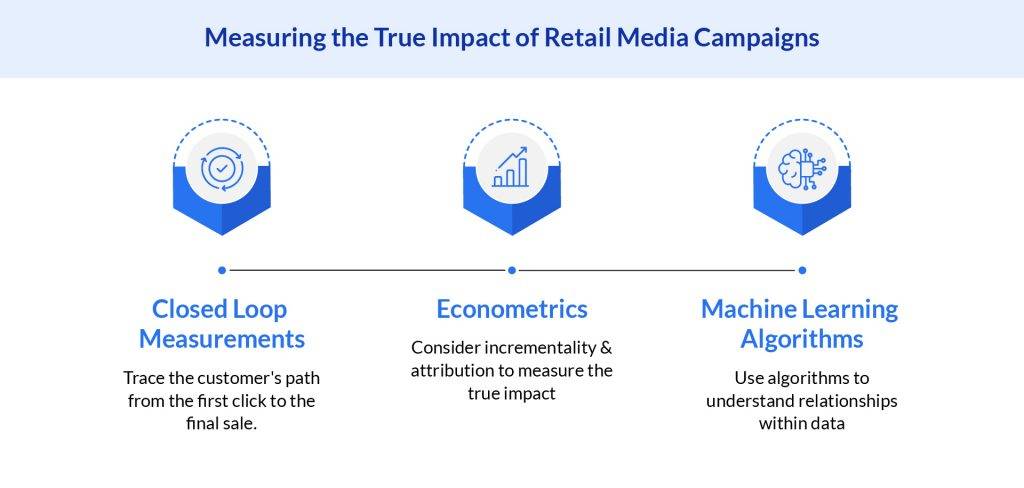
Let’s have a look at three main methods for measuring incrementality:

  • Closed Loop Measurements: This method involves tracking the entire customer journey from awareness to purchase. It uses customer transaction data to measure the impact of digital marketing campaigns on online and offline sales. It helps determine the effectiveness of campaigns driving sales revenue for brands or clients. Closed-loop measurement provides critical intel to refine campaigns in real time to improve results.
  • Econometrics: Econometrics uses statistical methods to find incrementality in large data sets. It leverages mathematical techniques with the objective of isolating a test case that is to be measured when applied in two or more variations. This approach often relies on integrating panel data for offline activity.
  • Machine Learning Algorithms: Machine learning algorithms can be used to understand the underlying relationships inside the data, removing human bias. These algorithms can provide accurate and reliable insights into the effectiveness of the campaign and its impact on the desired outcome.

How Can Flipkart Commerce Cloud Be Leveraged for Incrementality in Retail Media?

Flipkart Commerce Cloud (FCC) offers a suite of tools and analytics that enable advertisers and marketers to accurately measure and understand the incremental impact of their retail media investments. Let’s have a look at how Flipkart Commerce Cloud supports incrementality measurement:

  • Advanced Data AnalyticsFCC provides advanced data analytics capabilities that allow advertisers and marketers to track and measure the performance of their campaigns. These analytics can help identify which campaigns are driving incremental sales or engagements, enabling effective allocation of ad spend.
  • Customer Journey Mapping: FCC offers customer journey mapping tools that provide a comprehensive view of the customer’s path to purchase. This allows advertisers and marketers to understand which touchpoints are influencing customer behavior and driving incremental sales or engagements.
  • Attribution Modelling: FCC provides attribution modeling capabilities that distribute credit for conversions across all touchpoints a customer encounters on their journey to conversion. This model paints a picture of how each channel contributes to the end goal, providing a clear view of a campaign’s effectiveness.

By leveraging these features, you can provide advertisers on your retail media with an accurate picture of the effectiveness of their advertising efforts. This information will help them make informed decisions, ensure ad spend optimization, and maximize their return on investment.

If you are ready to take your retail media strategy to the next level, consider partnering with FCC. Our team of experts is ready to support you in your journey towards effective incrementality measurement. 

Contact us today to learn more! 

Stay tuned for the latest insights and updates.

FAQ

You calculate incrementality by determining the difference in the conversion rate or outcome metric between the test group and the control group, and then scaling that difference across the total exposed audience. The formula is: Incrementality = (Test Group Conversion Rate) - (Control Group Conversion Rate) x Total Exposed Users. This calculation yields the incremental number of conversions that were genuinely driven by the advertising.

Incrementality is the measurement in scenarios where a marketer needs to validate the effectiveness of a channel or campaign and prove that the advertising spend is driving new, valuable customer action, rather than just capturing existing demand. It is the essential measurement when evaluating new channels, new creative campaigns, budget changes, or the performance of automated bidding strategies, particularly in retail media and other closed loop systems like those offered by FCC.

Yes, Marketing Mix Modeling (MMM) does measure incrementality, but it does so holistically and at a macro level, rather than at the user or campaign level. MMM is a top-down, statistical analysis that uses historical data (sales, media spend, external factors) to attribute sales lift to different marketing channels and non-marketing factors over time. It provides a macro view of the incremental value of marketing spend, which can then be combined with bottom-up experiments for a comprehensive view.

Incrementality is different from traditional attribution because incrementality measures causality, while traditional attribution measures correlation. Traditional attribution (e.g., last-click) simply tracks the final touchpoint before a conversion and assigns credit to it, but cannot prove the conversion wouldn't have happened otherwise. Incrementality, using control groups, proves that the ad caused the conversion, isolating the true lift, regardless of what the user's final click was.

Incrementality measurement is not always possible, as there are significant limitations. It requires a statistically significant sample size and the technical ability to accurately control and hold out exposure to the control group without contamination (leakage), which is difficult in small or highly fragmented campaigns. Furthermore, it is often costly and time-consuming to run experiments, making it impractical for every single campaign, especially those with very small budgets.

Incrementality relates to ROAS or ROMI by providing the most accurate input for calculating these metrics. While traditional ROAS uses total conversions, Incremental ROAS (I-ROAS) uses only the incremental conversions (the true lift) in the calculation. This results in a more honest and reliable measure of marketing profitability: I-ROAS = Incremental Revenue/Total Ad Spend.

No, incrementality is not the same as uplift modelling, although they are closely related. Incrementality is a measurement technique that relies on running A/B tests to measure the lift after the fact. Uplift modelling is a predictive machine learning technique that forecasts the individual incremental lift before the campaign runs, identifying which specific users are most likely to convert only if they are exposed to the ad, optimizing the targeting before the spend is even executed.

A brand should use incrementality measurement instead of relying on platform-reported conversions whenever making significant strategic budget decisions or when there is high skepticism about the true value of a channel. Platform-reported conversions are susceptible to attribution errors, fraud, and over-reporting due to the platform's self-interest. Incrementality provides the necessary third-party, scientific proof of the true causal impact, ensuring budget allocation is based on actual added value.

More Blogs

See how retailers and brands are winning with FCC

Everything About Price Skimming Strategy Explained

Read More

What is a High-Low Pricing Strategy?

Read More

Ultimate Guide To Dynamic Pricing Strategy In 2026

Read More

Retail Pricing Strategies: Winning with Promotion Pricing in Competitive Markets

Read More
Ad Tags: Enhancing Ad Serving Efficiency in Large-Scale Campaigns

Read More