Imagine a customer visits your brand's website and sees your signature product priced at $150. Later that day, they're browsing Amazon and find the exact same item advertised at $99 by another seller. The damage is instant, not just a lost sale, but a crack in the trust you've spent years building. This is the daily reality for brands selling across multiple channels, and it's quietly eroding brand equity one pricing inconsistency at a time.
What Is MAP and Why Does It Matter?
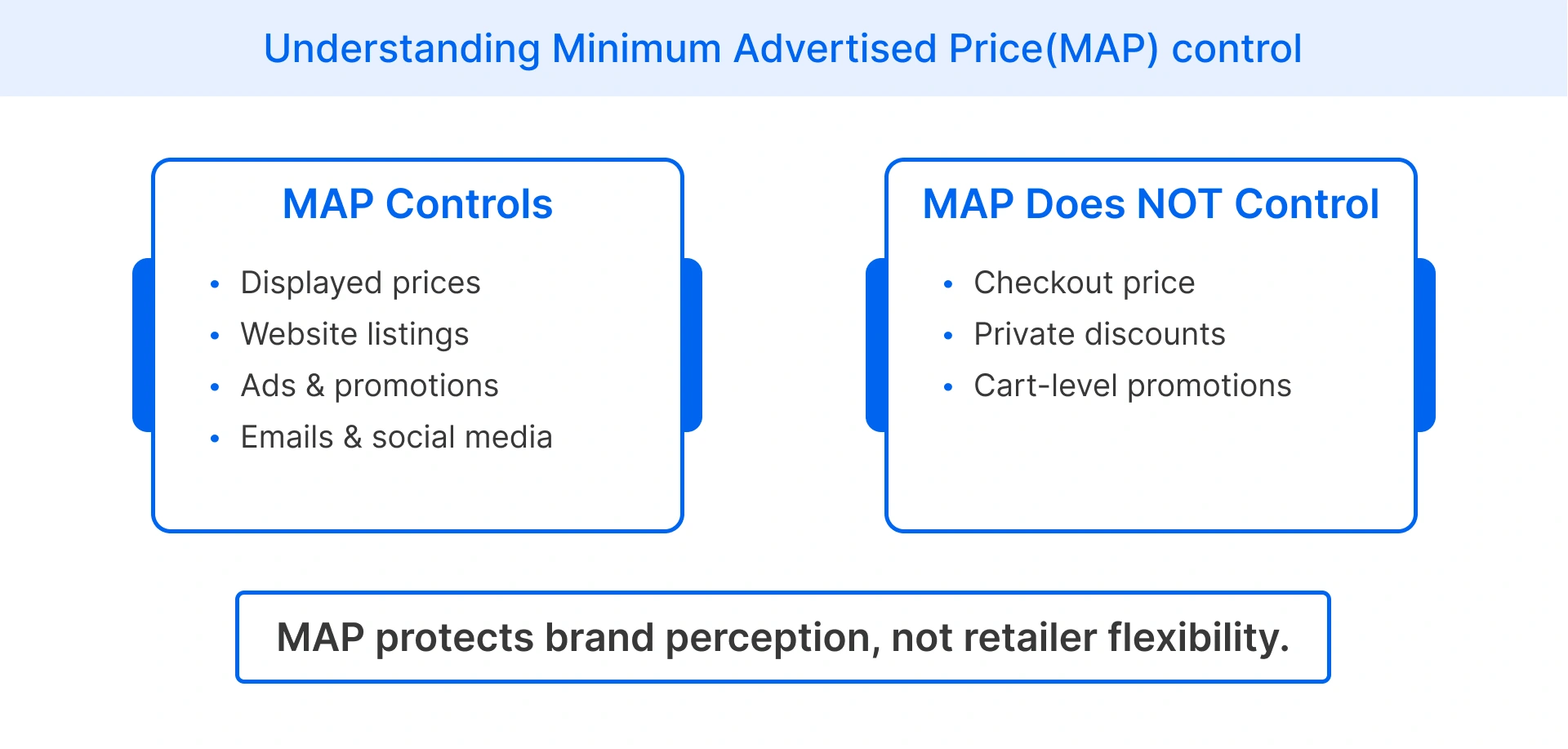
MAP stands for Minimum Advertised Price. It's the lowest price you, as a brand owner or manufacturer, allow retailers to advertise your products publicly. The keyword here is "advertised"; MAP controls the prices that retailers can display on their websites, in emails, on social media, or in any other marketing materials. It doesn't control the actual selling price at checkout, but it does protect how your brand is positioned in the market.
Think of it this way: if you set a MAP of $120 for your premium sneakers, authorized retailers must display them at $120 or higher on their product pages and advertisements. They could theoretically sell them for $110 at checkout, but they cannot advertise that lower price publicly. This distinction protects your brand positioning while giving retailers some flexibility in their actual pricing strategy.
MAP violations happen when retailers advertise your products below this minimum price threshold. These violations occur everywhere customers shop, on Amazon, eBay, retailer websites, social media ads, email campaigns, and price comparison sites. Each violation sends a message to customers that undermines the value perception you've carefully crafted.
How MAP Violations Destroy What You've Built
Perception is everything in lifestyle and fashion retail. Different brands have been associated with different categories of audiences by building a brand value and perception. You think IKEA, and you immediately think of affordable, quality furnishing for everyone. IKEA would not attract patrons of Baxter, even if they are both in the contemporary furnishing space, because pricing is also Baxter's positioning point.
With pricing comes a perception of 'premium' or 'niche' products, or you could label brands as 'affordable' and 'simple' based on how they price the majority of their merchandise. While lower-priced segments drive volumes for sellers, luxury segments drive cart value. A single boutique store can manage to keep the price perception in check, depending on factors like real estate, patrons, exclusive clubs, and the posh interiors.
Here's what makes this challenging at scale: once your merchandise becomes available in multiple geographies and on multiple channels, maintaining that perception of quality and category becomes exponentially harder. Unauthorized sellers and channels further compound the problem. Despite all the investment brands put into crafting a retail strategy, MAP violations create three devastating impacts.
First, brands become susceptible to increased violations while selling through multiple online platforms and channels, such as their own website and brick-and-mortar stores. Each new channel multiplies your exposure to pricing inconsistencies. Second, these variations in pricing lead to customer mistrust when they spot huge gaps in pricing on different platforms. Customers start questioning whether the quality differs, whether one version is counterfeit, or whether you're simply price-gouging on your own site. Third, violations reduce profitability by impacting sales on primary channels of distribution. When customers can find your product advertised cheaper elsewhere, they abandon your high-margin channels.
While brands themselves avoid these practices on authorized channels, unauthorized sellers and dealers trigger these exact issues. One Harvard Business Review study found that unauthorized resellers violated pricing and distribution policies about half the time. Think about that, every other unauthorized seller is actively undermining your pricing strategy.
88% of consumers require authenticity and transparency in their purchasing decisions, and 63% of young consumers are willing to pay premium prices for brands they perceive as honest and authentic
For large-scale brands such as Nike or Puma, the counterfeit and unauthorized selling industry runs into hundreds of millions of dollars annually. The lack of regular tracking translates to millions of dollars in lost revenue and irreparable damage to brand trust.
Understanding MAP Violations Competitive Intelligence
So what exactly is competitive intelligence when it comes to MAP enforcement? It's the systematic process of monitoring, analyzing, and acting on pricing data across every channel where your products appear. This goes far beyond simple price checking; it's about understanding your complete pricing landscape, identifying threats before they spread, and having the documentation you need to enforce your policies effectively.
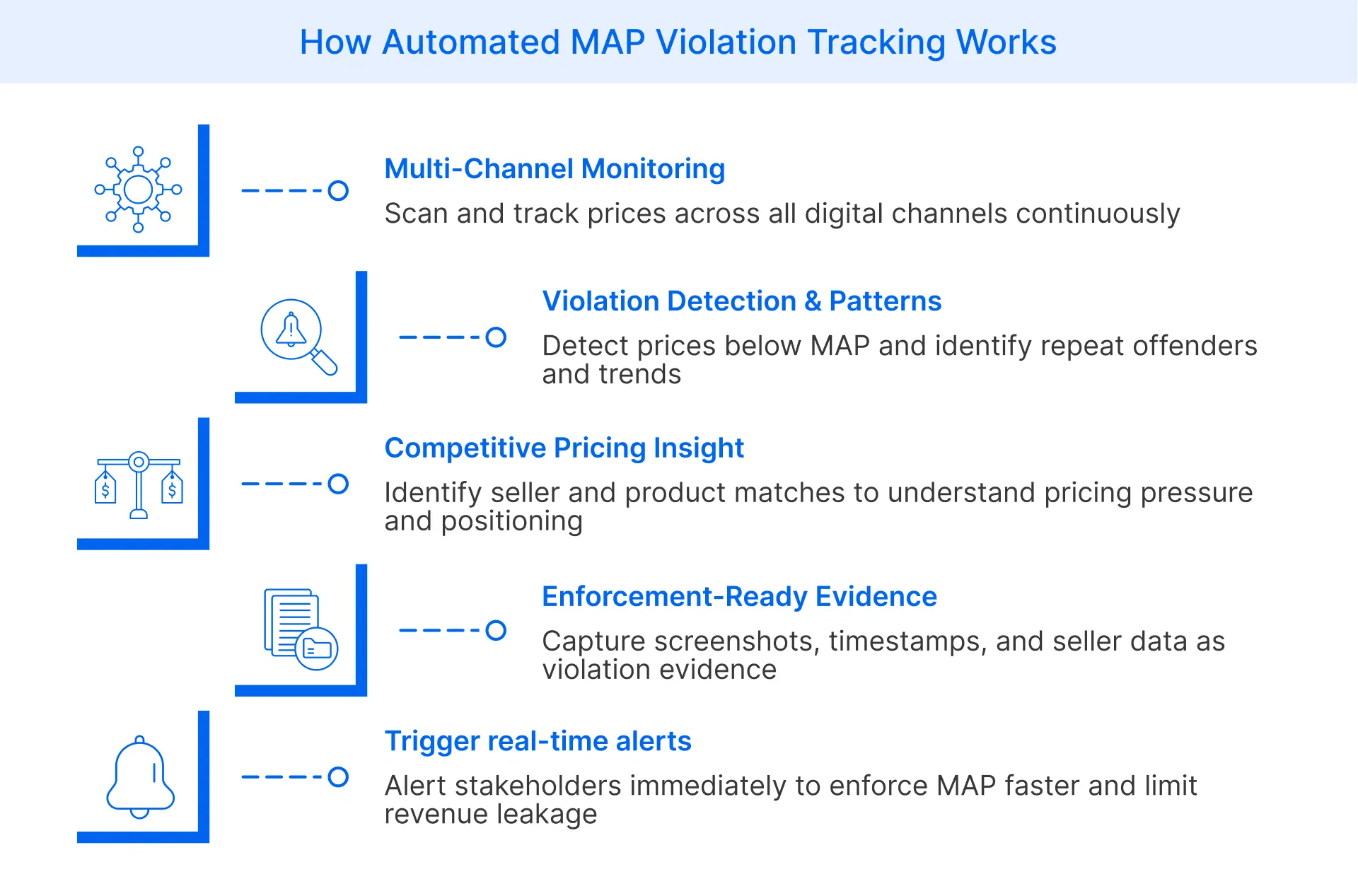
Competitive intelligence combines four critical elements. First is multi-channel monitoring, where you track product prices across hundreds of websites simultaneously, authorized retailers, major marketplaces, niche platforms, international sites, and even social media. This creates comprehensive visibility into where and how your products are being advertised. Second is violation detection and pattern analysis, which reveals not just individual violations but systematic issues. You discover which sellers violate repeatedly, which product categories face the most pricing pressure, and which regions show the weakest compliance. Third is competitive pricing insight, helping you understand how your pricing compares to competitors and where unauthorized sellers concentrate their efforts. Fourth is actionable enforcement data, the documented evidence of violations, including screenshots, timestamps, and seller information that supports every enforcement action you take.
The challenge most brands face is that manual tracking fails at this scale. While brands have teams fighting counterfeits and unauthorized selling on platforms like Amazon and eBay, the real problem is finding instances of violations before they begin to impact people's perceptions. Reporting unauthorized sellers on platforms is a basic safeguard that most trusted online channels offer, but tracking them across hundreds of sites multiple times daily with any accuracy is impossible for human teams. By the time you manually discover a violation, thousands of customers have already seen the inconsistent pricing and formed negative impressions about your brand.
The Solution: Automated MAP Violation Tracking in Ecommerce
The answer lies in automation powered by intelligent technology. Modern MAP violations competitive intelligence platforms transform enforcement from an impossible manual task into a systematic, manageable process that actually works at scale.
Advanced tracking algorithms can map hundreds of sites and online platforms and keep track of pricing on all online channels simultaneously. This makes it easier for brands to maintain consistency and transparency in pricing without dedicating entire teams to manual searches. These systems scan your entire digital footprint multiple times daily, catching violations within hours instead of weeks or months. You get immediate visibility into pricing across your authorized retailers, major marketplaces, niche platforms, and anywhere else your products might appear.
The real power comes from AI and machine learning. The benefit of employing an AI ML-based fuzzy matching algorithm is that you can track listings that may vary in some ways but would still fall in the category of a product similar to the original merchandise. This technology identifies products with modified titles or descriptions, listings using alternate SKU numbers, bundle offerings that include your products, and international sellers using different naming conventions. This level of retail pricing analytics ensures no violation goes undetected, regardless of how sellers attempt to disguise their listings.
By integrating data from multiple sources and multiple channels as frequently as possible, these automated solutions provide a complete picture of your pricing landscape. What would be a humongous task through manual operations becomes fairly achievable with automation tools guided by retail intelligence. Instead of quarterly audits that reveal violations weeks after they've damaged your brand, you receive real-time alerts the moment pricing drops below MAP. Detailed reports identify the specific seller, platform, product, and complete violation history, giving you everything needed for swift, effective enforcement action.
Once you start keeping track of violating listings and unauthorized sellers, you can take strategic action. For authorized retailers, policy discussions backed by concrete violation data typically resolve issues immediately. Most authorized partners want to comply; they just need to know when they've inadvertently drifted below MAP. For marketplace violations, reminding platforms of adhering to the mutual contract becomes dramatically more effective when you have documented violation evidence. Marketplace operators respond much faster to data-backed reports than to vague complaints. For repeat offenders, systematic tracking reveals patterns that support stronger enforcement measures, including removal from marketplaces or legal recourse when necessary.
Powered with such efficient technology, brands can reduce MAP violations, counterfeits, and unauthorized selling across their entire distribution network.
Protect Your Pricing Integrity with Flipkart Commerce Cloud
The difference between brands that maintain pricing integrity and those that watch it slowly erode comes down to having the right competitive intelligence tools and taking action before violations spread throughout your distribution network.
Flipkart Commerce Cloud's Competitive Intelligence tool delivers the automated MAP violations competitive intelligence that modern omnichannel brands require to compete effectively. The platform provides real-time MAP violation tracking in ecommerce across all major platforms and marketplaces, ensuring you catch pricing issues the moment they appear rather than weeks later during manual audits. The AI-powered fuzzy matching technology catches product variations and disguised listings that human reviewers would miss, while automated alerts notify you instantly when pricing drops below your MAP threshold.
The system delivers comprehensive reporting with complete seller details, violation history, and enforcement-ready documentation that makes your policy discussions and marketplace reports far more effective. Through multi-channel data integration, you get unified visibility across your website, all marketplaces, and your retail partners' platforms. Pattern analysis reveals systematic issues and identifies repeat offenders, transforming your enforcement from reactive firefighting into strategic brand protection.
When you implement comprehensive MAP violation tracking, the transformation extends throughout your entire business. Your brand's premium positioning stays intact because customers see consistent pricing that reinforces quality and value, maintaining the trust you've worked years to build. Your profit margins stabilize across all channels as unauthorized discounting disappears and your primary distribution channels maintain healthy margins. Your authorized retail partners can finally compete on service and experience rather than racing to match unauthorized sellers' prices. You make enforcement decisions with complete confidence because data-backed insights show you exactly where to focus efforts for maximum impact. Most importantly, you stop revenue leakage immediately; every violation you catch prevents lost sales on higher-margin channels and preserves the pricing architecture you've carefully designed.
Don't let MAP violations continue eroding the brand equity you've invested years in building. Every day without comprehensive monitoring means potential revenue loss, damaged customer trust, and weakened market positioning.
Schedule Your Demo to explore the FCC solution for MAP violation tracking in e-commerce, exactly what your brand needs to thrive across every channel.

FAQ
MAP violations in ecommerce occur when online retailers advertise a product below the minimum price set by the manufacturer. These pricing violations often trigger a chain reaction of price wars across various platforms. Flipkart Commerce Cloud helps brands identify these product pricing issues in real time to prevent long-term price erosion.
Brands should monitor MAP violations to protect their brand’s reputation and maintain healthy profit margins across all sales channels. Constant map monitoring ensures a level playing field for compliant retailers while preventing unfair competition. By taking swift action against map policy violations, businesses safeguard their brand equity and ensure long-term brand success.
Competitive intelligence helps with MAP enforcement by providing actionable insights into how various channels handle product listings. Using MAP violations competitive intelligence, Flipkart Commerce Cloud uncovers the root causes of price changes. This market intelligence gives brands a competitive edge, allowing them to implement enforcement actions that maintain consistent pricing.
Tools that can detect MAP violations automatically utilize machine learning and digital shelf analytics to scan retailer websites 24/7, which include tools like the Rule-Based Pricing Engine of FCC, TrackStreet, and MetricsCart. Flipkart Commerce Cloud offers a robust pricing policy engine that performs MAP violation tracking in ecommerce at scale. These digital platforms provide detailed reports on map pricing violations, ensuring fair competition across marketplaces.
MAP violations impact brand perception by creating a sense of inconsistent pricing that devalues the brand’s integrity. When consumers see a lower price or the lowest price on social media, it damages the brand’s reputation for quality. Consistent retail pricing is the first step in protecting your premium market share.
More Blogs
See how retailers and brands are winning with FCC
Everything About Price Skimming Strategy Explained
Read More
What is a High-Low Pricing Strategy?
Read More
Ultimate Guide To Dynamic Pricing Strategy In 2026
Read More
Retail Pricing Strategies: Winning with Promotion Pricing in Competitive Markets
Read More
Ad Tags: Enhancing Ad Serving Efficiency in Large-Scale Campaigns
Read More