Walmart released its Q2 earnings with a 30% growth in quarterly ad revenues, powered by Walmart Connect and Flipkart Commerce Cloud Ads. Walmart’s ad revenue was disclosed at $2.1 billion in retail media advertising in 2021, surpassing the $2 billion milestone twice as fast as Twitter. This growth momentum continued with Walmart Connect's ad business growing 28% in Q3 2024, reinforcing retail media's position as a primary growth driver for major retailers. While the earlier decade was dominated by social media platforms redirecting buyers to online shopping sites, CMOs and CFOs now see retail media advertising as a major opportunity to increase the mere 13.2% buying activity on their platforms with the help of retail media ads and adtech.
These rapidly growing retail media networks are becoming a critical part of the future of commerce, prompting retailers across categories,from Kroger, Dollar Tree, Kohl’s, Best Buy, Lowe’s, and CVS,to launch their own retail media advertising networks. In the US alone, retail media ad spend is projected to exceed $61.15 billion in 2024, with growth showing no signs of slowing as more retailers enter the market. Globally, the opportunity is even larger retail media spending reached $136.7 billion in 2024, making it one of the fastest-growing segments in digital advertising worldwide.
While the co-op advertising model,where brands share advertising costs,has existed since the early 2000s, it offered limited control over ad placements for brands. Any retailer will confirm that product placement plays a decisive role in sales. In physical stores, in-aisle positioning and end caps influence consumer behavior. Online, the same logic applies through retail media ads placed at the point of sale. This makes retail advertising media a natural evolution, driving both monetization and profitable selling.
Incremental revenue from retail media advertising is increasingly seen as a solution to declining efficiency in traditional advertising and fragmented digital channels. By tapping into shopper intent directly on a retailer’s website, retail media ads reduce wasted marketing efforts and improve conversions. With growing privacy constraints, the ability to use first-party retailer data responsibly has become essential, retail media ads features answer this need without compromising user trust.
But not all retail media networks are built the same. Some generate noise, while others unlock long-term value. Below are the retail media ads features that separate scalable monetization engines from distractions.
5 Retail Media Ads Features That Contribute To Retail Profitability
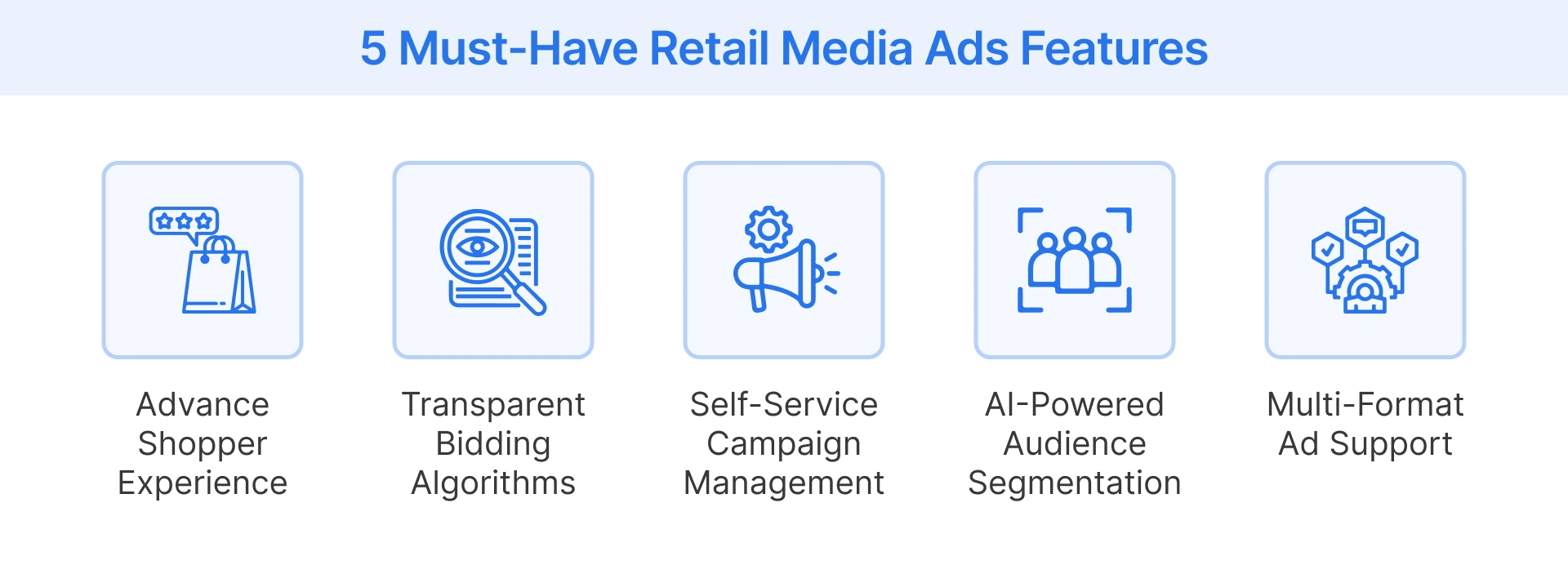
Enhance Shopper Experience
Enhancing the shopper experience is one of the most critical retail media ads features because it directly influences consumer behavior at the point of sale, both online and in physical stores. The most effective shopper marketing strategies improve discovery rather than interrupt it.
Just as a well-placed end cap or a styled mannequin helps shoppers navigate physical stores, retail media ads should feel contextual and relevant. Flooding search results with placements from the highest bidder damages trust and reduces ad exposure effectiveness. The trust factor is quantifiable: research shows 73% of consumers are more likely to purchase when ads appear on retailer sites they already trust, compared to generic advertising platforms.
When retail media ads align with the shopper’s intent, they guide discovery, shorten decision cycles, and improve conversion without compromising the overall experience. Successful retail media campaigns balance organic visibility with paid placements by relying on strong audience segmentation.
Build Bidding Algorithms That Benefit Platforms & Partnering Brands
Most retail media networks prioritize platform profitability, but the strongest retail media advertising ecosystems,such as Amazon Ads and Walmart Connect,are built to help brands maximize return on ad spend.
In retail media advertising, bidding algorithms must balance profitability with performance data transparency. Brands need visibility into how ads influence purchases across digital ads, physical stores, and longer buying journeys. Without this, advertising campaigns feel like a tariff rather than a growth lever.
Transparent bidding systems empower brands by showing how ad exposure contributes to sales outcomes. These retail media ads features help platforms differentiate themselves while strengthening long-term brand partnerships.
Self-Service Is the Way Ahead
Self-service has become a foundational retail media ads feature as platforms scale across more product categories and advertiser sizes. Industry data reveals that 84% of advertisers prioritize self-service capabilities when selecting retail media partners, making it a critical competitive differentiator. Retail media networks that depend entirely on ad ops teams struggle to support volume efficiently.
To scale retail media ads effectively, platforms must offer intuitive self-service tools for campaign setup, audience targeting, and performance tracking. The Flipkart Commerce Cloud Ads Manager reduces operational overhead by allowing advertisers to launch and optimize retail media campaigns independently.
The most effective retail advertising media platforms include creative studios, whitelabeling capabilities, APIs, and reporting dashboards that integrate seamlessly into existing marketing efforts.
Advanced Audience Segmentation & AI-Powered Targeting
Advanced audience segmentation is one of the most valuable retail media ads features available today. Advertisers need the ability to activate campaigns dynamically across digital channels, the open web, and owned properties using retailer data.
Leading digital platforms already rely on AI to optimize creative, bidding, and targeting in real time. Retail media networks that apply similar relevance models,powered by purchase history, search behavior, and contextual signals,unlock significant gains in efficiency.
The performance gains are substantial: research indicates that AI-powered ad optimization delivers 15-20% improvement in campaign performance compared to manual optimization approaches, with continuous improvement over time. AI-driven retail media campaigns ensure ads appear at the right time, in the right environment, and to the right audience, reducing wasted impressions and strengthening performance data accuracy.
Support Multiple Ad Formats Across Channels
Supporting multiple formats is a defining trait of modern retail advertising media. A fashion brand and an electronics brand require very different approaches, even though both operate within retail environments.
Retail media ads features should support sponsored listings, banner ads, display units, and richer digital ads that work across a retailer’s website and physical stores. When brands can manage multiple formats from a single creative hub, retail media advertising evolves from a conversion-only channel into a full-funnel branding solution. brands using multiple retail media formats see 37% higher conversion rates than those relying on a single ad type, as different formats resonate at different journey stages.
Multiple formats also improve ad exposure and allow brands to align messaging with different stages of the buying journey.
Scale Your Retail Media Strategy with Flipkart Commerce Cloud
Retail media is growing at twice the rate of traditional digital advertising, driven by superior targeting capabilities and closed-loop attribution that proves superior targeting capabilities and closed-loop attribution that proves direct impact on sales. As this channel matures, the difference between platforms that generate noise and those that unlock long-term value comes down to infrastructure and intelligence.
Flipkart Commerce Cloud (FCC) provides retailers with a complete retail media ads platform built for scalability and performance. The FCC Ads Manager enables advertisers to launch campaigns independently with self-service tools for audience targeting, bidding, and real-time optimization. Advanced AI-powered relevance models ensure ads appear at the right moment to the right shopper, reducing wasted impressions while maximizing conversions.
FCC supports multiple ad formats from sponsored product listings to display banners and video units, allowing brands to execute full-funnel campaigns from a single creative hub. The platform's transparent bidding algorithms give brands visibility into how ad spend translates to sales outcomes across digital and physical touchpoints, strengthening partnerships through data-driven accountability.
With first-party data integration, closed-loop measurement, and seamless whitelabeling capabilities, retailers monetize their platforms while enhancing the shopper experience. Whether you're launching your first retail media network or scaling an existing one, FCC provides the technology foundation to compete with industry leaders like Amazon Ads and Walmart Connect.
Book a demo today to transform your retail media advertising into a profitable growth engine.
FAQ
Retail media ads are advertisements placed directly within a retailer's digital properties, such as their websites, mobile applications, or even physical in-store displays. These ads allow brands to reach consumers at the exact point of purchase by appearing on homepages, search results pages, and product detail pages. By leveraging a retailer's rich first-party data, companies like FCC enable brands to target high-intent shoppers with precision, effectively turning the digital shelf into a powerful marketing channel that drives immediate sales and measurable returns.
The must-have retail media ads features include sophisticated self-service tools, advanced targeting capabilities, closed-loop measurement for sales attribution, support for multiple ad formats, and automated bidding systems. These features ensure campaigns remain competitive and efficient while providing the infrastructure to process real-time customer data at scale.
Enhancing the shopper experience is a crucial retail media ads feature because it ensures advertisements add value to the customer journey rather than creating friction. When ads are highly relevant and personalized, they serve as helpful recommendations that simplify discovery and purchase decisions. Platforms like Flipkart Commerce Cloud prioritize this alignment to help retailers foster long-term loyalty and trust.
The role bidding algorithms play in retail media ads involves automating ad space purchases based on real-time market conditions and performance goals. These systems analyze millions of data points to determine optimal bids for specific impressions, helping advertisers maximize return on ad spend without manual intervention while maintaining strict budget control.
Supporting multiple ad formats is considered a key retail media ads feature because it allows brands to engage consumers at different marketing funnel stages, from awareness to purchase. Offering sponsored listings, display ads, and video content provides a holistic presence across the retailer's platform. Research shows brands using multiple formats see 37% higher conversion rates than those relying on a single ad type.
A self-service retail media ads feature is a platform interface that gives advertisers direct control over campaign creation, management, and optimization without manual negotiations or sales representatives. This functionality allows brands to set budgets, choose targeting parameters, and upload creative assets in real time, empowering businesses of all sizes to launch and scale campaigns with speed and transparency.
AI can be used in retail media ads features to power hyper-personalization, dynamic creative optimization, and predictive analytics that forecast shopper behavior. AI allows platforms to automatically adjust headlines, images, and pricing based on individual user context, ensuring maximum relevance for every impression.
Examples of successful retail media ad campaigns include Amazon Ads and Walmart Connect. Amazon Ads allows brands to promote products directly within search results and product pages, connecting ad exposure to real-time sales data. Walmart Connect demonstrates how retail media advertising can link digital ads with physical store purchases, outperforming traditional advertising models that rely on indirect attribution.
More Blogs
See how retailers and brands are winning with FCC
Everything About Price Skimming Strategy Explained
Read More
What is a High-Low Pricing Strategy?
Read More
Ultimate Guide To Dynamic Pricing Strategy In 2026
Read More
Retail Pricing Strategies: Winning with Promotion Pricing in Competitive Markets
Read More
Ad Tags: Enhancing Ad Serving Efficiency in Large-Scale Campaigns
Read More