Imagine a customer browses products on your mobile app during their morning commute, visits your store at lunch to see the item in person, then completes the purchase on their laptop that evening using loyalty points earned in-store. Does your system recognize this as one seamless journey, or three disconnected transactions?
For most retailers, the answer reveals a critical gap. This fragmentation doesn't just create operational headaches, it costs real money and erodes customer trust. When systems can't communicate, inventory appears available online but is sold out in stores, loyalty rewards don't sync across channels, and customer service teams lack visibility into the full purchase history.
Digital transformation has fundamentally reshaped retail, with unified commerce emerging as the key differentiator for success. McKinsey's research reveals the impact: retailers can double their potential profitability through omnichannel technology.
The data from our analysis further validates this transformation: omnichannel customers spend 30% more than single-channel shoppers and are 1.7 times more likely to make repeat purchases.
Success in retail demands more than just presence across channels. It requires seamless integration that enhances every customer touchpoint, a capability that will define the difference between market leaders and followers.
Flipkart Commerce Cloud, with over 15 years of e-commerce expertise, has shown what drives unified commerce success. We've distilled these insights into a practical implementation checklist covering four critical areas: Operations & Inventory Management, Customer Experience Integration, Technology Infrastructure, and Innovation & Scalability.
What are the Unified Commerce Strategy Checklists?
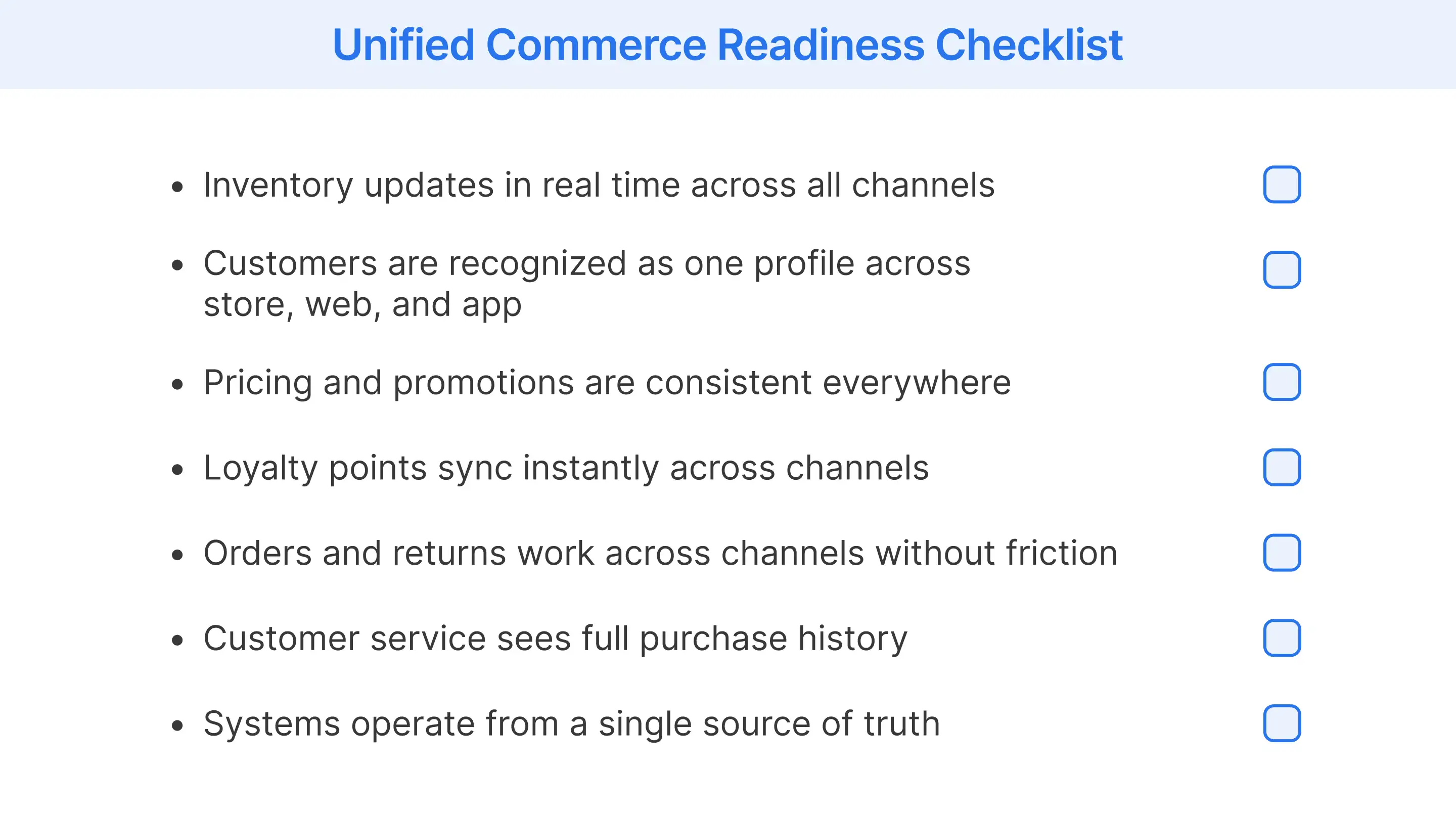
A unified commerce strategy checklist serves as your roadmap for transforming disconnected retail operations into an integrated ecosystem. Unlike traditional retail checklists that focus on individual channels, a unified commerce checklist evaluates how well your systems work together to create one cohesive experience.
This checklist is designed to help retail organizations assess their current capabilities and identify the most impactful areas for improvement. Think of it as a diagnostic tool that reveals both your strengths and your integration gaps across four foundational pillars.
How to Use This Checklist Framework:
Start by reviewing each capability area outlined below. For every question, assess whether you have this capability fully activated, partially implemented, or not yet addressed. This honest evaluation becomes the foundation for your implementation roadmap.
As you work through the items that should be on the unified commerce checklist, prioritize based on these factors:
- Immediate business impact: Which gaps are costing you revenue or customers right now?
- Customer experience value: Which improvements will customers notice and appreciate most?
- Implementation complexity: What can you accomplish quickly versus what requires long-term planning?
- Resource requirements: Where do you have the budget, technology, and team capacity to act?
The four pillars below represent the essential components of unified commerce. Each section contains key capabilities you should evaluate, along with strategic questions to guide your assessment.
1. Operations and Inventory Management
Real-time inventory visibility stands as the foundation of unified commerce operations. When a customer checks product availability online, they need accurate information, not yesterday's stock count or a guess. Leading retailers have reduced stockouts by 35% and increased inventory turnover by 25% simply by synchronizing inventory data across all channels in real-time.
Fulfillment flexibility represents the second critical component. Modern customers expect options: buy online, pick up in-store (BOPIS), ship from store, curbside pickup, or home delivery. Each fulfillment method requires different operational capabilities, but all must draw from the same inventory pool and update availability instantly. Retailers who offer multiple fulfillment options see a 20-40% increase in conversion rates compared to those with single-channel fulfillment.
The returns experience often gets overlooked, yet it's where many unified commerce strategies break down. A customer who purchases online should be able to return in-store without friction. Your systems need to recognize the transaction, process the refund correctly, and update inventory across all channels, all while the customer is standing at the counter.
Key Checklist Items to Evaluate:
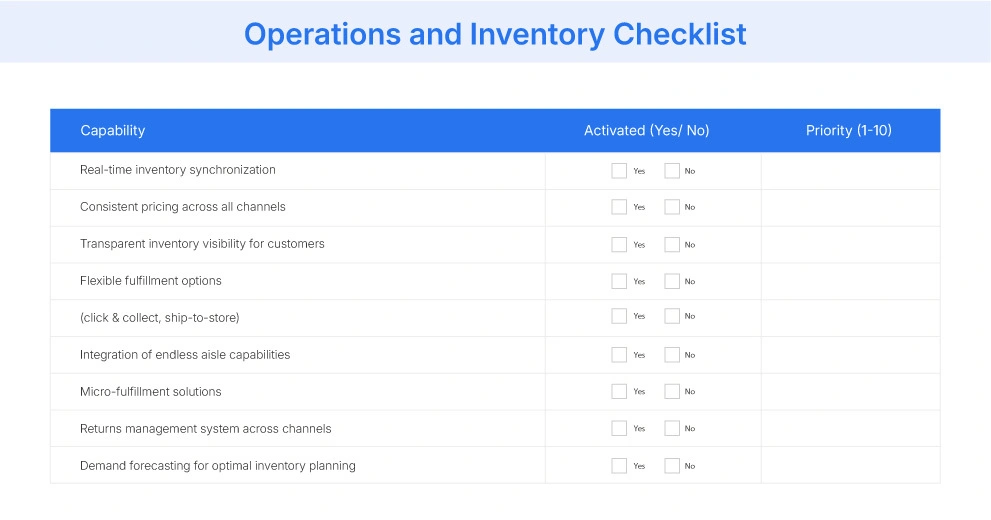
- Real-time inventory synchronization: Are your inventory levels updated instantly across all sales channels (online, mobile, stores, marketplaces)?
- Unified product catalog: Can customers view consistent product information, pricing, and availability regardless of where they shop?
- Flexible fulfillment capabilities: Do you offer BOPIS, ship-from-store, curbside pickup, and same-day delivery options?
- Cross-channel returns processing: Can customers initiate and complete returns through any channel, regardless of purchase origin?
- Demand forecasting integration: Are you leveraging unified data from all channels to predict demand and optimize inventory placement?
- Warehouse management integration: Do your warehouses, stores, and distribution centers operate from a single inventory truth?
2. Customer Experience Integration
A customer who spends $500 in your stores monthly but never shops online appears as a "new customer" when they first visit your website. This is the reality for retailers without unified customer profiles. Every interaction, whether in-store, online, via mobile app, or through customer service, should build on previous engagements, not start from zero.
Personalization at scale becomes possible only when you can track customer behavior across all touchpoints. Retailers with unified customer data report 30% higher customer lifetime value because they can deliver relevant recommendations, timely offers, and seamless experiences that acknowledge customer preferences and history.
Loyalty programs exemplify the power of integration. When customers earn points in-store, see their updated balance on mobile, and redeem rewards online without friction, engagement rates soar. Conversely, loyalty programs that don't sync across channels frustrate customers and leave money on the table.
Key Checklist Items to Evaluate:
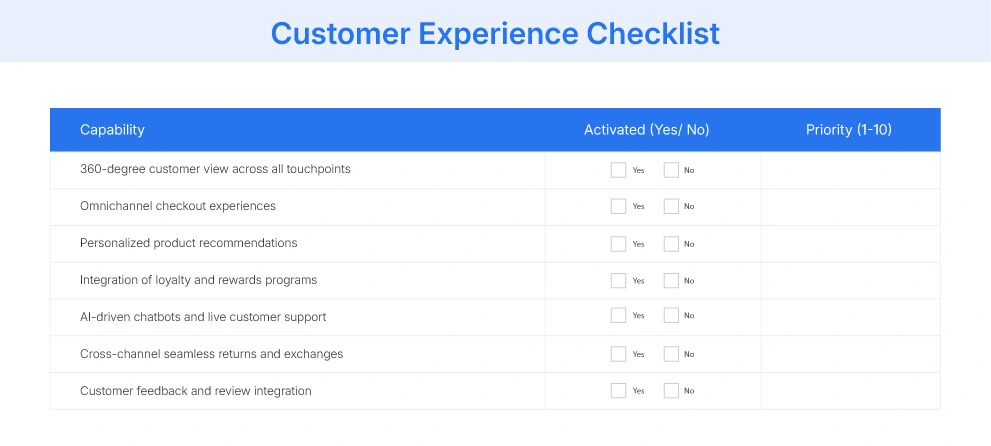
- Unified customer profiles: Do you maintain a single, comprehensive view of each customer across all interaction points?
- Cross-channel loyalty integration: Can customers earn and redeem loyalty rewards seamlessly across all channels?
- Journey continuity: Can customers start their shopping journey on one channel and complete it on another without losing cart contents, preferences, or context?
- Personalized communication: Are you leveraging unified customer data to deliver relevant, timely messages across email, SMS, app notifications, and in-store interactions?
- Feedback integration: Do you have mechanisms to capture customer feedback across all channels and route it to the appropriate teams for action?
- Customer service visibility: Can your support teams access complete customer history regardless of which channels the customer has used?
3. Technology Integration
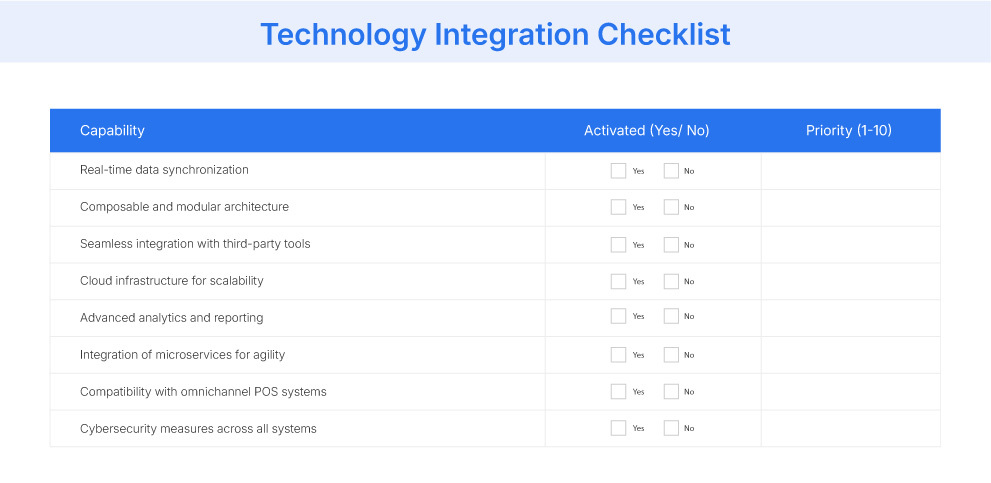
Your technology infrastructure either enables unified commerce or becomes its biggest obstacle. Modern, integrated systems can reduce manual operations by up to 70% while enabling rapid scaling and innovation. The key lies in composable architecture, building with modular components that connect seamlessly rather than monolithic systems that resist change.
API-first architecture has become the standard for unified commerce because it allows different systems to communicate in real-time. Your e-commerce platform, point-of-sale system, warehouse management, CRM, and analytics tools should exchange data automatically, not through nightly batch updates or manual data entry.
Data synchronization speed matters more than most retailers realize. A two-hour delay in updating inventory across channels means customers might place orders for out-of-stock items. A one-day delay in syncing customer data means missing time-sensitive personalization opportunities. True unified commerce requires near-instantaneous data flow.
Key Checklist Items to Evaluate:
- Composable architecture: Is your technology stack built with modular, API-connected components that can be upgraded independently?
- Third-party integration capabilities: How easily can you connect new tools, marketplaces, payment processors, or fulfillment partners?
- Real-time data synchronization: Do your systems update inventory, customer data, and order information in real-time across all channels?
- Analytics and reporting integration: Can you access unified analytics that combine data from all channels into actionable insights?
- Scalability and performance: Can your infrastructure handle traffic spikes, seasonal peaks, and business growth without degradation?
- Security and compliance: Are your integrated systems maintaining data security and regulatory compliance across all touchpoints?
4. Innovation and Scalability
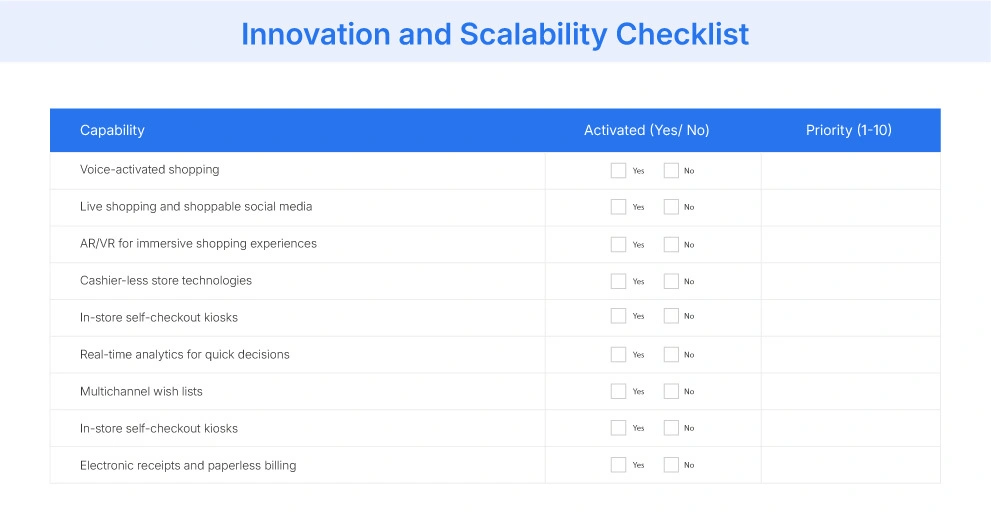
Staying ahead in retail requires continuous experimentation with emerging technologies and the ability to scale successful innovations quickly. Retailers who systematically test new capabilities, from AI-powered recommendations to automated inventory management, create sustainable competitive advantages.
Artificial intelligence and machine learning have moved from experimental to essential in unified commerce. Dynamic pricing algorithms adjust based on demand, competition, and inventory levels. Personalization engines predict what customers want before they search. Chatbots handle routine customer service while escalating complex issues to human agents with full context.
In-store automation represents the next frontier. Smart shelves detect when products need restocking. Computer vision systems track customer movement patterns to optimize store layouts. Mobile point-of-sale devices let associates complete transactions anywhere in the store, eliminating checkout lines.
The ability to test innovations in controlled environments before full rollout minimizes risk. Leading retailers operate innovation labs where they can pilot new technologies with real customers, measure results rigorously, and scale what works across their entire network.
Key Checklist Items to Evaluate:
- AI and machine learning deployment: Are you leveraging AI for personalization, demand forecasting, dynamic pricing, or customer service automation?
- In-store technology integration: Have you implemented smart POS systems, mobile checkout, digital signage, or automated inventory tracking?
- Innovation testing framework: Do you have structured processes for piloting new customer-facing features before network-wide deployment?
- Real-time decision-making infrastructure: Can your systems surface insights and recommendations to team members when they need them?
- Agile deployment capabilities: How quickly can you roll out new features, test variations, and iterate based on customer feedback?
- Cross-functional innovation teams: Do you have teams empowered to experiment with new technologies and business models?
Key Differences Between Omnichannel and Unified Commerce Checklists
Omnichannel focuses on being present and consistent across multiple customer touchpoints, usually by connecting several systems through integrations.
Unified commerce goes a step further by running all channels on a single architecture and shared data layer, allowing experiences, operations, and decisions to flow seamlessly across the entire business.
While the terms are sometimes used interchangeably, omnichannel and unified commerce represent different maturity levels, and their checklists reflect this distinction.
|
Differences Between Omnichannel and Unified Commerce Checklist |
|||
|
Omnichannel Checklists |
Unified Commerce Checklists |
||
|
Channel availability |
Are you present across multiple channels? |
System integration |
Are all channels operating from a single source of truth? |
|
Channel-specific optimization |
Is each channel performing well independently? |
Real-time synchronization: |
Is data updated instantly across all touchpoints? |
|
Customer choice |
Can customers choose how to engage with you? |
Journey continuity |
Can customers move seamlessly between channels mid-journey? |
|
Basic integration |
Do channels share some data, often through batch updates? |
Unified operations |
Do backend systems treat all channels as one ecosystem? |
The Critical Difference: Omnichannel asks: "Are we available everywhere customers shop?" Unified commerce asks: "Do all our channels work together as one coherent system?"
For example, an omnichannel checklist might verify that you have a mobile app, website, and physical stores. A unified commerce checklist verifies that a customer can add items to their cart on mobile, modify the order on desktop, and pick it up in-store, with all systems recognizing it as a single transaction.
How Flipkart Commerce Cloud Solution Meets Unified Commerce Implementation Checklist
Implementing a comprehensive unified commerce strategy requires the right technology foundation. While the capabilities outlined in this checklist can be built through various approaches, the most successful implementations share common characteristics: composability, scalability, and seamless integration.
The checklist framework provided gives you a practical tool for assessing your current capabilities and planning your unified commerce journey. Platforms like Flipkart Commerce Cloud have packaged these capabilities based on 15+ years of e-commerce experience, offering retailers a faster path to implementation with proven, integrated solutions.
Flipkart Commerce Cloud's platform includes five core modules that address the unified commerce checklist requirements:
Composable Storefront enables retailers to create engaging storefronts with composable architecture, delivering personalized experiences through AI-powered engines while managing rich media catalogs and seamless checkout experiences.
Seller Ecosystem provides marketplace sellers with intuitive dashboards for inventory and order management, featuring automated onboarding, real-time performance monitoring, and transparent commission management.
Supply Chain Management integrates order and warehouse management with smart delivery optimization, real-time tracking, and efficient returns management across all fulfillment channels.
Retail Media Platform offers brand partners a self-serve advertising portal for display, contextual, and listing ads, with full-funnel tracking and automated reporting dashboards.
Pricing Software uses intelligent algorithms to optimize pricing based on competitive data, demand elasticity, and market trends, with human oversight to ensure accuracy.
Whether you build, buy, or partner for your unified commerce infrastructure, success starts with a clear assessment of current capabilities and a realistic implementation roadmap.
Download the complete unified commerce implementation checklist to begin your assessment, or schedule a consultation to discuss how these capabilities can be tailored to your specific retail context.

FAQ
A unified commerce strategy is a business strategy that connects all backend systems to a single platform. This unified commerce approach consolidates customer data and inventory management systems into a single source of truth. Flipkart Commerce Cloud enables a seamless customer experience by breaking down the silos found in traditional multichannel commerce.
The checklist for testing an e-commerce site includes verifying order fulfillment, payment processing, and real-time data synchronization across different channels. A robust unified commerce strategy checklist ensures that product information remains accurate on your mobile app and website. Testing these key areas guarantees a consistent customer experience for your e-commerce business.
Unified commerce is not only for enterprise businesses, as retailers of all sizes need greater operational efficiency to compete. Any e-commerce business aiming for business growth should adopt a unified platform to manage customer behavior. Using a unified commerce system helps smaller brands offer a more cohesive experience usually reserved for giants.
Challenges associated with implementing unified commerce often involve integrating legacy systems and managing data points from different systems. Transitioning from an omnichannel strategy to a unified commerce environment requires careful data management to maintain a single customer profile. A successful unified commerce strategy overcomes these hurdles by centralizing all technology platforms.
Retailers need a unified commerce strategy to deliver a seamless shopping experience across both online and physical channels. This strategy allows a store associate to access accurate information and provide better customer service instantly. Flipkart Commerce Cloud helps merchants build customer loyalty by meeting modern customer needs through a unified commerce platform.
The items that should be on a unified commerce data checklist include real-time inventory levels, unified customer profiles, and a single product catalog. You must ensure all data points flow through a single source of truth to maintain accurate information. Flipkart Commerce Cloud helps brands centralize this data for greater operational efficiency.
You should review or update your unified commerce checklist at least quarterly to keep pace with the future of retail. Regular audits ensure your technology platforms continue to meet changing customer needs and business growth goals. This practice helps your e-commerce business maintain a seamless customer experience across all physical and online channels.
More Blogs
See how retailers and brands are winning with FCC
Everything About Price Skimming Strategy Explained
Read More
What is a High-Low Pricing Strategy?
Read More
Ultimate Guide To Dynamic Pricing Strategy In 2026
Read More
Retail Pricing Strategies: Winning with Promotion Pricing in Competitive Markets
Read More
Ad Tags: Enhancing Ad Serving Efficiency in Large-Scale Campaigns
Read More