
The most valuable piece of real estate in your company isn’t a flagship store or a corporate headquarters. It’s the few hundred pixels of the search bar on your website.
This is the precise location where your highest-intent customers show up and tell you, in their own words, exactly what they want to buy.
In our view, most retailers are completely wasting the opportunity.
For years, the industry has treated search as a passive utility. We built digital librarians, systems designed to perform a simple, reactive task: a customer types a keyword, the librarian fetches matching product tags.
This model is a profound strategic error, built on a misunderstanding of the customer's psychological journey. It forces the user to bear the entire cognitive load of the discovery process.
Shoppers Are Jumping Through Hoops
Essentially, the customer, with a complex, real-world mission in mind, must first translate their need into a set of sterile keywords they hope the machine will understand. They must learn the language of your catalog.
And when the machine inevitably fails to understand? The customer is forced to try again, reformulating their query, adding and removing terms in a frustrating game of guess-and-check.
This friction is far more than a minor inconvenience. You’re looking at a direct tax on conversion.
The data shows this model is not just inefficient; it's actively failing. A staggering 42% of shoppers cite "not enough product information" as a key frustration. Prima facie, that looks like a failure of the product page. But really, it’s a failure of the search engine to connect the user’s intent to the right product attributes in the first place. The leakage is immense.
Simultaneously, consumer expectations are being permanently reset by the rise of conversational AI in their daily lives. They can ask a smart device a complex, natural-language question and receive a nuanced answer.
This creates a stark and unforgiving contrast with the rigid, unforgiving nature of traditional site search. The demand for a more intelligent experience is no longer a latent desire; it's an explicit expectation. 76% of shoppers now want AI-powered shopping assistants and 72% want voice-enabled search.
Their patience for contextless machines is running out.
The strategic imperative, then, is to fundamentally re-architect the role of search. We must stop building passive librarians that match keywords and start engineering proactive systems that understand missions.
It’s time to stop answering what a customer types and start resolving why they’re searching.
It’s time to build an Intent Engine.
Human Intent Meets Machine Incompetence
The traditional model of keyword search is pretty much a structural liability actively costing you revenue and eroding customer trust.
For years, the industry accepted a "good enough" approach because the friction it created was seen as a routine cost of doing business.
That era is over.
The model is breaking under the combined weight of expanding catalogs, evolving consumer psychology, and a new standard for intelligent interaction being set outside of retail.
The evidence of this failure isn't buried in server logs; it's visible in your abandonment rates, your return logistics, and your declining customer loyalty.
Your Customers Don’t Speak in Keywords; They Think in Missions
The foundational flaw of keyword search is that it forces the user to do all the work.
It demands that a person with a complex, nuanced mission translate that need into a sterile, two-or-three-word query that the machine can understand. This is an unnatural act that creates immediate cognitive friction.
Customers think in narratives and problems to be solved. They aren't just looking for "shoes"; they are trying to solve for "comfortable shoes for teachers." They aren't searching for a "dress"; they are on a mission to find a "spring wedding guest outfit," a query loaded with unstated context about formality, season, and current trends.
A traditional search engine that sees the word "wedding" and returns everything from wedding gowns to photo albums has fundamentally misunderstood the user's mission and has likely lost the sale.
This translation failure extends across every vertical. For example:
- Home goods: A user’s mission is to find "a lamp that makes my small living room feel bigger." They’re thinking about attributes like scale, light diffusion, and ambient effect. A keyword search forces them to guess at technical terms like "tripod floor lamp" or "uplight," a process of trial and error that most will abandon
- B2B commerce: An engineer isn't just searching for a "valve." Their mission is to find "a replacement valve compatible with the XJ-700 series pump that can ship overnight." A system that only matches the word "valve" is not just unhelpful; it's an operational bottleneck. It fails to recognize that in B2B, attributes like compatibility, spec compliance, and delivery speed are not just filters; they are the entire point of the search
- Fashion: The search "black top" is hopelessly vague. Is the user looking for a "black silk camisole for a night out" or a "black merino wool turtleneck for work"? One is a social mission, the other a professional one. The keyword is identical; the intent is entirely different
The psychology at play is critical. When a search engine fails to understand these missions, it does more than just return poor results. It sends a clear signal to the customer: "We don't get you."
This creates a cognitive dissonance that breaks trust and sends them to a competitor or marketplace whose superior discovery tools make them feel understood.
The Hidden Tax of Irrelevant Results
This failure to understand intent isn't a soft problem with vague consequences. It imposes a direct, measurable, and compounding tax on your entire operation, from top-line revenue to bottom-line profit.
The most immediate cost is cart abandonment, which – according to the Baymard Institute – hovers around an average of ~70%, which “translates to $260 billion worth of lost orders.”
A search engine that cannot understand and prioritize products based on operational realities—like which items are available in a local warehouse for faster shipping—is actively contributing to that abandonment rate.
The "perfect" product is useless to a customer if it can't arrive in time for their child's birthday.
The second-order cost is the ballooning expense of product returns.
The data is damning. A shocking 54% of returns are because the item was of "poor quality or faulty," and 39% are because it "didn't look like the image” (DHL, 2025).
This is not just a product quality or photography issue; it is a discovery failure. An intelligent search engine would understand that for a query like "durable work pants," it should prioritize items with low return rates and high review scores for quality. It would surface user-generated photos in the results to set realistic expectations.
Instead, a keyword-driven search returns a visually appealing but functionally inadequate product, starting a costly reverse logistics process the moment the user clicks "buy."
💡Pro tip: Open your site search analytics. Filter for queries longer than four words with an exit rate above, say, 50%. These are your customers trying, and failing, to explain their mission to your system. Next, look at your top 100 null-result searches. This is the sound of your highest-intent customers finding nothing and leaving. The revenue potential of solving just these queries is often in the millions.
Why "Good Enough" Search Is Failing
For years, many retailers survived with the search functionality embedded in their commerce platform. It was considered a solved problem.
That assumption became obsolete almost overnight. Four factors created a perfect storm that turned mediocre search from a nuisance into a crisis.
- The scale of assortment: The modern e-commerce catalog is a beast. It's not uncommon for retailers to manage tens of millions of SKUs; Flipkart, for instance, lists over 200 million products. At that scale, manual merchandising is impossible and simple keyword search is useless. Without intelligent, AI-driven discovery, your catalog becomes a liability, not an asset—an endless warehouse where customers can't find anything
- The marketplace expectation: Marketplaces have permanently rewired consumer expectations for discovery. These platforms have trained users to expect near-infinite choice coupled with sophisticated filtering and personalization. When a customer leaves a marketplace and visits a standalone brand's site, a basic search experience feels jarringly broken by comparison
- The conversational AI reset: Mainstream adoption of tools like ChatGPT and voice assistants has fundamentally altered what customers perceive as a "smart" digital interaction. They are now accustomed to asking complex, conversational questions and getting nuanced answers. This makes a rigid, keyword-based search feel like a technological step backward
- Retail tech deficit: The most alarming factor is that most retailers are unprepared for this shift. Nearly 89% of retail organizations are not yet in the "managed" or "optimized" stages of AI maturity (IDC, 2025). The industry is still in its infancy, with most businesses just now adopting their first modern, enterprise search solution (Forrester, 2025). There is a massive—and widening—gap between customer expectations and retailer capabilities
The old model of search is not just underperforming; it is a liability in the face of these new realities. It creates customer friction, actively drains profit from your P&L, and is being made obsolete by forces your customers are already embracing.
The only path forward is a complete architectural rethinking of what a search bar is for.
Also Read: The Ecommerce Experience Gap: Where Revenue Hides in Plain Sight
The New Model: Building The Intent Engine
The solution is not to incrementally improve a broken model. It's to fundamentally re-architect your search from a passive "matching database" into a proactive “Intent Engine."
This is a system designed not to answer a query, but to deconstruct and understand the mission behind it. It operates on the principle that the user is always right, and it is the machine's job to do the hard work of translation.
An Intent Engine is a sophisticated, multi-layered system. Each layer solves a specific part of the human-machine communication problem, working in sequence to transform a messy, ambiguous query into a precise, context-aware instruction that delivers exactly what the user was looking for, even when they couldn't perfectly articulate it.
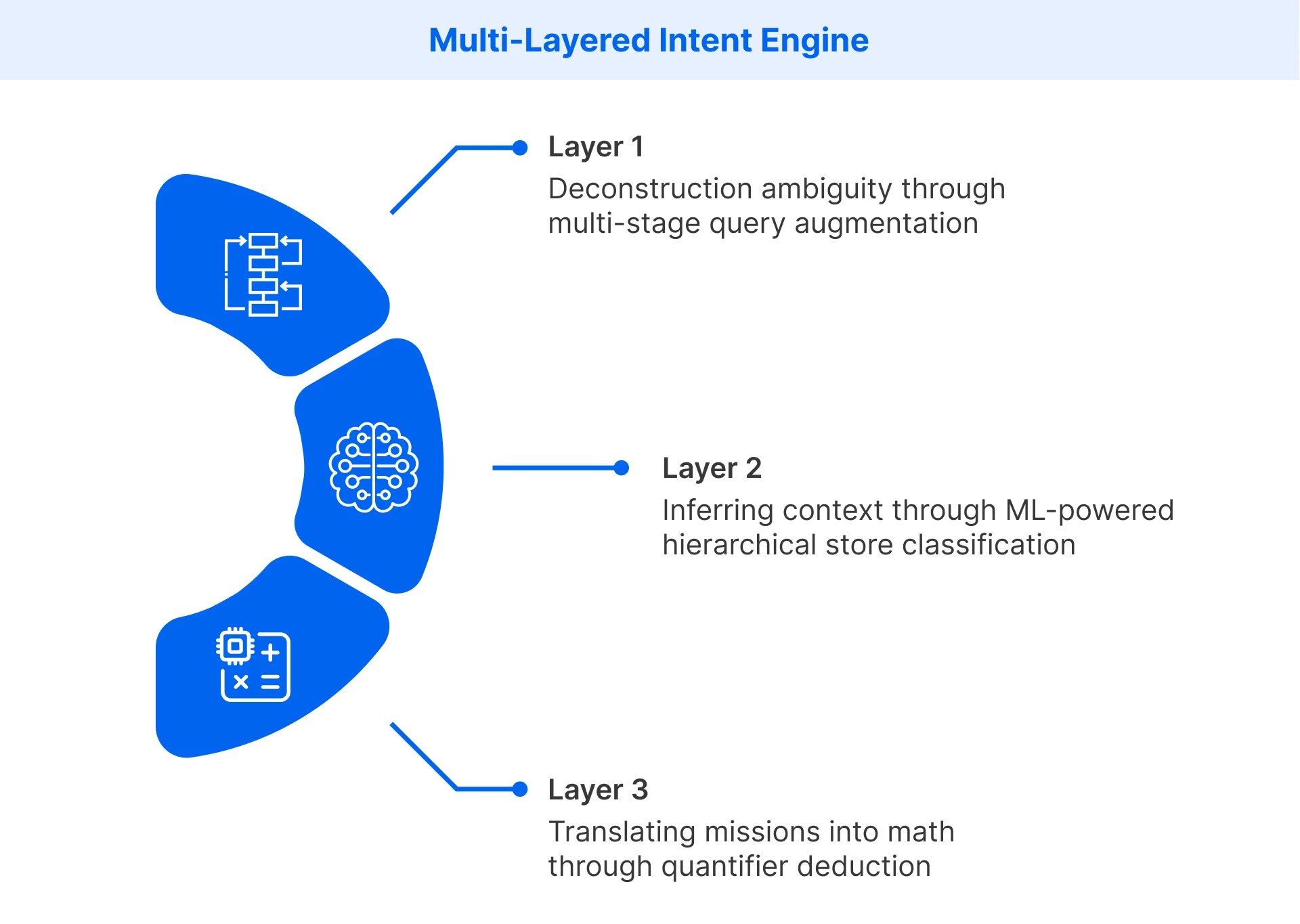
Layer 1: Deconstructing ambiguity
The engine's first and most critical job is to clean up the raw input. It must translate messy, error-prone human language into a precise, machine-readable instruction set, laundering the query before the search ever begins.
This process goes far beyond basic typo correction; it's an act of interpretation.
A modern engine like FCC’s Smart Search uses multi-stage query augmentation to methodically refine user input. It starts by protecting the integrity of the query, maintaining a "Do Not Augment" dictionary of brand names, specific product codes, and industry jargon to prevent incorrect "corrections" like changing "iphone" to "i phone."
This simple step prevents the system from breaking a query before it has a chance to understand it.
From there, it applies advanced, two-phase spell correction. The system first generates multiple correctly spelled variants of the input and then uses a scoring model to select the most probable correction. This allows it to handle not just simple typos, but also ambiguous word breaks ("i phone" vs "iphone") and phonetic misspellings ("shoos" vs "shoes").
For the most complex queries where a user simply doesn't know the official terminology, the engine can use sequence-to-sequence machine learning models to completely reformulate the input. It actively bridges the "articulation gap" by rewriting a phrase like "hair air blower machine" to the correct catalog term, "hair dryer."
The psychological impact is profound
It removes the cognitive burden from the user. They’re no longer required to be a perfect speller or a product expert to be understood. The experience shifts from one of frustrating trial-and-error to one of effortless communication.
Essentially, the system signals to the user: "I'll figure it out for you."
This is the new baseline, and it's why analysts now identify "agentic or conversational product discovery" as a key capability for market-leading solutions (Forrester, 2025).
Layer 2: Inferring context
Once the query is clean, the engine's next job is to figure out where it belongs.
A query is meaningless without context. The engine must act as an expert store associate, instantly placing the user's request in the correct "aisle" of your digital store.
This is achieved through hierarchical store classification (HSC).
Using machine learning classifiers trained on millions of past user journeys, the system maps an incoming query to the most relevant path in your product taxonomy.
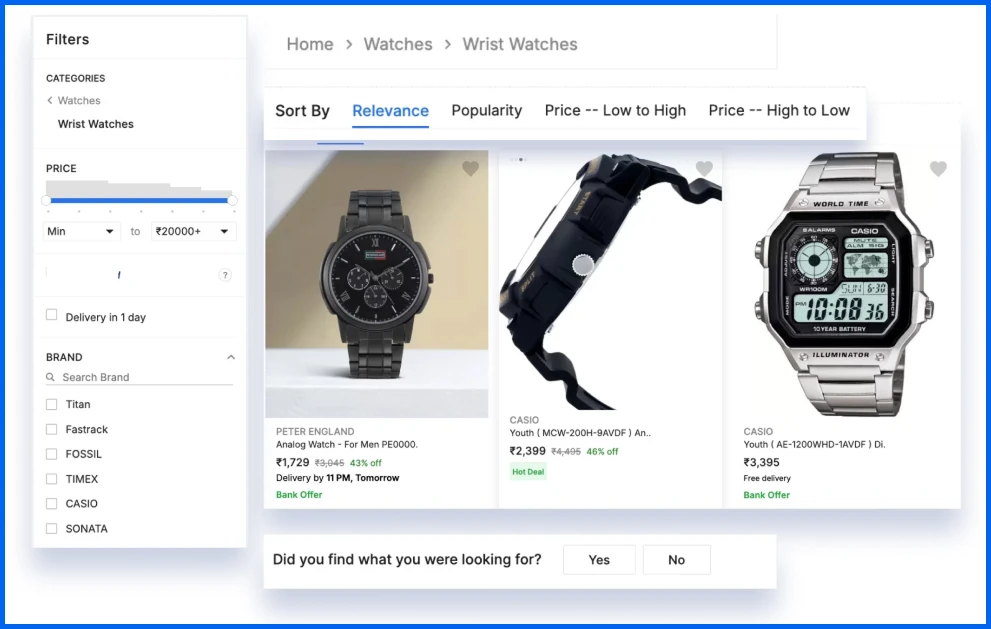
For example, a search for "jordan 1" isn't just a keyword; the engine instantly classifies it into a path like `Lifestyle > Footwear > Men's Casual Shoes.’ This classification is a pivotal step. It determines the entire context of the results page, from the specific, relevant filters that are displayed (size, color, version) to the ranking rules and merchandising experiences that are applied.
Designed for resilience
If the system's confidence in a specific, deep-level classification is low, it intelligently "rolls up" to the most likely parent category.
This is a critical CX-saving mechanism. It prevents the journey-ending experience of a "no results" page. Instead, it presents the user with a broader but still highly relevant set of products, preserving the session and empowering them to continue their discovery journey.
This ability to adapt to new consumer behaviors is not theoretical.
For example, at Myntra, a Flipkart company, the team saw that Gen Z shoppers were moving away from text-based search, preferring a visual "See, Search, Shop" experience. Building a powerful, AI-driven visual search capability that understood the context of an image was a direct response to this shift in user intent, ultimately growing visual search traffic by 35% in a single year. The engine learned to infer context from pixels, not just text.
Layer 3: Translating missions into math
The final layer of a true Intent Engine is the ability to parse the nuances of human language that express constraints, conditions, and missions. It translates a customer's real-world needs into a precise mathematical and logical query.
This requires specialized modules for "Quantifier Deduction." When a user searches for "mobiles under $300 " or "mobiles between $100 and $300," they are providing explicit, non-negotiable instructions.
An advanced engine can parse the entire string to identify the core components:
- The condition ("under," "between")
- The value ("100," "300," "1")
- The unit of measurement ("$")
It ten translates these components into a structured filter that the search index can execute flawlessly.
This is the ultimate form of being understood. The system isn't just finding related items; it's respecting the customer's explicit boundaries and needs.
This builds a deep sense of trust and efficiency, signaling that the platform is a tool that works for them. This capability is the foundation for the future of discovery, which will be "decoupled from the interface" and mediated by AI agents that rely entirely on structured data and precise constraints to function (IDC, 2025).
Also Read: Retail’s Shift From Digital Transformation to AI Transformation
An Intent Engine Requires a Real Foundation
Building an engine this sophisticated is not a simple software update. It is a strategic commitment to a new way of thinking, and it has two non-negotiable prerequisites.
Data readiness
An Intent Engine cannot be built on a foundation of unstructured, messy, or incomplete catalog data. This directly addresses any form of unstructured data “tax.”
You must first solve your data quality problem. The engine needs a clean, well-organized, and deeply attributed product taxonomy to function.
This is why the primary barrier to AI adoption for most retailers is not a lack of ambition, but the need to modernize their core data infrastructure first (IDC, 2025).
Attempting to deploy advanced intent-matching on a poor data foundation will fail. The result is an AI that confidently returns the wrong products, which is an even more frustrating customer experience than a simple "no results" page.
Investment in specialized expertise
These are not OOTB features in a basic commerce platform.
As Forrester notes in their 2024 Commerce Search And Product Discovery Market Insights report, companies ultimately choose their technology partners based on deep solution and industry expertise, not just a checklist of features.
FCC’s Smart Search (the entire Digital Commerce Solution, in fact) was born from over a decade of solving these exact challenges at the immense scale of the Indian market, embedding these hard-won lessons into its core architecture.
💡Pro tip: An Intent Engine is a learning system; it gets smarter with every query. Start by focusing on your highest-volume categories. Analyze your long-tail (4+ word) and null-result searches to identify the biggest "articulation gaps." Use this data to prioritize the training of your query-rewriting and classification models. The goal is a virtuous cycle: better results lead to more user engagement, which generates more training data, which leads to even better results.
The Business Case for Intent
Building an Intent Engine is not an incremental upgrade to a website feature. It is a fundamental shift in business strategy. \
It requires moving the primary success metric for discovery away from tactical outputs like "relevance" and toward a strategic outcome: mission resolution. Did you successfully resolve the customer's unique, contextual, and often poorly articulated mission?
When you do, the benefits cascade far beyond a simple lift in conversion rates. You:
- See a measurable reduction in returns, because the customer bought the right product for their mission, not just a visually similar one
- See an increase in CLTV, because the shopping experience was frictionless and made them feel understood—the very foundation of emotional loyalty
- Transform search from a transactional function into a trust-building engine
This is the foundational work required to compete in a world where discovery is actively being decoupled from the interface.
AI agents and answer engines are becoming the new gatekeepers of commerce, and they operate entirely on the currency of intent (IDC, 2025). A system that cannot understand a complex mission will be invisible to the next generation of search.
Preparing for this future is now all about building a robust, intelligent, and machine-readable foundation today.
And this future isn’t ‘around the corner’ anymore.
The technology powering FCC’s Smart Search was engineered on this principle, forged over a decade of solving these exact challenges at the immense scale of the Indian market.
The lessons from processing billions of queries are clear: intent is the signal, and everything else is noise. The intelligence must be built into the core of the platform.
We see the data pointing away from simple keyword matching and towards deep intent resolution. The critical question for every retail leader today is this:
Is your search engine built to answer what a customer types, or to understand what they truly mean?

FAQ
For an ecommerce application, the best AI site search engines are specialized platforms like Bloomreach or Algolia, as they are built specifically to leverage retail data for deep personalization, visual search, and high-conversion product discovery.
AI-powered ecommerce search is a site search engine that utilizes Artificial Intelligence, including natural language processing (NLP) and machine learning (ML), to understand the customer's true intent and context behind a query, rather than just matching exact keywords. This enables the system to deliver highly relevant, personalized product results in real-time, even when faced with complex, conversational, or imperfect language.
AI is used extensively in ecommerce across the entire customer journey, most pivotally in personalized product recommendations based on behavior and purchase history, and in AI-powered site search to improve discovery. It is also used in commerce operations for demand forecasting and inventory management, real-time fraud detection, dynamic pricing, and generating marketing assets like SEO-friendly product descriptions, which is a capability often integrated into advanced platforms like FCC.
Yes, AI can do web searches by leveraging underlying conventional search engines or proprietary indexes, acting as an intelligent agent that can query the live internet. When you ask a modern AI tool a question, it uses its natural language understanding to refine and rewrite your query, sends it to a search engine like Bing or Google, analyzes the results from multiple sources, and then synthesizes those findings into a single, comprehensive, cited answer.
AI search is better than keyword search because it uses semantic understanding to interpret the meaning and intent of a query, going far beyond a literal match of words. Traditional keyword search only finds products where the exact phrase exists in the product data, while AI search can recognize synonyms, analyze long-tail phrases, and factor in the shopper's past behavior to surface the most relevant product, significantly boosting the search-to-conversion rate.
Large language models (LLMs) enhance site search by giving it advanced natural language understanding capabilities, allowing shoppers to use conversational and complex long-tail queries. They can accurately determine the user's intent, handle the nuances of human language, and can even be used to generate direct, curated product summaries or conversational shopping assistants that guide the user through the product catalog.
Yes, AI search can handle typos, slang, and multilingual queries with high accuracy due to its reliance on machine learning and Natural Language Processing (NLP). It automatically employs typo tolerance to correct common spelling mistakes, uses semantic mapping to understand that a user searching for "joggers" is the same as one searching for "track pants" (slang/synonym resolution), and can translate and process queries across multiple languages to serve a global customer base effectively.
AI search should be extremely fast, with the ideal response time for results loading being under 100 milliseconds. Research has consistently shown that even marginal delays, such as adding a few hundred milliseconds, can significantly decrease user engagement, clicks, and ultimately reduce sales and conversion rates.
To get started with AI-powered ecommerce search, you should begin by evaluating and integrating a specialized third-party AI search and discovery solution that is built for commerce, such as those that integrate seamlessly with platforms like FCC. The process involves ensuring your product data is clean and rich with metadata, implementing the platform's API or plugin, and then configuring the machine learning model to index your catalog and start learning from real-time customer search behavior.
More Blogs
See how retailers and brands are winning with FCC
Everything About Price Skimming Strategy Explained
Read More
What is a High-Low Pricing Strategy?
Read More
Ultimate Guide To Dynamic Pricing Strategy In 2026
Read More
Retail Pricing Strategies: Winning with Promotion Pricing in Competitive Markets
Read More
Ad Tags: Enhancing Ad Serving Efficiency in Large-Scale Campaigns
Read More