
December 2, 2025
What is B2B Commerce?
B2B commerce refers to the exchange of products or services between businesses through digital channels or physical means. It focuses on logic-driven sales strategies rather than emotional impulse buys common in consumer retail.
Drishti, Manager - Digital Marketing

Table of Contents
- What is B2B Commerce?
- Difference between B2B vs B2C Commerce
- Types of B2B Commerce You Need to Know
- Top 5 B2B Commerce Trends in 2026
- B2B Commerce Examples
- How do I choose the right B2B e-commerce platform?
- Develop a Growth Engine with B2B Commerce
What is B2B Commerce?
B2B commerce is defined as the transaction of goods or services between two businesses rather than between a business and an individual consumer. In recent years, this business model has evolved from traditional catalogs to sophisticated digital commerce. This broad category includes transactions between a manufacturer and wholesaler or a wholesaler and a retailer in the supply chain.
The B2B commerce ecosystem involves various specialized players who ensure products move smoothly from production lines to the final retail shelves.
- Wholesalers purchase goods in bulk from manufacturers to sell them to retailers or other professional buyers at a markup.
- Manufacturers produce finished goods from raw materials and sell them to other businesses for resale or internal operational use.
- Distributors act as key intermediaries that hold inventory and manage logistics to supply products to retailers or manufacturers.
B2B commerce often involves complex processes and intricate workflows that require approval from multiple stakeholders. Unlike B2C, where a credit card swipe is instant, B2B often involves negotiated payment terms (like Net 30) and strict adherence to specific customer needs. This commerce model relies heavily on long-term strategic partnerships and negotiated contracts rather than one-off transactional purchases.
Difference between B2B vs B2C Commerce
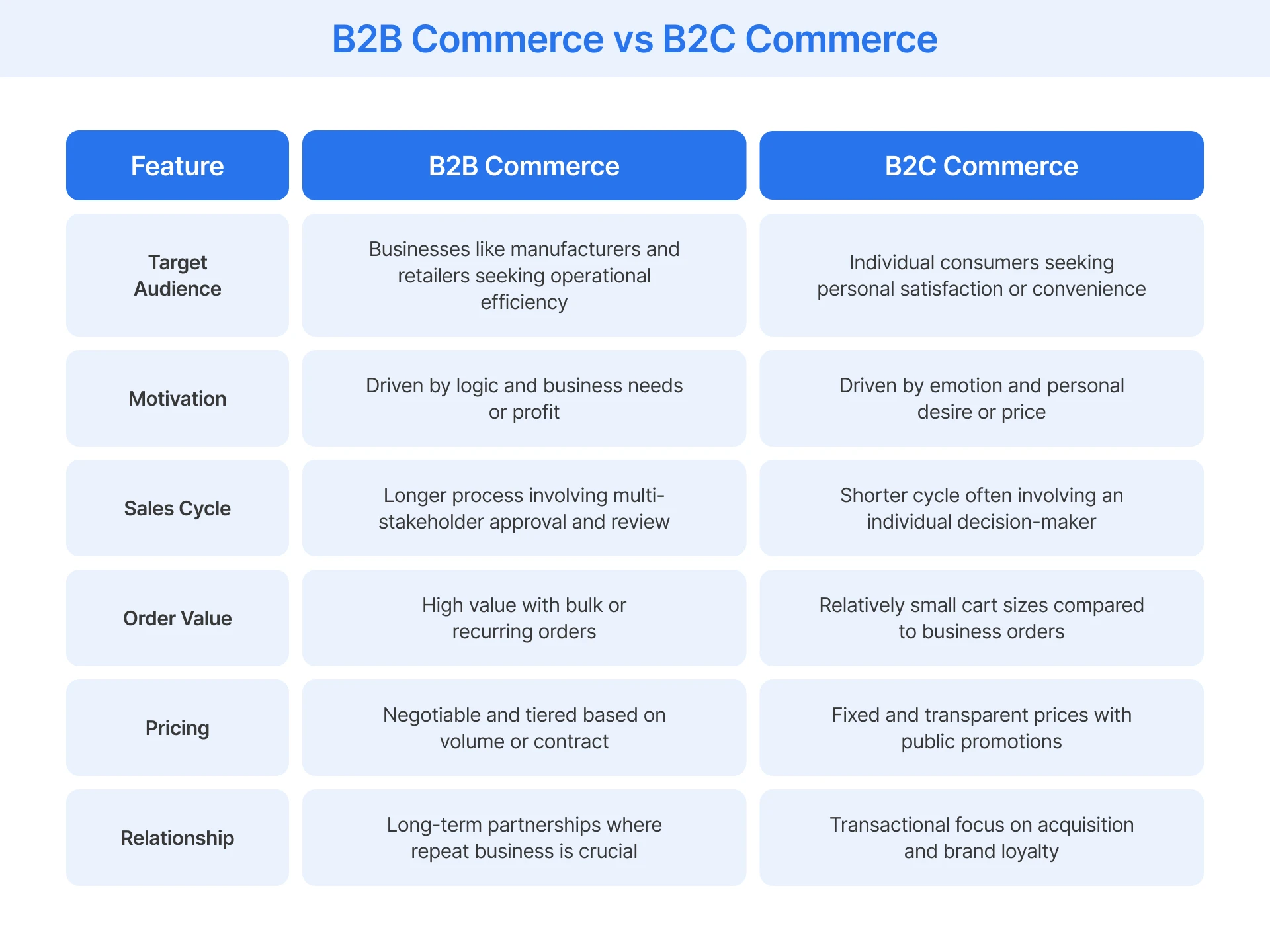
B2B and B2C commerce differ not just in who makes the purchase but in how decisions unfold. Consumer buying often moves fast, while business purchases involve evaluation and budget alignment. Recognizing these differences helps shape the right ecommerce strategy for your business.
While B2C focuses on individual customer satisfaction, B2B focuses on the needs of businesses to improve efficiency. However, the gap is closing; business buyers now expect the same seamless user experience they get on sites like Amazon Business.
3 Types of B2B Commerce You Need to Know
Understanding the specific ecommerce model helps structure your ecommerce website and operations to meet the specific needs of your partners in specific industries.
- Supplier-Centric Commerce: This model involves a single seller providing goods to multiple business buyers through a dedicated digital portal. Manufacturers use this to control their brand awareness and pricing while dealing directly with their vast wholesale network.
- Buyer-Centric Commerce: Large organizations use this model to request quotes from multiple suppliers to secure the best rates. You typically see this in government procurement where buyers dictate the terms to improve conversion rates.
- Intermediary-Centric Commerce: These platforms bring buyers and sellers together in a shared digital marketplace. These ecommerce sites facilitate trade efficiently, allowing new customers to discover products from various distributors.
Top 5 B2B Commerce Trends in 2026
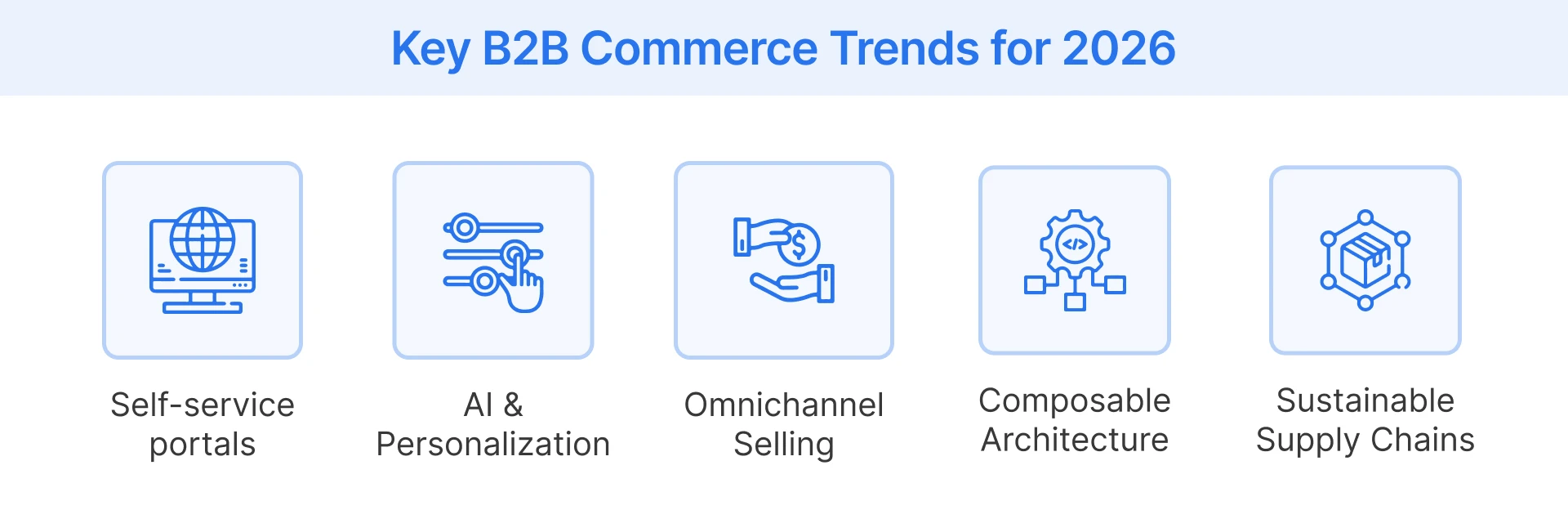
Staying ahead in the dynamic retail ecosystem requires adopting digital tools that streamline operations and enhance the customer experience. Here are the trends shaping the industry:
- Self-service portals: Modern buyers have high customer expectations. They prefer managing orders independently without needing to contact customer service for every small task. You should provide dashboards that allow clients to reorder products at their own convenience.
- AI & Personalization: Data analytics helps you analyze purchasing history to recommend products and predict inventory needs. This technology allows you to offer tailored catalogs and custom pricing, improving customer behavior analysis.
- Omnichannel Selling: Business buyers expect a seamless experience across new channels. You must ensure that product data remains consistent whether they interact with you via social media platforms, your website, or a mobile app.
- Composable Architecture: Businesses are moving toward headless commerce. This modular setup allows you to swap features as needed. It helps you adapt to market changes quickly without overhauling your entire technology stack.
- Sustainable Supply Chains: Corporate buyers prioritize suppliers who demonstrate environmental responsibility. Sharing your sustainability metrics can function as powerful content marketing, differentiating you from competitors.
B2B Ecommerce Examples
Here are some case studies showing how different industries use digital platforms to streamline operations and scale online sales.
Wholesale Electronics Distributor
A large electronics distributor utilizes a digital portal to support corporate IT teams. The platform displays real-time inventory and payment options so buyers can plan procurement. Companies place bulk orders for laptops and servers, relying on accurate data to meet their operational specific needs.
Automotive Parts Manufacturer
An automotive parts manufacturer operates an online system that helps repair shops source components. The portal features detailed diagrams to ensure mechanics avoid mismatches. This digital transformation eliminates the need for phone calls, allowing the sales team to focus on high-value accounts rather than order entry.. This digital approach eliminates the need for phone calls, physical catalog books, faxes, or slow offline channels.
Medical Supplies Provider
A medical supplies provider runs a secure marketplace supporting hospitals, clinics, labs, and diagnostic centers with essential equipment. Buyers access certifications, usage guidelines, expiration dates, and replenishment recommendations directly on the platform for compliant decision-making. The system integrates with hospital inventory logs to prevent shortages. It triggers timely restocks of surgical instruments, protective gear, testing kits, and sanitation supplies to ensure availability.
How do I choose the right B2B e-commerce platform?
Selecting the right technology foundation is crucial for scaling your B2B ecommerce operations and effectively meeting complex customer demands.
- Assess Business Needs: Evaluate your specific requirements regarding catalog size and the complexity of your pricing structures and rules. Identify the essential features needed to support your unique workflows and integration points with existing internal systems.
- Check Integration Capabilities: Ensure the platform integrates seamlessly with your ERP and CRM systems to synchronize data and reduce manual errors automatically. This connectivity prevents data silos and ensures accurate inventory levels across all your sales channels and locations.
- Evaluate Scalability: Choose a solution that can handle increased traffic as you move from a growth stage to an expansion stage. You need a robust architecture that supports market reach into new regions.
- Review Security Features: Prioritize platforms that offer enterprise-grade security to protect sensitive customer data and financial transactions from potential cyber threats. You must ensure compliance with industry standards to maintain trust and prevent costly data breaches or leaks.
- Analyze Total Cost: Consider the initial implementation fees and ongoing maintenance costs associated with the platform ownership and third-party plugins. You should calculate the long-term return on investment to ensure the solution fits within your financial budget limits.
Develop a Growth Engine with B2B Commerce
B2B commerce transforms how organizations trade by replacing manual processes with efficient digital workflows and intelligent automation. It enables you to scale operations rapidly while reducing errors associated with traditional paper-based ordering methods and manual entry.
To truly grow, you need to align your marketing strategies with your sales goals. This includes using Search Engine Optimization (SEO) to attract potential customers, leveraging social media for lead generation, and utilizing email marketing to nurture your email list.
Managing complex price lists and large catalogs requires a robust technological partner to navigate these challenges effectively. At Flipkart Commerce Cloud (FCC), we understand the intricacies involved in modernizing your wholesale and distribution channels for the digital age.
We offer a comprehensive suite of enterprise solutions to streamline your entire B2B sales cycle. Our platform provides an advanced Order Management System that allows you to handle bulk transactions with absolute precision.
We empower your business with data-driven insights to optimize inventory management and enhance buyer relationships through personalization. Our technology ensures you stay competitive by delivering the seamless experiences that modern business buyers demand from their suppliers.
FAQ
B2B, or business-to-business commerce, refers to transactions where one business sells goods or services directly to another business. Real-world examples include a manufacturer selling bulk electronics to a distributor, a wholesaler supplying medical equipment to hospitals, and a software company licensing enterprise tools to corporate clients across multiple departments.
The key benefits of B2B ecommerce include streamlined order management, reduced manual errors, and faster transaction cycles. Businesses gain real-time inventory visibility, automated pricing, and self-service portals that improve buyer satisfaction. With solutions like Flipkart Commerce Cloud, businesses manage complex catalogs, scale operations efficiently, and deliver the personalized buying experiences that modern buyers expect from their suppliers.
The rule of 7 in B2B marketing states that a potential buyer must encounter your brand at least seven times before making a purchasing decision. This principle drives multi-channel strategies, including email campaigns, SEO content, and social media outreach. Consistent visibility builds trust and keeps your business top of mind during extended B2B sales cycles.
B2B ecommerce works by enabling businesses to buy and sell products through digital platforms rather than traditional offline channels. Buyers log into dedicated portals, browse catalogs with account-specific pricing, place bulk orders, and manage invoices online. The platform integrates with ERP and CRM systems to automate order processing and synchronize data across all sales operations.
Starting a B2B ecommerce business requires identifying your target buyers, structuring your product catalog, and choosing a platform that supports bulk ordering and complex pricing. Integrate your ERP and CRM systems, build a self-service portal, and launch a digital marketing strategy. Flipkart Commerce Cloud provides the enterprise infrastructure needed to launch and scale B2B operations efficiently.
Must-have features in a B2B ecommerce platform include account-specific pricing, bulk order management, self-service portals, and seamless ERP integration. Support for tiered pricing, real-time inventory visibility, quote generation, and multi-user account access is equally critical. Strong security features like multi-factor authentication and role-based permissions protect sensitive data across your entire buyer network.
Manufacturers and wholesalers rely on these systems to manage large catalogs and diverse client bases effectively. Distributors also use these platforms to streamline logistics and order fulfillment for their retail partners. Software companies use it to sell enterprise licenses directly to other organizations.
Yes, modern platforms support tiered pricing structures based on customer groups or specifically negotiated contracts. You can configure specific discounts for bulk purchases or loyal clients without manual intervention. This automation ensures accuracy during the complex checkout and quoting process.
You should implement multi-factor authentication and SSL encryption to safeguard all sensitive user data and payments. Regular security audits and compliance with data protection regulations help maintain a secure environment. This builds trust and protects your business from potential liabilities.