
April 7, 2025
What is the Customer Satisfaction Index?
The Customer Satisfaction Index (CSI) is a metric that quantifies customer contentment with a company’s offerings. It provides businesses with valuable insights into customer perceptions, helping them identify areas for improvement and track satisfaction trends over time.
Drishti, Manager - Digital Marketing

Table of Contents
- What is the Customer Satisfaction Index?
- Components of Customer Satisfaction Index
- Customer Satisfaction Index vs. Other Customer Experience Metrics
- How to Calculate Customer Satisfaction Index
- Benefits of Measuring Customer Satisfaction Index
- Challenges in Implementing Customer Satisfaction Index
- Conclusion
What is the Customer Satisfaction Index?
The Customer Satisfaction Index (CSI) is a widely adopted metric used by businesses to evaluate customer satisfaction levels. It measures how well an individual company's products, services, or overall user experience meet or exceeds customer expectations. By converting qualitative customer feedback into a numerical score, CSI provides an objective assessment of customer sentiment.
Originating from customer experience management practices, the CSI offers valuable insights into consumer preferences and identifies areas for improvement across different touchpoints, such as customer service and online social media interactions. This metric plays a crucial role in shaping business strategies, enhancing service quality, and boosting customer retention. Companies across industries leverage the CSI to benchmark performance against competitors and industry standards.
Components of Customer Satisfaction Index
The Customer Satisfaction Index (CSI) for the retail industry encompasses five key elements:
- Customer Expectations: This element evaluates how well a company meets customer expectations regarding product quality, service standards, and overall experience. It reflects the alignment between initial customer hopes and actual service delivery.
- Perceived Quality: This component measures how customers perceive the quality of a product or service based on their direct experience. It includes aspects like performance, durability, and the overall value received.
- Perceived Value: This factor reflects whether customers believe the product or service justifies its cost. It considers both monetary investment and the overall experience, including factors such as product development initiatives and pricing strategies that drive consumer spending.
- Customer Complaints: This component tracks the volume and nature of complaints, highlighting areas that need improvement. Frequent complaints can indicate gaps in service delivery or product performance.
- Overall Satisfaction: This is a comprehensive measure of customer sentiment after engaging with a brand. It considers both positive experiences and potential areas for improvement, reflecting overall satisfaction levels.
Customer Satisfaction Index vs. Other Customer Experience Metrics
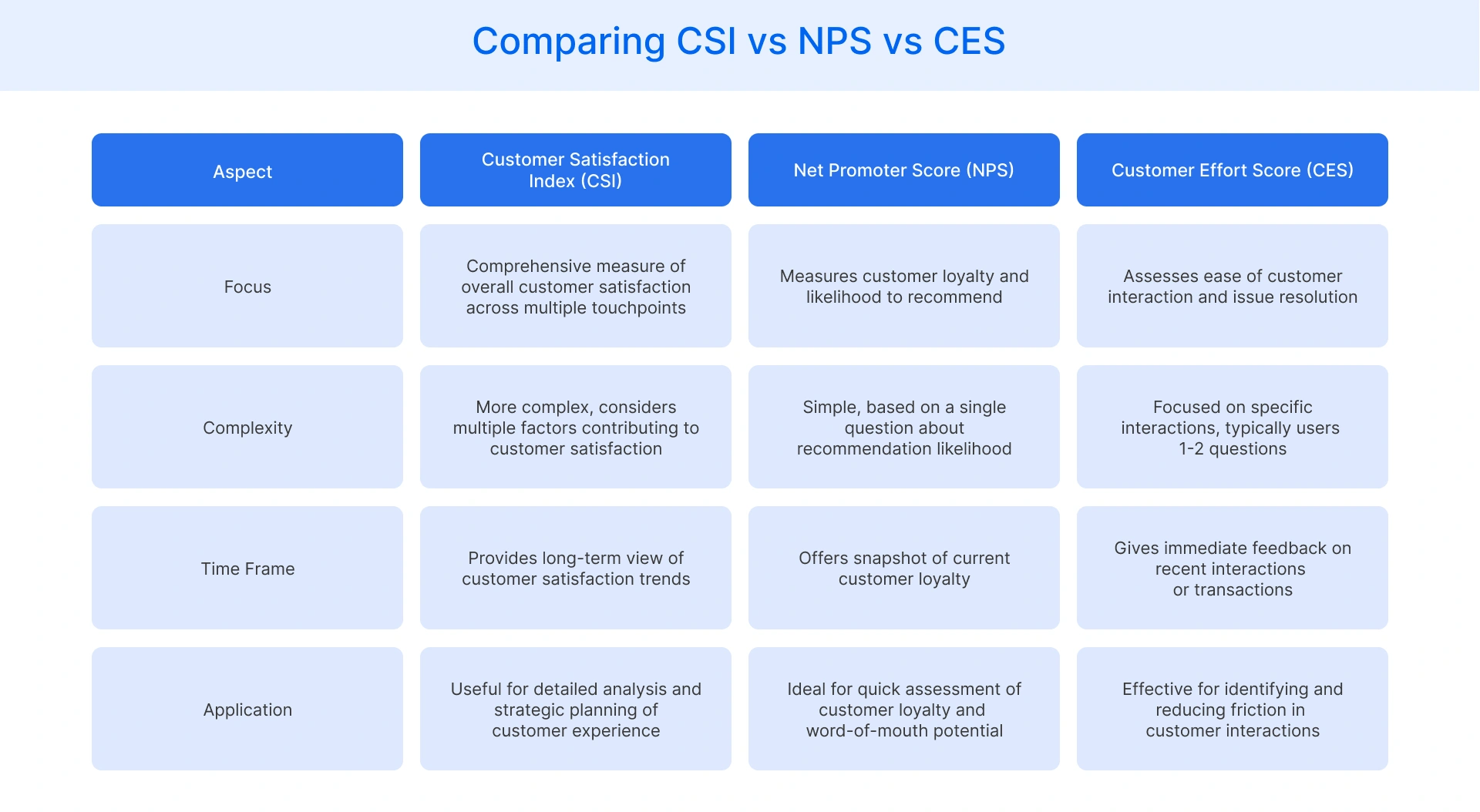
Customer Satisfaction Index (CSI), Net Promoter Score (NPS), and Customer Effort Score (CES) are key metrics for understanding customer experience, but they serve distinct purposes.
- Customer Satisfaction Index (CSI): CSI measures overall customer satisfaction based on various factors such as expectations, perceived quality, and perceived value. It offers a comprehensive view of how well your business meets customer needs.
- Net Promoter Score (NPS): NPS assesses customer loyalty by asking a single question about the likelihood of recommending your products or services to others. It focuses on identifying promoters, passives, and detractors.
- Customer Effort Score (CES): CES evaluates the ease of customer interactions by asking how much effort was required to resolve an issue or complete a task. It highlights areas where reducing customer effort can enhance satisfaction.
What is the Customer Satisfaction Index Calculation?
Calculating the CSI is a systematic process that helps quantify and analyze customer contentment with a retail business. Here are the steps to calculate this metric:
Design and Conduct Customer Surveys
Start by creating targeted surveys that address key aspects of the customer experience. Focus on product quality, service interactions, and overall satisfaction. Keep questions clear and concise, using a mix of rating scales and open-ended questions to capture both quantitative and qualitative data.
Collect and Aggregate Data
Distribute your surveys across various channels to reach a diverse customer base. Aim for a statistically significant sample size to ensure reliable results. Use digital tools to streamline data collection and automatically compile responses into a centralized database for analysis.
Assign Numerical Values
Transform qualitative responses into quantitative CSI data by assigning numerical values to each answer option. For instance, on a five-point scale, ‘Very Satisfied’ might equate to 5, while ‘Very Dissatisfied’ corresponds to 1. This step enables mathematical analysis of the survey results.
Calculate the Average Score
Sum up all individual scores for each question or category. Divide this total by the number of respondents to obtain the average satisfaction score. This calculation provides an initial indication of your customers' overall satisfaction levels across different aspects of their experience.
Normalize the Results
Convert your average scores into a standardized index value to facilitate easy interpretation and comparison. Typically, this involves scaling the results to a 0-100 range. Use a consistent formula across all calculations to ensure accuracy and comparability over time and across different departments or stores.
Benefits of Measuring Customer Satisfaction Index Score
Measuring the CSI offers numerous advantages for retailers seeking to enhance their customer experience and business performance.
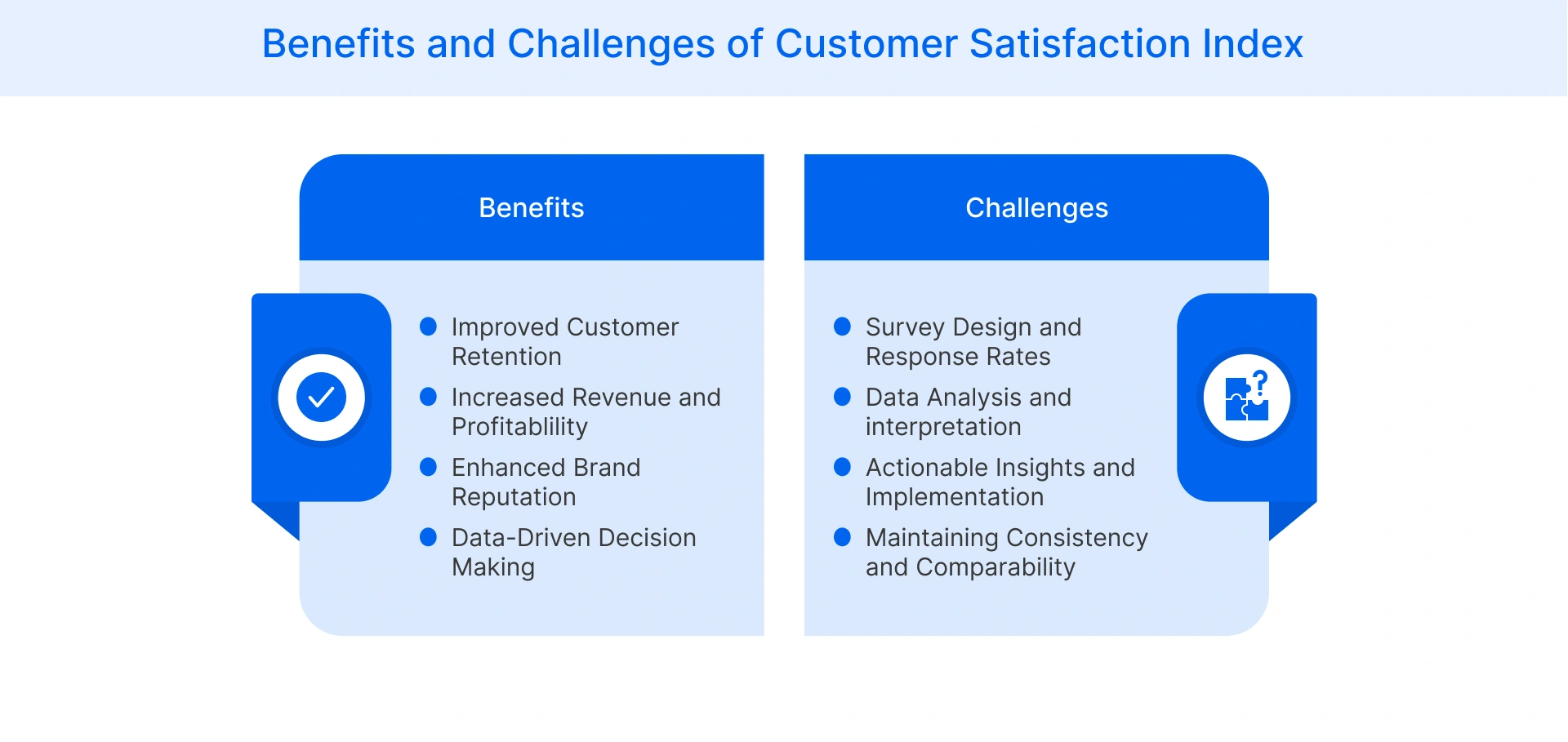
- Improved Customer Retention: By regularly tracking your CSI, you can identify pain points in the customer journey and address them promptly. This proactive approach helps build stronger relationships with your customers, increasing their loyalty to your brand. As you consistently meet or exceed customer expectations, you will see a significant reduction in churn rates.
- Increased Revenue and Profitability: A high CSI often correlates with increased customer spending and purchase frequency. Satisfied customers tend to be less price-sensitive and are more likely to explore your product range, leading to higher average transaction values.
- Enhanced Brand Reputation: As your CSI improves, so does your brand's reputation in the market. Satisfied customers become brand advocates, sharing positive experiences with their networks. This word-of-mouth marketing can significantly boost your brand's credibility.
- Data-Driven Decision Making: The CSI provides valuable insights that can guide your strategic decisions. By analyzing trends and patterns in customer satisfaction, you can prioritize investments in areas that matter most to your customers.
Challenges in Implementing Customer Satisfaction Index
While the CSI is a powerful tool, its implementation can present several challenges for retailers.
- Survey Design and Response Rates: Creating effective surveys that capture accurate customer sentiment can be challenging. You need to strike a balance between gathering comprehensive data and keeping surveys concise to encourage participation. Low response rates can skew results, potentially leading to biased insights.
- Data Analysis and Interpretation: Collecting data is only half the battle; interpreting it correctly is crucial. Without proper analysis, you might miss important trends or draw incorrect conclusions. Invest in training for your team or consider partnering with data analytics experts to extract meaningful insights.
- Actionable Insights and Implementation: Translating CSI results into concrete actions can be difficult. You might identify areas for improvement but struggle to implement effective changes. Develop a systematic approach and create cross-functional teams to prioritize and address issues highlighted by your CSI.
- Maintaining Consistency and Comparability: As your business evolves, maintaining consistency in CSI measurements can be challenging. Changes in survey questions or methodology can affect comparability over time. Establish a standardized process and carefully manage any necessary changes to ensure long-term trend analysis remains insightful.
Conclusion
The Customer Satisfaction Index (CSI) is an essential metric for measuring and understanding customer satisfaction. By tracking CSI, businesses can improve their customer satisfaction scores, increase revenue, and enhance brand reputation. Despite challenges in its implementation, the benefits of CSI make it a crucial tool for maintaining and improving customer relationships. Utilizing the right tools and strategies, such as those offered by Flipkart Commerce Cloud, can significantly aid in effectively monitoring and analyzing CSI.

FAQ
Pricing strategy significantly influences the Customer Satisfaction Index (CSI) through its impact on perceived value. When customers feel they are receiving good value for their money, satisfaction scores are positively affected. Conversely, if prices are perceived as too high relative to quality or competitor offerings, it can negatively impact CSI and overall customer contentment.
Yes, the Customer Satisfaction Index can predict customer loyalty. Studies show that higher CSI scores correlate with stronger retention, repeat purchases, and positive referrals. While CSI alone does not guarantee loyalty, consistently tracking your customer satisfaction index score over time reveals behavioral patterns that signal whether customers are likely to stay or churn.
The Customer Satisfaction Index (CSI) measures overall satisfaction across multiple touchpoints, while Net Promoter Score (NPS) focuses on customer loyalty through one question: likelihood of recommending the brand. CSI offers comprehensive insights, whereas NPS provides a quick snapshot of customer sentiment.
A good customer satisfaction index score typically falls between 75 and 85 on a 0-100 scale, with scores above 80 considered strong. Businesses should benchmark their CSI against industry averages, since acceptable ranges vary by sector. Consistently tracking results helps identify performance gaps and drive targeted, continuous improvement efforts.
The 3 C's of customer satisfaction are Consistency, Communication, and Care. Consistency means delivering reliable quality at every touchpoint. Communication involves resolving concerns clearly and promptly. Care means genuinely understanding and addressing customer needs. Businesses that apply all three consistently tend to maintain higher customer satisfaction index scores over time.
CSI and CSAT differ in scope. The Customer Satisfaction Index evaluates satisfaction across multiple touchpoints using weighted factors like perceived quality, value, and expectations. CSAT measures satisfaction with a single interaction using one direct rating question. CSI provides a broader, strategic view, while CSAT captures immediate, transaction-level feedback.
You measure CSI by designing targeted surveys, collecting responses across multiple channels, and assigning numerical values to each answer. Scores are then averaged and normalized to a 0-100 scale. Tools like Flipkart Commerce Cloud help standardize the customer satisfaction index calculation, making it easier to track performance trends accurately over time.
To mitigate CSI limitations, keep surveys concise and distribute them across multiple channels to improve response rates. Standardize your customer satisfaction index calculation to ensure consistency over time. Train teams to interpret data accurately and develop cross-functional action plans that translate findings into targeted service improvements rather than overlooked insights.