
September 24, 2025
What is Headless Commerce?
Headless commerce is an ecommerce architecture that separates the front-end presentation layer from the back-end functionality. This approach allows retailers to deliver flexible, customized digital shopping experiences across multiple channels and devices.
Drishti, Manager - Digital Marketing

Table of Contents
- What is Headless Commerce?
- How Does Headless Commerce Work?
- How is Headless Commerce Different from Traditional Commerce?
- Headless vs Composable vs Monolithic
- What are the Common Use Cases of Headless Commerce?
- How Does Headless Commerce Enhance the Customer Experience?
- What are the Key Steps to Implement a Headless Commerce Solution?
- What are the Benefits of Headless Commerce?
- What are the Challenges of Headless Commerce?
- How Much Does Headless Commerce Cost?
- Conclusion
Headless commerce is a modern e-commerce architecture that decouples the customer-facing front-end from the back-end commerce functionality. This separation allows retailers to deliver customized storefronts across multiple channels without altering the stability of their backend systems.
In a modern retail environment, where customer journeys span websites, mobile apps, marketplaces, and connected devices, headless commerce has become an important enabler. By using an API layer to connect both, retailers gain agility, accelerate innovation, and provide a consistent customer experience across touchpoints.
Here are the key features of headless ecommerce platforms:
- Uses APIs to integrate product data, payment processing, order management, and third-party services seamlessly across multiple touchpoints and devices.
- Supports omnichannel strategies by delivering greater control over product, pricing, and inventory management across web stores, mobile applications, kiosks, and emerging IoT platforms.
- Enables faster adaptation to changing consumer behaviours, seasonal trends, and market demands by decoupling system updates from ecommerce websites and apps.
- Provides flexibility for developers and marketers to experiment with new technologies, frameworks, and interfaces without re-engineering the core commerce engine.
How Does Headless Commerce Work?
The core principle of a headless commerce architecture is the complete separation of concerns. The back-end acts as a central repository, managing product catalogues, pricing rules, customer data, and order processing. Unlike traditional systems, it does not rely on a fixed front-end template; instead, it exposes all functionality through robust APIs, enabling development teams to create custom ecommerce experiences.
These APIs allow front-end teams to build customized interfaces using technologies such as React, Vue.js, or Angular. The presentation layer communicates exclusively with the back-end via API calls to retrieve product details, manage shopping carts, and process payments. This stateless interaction streamlines data exchange, enabling faster performance and smoother customer journeys.
By adopting this API-first model, businesses can power multiple front-ends, websites, mobile apps, kiosks, or smart devices, using the same data. This ensures consistency, simplifies omnichannel operations, and enables each touchpoint to deliver an optimized, context-specific user experience.
How is Headless Commerce Different from Traditional Commerce?
Unlike the integrated, all-in-one structure of traditional ecommerce platforms, the headless commerce approach follows a decoupled architecture. This gives you significantly more freedom to customize the customer journey and innovate on the front-end without the constraints of a rigid, template-based system that combines both layers.
Here is a comparative analysis:
|
Feature |
Headless Commerce |
Traditional Commerce |
|
Architecture |
Decoupled front-end and back-end layers. |
Tightly coupled, monolithic platform. |
|
Flexibility |
High creative freedom for custom experiences. |
Limited by pre-built themes and templates. |
|
Customization |
Unlimited ability to design unique user interfaces. |
Customizations are complex and can be risky. |
|
Time-to-Market |
Faster front-end updates and new channel rollouts. |
Slower development cycles for new features. |
How Does Headless vs Composable vs Monolithic Commerce Compare?
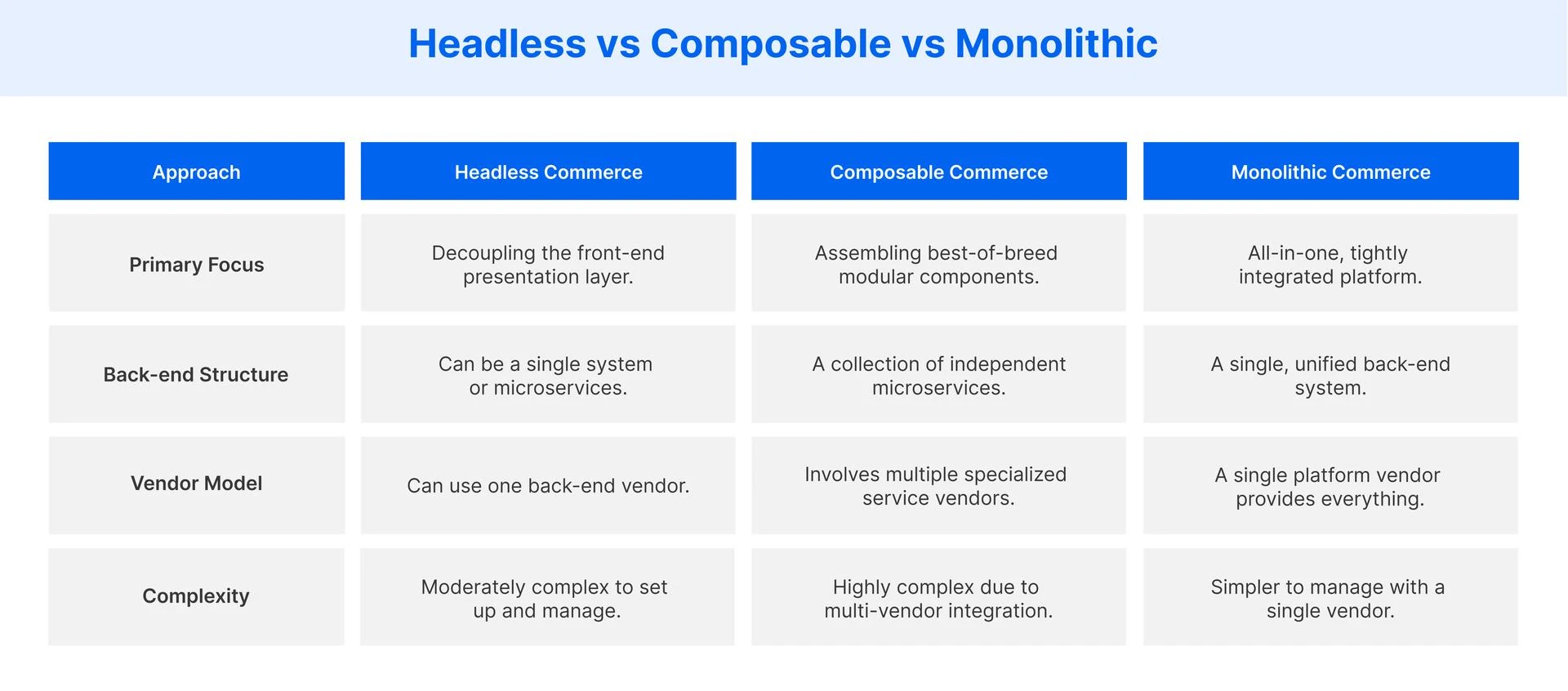
While a headless platform focuses on decoupling the presentation layer, it differs from both monolithic and composable architectures. Monolithic systems are all-in-one platforms, whereas composable commerce takes the headless concept further by breaking down back-end functions into individual, interchangeable services from various vendors.
What are the Common Use Cases of Headless Commerce?
Adopting a headless commerce architecture is ideal for retail businesses aiming to deliver unique and sophisticated shopping experiences.
- Omnichannel Retail: You can power diverse touchpoints, from your website and mobile app to in-store kiosks and social media, from a single back end. This ensures consistent product data and a unified customer profile across all channels.
- Content-Driven Commerce: Brands that rely heavily on storytelling, blogs, or editorial content can seamlessly integrate transactional capabilities. This allows you to add "buy" buttons directly into rich media content without disrupting the user experience.
- Mobile-First Shopping Experiences: You can build highly optimized Progressive Web Apps (PWAs) or native mobile apps that offer superior performance and functionality compared to responsive websites. This directly caters to the growing number of mobile shoppers.
- International Expansion: Launching new storefronts for different regions or languages becomes much simpler. You can create unique, localized front-end experiences for each market while managing all operations from one centralized back-end commerce platform.
How Does Headless Commerce Enhance the Customer Experience?
A headless approach directly translates into a superior and more engaging journey for your customers. Here is how it elevates their experience:
- Blazing-Fast Performance: Since the front-end is decoupled, you can use modern frameworks that render pages faster, leading to quicker load times, improved engagement, and higher conversion rates.
- Seamless Omnichannel Consistency: Customers receive a consistent brand experience whether they shop on your website, mobile app, or an in-store device, as all channels pull from the same back-end data.
- Rich, Personalized Journeys: You gain the flexibility to A/B test and personalize every element of the user interface, tailoring content, promotions, and recommendations to individual customer preferences.
- Uninterrupted User Flow: By integrating commerce into content-rich platforms, you allow customers to make purchases at the point of discovery without being redirected to a separate product page, creating a frictionless path to purchase.
What are the Key Steps to Implement a Headless Commerce Solution?
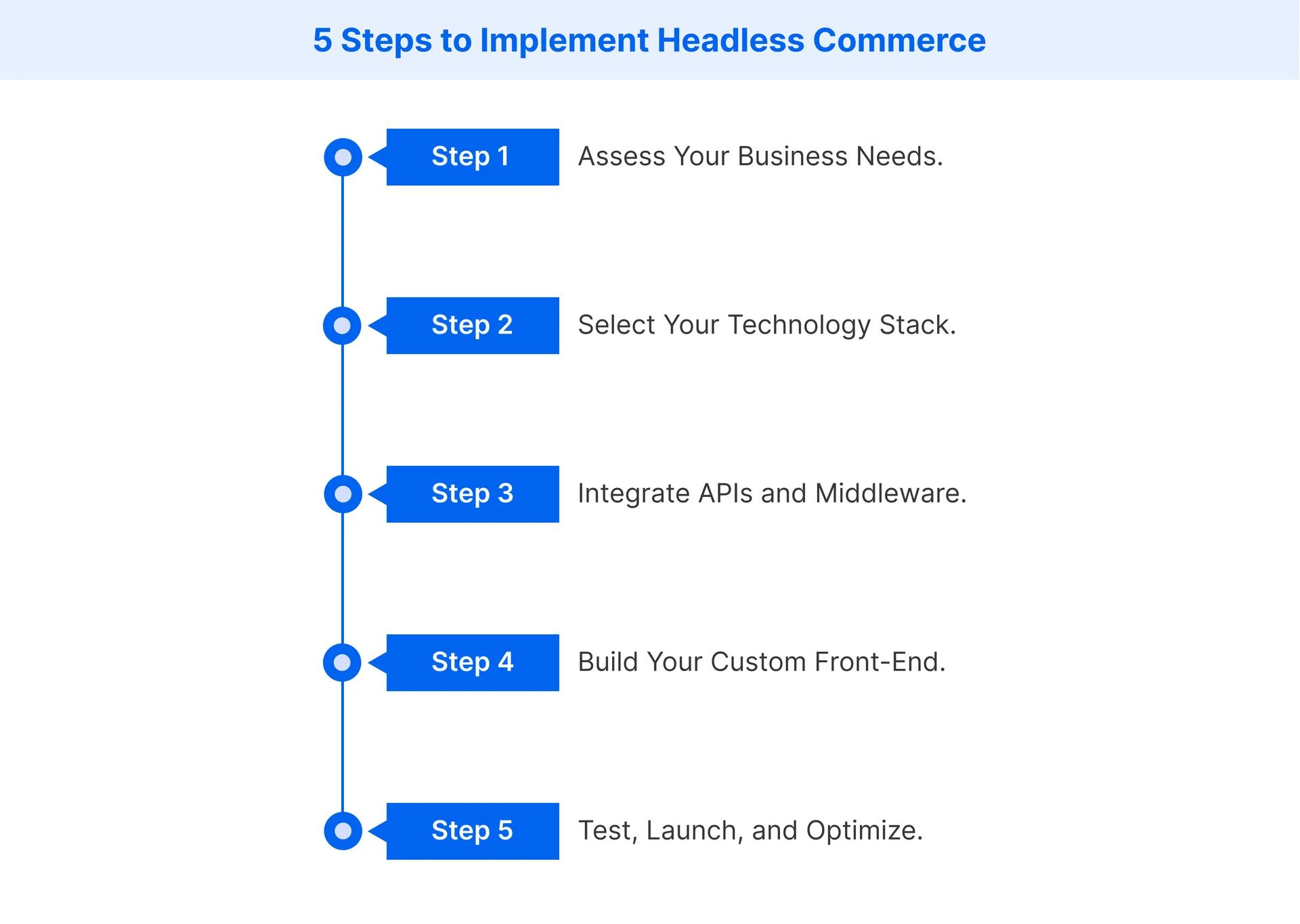
Transitioning to headless commerce requires a strategic and technically sound approach to ensure a successful deployment. Follow these key steps.
1. Assess Business Needs and Objectives
Begin by defining clear business goals. Evaluate whether your primary objectives, such as rapid international expansion, creating highly customized user experiences, or improving site performance, justify the investment. Analyze your existing technology stack to identify pain points and limitations that a headless commerce architecture would directly solve, ensuring strategic alignment from the outset.
2. Select the Right Technology Stack
Choose front-end frameworks like React, Vue.js, or Svelte that align with your team's expertise and project requirements. On the back-end, select a robust commerce platform that offers comprehensive GraphQL or REST APIs. Your choice should support scalability and provide well-documented endpoints for products, carts, payments, and customer data to ensure a smooth development process.
3. Integrate Headless APIs and Middleware
Effective integration is crucial for seamless data flow. Implement an API gateway to manage, secure, and monitor API calls between the front-end and various back-end services, including your PIM, CRM, and ERP. Consider using middleware to orchestrate complex business logic and data transformations, which keeps your front-end lean and focused purely on presentation.
4. Implement FCC’s Headless Commerce Platform
Leverage a platform like Flipkart Commerce Cloud’s Digital Commerce Solution to accelerate your implementation. Such platforms provide a pre-integrated, API-driven back end with modular services. This approach simplifies development by offering a ready-to-use foundation for commerce functionalities, allowing your team to focus on building a unique front-end experience rather than reinventing core commerce logic.
5. Test, Monitor, and Optimize Continuously
Before going live, conduct rigorous testing, including performance testing to handle traffic spikes, user acceptance testing (UAT) to validate workflows, and security testing to protect data. Post-launch, continuously monitor API performance, uptime, and user behavior. Use the insights gathered to A/B test different front-end features and optimize the customer journey for better conversion and engagement.
What are the Benefits of Headless Commerce?
Adopting a headless commerce architecture provides the following benefits:
- Unmatched Flexibility allows your teams to create truly unique and brand-specific user experiences without being constrained by the back-end platform's limitations.
- Faster Time-to-Market for new features and updates is possible because front-end developers can work independently of back-end release cycles.
- Seamless Omnichannel Delivery enables you to push products, content, and commerce functionality consistently across websites, mobile apps, IoT devices, and more.
- Improved Site Performance is achieved by using modern front-end frameworks that optimize for speed, leading to better SEO rankings and conversion rates.
What are the Challenges of Headless Commerce?
While powerful, headless commerce also presents several challenges that your business must be prepared to navigate effectively:
- Increased Development Complexity arises from managing two separate systems, requiring skilled developers who are proficient in both front-end frameworks and API integrations.
- Higher Upfront Investment is often needed for the initial build, including costs for specialized development talent and potentially multiple technology vendors.
- Dependency on Technical Teams for marketing and content updates can create bottlenecks if business users cannot easily make changes without developer assistance.
- Greater Responsibility for Maintenance falls on your team, as you must manage the performance, security, and hosting of the front-end application separately.
How Much Does Headless Commerce Cost?
The cost of implementing headless commerce varies significantly depending on the scale and complexity of your business. Unlike traditional platforms with straightforward licensing fees, the total cost of ownership for a headless solution is multifaceted. It includes expenses for the back-end commerce platform, the Content Management System (CMS), and any other third-party services you integrate into your technology stack.
You must also account for the significant upfront development costs. Building a custom front-end from scratch requires a skilled team of developers, which can be a substantial investment. If you do not have this expertise in-house, you will need to budget for agency fees or hire new talent. This initial build phase is often the most expensive part of the transition to a headless architecture.
Beyond the initial setup, you need to plan for ongoing maintenance, hosting, and optimization costs. The front-end application requires continuous monitoring and updates to ensure performance, security, and compatibility with new devices. These recurring operational expenses are a critical component of the long-term budget and should be factored in when calculating the overall investment required for headless commerce.
Conclusion
Headless commerce is a transformative architecture that empowers your retail business to deliver innovative and highly customized customer experiences. By separating the front-end presentation layer from the back-end commerce engine, it provides the flexibility needed to adapt to new channels and evolving customer expectations. While it requires a strategic implementation and technical expertise, the result is a scalable, future-proof digital commerce solution.

FAQ
The cost varies widely, from around $50,000 to over $500,000 annually. It depends on factors like the back-end platform license, the complexity of your custom front-end build, developer costs, and ongoing fees for hosting, maintenance, and third-party integrations.
Headless storefronts are the custom-built, customer-facing presentation layers (like a website or mobile app) that are decoupled from the back-end. They are built using modern frameworks and communicate with the commerce platform via Application Programming Interfaces (APIs) to display products and process transactions.
For brands that need to deliver unique, high-performance, and omnichannel experiences, it is absolutely worth it. It provides flexibility and scalability that traditional platforms cannot match, making it a valuable long-term investment for ambitious, growth-focused businesses.
Common front end technologies include JavaScript frameworks like React, Vue.js, and Next.js. For APIs, GraphQL and REST are the standards. The back-end can be any commerce platform that offers robust API capabilities, often paired with a headless CMS for content management.
It allows a single back-end to power multiple, distinct front-ends. This means you can manage your products, inventory, and customer data centrally while delivering tailored shopping experiences on your website, mobile app, in-store kiosks, and other customer touchpoints seamlessly.