
September 24, 2025
Shopping Cart Software
Shopping cart software is an e-commerce tool that allows online shoppers to select and accumulate items for purchase. It acts as a virtual cart, holding products until the customer is ready to proceed to payment and complete their transaction.
Drishti, Manager - Digital Marketing

Table of Contents
- What is Shopping Cart Software?
- How Does an Online Shopping Cart Work?
- Why is Shopping Cart Software Important for E-commerce Businesses?
- What Are the Different Types of Shopping Carts in E-commerce?
- How to Choose the Right Shopping Cart Software?
- What Features to Look for in Shopping Cart Software?
- Best shopping cart software example
- Conclusion
Shopping Cart Software
The success of e-commerce depends on creating smooth shopping experiences that turn browsing into actual purchases. Shopping cart solutions are a key system that makes this possible. It helps online retailers display products, manage stock, and handle payments through one platform.
As digital commerce expands, business owners must prioritize reliable carts that enhance the checkout experience and integrate with order management systems, ensuring seamless operations and cost efficiency.
Here are the key features of a shopping cart software:
- Provides a unified interface for product selection and checkout
- Supports multiple payment gateways and shipping integrations
- Automates tax and discount calculations for purchases
- Syncs real-time inventory data with product availability
What is Shopping Cart Software?
A shopping cart software is an e-commerce application that enables customers to select products from an online store and place them in a virtual basket. This software is the interface between your online storefront and the back-end infrastructure, managing the entire purchasing process. It also integrates with business tools like email marketing and social media platforms to drive engagement and conversions.
It holds the selected items, allows for modifications like changing quantities or removing products, and saves the cart's contents for a later purchase. The primary function of shopping cart software is to simplify and automate the transaction process. The software calculates the total cost, applies discounts, adds sales tax, and determines shipping costs before guiding the customer to the final payment stage.
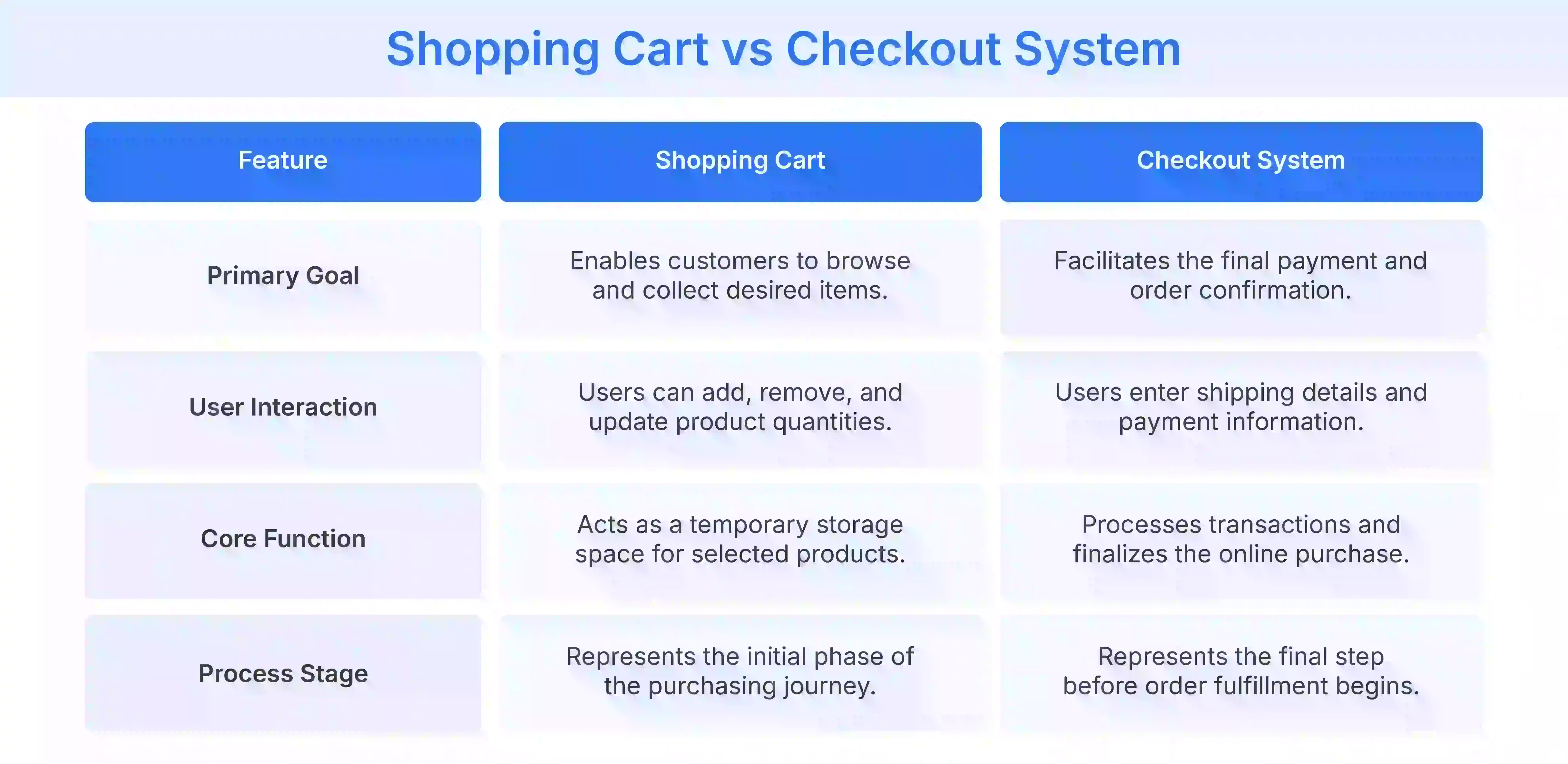
While often used interchangeably, the shopping cart and checkout are distinct components. Here are the key aspects that distinguish both these tools:
How Does an Online Shopping Cart Work?
Here is a step-by-step breakdown of the operational flow of a shopping cart in an e-commerce environment.
- Product Selection: A customer browses your online store and clicks the "Add to Cart" button for a desired product. The software registers this action and adds the item to the virtual cart, which is often linked to the user's session.
- Cart Management: The customer can view their cart at any time to see all selected items, update quantities, or remove products. The shopping cart software dynamically recalculates the subtotal with each change the customer makes.
- Cost Calculation: When the customer proceeds to the checkout, the software calculates the complete order total. This includes adding applicable taxes based on location and integrating real-time shipping rates from various carriers based on the delivery address.
- Integration with Payment Gateways: The software securely transmits the final order details and total amount to a payment gateway. This is where the customer enters their payment information, such as credit card details or digital wallet credentials, for authorization.
- Order Confirmation: After a successful payment, the shopping cart software communicates back to your e-commerce platform to confirm the order. It then updates your inventory management system, generates an order confirmation for the customer, and initiates the fulfillment process.
Modern popular shopping carts also provide additional features such as persistent carts, tailored promotions, and analytics to track consumer behavior, enabling better decision-making.
Why is Shopping Cart Software Important for E-commerce Businesses?
Let’s analyze why implementing a robust shopping cart software is crucial for any ecommerce website aiming for growth and customer satisfaction:
- Enhances Customer Experience: A seamless and intuitive cart helps customers navigate the buying process effortlessly. Features like persistent carts, which save items for later, and clear cost breakdowns create a positive and user-friendly journey that encourages repeat business.
- Reduces Cart Abandonment: Complicated or lengthy checkout processes are a primary reason for cart abandonment. Robust software simplifies these steps, offers guest checkout options, and displays trust signals like security badges to build confidence and ensure more customers complete their purchase.
- Enables Secure Payments: Security is a major concern for online shoppers. Reliable shopping cart software integrates with trusted payment gateways and maintains PCI compliance, ensuring that your customers' sensitive financial data is encrypted and protected from potential threats.
- Streamlines Business Operations: The software automates crucial tasks like tax calculation, inventory updates, and order confirmations. This reduces the risk of manual errors, saves valuable time, and allows your team to focus on other strategic areas of the business.
What Are the Different Types of Shopping Carts in E-commerce?
Here are the different types of shopping carts available for ecommerce platforms:
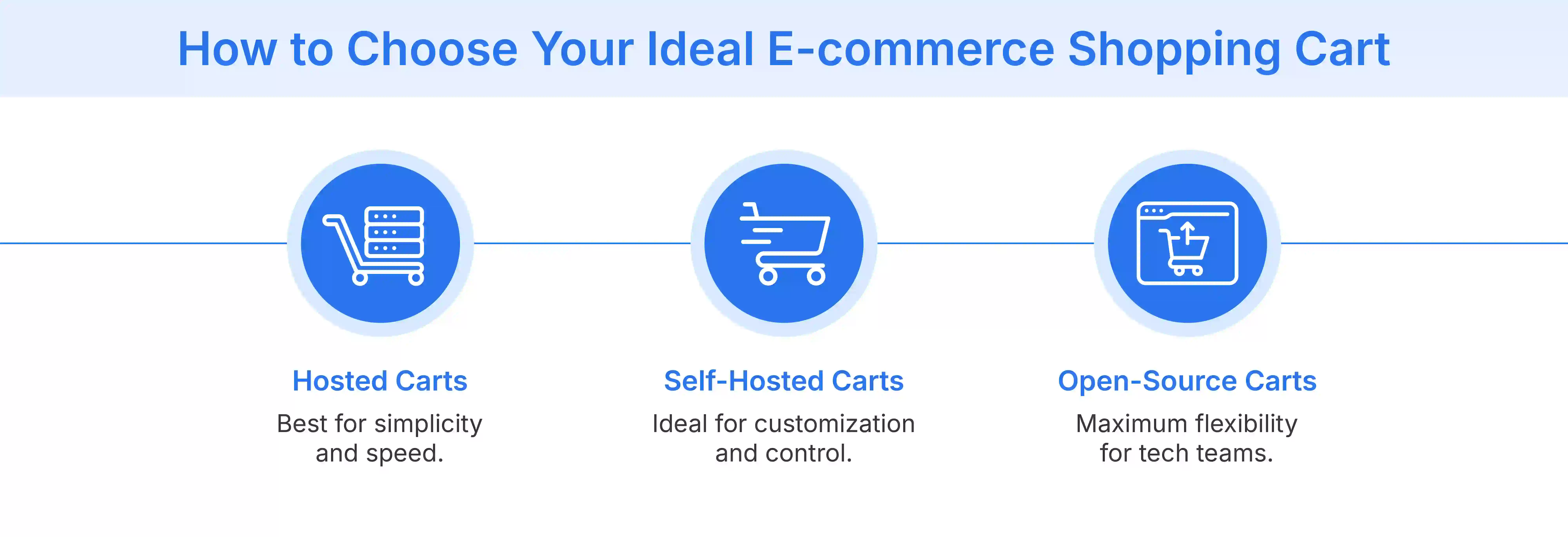
Hosted Shopping Carts
Hosted solutions, also known as Software-as-a-Service (SaaS), are managed entirely by a third-party provider. They handle all technical aspects, including hosting, security, and software updates. This type is ideal for businesses that want a quick, easy, and reliable setup without technical overhead.
Self-Hosted Shopping Carts
Self-hosted shopping carts are licensed software that you install and manage on your web hosting servers. This approach provides you with greater control and customization over the cart's features and design. It is best suited for businesses with dedicated IT resources and specific functional requirements.
Open-Source Shopping Carts
Open-source carts offer you complete access to the source code, providing maximum flexibility and customization potential. You can modify every aspect of the software to fit your unique business needs. This option is perfect for large-scale retailers or businesses with developers on staff.
How to Choose the Right Shopping Cart Software?
Selecting the right shopping cart software is a critical decision that directly influences your online store's performance and scalability. Your choice should align with your business goals, technical capabilities, and customer expectations. Consider factors like free trial, available support channels, ease of integration with your existing website, marketing tools, payment gateways like credit cards and Apple Pay, and inventory management systems to ensure a cohesive technology stack.
Look for a solution that can grow with your business. Scalability is a crucial feature to handle increasing traffic and transaction volumes without compromising speed or reliability. Also, evaluate the software's security features, such as PCI compliance and fraud protection, to safeguard your business and your customers' data. Finally, ensure the platform has a robust technical support team and is fully mobile-responsive.
For enterprises seeking a solution built for peak retail performance, Flipkart Commerce Cloud’s Cart and Checkout Solution offers unparalleled scalability and reliability. Our software has been designed to handle massive traffic surges effortlessly, ensuring your checkout process remains fast and stable even during the biggest sale events. It integrates seamlessly with retail platforms, ensuring scalability, data-driven insights, and a smooth shopping experience for customers.
What Features to Look for in Shopping Cart Software?
Here are the essential features to look for in a modern shopping cart software:
- Ensure the cart provides a seamless and responsive experience across desktops, tablets, and smartphones.
- Look for a system that offers real-time synchronization with your inventory to prevent overselling popular items.
- The software should support multiple payment gateways and alternative payment methods to cater to diverse customer preferences.
- Seek out personalization capabilities, such as tailored product recommendations or targeted promotions, to increase order value.
- Choose software with robust analytics and reporting tools to gain insights into sales trends and customer behavior.
Best shopping cart software example
The best shopping cart software is one that evolves from being a simple utility to a strategic asset that drives growth. Leading solutions today are built on the principles of composable commerce, featuring a modular, API-first architecture. This allows you to seamlessly integrate with other best-of-breed systems, creating a flexible and powerful e-commerce ecosystem tailored to your specific business needs.
Top-tier solutions prioritize performance and scalability, engineered to handle massive traffic loads without any drop in speed. A fast, reliable cart is crucial for maximizing conversions during peak shopping events. At Flipkart Commerce Cloud, our Cart and Checkout Solution is built on these exact principles, having been tested at an immense scale to power one of the world's largest e-commerce marketplaces.
Our software is designed for resilience, ensuring a frictionless experience even with millions of concurrent users. We provide a suite of powerful features, including a rule-based cart flow orchestration that lets you customize the checkout journey and an intelligent cart preservation system that maintains contents across sessions and devices. This level of control helps you actively reduce cart abandonment and increase conversions.
With our shopping cart software, you gain access to a retail-grade, adaptable solution. Our API-first design offers the flexibility to innovate, while features like automated cart recovery and transparent price calculation enhance the customer experience. With FCC Cart and Checkout solution, you get a proven foundation designed to keep your platform ready for the future of digital commerce.
Conclusion
Shopping cart software is the engine of your ecommerce business, directly shaping the customer journey from interest to loyalty. The right solution empowers you to create a seamless, secure, and satisfying buying experience for every visitor.
By carefully selecting a platform that aligns with your business needs and customer expectations, you can significantly reduce friction, boost conversion rates, and build a strong foundation for sustainable growth. Investing in superior shopping cart technology is an investment in the future success of your online retail business.

FAQ
The best software for small businesses is one that offers scalability, ease of use, secure payment gateways, and cost-effectiveness. Hosted options are often preferred for their lower setup and management needs. They allow you to focus on growing your business without needing extensive technical knowledge or resources.
A shopping cart is where customers collect and manage items they intend to buy. The checkout page is the subsequent step where they provide shipping information, select a payment method, and finalize the purchase. The cart is for selection, while the checkout is for transaction.
Yes, Flipkart Commerce Cloud’s solution is built with an API-first approach, enabling seamless integration with your existing inventory management systems, ERPs, and other third-party applications. This ensures real-time data synchronization and a cohesive operational workflow for your entire e-commerce ecosystem.
Absolutely. Shopping cart software is essential for any business selling online, regardless of its size. Many solutions are specifically designed for small businesses, offering affordable plans and easy-to-use features that help them compete effectively in the digital marketplace and provide a professional customer experience.
Essential security measures include PCI DSS compliance to protect cardholder data, SSL encryption to secure data transmission between the customer's browser and your server, and fraud detection tools. These features are critical for building customer trust and protecting your business from financial losses.