
June 18, 2026
What Is Cost Per Lead (CPL)?
Cost per lead (CPL) is a marketing metric that measures the amount businesses spend to acquire a single lead. It helps marketers evaluate campaign performance, optimize ad spend, and improve lead generation efficiency across channels.
Drishti, Manager - Digital Marketing

Table of Contents
- What Is Cost Per Lead (CPL)?
- How Is Cost Per Lead Calculated?
- Why Is Cost Per Lead Important?
- What Factors Affect Cost Per Lead?
- What Is a Good Cost Per Lead?
- Cost Per Lead vs CPA vs CAC: What Is the Difference?
- How Can Businesses Reduce Cost Per Lead?
- Conclusion
What Is Cost Per Lead (CPL)?
Cost per lead (CPL) is a key marketing metric measuring the cost to acquire a single lead, i.e., a potential customer who has taken an action, such as filling out a form, downloading a resource, or requesting a demo. By tracking CPL across channels like paid ads, email, and social media, businesses can evaluate marketing efficiency, optimize budgets, and improve ROI.
While reducing CPL is a common objective, lead quality is also paramount. A low CPL is only valuable if those leads convert into paying customers; prioritizing high-volume, low-intent leads can inflate downstream costs. Businesses often analyze CPL alongside metrics like conversion rates and customer acquisition cost (CAC) for a comprehensive view of performance.
For many businesses, cost per lead works alongside related metrics such as customer acquisition cost (CAC), cost per acquisition (CPA), and conversion rate to provide a fuller view of marketing performance.
How Is Cost Per Lead Calculated?
Businesses calculate cost per lead (CPL) by dividing the total amount spent on a marketing campaign by the number of leads generated during a specific period.
|
Cost Per Lead Formula: |
Marketing spend may include paid advertising, campaign management, creative production, software, agency fees, and promotional expenses. Leads generated refer to people who complete a desired action, such as filling out a form, subscribing to a newsletter, downloading a resource, or requesting a demo.
For example, if a business spends $5,000 on a marketing campaign and generates 250 leads, the cost per lead would be:
Cost Per Lead (CPL) = $5,000 ÷ 250 = $20
Why Is Cost Per Lead Important?
- Better Budget Allocation: Compare CPL across channels such as paid search, email marketing, social media, and display advertising to identify high-performing campaigns.
- Improved Marketing ROI: Understand whether lead generation costs support profitable customer acquisition and long-term growth.
- Forecasting Marketing Spend: Estimate how much budget is required to meet lead generation goals based on average CPL.
- Campaign Performance Analysis: Identify which channels generate leads most efficiently and optimize marketing investments accordingly.
Businesses often track cost per lead alongside related metrics such as conversion rate, customer acquisition cost (CAC), and return on ad spend (ROAS) to gain a fuller understanding of marketing efficiency.
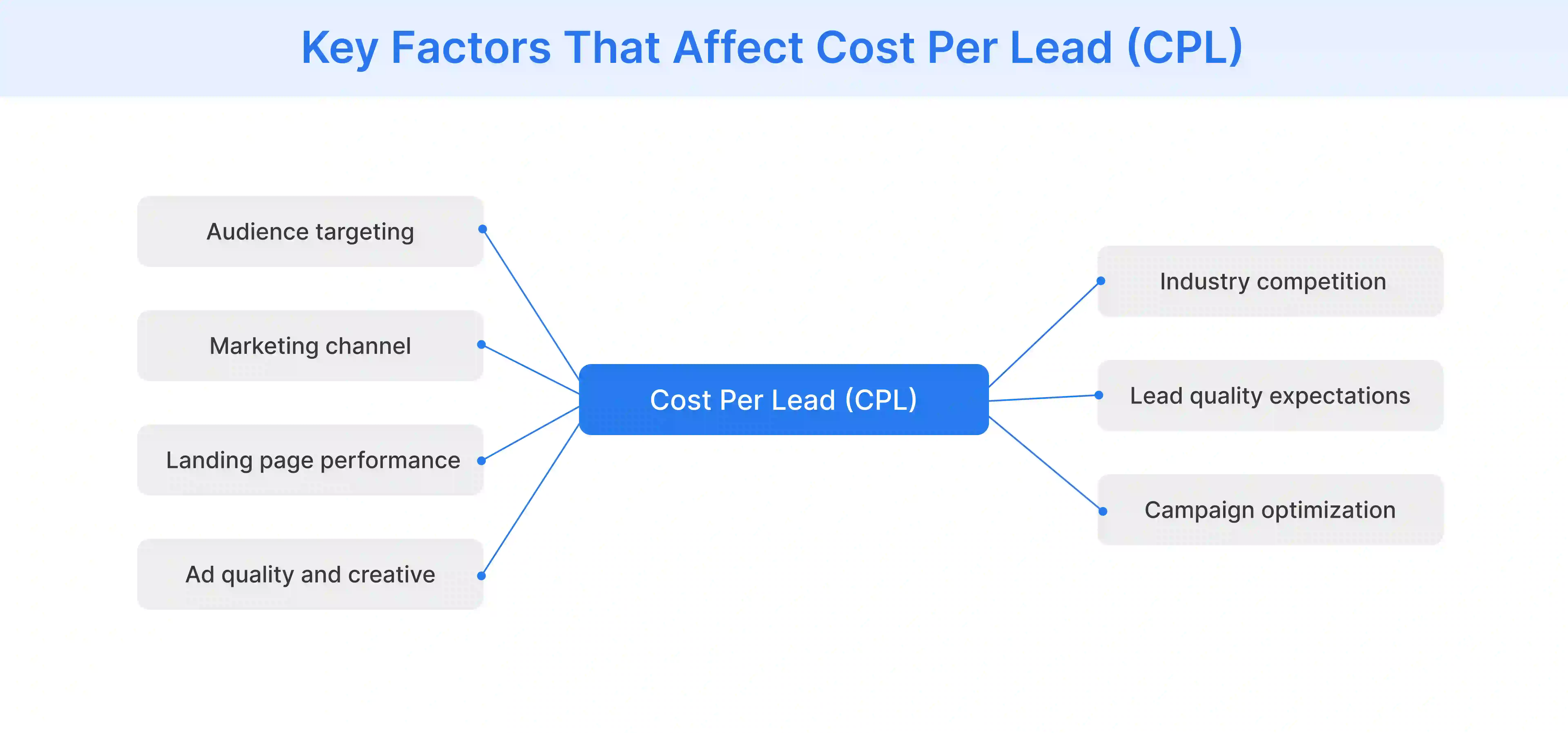
What Factors Affect Cost Per Lead?
- Audience Targeting: Campaigns aimed at highly specific or competitive audiences often cost more. Poor targeting can also increase CPL by attracting low-intent leads.
- Marketing Channels: Paid search may generate high-intent leads but often comes with higher advertising costs, while email marketing or organic search may produce lower CPL over time.
- Landing Page Performance: Slow-loading pages, unclear messaging, or complicated forms can reduce conversions and increase lead costs.
- Lead Quality Expectations: Businesses targeting enterprise buyers or high-value customers may accept a higher CPL because those leads often generate greater long-term value.
- Industry Competition and Ad Quality: Competition, campaign optimization, ad relevance, and creative quality can all influence acquisition costs.
Businesses often compare these factors across campaigns to find the best balance between lead quality and marketing efficiency.
What Is a Good Cost Per Lead?
There is no universal benchmark for a good cost per lead (CPL). An ideal CPL depends on factors such as industry, target audience, customer lifetime value, and business model.
For example, businesses selling high-value products or services often accept a higher CPL because customers generate more long-term revenue. In contrast, ecommerce and lower-priced businesses usually aim for a lower CPL to maintain profitability.
Lead quality also matters. A low CPL may seem efficient, but it becomes less valuable if leads rarely convert. Many businesses prioritize higher-quality leads even if acquisition costs are higher.
Cost Per Lead vs CPA vs CAC: What Is the Difference?
While CPL focuses on lead generation, CPA measures completed actions or conversions, and CAC tracks the total cost of acquiring a paying customer.
|
Basis of Difference |
Cost Per Lead (CPL) |
Cost Per Acquisition (CPA) |
Customer Acquisition Cost (CAC) |
|
Definition |
Measures the cost of generating a lead |
Measures the cost of a completed action or conversion |
Measures the total cost of acquiring a paying customer |
|
Funnel Stage |
Top or middle of the sales funnel |
Lower funnel |
End-to-end customer journey |
|
Goal |
Lead generation |
Conversion tracking |
Customer acquisition efficiency |
|
Example |
Newsletter signup or demo request |
Product purchase or completed registration |
New paying customer acquired |
|
Primary Focus |
Marketing efficiency |
Campaign performance |
Overall business profitability |
How Can Businesses Reduce Cost Per Lead?
- Improve Audience Targeting: Refine audience segments to reach people more likely to convert and reduce wasted ad spend.
- Optimize Landing Pages: Improve page speed, messaging, forms, and calls to action to increase conversion rates.
- Run A/B Tests: Test headlines, visuals, and ad copy to identify what generates leads more efficiently.
- Use Retargeting Campaigns: Re-engage visitors who showed interest but did not convert during their first visit.
- Focus on High-Performing Channels: Prioritize marketing channels that consistently generate quality leads at lower costs.
- Improve Lead Magnets and Offers: Use demos, free trials, webinars, or gated content to encourage signups.
- Automate Lead Nurturing: Use automation tools to follow up with leads and improve engagement.

Conclusion
Cost per lead (CPL) helps businesses measure how efficiently marketing efforts generate potential customers. While reducing CPL is important, businesses also need to balance lead quality, conversion potential, and profitability for sustainable growth. Flipkart Commerce Cloud helps businesses improve marketing efficiency through customer intelligence, audience segmentation, and marketing automation to support better lead generation outcomes.

FAQ
CPL measures the exact marketing expense required to capture a prospective customer's contact information, like an email address or phone number. Conversely, CPA calculates the total budget spent to secure an actual paying buyer. Both metrics help businesses evaluate the performance of their marketing funnel.
This metric matters because it directly shows the financial efficiency of your marketing campaigns. By tracking it, you can instantly see which advertising channels are profitable and which are wasting money. This ensures you scale your sales pipeline smoothly while keeping your customer acquisition costs fully predictable.
To find this number, simply divide your total marketing campaign spend by the number of leads generated. For example, if you spend $1,000 on digital ads and secure 20 sign-ups, your final cost is exactly $50 per lead. Automated analytics tools make tracking this math effortless for digital teams.
A healthy target depends heavily on your specific industry, profit margins, and final customer lifetime value. Generally, an acquisition cost is considered good if the eventual revenue generated from those converted prospects remains comfortably higher than the initial marketing budget required to capture their interest.
The main distinction comes down to the specific user action being measured. A standard lead campaign focuses entirely on top-of-funnel engagement like a form submission. Meanwhile, CPA tracks bottom-of-funnel financial transactions like a completed sale. Enterprise platforms like FCC help businesses track both metrics seamlessly.
The standard benchmarks for the average cost of acquiring a lead vary wildly based on market competition and average deal sizes. Retail and e-commerce leads are relatively affordable, whereas complex corporate fields frequently climb much higher. Tracking these shifting trends with Flipkart Commerce Cloud helps merchants optimize their ad spend effectively.