
April 20, 2026
Return on Ad Spend (ROAS)
Return on Ad Spend is a key financial metric that tracks the success of promotional efforts. It helps marketing teams understand the specific revenue generated from their ad campaigns.
Drishti, Manager - Digital Marketing

Table of Contents
- What Is Return on Ad Spend?
- How Do You Calculate Return on Ad Spend?
- What Is a Good ROAS?
- What Is the Difference Between ROAS and ROI?
- Why Is ROAS Important for Retailers?
- What Are the Advantages and Disadvantages of Using ROAS?
- How Can Retailers Improve Their ROAS?
- Optimize Your Advertising Strategy with Flipkart Commerce Cloud
Return on Ad Spend (ROAS)
Return on Ad Spend measures the success of promotional activities across various digital spaces. Retailers use this metric to determine the success of their total advertising investments and campaigns.
ROAS can help a marketing team understand the return on investment generated by promotional costs. Decision makers then allocate their advertising budget across various active online platforms to maximize reach.
- The calculation provides clear insights into the financial outcomes of an advertising campaign.
- Companies use this detailed data to identify their most profitable channels across the internet.
- This evaluation method supports smarter strategic choices for all future digital marketing efforts.
- Tracking these numbers prevents wasted expenditures on underperforming digital or traditional media platforms.
What Is Return on Ad Spend?
Return on Ad Spend measures revenue earned for each dollar spent on advertising. It shows which ad campaign drives most revenue and helps teams compare ad platforms. Retailers use ROAS to link advertising costs to sales and set clear targets.
ROAS guides budget allocation by showing which channels return most for ad dollars. It supports decisions to scale or pause campaigns and helps prioritize ads. Teams track ROAS across the customer journey to improve campaign performance and cut wasted spend.
ROAS works best with metrics like Customer Lifetime Value (CLV) and Customer Acquisition Cost (CAC) to give clearer view. It does not show profit margins or total costs. Use ROAS to test advertising tactics and combine results with broader retail metrics for planning.
How Do You Calculate Return on Ad Spend?
Retail brands determine their overall success rate by using the standard ROAS formula for their ongoing online digital marketing initiatives:
ROAS = Total Advertising Revenue / Advertising Costs
This formula compares total advertising revenue with the cost of the ad. It shows how much revenue is earned for every dollar of ad spend.
For example, if a retailer spends $1,000 on an advertising campaign and generates $4,000 in total revenue, the Return on Ad Spend equals 4. This means the business earns four dollars for every dollar of ad. To express this as a percentage, multiply the ratio by 100 to get 400%. This helps evaluate overall campaign performance and guides campaign optimization across ad platforms.
What Is a Good ROAS?
A good return on ad spend depends on cost structure and business model. Retailers often target a good ROAS ratio of 4:1 or higher because they operate with lower profit margins and higher operating costs.
High-margin industries like software or luxury goods can be profitable with ROAS as low as 2:1 or 3:1. Early-stage brands may accept lower ROAS while they build repeat customers and lifetime value. Measure costs before you scale campaigns and profit.
The ideal ROAS depends on profit margins, business expenses, and the company growth stage. Include all costs, such as fulfillment, returns, and overhead, when you set targets. Use attribution modeling to link total advertising revenue to specific campaigns and channels.
What Is the Difference Between ROAS and ROI?
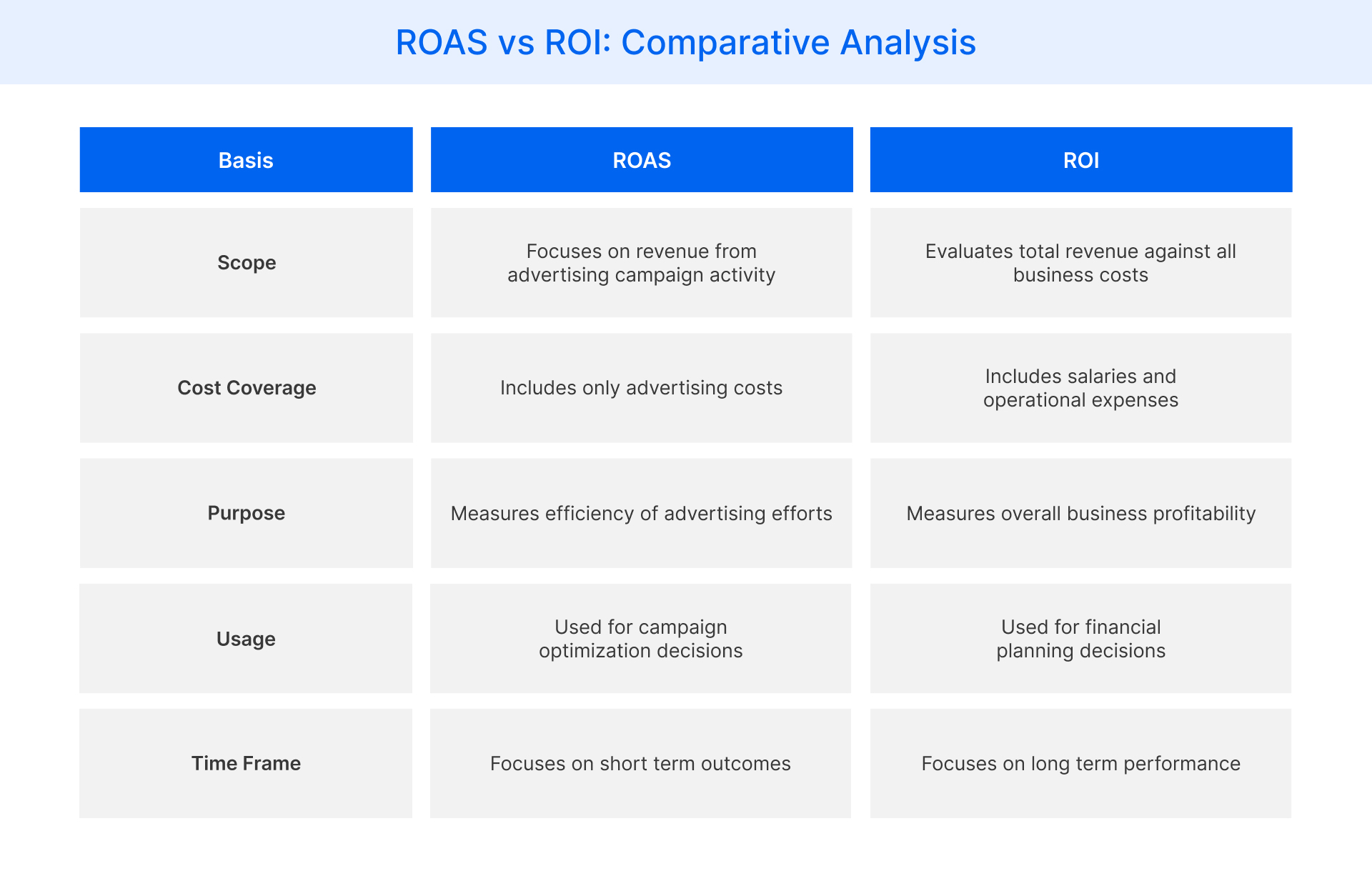
Return on Ad Spend measures revenue generated from advertising efforts, while ROI evaluates overall profitability by factoring in additional costs. Both provide a useful view of performance at different levels.
Return on Ad Spend focuses on specific campaign efficiency, while ROI measures total financial outcomes, including overhead and operational costs. Using both metrics helps marketing teams understand performance clearly.
Here is a comparative analysis between Return on Investment (ROI) and Return on Ad Spend (ROAS) to better understand their differences:
Why Is ROAS Important for Retailers?
Return on Ad Spend helps retailers improve advertising efficiency and revenue outcomes. Let’s understand why this metric is crucial for companies:
- Measure Campaign Effectiveness: Return on Ad Spend shows which advertising channels generate more revenue per dollar of ad spend. It helps retailers identify which campaigns perform well across platforms.
- Optimize Budget Allocation: Retailers can move ad spending toward campaigns with better Return on Ad Spend. This improves the efficiency of advertising investments and reduces spending on underperforming campaigns.
- Track Marketing Performance: Tracking Return on Ad Spend across platforms helps compare results across different channels. Retailers gain a clear view of campaign performance across social media and search.
- Identify Profitable Channels: Return on Ad Spend highlights the most profitable channels. This helps retailers focus on platforms that generate higher returns from advertising investments.
- Make Data Driven Decisions: Return on Ad Spend provides measurable insights. Retailers can scale campaigns with positive ROAS and improve or stop campaigns with lower returns.
What Are the Advantages and Disadvantages of Using ROAS?
ROAS is simple and useful for checks, but it can miss hidden costs and long-term value when used alone.
Advantages of ROAS
- Easy to Calculate: The simple formula makes ROAS quick to compute for any team. It needs only revenue and ad cost figures to give a clear campaign comparison across channels and time periods.
- Campaign Specific Insights: ROAS can be measured for a single ad, a campaign, or a whole channel. This lets teams spot which specific ads drive sales and where to focus ad dollars now.
- Real Time Tracking: Many ad platforms report ROAS in near real time so teams can act fast. This supports quick tests, b testing, and fast changes to improve campaign performance and lower costs.
- Budget Justification: Clear ROAS numbers help marketers show the value of ad spending to leaders. This makes it easier to secure an advertising budget and explain advertising investments across teams and channels.
Disadvantages of ROAS
- Ignores Total Costs: ROAS does not include overhead, shipping, or product costs, so it can overstate profit. Teams must add additional costs to see true returns and set realistic targets for each campaign.
- Attribution Challenges: Customers touch many channels before buying, which makes it hard to assign revenue to one campaign. Use attribution modeling and advanced attribution models to spread credit across touchpoints and devices.
- Short Term Focus: ROAS favors immediate returns and can undervalue ads that build brand or customer lifetime value. Teams should balance short-term gains with long-term growth and retention over future revenue.
How Can Retailers Improve Their ROAS?
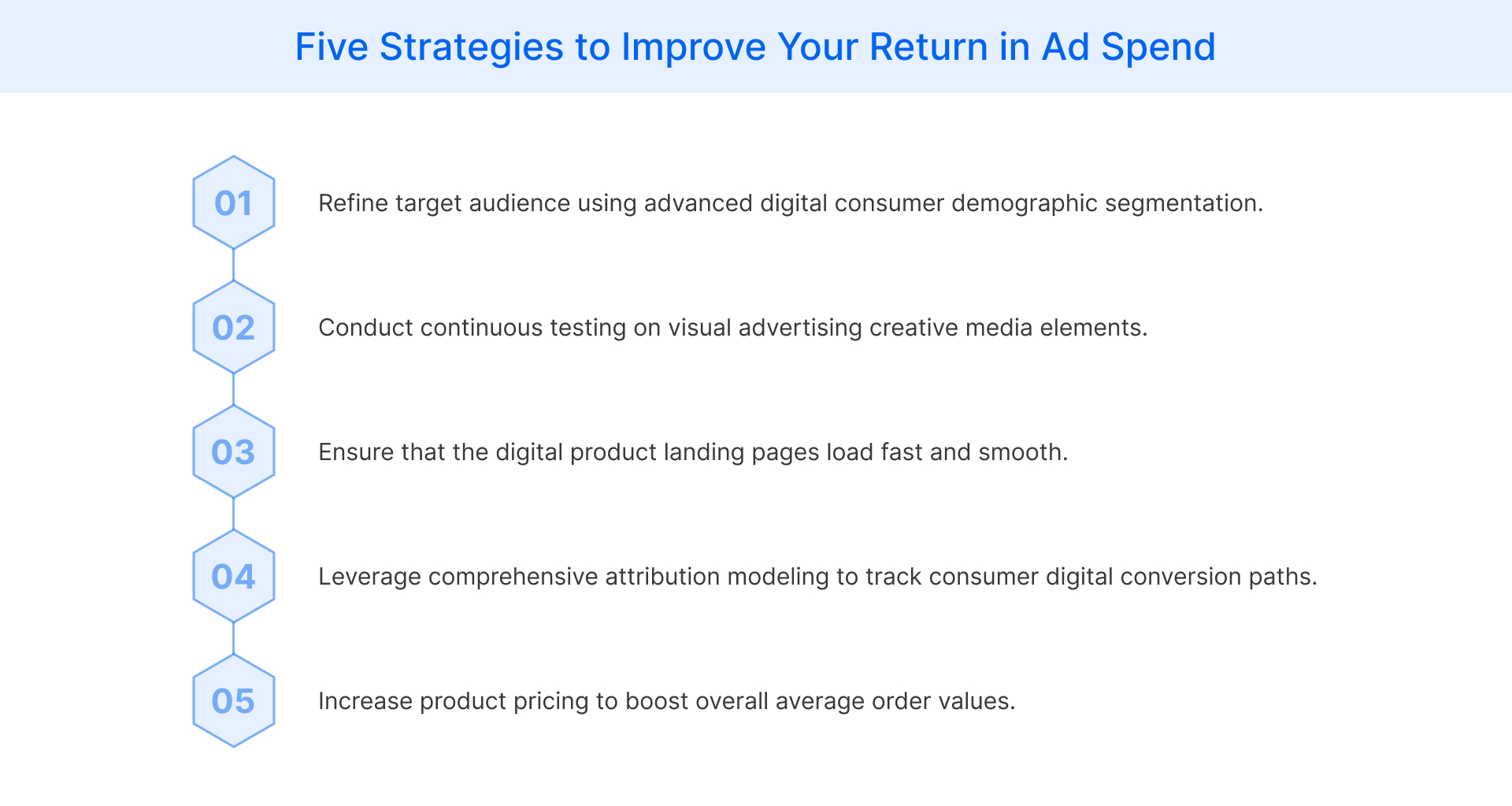
Let’s understand how retailers can improve their Return on Ad Spend through better targeting, testing, and pricing strategy framework.
- Refine Audience Targeting: Use customer data to target high-value segments that convert more often and at higher order values. Focus on behaviors, past purchases, and lifetime value to cut wasted ad spend today.
- Optimize Landing Pages: Ensure ad clicks land on fast pages with clear calls to action that match ad messaging and intent. Reduce load time, simplify forms, and remove distractions to lift conversion rates.
- Test Ad Creative Regularly: Run A/B tests on headlines, images, and copy to find which creative drives the best results. Keep tests small, measure conversion and revenue, then scale winning ads across channels now.
- Adjust Bidding Strategies: Lower bids on low-performing keywords and pause wasteful placements to save ad dollars. Increase bids on high-converting terms or audiences and monitor cost per acquisition to protect total revenue today.
- Improve Product Pricing: Raise Average Order Value (AOV) with bundles, upsells, and cross-sells to increase revenue per purchase. Test price points and promotions to find a balance between conversion rate and profit margins for ROAS.
Optimize Your Advertising Strategy with Flipkart Commerce Cloud
Understanding and improving your Return on Ad Spend is critical for retail success in competitive digital markets. You need tools that connect first-party data, ad platforms, and analytics to measure how much revenue each dollar of ad spend produces.
Flipkart Commerce Cloud provides retailers with a comprehensive Retail Media Platform that enables you to monetize your digital properties while delivering targeted advertising to shoppers. Our platform helps brands and retailers achieve measurable ROAS through first-party data and advanced audience targeting.
Our Retail Media Platform offers self-serve ad management capabilities with transparent reporting and analytics tools. You can track campaign performance metrics, including ROAS, conversion rates, and return on investment, in real-time through interactive dashboards.
Sign up for a free demo to understand how you can boost your ROAS with Flipkart Commerce Cloud through targeted retail media campaigns.

FAQ
Yes, you can have a negative ROAS when ad costs exceed revenue. This means the advertising campaign lost money and reduced total revenue. Marketers should pause or revise the ad campaign and check attribution and additional costs to prevent further losses and review bidding strategy.
Review ROAS frequently for active campaigns and regularly for long term planning. Daily checks help spot sudden drops and allow quick campaign optimization. Weekly or biweekly reviews support budget shifts, attribution checks, and strategic decisions across advertising channels while aligning with sales and inventory cycles.
No, ROAS measures revenue per dollar of ad spend, not profit. It ignores overhead, product costs, and other expenses that affect net profit. Use ROI or margin calculations alongside ROAS to assess true profitability and guide advertising budget decisions for each product and campaign.
ACOS shows advertising cost as a share of sales, common on marketplaces. ROAS shows how much revenue each dollar of ad spend generates across channels. ACOS is a percentage while ROAS is a ratio; use both to compare efficiency and ad cost daily by channel.
Yes, product level ROAS shows which SKUs drive the most revenue and profit potential. This helps find the most profitable channels and specific ads for each item. Track ROAS by SKU, campaign, and channel to guide pricing, inventory, and advertising budget decisions across different channels.