
June 20, 2026
What Is Advocacy Marketing?
Advocacy marketing is a growth strategy that focuses on encouraging highly satisfied customers, employees, or partners to organically promote a brand through word-of-mouth, reviews, and social content.
Drishti, Manager - Digital Marketing

Table of Contents
- Why Is Advocacy Marketing Important for Modern Businesses?
- How to Get Advocates and Find True Brand Supporters
- How Does a Customer Advocacy Program Work?
- What Are the Main Benefits of Advocacy Marketing in Ecommerce?
- Common Formats Used to Turn Customers into Brand Advocates
- Advocacy Marketing vs. Affiliate Marketing vs. Influencer Marketing
- Conclusion
What Is Advocacy Marketing?
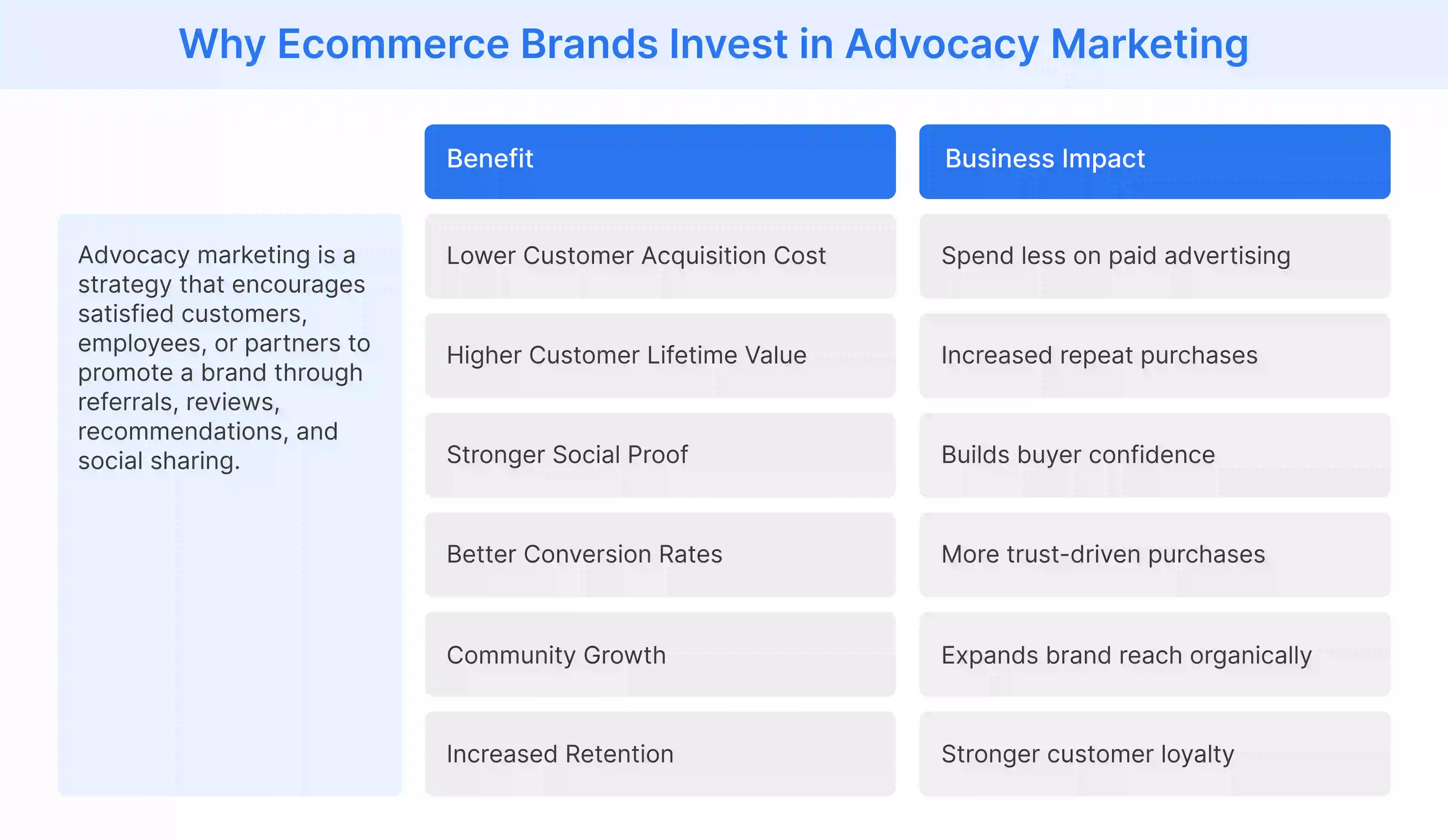
Advocacy marketing is a business strategy that encourages loyal customers, employees, or partners to promote a brand through referrals, reviews, recommendations, and social sharing. Instead of relying entirely on paid advertising, brands leverage authentic experiences shared by real supporters to build trust and influence purchasing decisions.
A strong advocacy marketing strategy can reduce customer acquisition costs, build social proof, and help convert new shoppers through trusted recommendations.
Why Is Advocacy Marketing Important for Modern Businesses?
Advocacy marketing helps businesses address three common challenges in ecommerce: rising advertising costs, declining consumer trust, and increasing customer churn.
- Combats Ad Fatigue and Skepticism: Advocacy marketing creates a peer-driven acquisition channel that is less dependent on paid advertising. When real people voluntarily endorse a brand across social platforms online, it builds credibility that paid placements cannot replicate.
- Shortens the Sales Cycle: New shoppers often spend considerable time researching before purchasing. Authentic advocacy content, such as reviews, unboxing videos, and peer referrals, helps answer product questions and reduce purchase hesitation.
- Protects Profit Margins: Every dollar spent on paid search or social auction-based ads cuts directly into margin. Referred customers cost less to acquire and spend more over time.
How to Get Advocates and Find True Brand Supporters?
Building an advocacy marketing strategy begins long before a referral link is sent. These are the operational steps that produce genuine brand advocates.
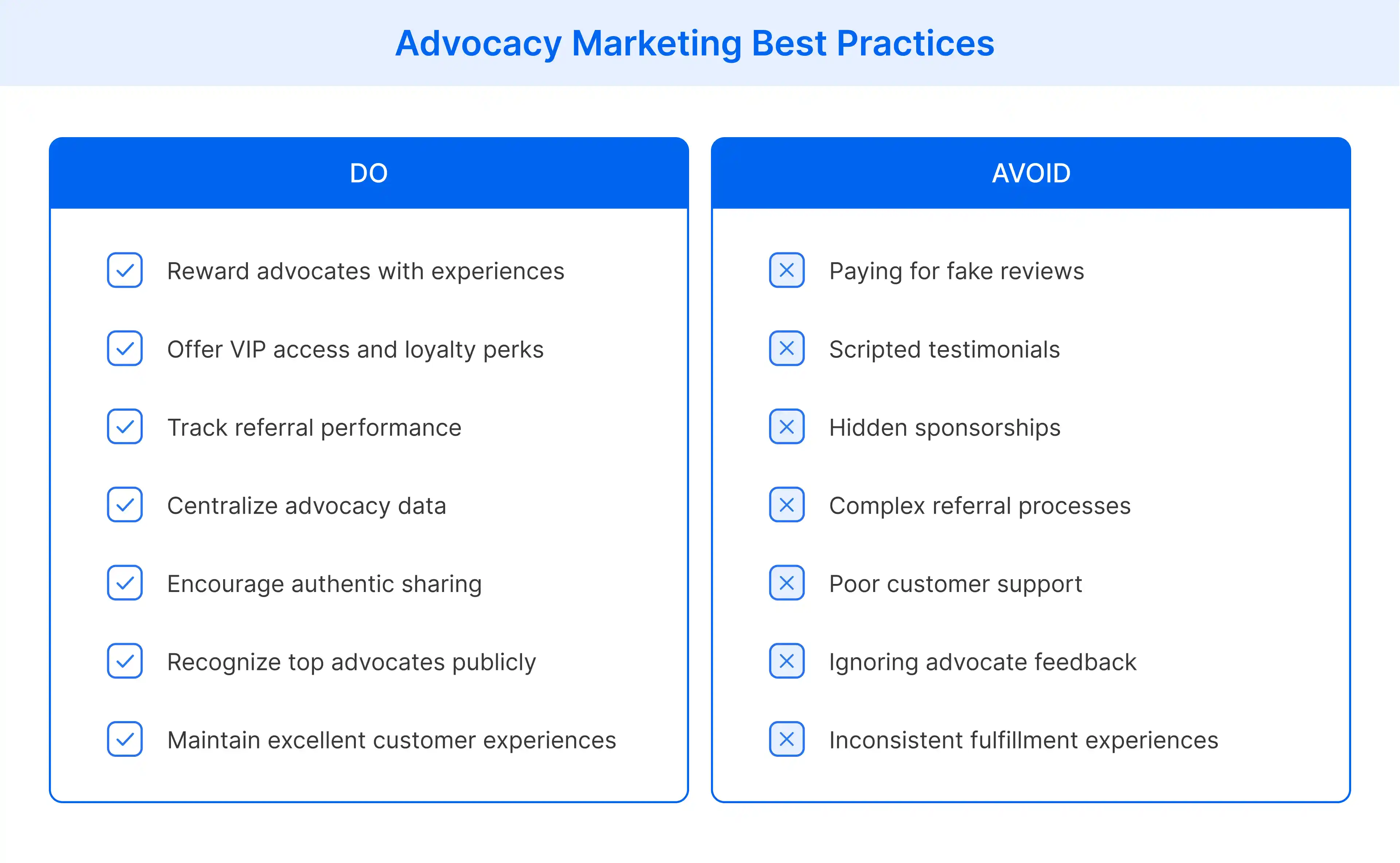
- Deliver an Exceptional Product Experience: True advocacy starts with a product that reliably meets or exceeds expectations. No referral mechanic, incentive structure, or loyalty point system can compensate for a poor-quality product. Product excellence is the non-negotiable foundation.
- Create a Compelling Brand Narrative: Customers who connect with a brand's values or community become advocates naturally because they are not just buying a product, they are aligning with an identity. A clear, consistent brand story gives supporters something they genuinely want to share with their networks.
- Combine Brand Narrative with Incentives: Tie your story to meaningful rewards. Exclusive early access, loyalty points, VIP tier perks, or recognition within a brand community give advocates an additional reason to promote your store while reinforcing their emotional connection to the brand.
- Prioritize Post-Purchase Experiences: The customer journey does not end at checkout. Seamless order tracking, on-time delivery, and premium packaging create an unboxing experience that customers naturally want to capture and share on social media. Maintaining accurate real-time inventory and clean order flows ensures this post-purchase moment is never disrupted by a fulfillment error.
- Engage Internal Employees: Brand advocates are not limited to customers. Employees who speak authentically about company culture, values, and behind-the-scenes operations extend your advocacy marketing reach into professional networks that paid campaigns rarely penetrate.
How Does a Customer Advocacy Program Work?
A customer advocacy program is a structured system for identifying your most satisfied customers, activating their sharing behavior, and capturing the resulting social proof.
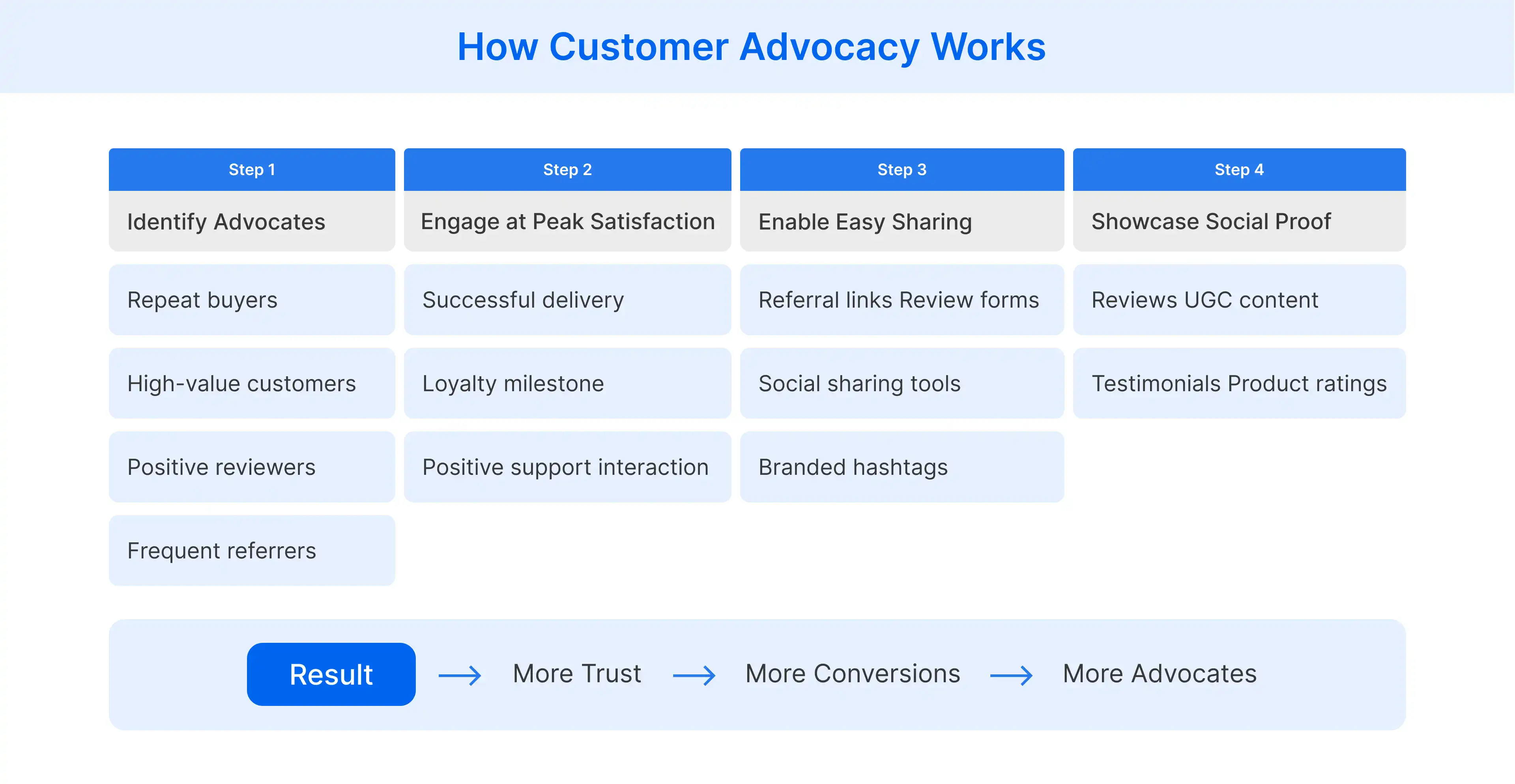
Most customer advocacy programs follow four stages:
- Track High-Goodwill Customer Milestones: Use your data backend to identify potential advocates: repeat buyers, customers with high order value, and individuals who consistently leave reviews or refer others. These signals indicate a customer who is already predisposed to share their experience.
- Ask at the Right Moment: The highest-conversion point to request advocacy action is immediately after a positive experience, a successful delivery, a resolved support ticket, or a loyalty milestone. Asking at peak satisfaction produces higher participation rates than generic broadcast emails.
- Provide Low-Friction Sharing Tools: Reduce the barrier between the advocate's intent and the sharing action, as complicated sharing processes often reduce participation rates. One-click referral links, pre-populated social messages, branded hashtags, and simple review submission forms all increase program participation.
- Display Social Proof Natively: Collect organic reviews, user-generated video, and ratings, and feature them prominently across product listing pages, checkout screens, and campaign landing pages. Displayed advocacy content turns browsing traffic into confident buyers by showing real customer outcomes at the exact moment a purchase decision is forming.
What Are the Main Benefits of Advocacy Marketing in Ecommerce?
- Drastically Lowers Customer Acquisition Cost (CAC): Brands spend significantly less per acquired customer. Referral programs can help reduce customer acquisition costs by encouraging existing customers to bring in new buyers.
- Drives Higher Customer Lifetime Value (LTV): Referred customers arrive with pre-existing trust established by someone they know. This baseline trust leads to higher purchase frequency, larger average order values, and lower churn.
- Builds High-Trust Social Proof: Every organic review, forum post, and tagged social video is an authentic asset your brand does not have to create or pay for. This user-generated content UGC is a credible proof that influences purchase decisions.
- Accelerates Brand Community Growth: Recognizing and rewarding vocal advocates deepens their sense of ownership in the brand's success. This emotional investment increases long-term retention and creates a core base of customers who actively bring others into the community.
Common Formats Used to Turn Customers into Brand Advocates
- Two-Sided Referral Programs: Mutual reward structures, such as a discount for both the referrer and the new buyer, create shared incentives. Two-sided reward models are widely used because they create value for both the referrer and the new customer.
- User-Generated Content (UGC) Campaigns: Customers are prompted to post photos or videos of their purchases using a specific branded hashtag, in exchange for community recognition, reward points, or entry into a prize draw. UGC functions simultaneously as social proof, advertising, and community building.
- Native Review and Rating Systems: Post-purchase prompts that invite buyers to leave structured feedback directly on product listing pages. These reviews surface inside the purchase decision environment and are among the highest-impact advocacy formats for converting new shoppers.
- VIP Loyalty Communities: VIP programs deepen advocacy by creating a sense of earned belonging that casual customers do not have access to. Create exclusive tiers that give the top segment of buyers early access to product launches, private community access, or personalized brand interactions.
Advocacy Marketing vs. Affiliate Marketing vs. Influencer Marketing
These three strategies are frequently grouped together, but their financial structures, content authenticity, and audience relationships are fundamentally different. Understanding the distinctions is essential for allocating budget across the right channels in a benefits of advocacy marketing framework.
|
Strategy Attribute |
Influencer Marketing |
Affiliate Marketing |
Advocacy Marketing |
|
Financial Relationship |
Paid upfront via flat fees or legal contracts |
Performance-based commission per sale or click |
Unpaid or incentivized via loyalty perks |
|
Motivation |
Professional content creation and audience reach |
Financial return from traffic generation |
Genuine brand passion and community belonging |
|
Audience Relationship |
Public followers and macro digital fanbases |
General web traffic and anonymous search users |
Intimate social circles, including friends, family, and peers |
|
Content Authenticity |
Medium, disclosed as paid sponsorship |
Low to medium, driven by tracking links |
High, unbiased, firsthand user experience |
|
Brand Control |
High, brand approves deliverables |
Medium, brand controls landing pages |
Low, organic, brand does not script advocates |
|
Scalability |
Limited by budget per creator |
Scales with traffic volume and affiliate network |
Scales organically with customer base growth |

Conclusion
Advocacy marketing helps businesses turn satisfied customers into trusted brand advocates who influence new buyers through referrals, reviews, and recommendations. When satisfied buyers share genuine experiences with their networks, they deliver conversions that no paid channel can match in trust.
For advocacy marketing to succeed, brands need accurate product information, reliable inventory visibility, and seamless customer experiences. Flipkart Commerce Cloud (FCC) helps businesses maintain synchronized catalog and inventory data across channels, reducing fulfillment issues that can negatively impact customer trust and advocacy efforts.
Book a demo to learn how FCC helps businesses deliver the consistent commerce experiences that build customer trust, loyalty, and advocacy.
FAQ
Customer advocacy marketing is a strategy that activates a brand's most loyal buyers to organically promote its products to their personal and professional networks. It differs from general advocacy marketing by focusing specifically on the post-purchase customer relationship, turning a completed transaction into the starting point of a long-term referral relationship.
A clear example of advocacy advertising is a customer posting an unboxing video of their purchase on social media and tagging the brand. The content is unpaid, unscripted, and reaches the creator's personal network with full peer credibility. Brands that feature this user-generated content on their product pages are actively deploying advocacy advertising inside their conversion funnel.
The common forms of advocacy marketing include two-sided referral programs, user-generated content campaigns, native review and rating systems, and VIP loyalty communities. Each format activates a different segment of the customer base , referral programs target engaged buyers, while UGC campaigns surface organic social content that functions as persistent, peer-driven advertising.
You build advocacy in marketing by starting with product excellence, creating a brand narrative customers want to align with, and combining that story with meaningful loyalty incentives. From there, you identify high-goodwill customers through purchase behavior data, ask for advocacy at peak satisfaction moments, and make sharing as frictionless as possible with one-click referral tools.
The most effective way to attract advocates is to deliver a post-purchase experience worth talking about, a quality product, on-time delivery, and responsive support. Once that foundation exists, a structured advocacy marketing strategy with double-sided referral rewards and VIP recognition activates sharing behavior. Brands using Flipkart Commerce Cloud can ensure every referred customer lands on a fully accurate, in-stock product page.
The benefits of advocacy marketing include lower client acquisition costs, increased customer lifetime value, and stronger social proof. Empowering brand ambassadors to share authentic recommendations drives the organic adoption of new products. For modern enterprise stores, launching an effective advocacy marketing campaign optimizes long-term retention and deepens brand loyalty.
The difference between advocacy marketing and influencer marketing centers on compensation and authenticity. Influencer marketing involves paid commercial contracts to target specific social media followers. Conversely, advocacy marketing relies on real customer advocates sharing genuine passion on social networks, offering unbiased peer validation that paid sponsorships simply cannot replicate.
Industries best suited for advocacy marketing include lifestyle verticals, direct-to-consumer apparel, and viral consumer sectors, much like Starbucks has mastered. Any brand reliant on peer validation thrives by showcasing real customer case studies. Flipkart Commerce Cloud empowers these businesses by ensuring accurate backend operations back up every single customer recommendation.