
July 2, 2025
What is Promotion Management?
Promotion management is the strategic process of planning, executing, and analyzing promotional campaigns to achieve marketing objectives. It encompasses various activities designed to boost sales, enhance brand visibility, and foster customer loyalty in retail and e-commerce environments.
Drishti, Manager - Digital Marketing

Table of Contents
- What is Promotion Management?
- Why is Promotion Management Important for E-commerce Success?
- What Are the Key Components of an Effective Promotion Management Process?
- What Types of Promotions Work Best in E-commerce?
- How Can Retailers Overcome Common Challenges in E-commerce Promotions?
- Which Best Practices Maximize Sales Through E-commerce Promotions?
- How FCC’s Promotion Management Software Can Help
What is Promotion Management?
Promotion management is the systematic process of planning, executing, and evaluating promotional activities to effectively drive customer engagement and sales while maintaining brand integrity. It encompasses coordinating various promotional elements across multiple channels to achieve business objectives.
- Strategic Planning: Creating promotional calendars aligned with business goals, seasonality, and consumer behavior patterns.
- Multi-channel Coordination: Synchronizing promotional activities across digital platforms, mobile apps, and physical stores for consistency in messaging.
- Resource Allocation: Distributing budget, inventory, and human resources efficiently to maximize promotional impact and ROI.
- Performance Monitoring: Tracking key metrics to measure promotion effectiveness and make data-driven adjustments in real-time.
- Cross-functional Collaboration: Working with marketing, sales, finance, and inventory teams to ensure promotions support overall business strategy.
Why is Promotion Management Important for E-commerce Success?
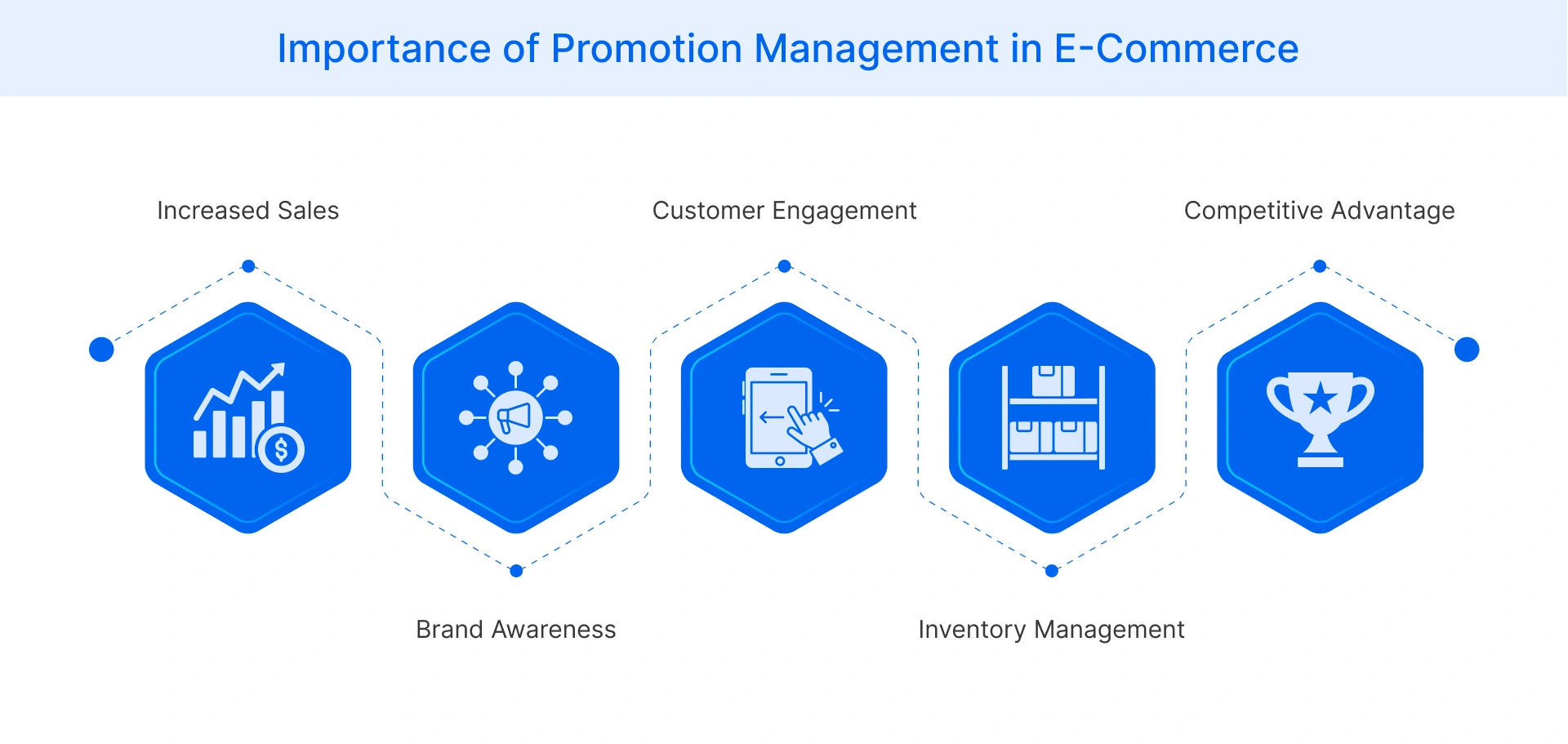
Effective promotion management plays a pivotal role in driving revenue and expanding customer reach. Here are the benefits of well-executed promotion management:
- Increased Sales: Promotions directly boost sales by attracting potential customers and encouraging existing ones to purchase more. They create urgency and incentivize immediate transactions, leading to higher conversion rates.
- Brand Awareness: Strategic promotions raise awareness about products or services, significantly enhancing brand visibility. This exposure helps differentiate your brand in a crowded online marketplace.
- Customer Satisfaction: Promotional activities foster stronger engagement with your customer base, building lasting relationships. Engaged customers are more likely to return and advocate for your brand.
- Inventory Management: Promotions efficiently manage inventory by clearing excess stock or accelerating sales of specific products. This optimizes stock levels and reduces holding costs, improving operational efficiency.
- Competitive Advantage: Effective promotion management provides a distinct competitive edge by attracting customers and fostering a strong brand presence. This strategic advantage helps secure market share and sustain growth.
What Are the Key Components of an Effective Promotion Management Process?
A successful promotion management framework requires several interconnected elements working in harmony to deliver and optimize promotional campaigns that drive measurable business results.
- Planning: The foundation involves defining clear objectives, identifying target audience segments, allocating appropriate budgets, and developing specific promotional tactics aligned with your overall business strategy.
- Implementation: This execution phase focuses on creating compelling promotional assets, configuring promotion rules in your e-commerce platform, coordinating launch timing, and ensuring seamless integration across all customer touchpoints.
- Monitoring and Analysis: Continuous tracking of key performance indicators allows for real-time assessment of promotion effectiveness, comparing actual results against forecasts, and gathering customer feedback to identify improvement opportunities.
- Integration: Effective promotion management requires seamless coordination between marketing, sales, inventory, and customer service teams to deliver consistent messaging and exceptional customer experiences throughout the promotional lifecycle.
What Types of Promotions Work Best in E-commerce?
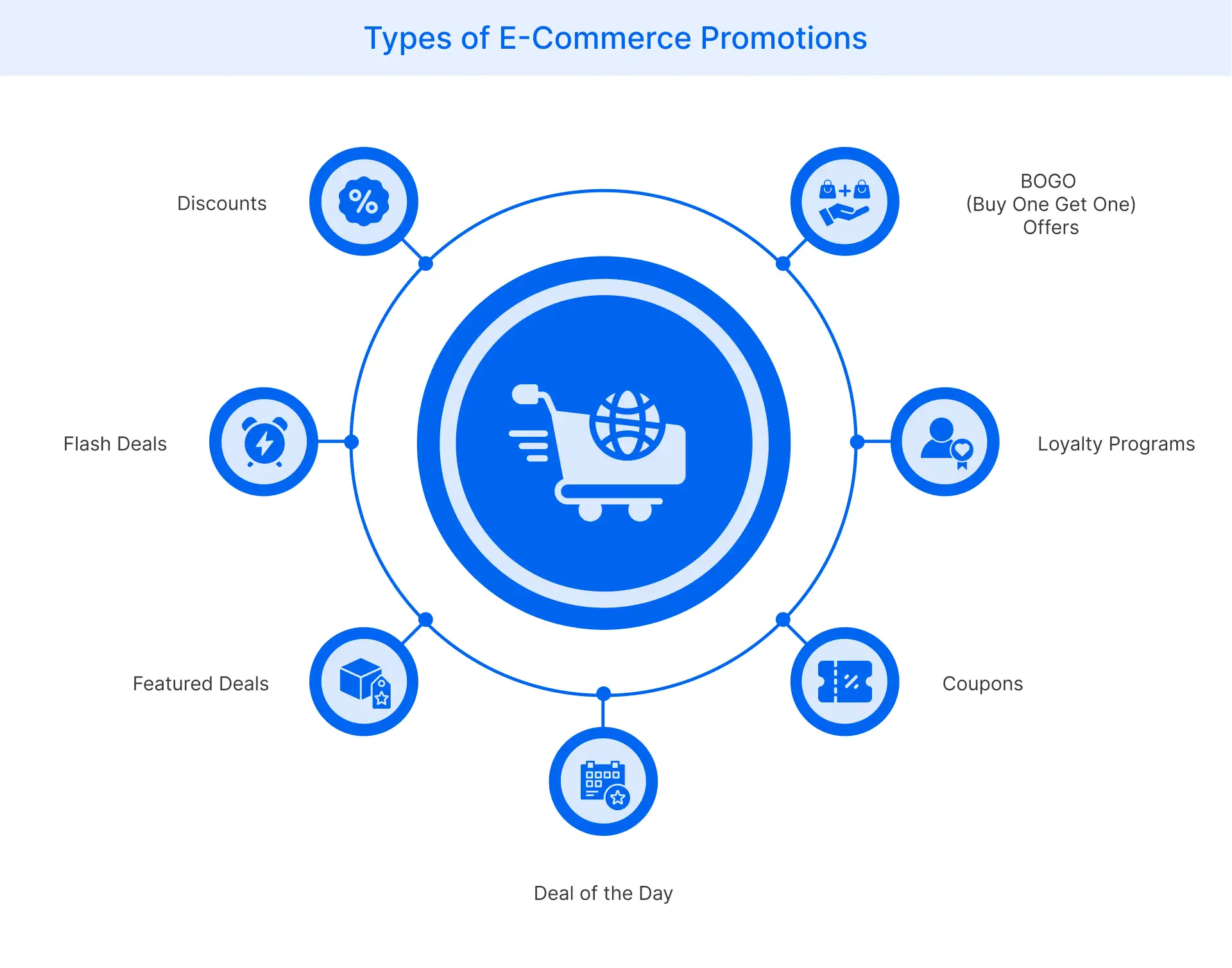
E-commerce businesses can leverage various promotion strategies, each serving distinct purposes across the customer journey.
Discounts
Discounts are versatile tools for converting hesitant shoppers and managing inventory. You can implement percentage-off (e.g., ‘20% off all summer dresses’), fixed amount (e.g., ‘Save $10 on orders over $50’), or tiered discounts (e.g., ‘Buy 2, get 15% off; Buy 3+, get 25% off’) to incentivize purchases, catering to different customer segments and maximizing sales.
Flash Deals
Flash deals leverage time-sensitive urgency, prompting immediate purchases. These short-duration promotions, such as ‘Limited 2-hour sale on electronics,’ create excitement and a fear of missing out. Ensure they don't devalue the brand or product perception by offering high-demand items at a significant, but sustainable, markdown.
Featured Deals
Featured deals highlight specific products or categories by giving them prominent placement on your homepage or category pages. Unlike regular promotions, these strategic placements, such as ‘Editor's Pick: Top Gadgets of the Month,’ draw attention to key items, driving targeted sales and increasing product visibility on your platform.
Deal of the Day
Implementing a rotating daily deal creates habitual shopping behavior among the customers, encouraging them to check the site regularly. Carefully select products for these daily offers, like ‘Today's Steal: 50% Off Wireless Headphones,’ to maximize conversion rates and encourage repeat visits to the e-commerce store.
Coupons
Coupons offer flexibility for targeted marketing campaigns or specific customer segments. Distribute them through various channels, such as email newsletters (‘Your exclusive 15% off coupon’), social media, or affiliate partnerships, to attract new customers, reward loyal ones, or clear out particular product lines effectively.
Loyalty Programs
Loyalty programs build sustainable relationships by rewarding repeat purchases, such as earning points for every dollar spent that can be redeemed for discounts or exclusive products. Structure these programs to incentivize continued engagement, fostering long-term customer retention beyond one-time promotional discounts and strengthening brand advocacy.
BOGO (Buy One Get One) Offers
BOGO offers are effective for moving specific inventory while providing perceived value to customers (e.g., ‘Buy one T-shirt, get one 50% off’). Strategically structure these promotions to ensure profitability and encourage higher basket sizes, appealing to the desire for a good deal while clearing excess stock or promoting new arrivals.
How Can Retailers Overcome Common Challenges in E-commerce Promotions?
Retailers frequently encounter obstacles in managing e-commerce promotions effectively. Here is how specialized platforms, such as FCC Promotion Management software, offer viable solution to these challenges:
- Promotion Complexity: Advanced promotion management platforms simplify the creation of sophisticated promotional rules with visual builders and templates. This enables marketers to craft multi-conditional offers without requiring technical expertise or developer resources.
- Data Fragmentation: Integrated promotion management systems consolidate customer, product, and transactional data into unified dashboards. This provides comprehensive visibility into promotional performance across channels and eliminating siloed decision-making.
- Targeting Precision: AI-powered promotion engines analyze customer behavior patterns to deliver personalized offers to specific segments. This dramatically improves conversion rates compared to generic promotions while optimizing marketing spend efficiency.
- Execution Errors: Automated promotion workflows eliminate manual setup processes that frequently lead to costly mistakes. This ensures accurate promotion timing, proper discount application, and consistent messaging across all customer touchpoints.
- Scalability Limitations: Cloud-based promotion management solutions enable retailers to simultaneously run thousands of promotions across multiple product categories and customer segments. This allows for continuous optimization without overwhelming operational resources.
Which Best Practices Maximize Sales Through E-commerce Promotions?
To optimize promotional performance and maximize sales, e-commerce businesses should adhere to several proven best practices, such as:
- Segment your audience based on behavior patterns and purchase history to deliver targeted offers with maximum relevance.
- Implement mobile-optimized promotion designs that ensure seamless visibility and redemption across all devices and screen sizes.
- Create a promotional calendar that balances regular offers with strategic pauses to prevent discount fatigue and value perception erosion.
- Design clear promotion rules and transparent terms to build customer trust and eliminate confusion about offer eligibility.
- Integrate social sharing functionality with promotions to amplify reach through customer networks and generate organic referrals.
- Analyze performance data continuously to identify winning promotion patterns and quickly sunset underperforming campaigns.
How FCC’s Promotion Management Software Can Help E-Commerce Platforms?
Flipkart Commerce Cloud's (FCC) Promotion Management software is an intelligent solution designed to help modern e-commerce platforms overcome the challenges of manual, inflexible, and poorly targeted promotional campaigns.
- Promotion Automation and Multi-Tier Offers: The platform features a powerful, rule-based engine that allows businesses to create complex, multi-tier promotions without manual effort. You can configure layered discounts, such as offering 10% off for buying two items and 20% off for buying three, to incentivize larger purchases.
- Precise Audience Targeting: To maximize return on investment, the software enables precise targeting of promotions to specific customer segments. Instead of deploying generic, site-wide offers, you can tailor promotions based on user behavior and other attributes, ensuring the right offer reaches the right customer at the right time.
- Self-Serve Seller Portal: FCC streamlines collaboration with third-party sellers through a dedicated self-serve portal. This feature empowers sellers to easily discover and opt into promotional campaigns, reducing the operational burden on your team and creating a seamless experience for marketplace partners.
- Analytics and Reporting Dashboard: The platform includes an advanced analytics dashboard that delivers real-time insights and comprehensive reports on campaign performance. This allows you to track key metrics, measure the effectiveness of your promotions, and make data-driven decisions to optimize future strategies.
Built on Flipkart's own battle-tested infrastructure, the system is designed to scale and handle high-traffic events without performance issues.
FAQ
E-commerce businesses should strategically plan promotion frequency to maintain brand value. Avoid constant sales, which can train customers to wait for discounts. Instead, intersperse promotions with full-price periods, creating urgency and genuine value perception, thereby protecting your brand's integrity.
Beyond immediate sales, evaluate metrics like customer acquisition cost, customer lifetime value, and repeat purchase rates. Also, analyze changes in average order value and brand sentiment. These indicators provide a holistic view of your promotion's long-term impact and overall effectiveness on your business growth.
E-commerce businesses must adhere to advertising standards, consumer protection laws, and data privacy regulations. Clearly state terms and conditions, disclose any limitations, and ensure pricing accuracy. Compliance prevents legal issues, builds customer trust, and maintains your brand's reputation for ethical practices.
For new product launches, promotions should focus on building awareness and driving initial trials, perhaps through introductory discounts or bundles. For existing inventory, strategies might aim to clear excess stock with deeper discounts or BOGO offers, optimizing inventory flow and maximizing sales.
Promotion management primarily encompasses two types. Trade Promotion Management (TPM) focuses on activities targeting retailers and distributors, aiming to increase product visibility and sales within retail channels. Consumer Promotion Management directly targets consumers, using tactics like discounts, coupons, and contests to drive purchasing behavior.