
February 24, 2026
Remnant Inventory
Remnant inventory refers to unsold advertising space on a retailer's digital platform that is available for purchase at a discounted rate. It allows retailers to monetize every impression by filling empty slots through programmatic auctions or indirect channels.
Drishti, Manager - Digital Marketing

Table of Contents
- What is Remnant Inventory?
- Why Does Remnant Inventory Exist in E-commerce?
- Remnant vs. Premium Inventory: Key Differences
- The Benefits of Monetizing Unsold Ad Space
- Challenges of Managing Remnant Inventory
- Strategies to Manage Your Remnant Inventory
- How FCC Optimizes Your Remnant Strategy
Remnant Inventory
Remnant inventory represents the unsold advertising spots on a website or app after direct and premium sales campaigns conclude. Retailers and publishers utilize this inventory to ensure continuous revenue generation from their digital assets without leaving any ad space empty.
This inventory type typically sells at a lower price point compared to premium placements and frequently trades through automated programmatic channels. Advertisers purchase these slots to achieve wider reach or maintain brand visibility at a more efficient cost per thousand impressions.
- Remnant inventory consists of unsold ad units that remain after all premium placements have been purchased by direct advertisers.
- These units are typically made available at discounted rates through programmatic channels or open auction environments.
- Retailers and publishers use remnant inventory to maintain full ad fill rates and avoid completely empty placements on their platforms.
- When managed strategically, remnant inventory becomes a reliable secondary revenue stream rather than a wasted asset.
What is Remnant Inventory?
Remnant inventory is the collection of ad impressions that a publisher or retailer has not sold through direct sales teams or premium guaranteed deals. It constitutes the "leftover" supply of digital advertising space that remains available after fulfilling all higher-priority campaigns and direct orders.
This inventory typically enters the market through real-time bidding exchanges or ad networks where demand dictates the final price. It allows publishers to clear their supply while offering advertisers an opportunity to bid on ad placements at significantly reduced rates compared to premium inventory.
Why Does Remnant Inventory Exist in E-commerce?
Even the largest retailers cannot sell every impression on their digital shelf at a premium price. Demand from direct advertisers fluctuates with seasons, budgets and market conditions, which means a portion of available ad space will always go unfilled at the desired rate.
Last-minute campaign cancellations, advertiser budget constraints and the natural gap between projected and actual traffic also contribute to the creation of remnant inventory. When a premium buyer does not purchase a particular placement, that slot becomes remnant rather than sitting empty.
The structure of e-commerce advertising itself plays a role as well. Premium placements such as homepage banners or top-of-search positions have finite direct-buyer demand, while the broader volume of run-of-site impressions across category and product pages consistently exceeds what premium channels can absorb at full price.
Remnant vs. Premium Inventory: Key Differences
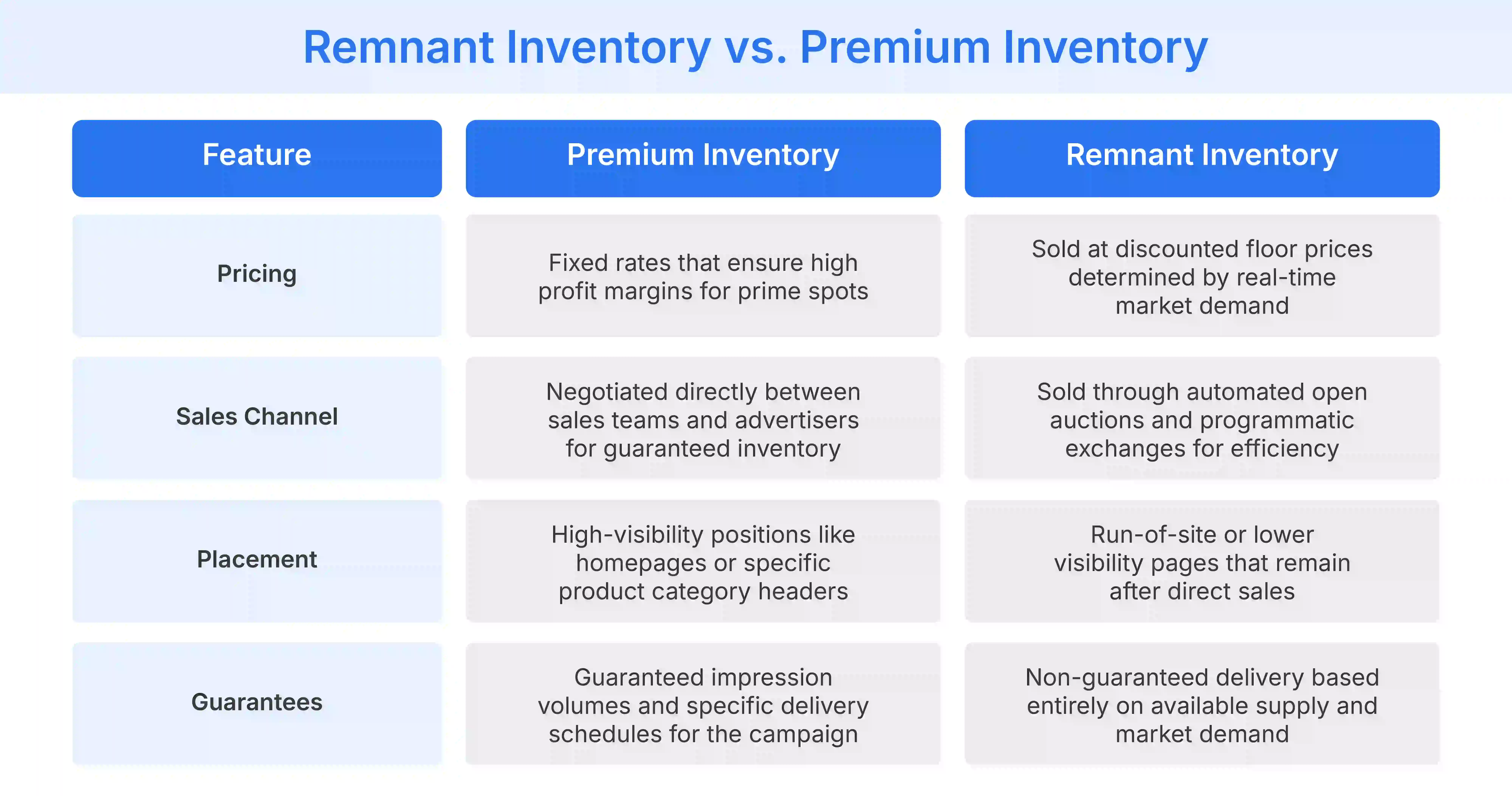
Premium inventory represents the most sought-after placements on a retailer's platform, sold in advance through direct agreements at fixed rates. Remnant inventory, by contrast, consists of whatever space remains after those allocations are made, offered at reduced prices through more flexible buying methods.
The Benefits of Monetizing Unsold Ad Space
Monetizing your unsold inventory transforms potential waste into a steady revenue stream and strengthens your overall yield management strategy.
- Recovering Wasted Yield: Every empty ad slot generates zero revenue. By routing unsold impressions through programmatic channels or open auction systems, retailers can achieve near-complete fill rates and recover yield that would otherwise be lost entirely. Even lower CPMs on remnant placements add up significantly at scale.
- New Revenue Streams: Not every advertiser can afford premium placements on a major retail platform. Remnant inventory gives smaller brands and emerging advertisers access to audiences they could not reach through direct deals. This creates a new and often underutilized revenue stream for retailers willing to open programmatic demand.
- Data Insights: Monitoring the performance of remnant placements provides retailers with actionable data on which ad slots consistently attract strong engagement. Placements that perform well in the remnant channel can be reclassified as premium inventory, helping retailers continuously refine their pricing tiers and maximize overall platform yield.
Challenges of Managing Remnant Inventory
Managing this inventory requires careful attention to protect your brand reputation and ensure that it complements your premium offerings.
- Brand Safety: Automated auctions may display low-quality ads that do not align with your brand values or aesthetics. You must implement strict blocklists and verification tools to ensure that only appropriate content appears on your site.
- Channel Conflict: selling inventory cheaply might undercut your direct sales team if premium advertisers switch to lower-cost programmatic channels. You need to differentiate the value proposition of premium deals to prevent cannibalization of your higher-margin revenue.

Strategies to Manage Your Remnant Inventory
Effective remnant inventory management requires a clear approach for publishers, buyers and an awareness of the risks and pricing dynamics involved at every stage.
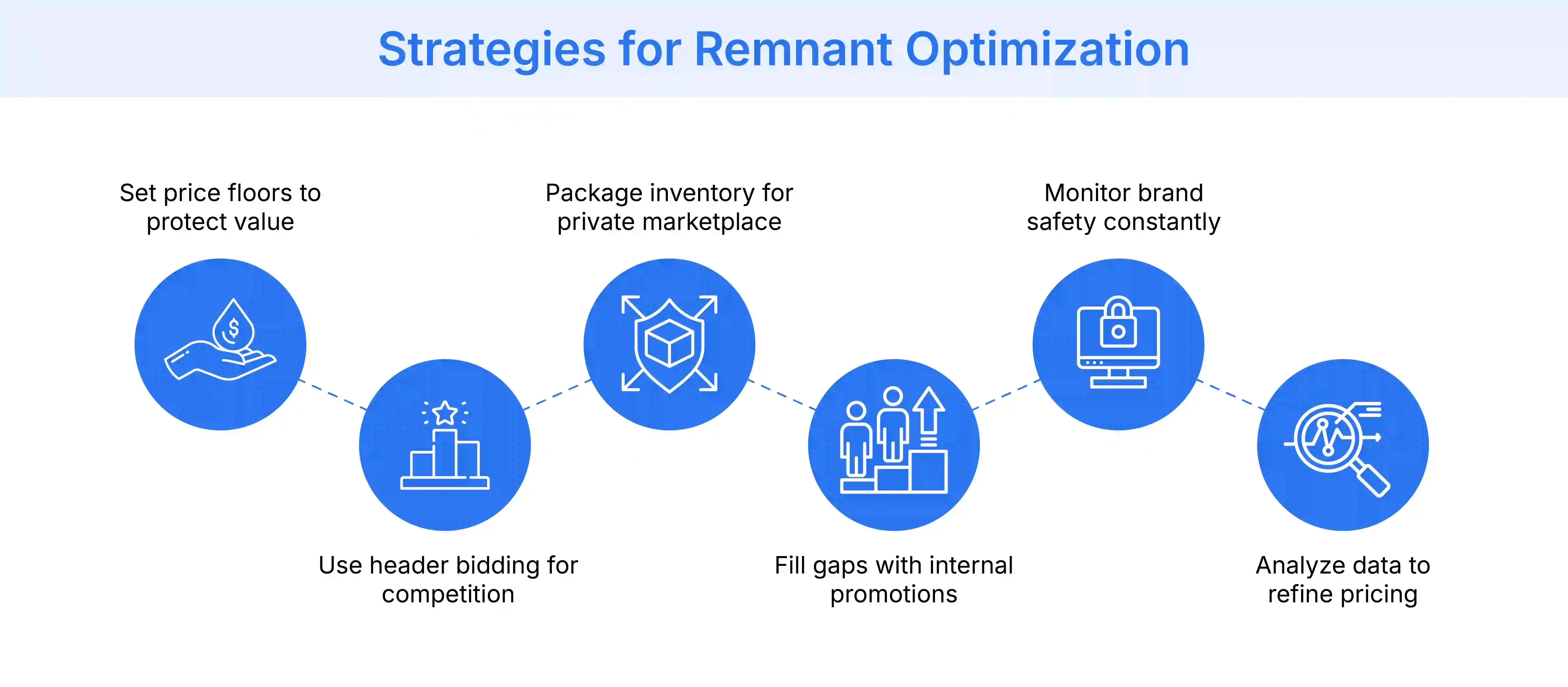
- For Publishers: As a retailer or publisher, you can maximize revenue from unsold placements by using programmatic demand channels, enabling header bidding for simultaneous multi-partner competition and structuring waterfall setups that prioritize the highest-yielding demand source before defaulting to lower-value fills.
- For Buyers: If you are purchasing remnant inventory, partnering with specialized media agencies or real-time bidding platforms gives you access to discounted placements efficiently. These platforms aggregate available remnant supply across publishers and help secure relevant ad slots at significantly lower costs than direct deals.
- Set Price Floors: Establishing a minimum CPM threshold ensures remnant inventory is never sold below a rate that undermines the value of your premium placements. Price floors protect overall yield integrity while still allowing programmatic demand to competitively fill every unsold impression.
- Manage Risks: Remnant inventory is often pre-emptable, meaning a premium advertiser can displace your booked slot at any point before the ad runs. This unpredictability makes remnant unsuitable as a primary channel, reinforcing the need for a diversified media-buying approach.
How FCC Optimizes Your Remnant Strategy
Flipkart Commerce Cloud provides advanced tools that help you maximize the yield from your remnant inventory through intelligent automation. Our platform connects you with a vast network of demand partners to ensure high fill rates without compromising your premium sales.
We utilize machine learning algorithms to predict the value of each impression and route it to the most profitable channel dynamically. This technology ensures that you always get the best price for your inventory while maintaining strict controls over brand safety and ad quality.
You can focus on your core business while our system handles the complexities of programmatic selling and yield optimization. Our solution empowers you to turn your leftover ad space into a significant contributor to your bottom line.
Schedule a personalized demo to see how we can safeguard your bottom line by eliminating hiring mistakes before they happen.

FAQ
Remnant inventory is not necessarily lower quality as it often includes premium slots that simply went unsold. The difference lies in the sales channel and price rather than the inherent quality of the ad placement or audience.
Retailers monetize this inventory primarily through programmatic advertising platforms and ad exchanges that automate the selling process. They may also use it for house ads to promote their own products or services to shoppers.
Remnant inventory refers to the available unsold space while backfill describes the process of filling that space. Backfill is the action or campaign used to occupy the inventory that would otherwise remain empty on the page.
The price is typically determined through real-time bidding auctions where advertisers compete for the available impressions. Supply and demand dynamics in the open market dictate the final cost per thousand impressions for each specific slot.