
December 18, 2024
What is Everyday Low Pricing (EDLP)?
Everyday Low Pricing (EDLP) is a retail pricing strategy that involves offering regularly low prices on products.
Drishti, Manager - Digital Marketing

Table of Contents
- What is Everyday Low Pricing EDLP?
- Rationale behind the Everyday Low Pricing (EDLP)?
- Everyday low pricing vs high low pricing
- Advantages of everyday low pricing?
- Disadvantages of everyday low pricing?
- Enhance your EDLP retail pricing strategy
What is Everyday Low Pricing (EDLP)?
Everyday Low Pricing (EDLP) is a retail pricing method where prices are consistently kept low rather than relying on discount events or promotional campaigns. This approach contrasts with similar pricing strategies like high-low pricing, where prices fluctuate based on promotions. EDLP aims to assure customers that they can always find the lower price for their desired products, encouraging consistent purchasing and high customer satisfaction.
This strategy aims to drive higher sales volumes by maintaining competitive prices year-round. EDLP has proven effective in sustaining strong sales performance, especially for large corporations like the Walmart company, which has built a strong brand reputation using this business model. By always offering the lowest prices, EDLP helps maintain a retailer's market share in a competitive environment.
What is the EDLP Pricing Strategy?
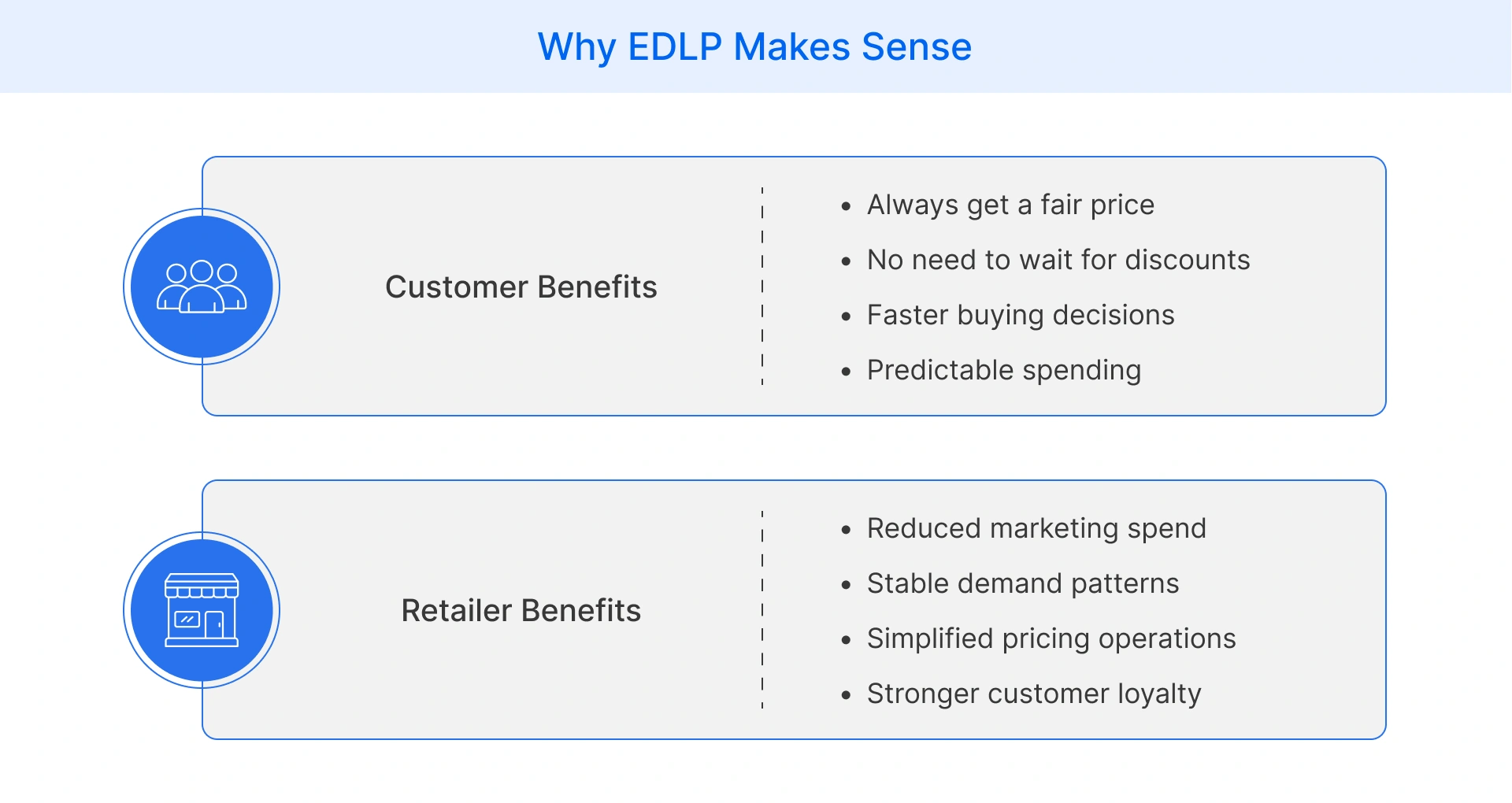
The Everyday Low Pricing (EDLP) strategy operates on the belief that customers are consistently drawn to products with persistently low prices. This approach drives brand awareness by creating the perception that customers are always getting the fair price, which influences their decision to return. The assurance of a product always being priced at its lowest enhances customer loyalty, as they find comfort in the long-term price stability.
From a marketing perspective, the everyday low pricing strategy simplifies the shopper's decision-making process. Customers are relieved from waiting for sale events or using coupons, secure in the knowledge that a specific store or product offers low prices daily. For retailers, this strategy reduces the need for dynamic pricing adjustments or frequent promotional campaigns.
Given that the EDLP strategy aims to drive profit through high sales volumes, it is most effective when applied to certain products and categories, such as premium product selection that is regularly added to a customer's basket. This strategy ensures that customers are attracted to the products and remain loyal due to the consistent value they receive. The biggest benefit of EDLP is the ability to sustain a steady volume of items sold, which is crucial for retailers with a long timeframe for return on investment.
Everyday low pricing vs high-low pricing
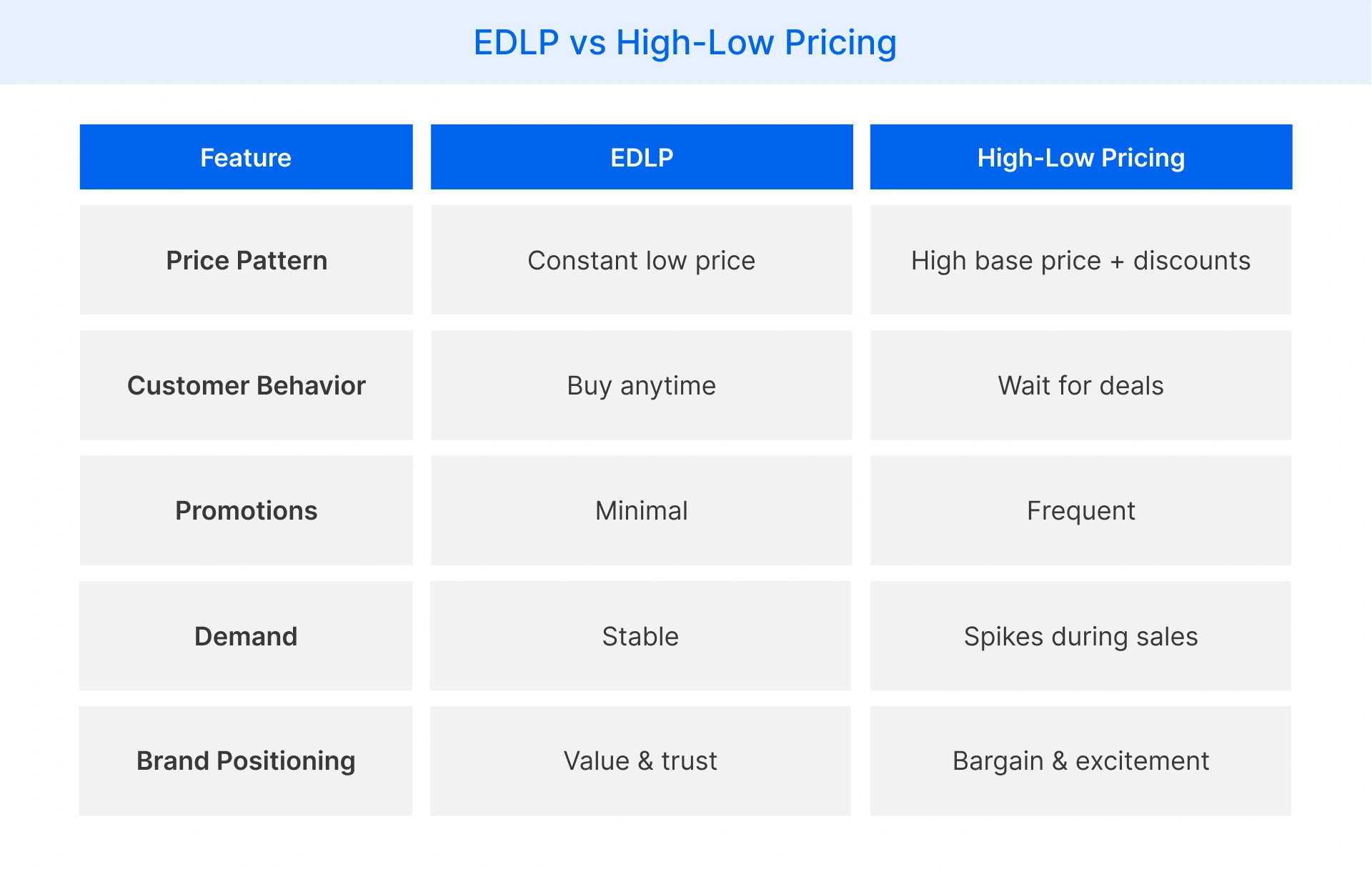
High Low Pricing is a method where companies initially set high prices for their products and later reduce them through promotions, markdowns, or clearances. This approach creates the perception, or some might argue, the ‘illusion’ of a bargain once discounts are applied. The strategy is often employed to attract customers and leverage the excitement of a sale to promote products with higher profit margins.
In contrast, the everyday low price strategy, with its continuous and unchanging nature, is quite distinct. EDLP maintains a constant price, whereas High Low Pricing involves a strategic timing approach. Deciding which strategy aligns best with your unique business goals requires understanding your products, product categories, and brand positioning. For example, EDLP is particularly effective in the United States market for retailers like Walmart and Costco.
However, the choice between EDLP and High Low Pricing does not have to be binary or absolute. Some businesses opt for a hybrid pricing strategy, applying EDLP to certain products while employing High Low Pricing, competitive pricing, or different pricing strategies for other products.
Advantages of everyday low pricing?
The Everyday Low Pricing (EDLP) strategy offers several advantages. A key benefit is the potential for increased sales over an extended period, driven by customers’ desire for consistently low-prices. Furthermore, retailers employing the EDLP strategy do not need to adjust promotional pricing to compete in the market or attract customers during sales events.
Another significant advantage of the EDLP strategy is that retailers do not need to invest heavily in promoting discount events or low pricing deals, as they offer the lowest fixed prices in the market. A prime example of this strategy’s success is Costco, where the long-term implementation of EDLP has proven profitable and remains their core business model. This approach can also reduce production costs by optimizing the supply chain and focusing on bulk purchases.
Disadvantages of everyday low pricing?
The main drawback is that the everyday low pricing strategy keeps profit margins at lower levels. Given that a store must offer the lowest prices, the profit margin between the cost of the product and its selling price is minimal. As a result, this strategy can only be effective with substantial sales volumes and a long-term plan. The return on investment with this approach can take a significant amount of time, making it potentially unsuitable for certain retailers.
Unlike the High Low Pricing strategy, EDLP does not depend on sensational promotions or enticing customers with special deals. Consequently, a retailer employing the EDLP strategy may lack appeal to customers during special shopping events. This is because the constant low prices may not create the same sense of urgency or excitement as limited-time discounts or sales events.
Enhance your EDLP retail pricing strategy
After a thorough analysis of the Everyday Low Pricing (EDLP) strategy, its benefits, and drawbacks, it can be concluded that EDLP is an effective approach for retailers with high sales volumes and the ability to plan for long-term investment returns. The EDLP strategy can potentially boost the number of loyal customers.
A well-executed EDLP retail pricing strategy can potentially boost the number of loyal customers. By maintaining consistently low prices, a retailer ensures that customers can always secure the best deal, reinforcing their loyalty and encouraging repeat business. This strategy, therefore, serves as a powerful tool for retailers aiming to build a stable customer base while offering the best value every day.
Whether you are just getting started or looking to sharpen your existing pricing approach, the right tools make all the difference. FCC gives retailers the data intelligence and automation needed to implement and sustain an EDLP strategy with confidence, keeping prices competitive, margins healthy, and customers coming back.

FAQ
An example of everyday low pricing is a grocery store keeping a gallon of milk at a constant, low price of $3.00 year-round. Instead of fluctuating between $4.00 and $2.50 during sales, the price remains fixed. This reliability builds customer trust and simplifies the shopping experience for every visitor.
The difference between everyday low pricing and high-low pricing is the frequency of price fluctuations and promotional depth. While high-low pricing relies on temporary discounts to create urgency, EDLP focuses on price stability. Retailers use FCC to track these market differences and choose the most effective strategy.
To implement EDLP into your business, you must first optimize your supply chain to support lower profit margins. Shift your marketing focus from temporary deals to permanent value propositions. Utilizing the FCC platform helps automate this transition by automating price adjustments and providing the data needed to maintain thin but consistent profit margins.
Everyday low price means a retailer commits to consistently low prices on products year-round, rather than relying on temporary promotions or discount events to attract shoppers. The strategy builds customer trust through price stability, removing the need for buyers to wait for sales. Walmart popularized this model and built its brand identity around it.
An everyday low pricing strategy is a retail approach where businesses maintain fixed, competitive prices on products rather than fluctuating them through seasonal promotions or markdowns. The EDLP model drives revenue through sustained high sales volumes rather than high margins. Flipkart Commerce Cloud equips retailers with the pricing intelligence needed to execute this strategy profitably.
An Everyday Low Pricing (EDLP) strategy can boost profits by driving customer loyalty, reducing promotional costs, and optimizing inventory management. Consistent low prices attract customers seeking value, leading to increased sales volume and higher revenue. Eliminating the need for frequent sales and discounts saves significant marketing expenses. Predictable demand with EDLP allows for better inventory control, reducing stockouts, markdowns, and carrying costs, ultimately improving profit margins.
The main advantage of everyday low pricing is that it builds consistent customer loyalty through price transparency and eliminates heavy promotional spending. The key disadvantage is razor-thin margins that require high sales volumes to remain profitable. Retailers must carefully evaluate their cost structure and inventory turnover before committing to an EDLP approach long-term.