
December 19, 2024
Retail Pricing
Retail pricing is the final cost that consumers pay for goods in retail stores and platforms. This price is decided after considering costs, supply, and demand conditions.
Drishti, Manager - Digital Marketing

Table of Contents
- What is the retail price?
- What is the manufacturer’s suggested retail price?
- How is retail pricing set?
- Example of the retail price
- How does the retail price differ from the wholesale price?
- Conclusion
What is retail pricing?
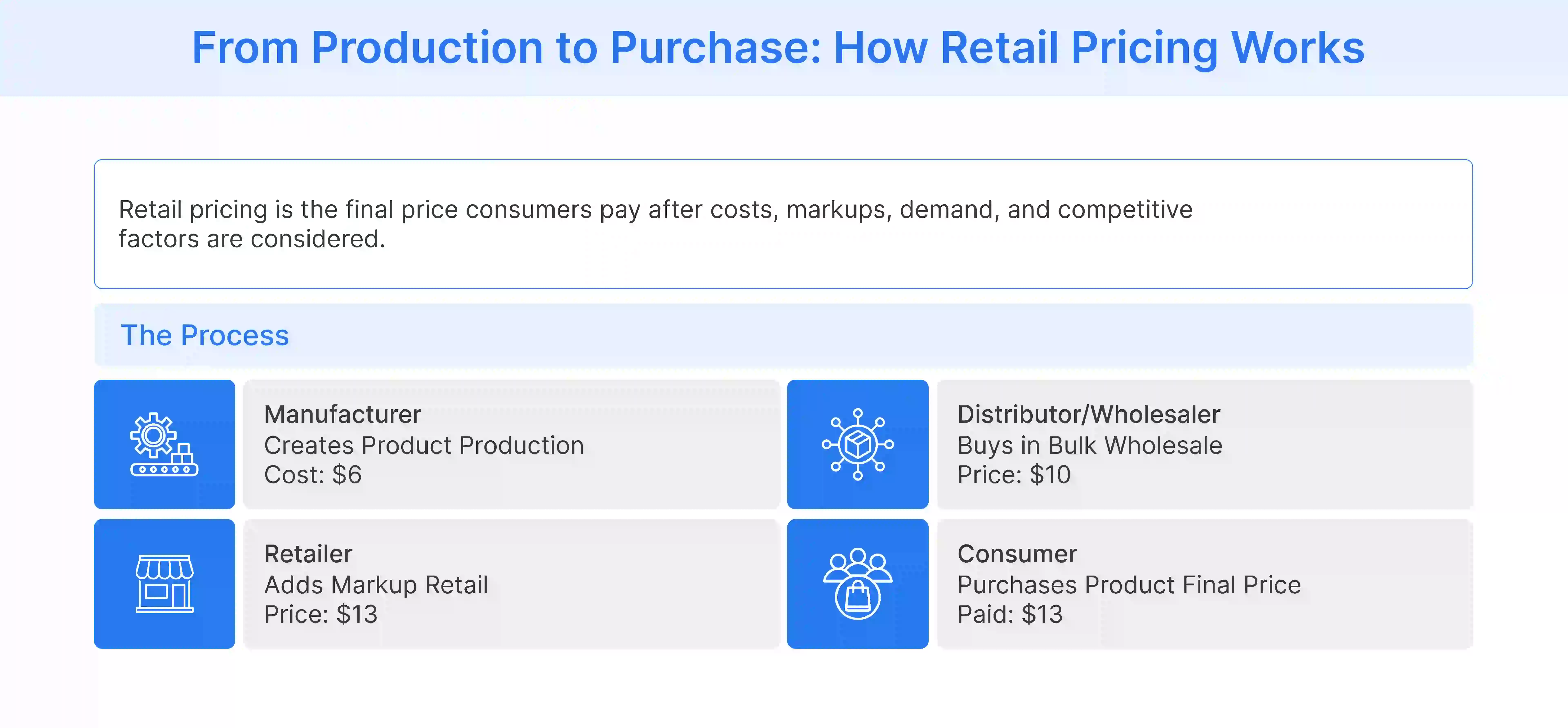
Retail pricing is the cost that end consumers pay for products at retail outlets as well as at different e-commerce platforms.
Retailers set it based on the cost of acquisition and other important factors like market demand, competition, supply chain costs, economic conditions, and broader market dynamics.
For instance, if a retailer buys a product at a wholesale price, they add a markup to determine the right price that can offer them a competitive advantage.
This markup covers operational costs and allows for profit. The Manufacturer's Suggested Retail Price (MSRP) can also significantly impact the retail price of a product, but ultimately, the retailer has the final say in determining this amount.
What is the manufacturer's suggested retail price?
The Manufacturer’s suggested retail price (MSRP) is the price recommended by a product's manufacturer for retail sale. It is often used in the automobile industry, but it also applies to most retail products.
The MSRP reflects all costs associated with the manufacturing and selling process, as well as an average markup by retailers.
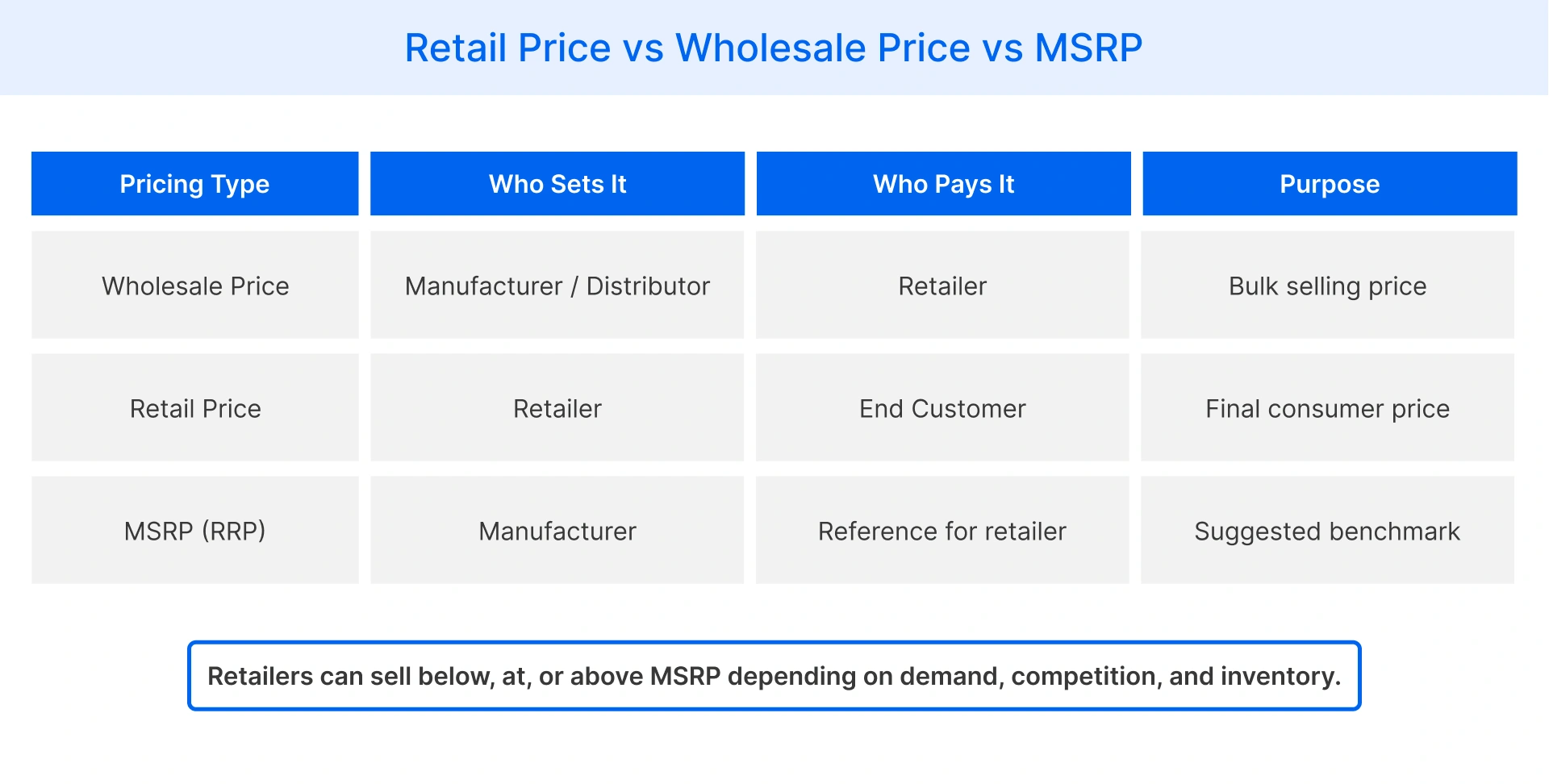
It serves as a reference point for consumers and helps standardize price points across different retail locations. However, it's not a price ceiling or minimum; retailers can sell products at, below, or above the MSRP based on factors like demand, competition, and inventory management.
Also read: Retail Pricing Strategies
How is retail pricing set?
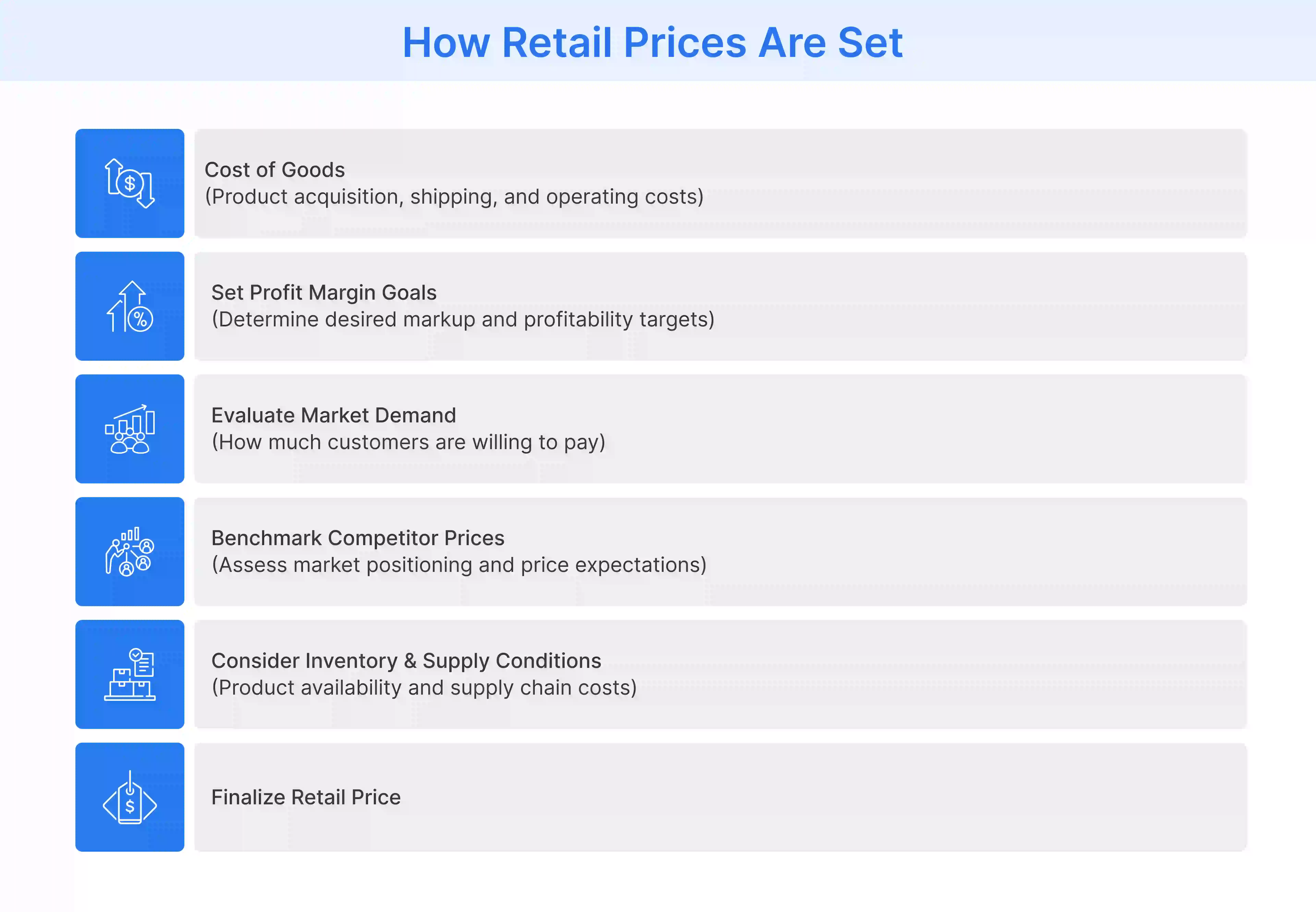
Setting the retail price is a complex process that involves several key factors:
- Production Costs: They cover the expenses related to the creation of a product. This includes the cost of raw materials, labor, and overhead costs associated with manufacturing the product.
- Markup: Retailers add a markup to the cost of the product to cover operational expenses and ensure profitability. The basic formula for this calculation is: Retail Price = (Cost of item × 100) ÷ (100 − markup percentage)
- Market Demand and Supply: The principles of demand and supply significantly influence pricing. If a product is in high demand but low supply, its price may increase.
- Competition: The pricing strategies of related products from competitors can dictate how a new product is priced. Retailers often set different prices for various products in relation to competitor prices.
- Respecting MSRP: If the manufacturer enforces a strict MSRP, the retailer should adhere to it.
While these factors guide the setting of retail prices, the final decision rests with the retailer.
They must balance competitiveness, market price sensitivity, price elasticity, and sustainable profits to determine the optimal retail price.
Example of retail price
Understanding how to set a retail price is crucial for any retailer. Let's illustrate this with an example:
Consider Sarah, who owns a local bookstore. She buys 500 copies of a popular novel from a distributor at $10 per book. The distributor had originally purchased the books from the publisher at $6 per book. The publisher's suggested retail price (MSRP) is $15 per book.
Sarah is aware that the bookstore on the next block sells the same novel for $15. She wants to offer the best deal in town, so she decides to sell the books for $13, which is a $3 markup from her cost. Customers appreciated her competitive pricing strategy, which was lower than the MSRP, helping boost sales volumes.
Sarah can calculate retail prices in several ways. One simple method is to use the Retail Price Formula, which is as follows:
Retail price = Markup + Cost of Goods
Here,
Cost of Goods = Retail Price - Markup
Markup = Retail Price – Cost of Goods
However, setting pricing solely based on markup is not ideal. Retailers should think about the market demand, existing competition, and customer sentiment while deciding on the optimal price.
How does the retail price differ from the wholesale price?
The retail price and wholesale price are two critical product pricing points in the supply chain.
The wholesale price is the cost that a retailer pays to a manufacturer or wholesaler for products in large quantities. This wholesale pricing model allows suppliers to sell products in bulk at lower rates before retailers apply markups.
This price is generally less than the retail price. The difference between retail price and wholesale price is the retailer's markup, which covers operational costs and allows for profit.
In order to qualify for wholesale prices, a business typically needs to meet the minimum order quantity (MOQ) to receive a bulk discount. Often, the buyer is required to validate their business status, which can be done by providing business registration documents or resale certificates.
On the other hand, the retail price is the final cost that consumers pay for individual products in stores or online. This price is set by retailers and includes a markup to cover business costs and profit.
Retail prices are generally set at higher levels than wholesale prices, and they are the prices that the general public pays for products.
Conclusion
Retail pricing determines the final amount customers pay for products and directly influences profitability, competitiveness, customer perception, and long-term customer loyalty. By balancing costs, demand, competition, and pricing objectives, retailers can set prices that support both sales growth, market share, and long-term profitability.
Flipkart Commerce Cloud helps businesses optimize retail pricing through advanced merchandising, pricing, and retail media solutions that support better decision-making across channels. With FCC’s Retail Media Platform, brands can improve product visibility, drive customer engagement, and maximize revenue opportunities.
Book a demo to optimize retail pricing and accelerate your business growth.

FAQ
The Manufacturer's Suggested Retail Price (MSRP) and the retail price are two distinct concepts in pricing strategy. The MSRP is a price recommended by the manufacturer, reflecting the costs of production and selling a product. It serves as a benchmark for retailers and helps standardize prices across different retail locations.
However, the retail price is set by the retailer and is the final cost that consumers pay for a product. It is influenced by factors like the cost of acquisition, target market, competition, and desired profit margins.
The terms' market price' and 'retail price' are often used in the context of retail pricing strategies. The market price refers to the present price at which a product or service can be purchased or sold; the dynamics of supply and demand shape it.
On the other hand, the retail price is the final cost that consumers pay for a product. Retailers set it and include a markup to cover business costs and profit. While these two prices may sometimes coincide, they can also differ based on factors like competition, market trends, and retailer strategies.
Cost price and retail price are two key terms in a product's pricing strategy. The cost price, often listed under the cost of goods sold (COGS) in financial statements, is the cost of creating a product or service a company sells. It comprises the price paid for raw materials and direct labor involved in production.
On the other hand, the retail price is the final price that consumers pay for a product. Retailers set this price considering several factors, including the cost price, market demand, competition, and desired profit margins. The retail price typically includes a markup on the cost price, which covers operational expenses and ensures profitability.
While the cost price is a factor in setting the retail price, they are not the same and can vary significantly based on the retailer's pricing strategy.
The calculation of the retail price involves the following formula:
Retail price = Cost of Goods Sold (COGS) + markup
Here:
-
Cost of Goods Sold (COGS): This is the total cost involved in the production or acquisition of the product.
-
Markup: This is the amount added to the COGS to cover operational expenses and ensure profitability.
To determine the retail price, add the COGS to the markup. This formula allows retailers to cover their costs and make a profit while also considering factors like market demand and competition.