
October 24, 2026
Omnichannel Strategy and the Connected Retail Experience
An omnichannel strategy connects retail sales, marketing, and customer service channels to provide a consistent shopping experience. By coordinating customer information, inventory, and orders, retailers can help shoppers move between physical stores, ecommerce websites, mobile apps, and other touchpoints more easily.
Drishti, Manager - Digital Marketing

Table of Contents
- What Is an Omnichannel Strategy?
- How Does an Omnichannel Strategy Work in Retail?
- What Is the Difference Between Omnichannel and Multichannel Retail?
- What Are the Key Components of an Omnichannel Retail Strategy?
- What Are the Benefits of an Omnichannel Strategy for Retailers?
- What Are the Challenges of Implementing an Omnichannel Strategy?
- How Can Retailers Build an Effective Omnichannel Strategy?
- Conclusion
Omnichannel Strategy and the Connected Retail Experience
Customers often interact with several retail channels before completing a purchase. They might discover a product on a marketplace, browse an ecommerce website, check availability through a mobile app, or visit a physical store. These interactions shape the overall shopping experience and influence how customers engage with retailers.
For retailers, maintaining consistent product information, inventory availability, order processes, and customer service across these touchpoints can be challenging. An omnichannel strategy addresses the need for greater coordination between channels. This article explains how the approach works, how it differs from multichannel retail, its key components, benefits, challenges, and practical implementation considerations.
What Is an Omnichannel Strategy?
An omnichannel strategy is a coordinated retail approach that connects sales and marketing channels with customer service to provide a consistent customer experience across different touchpoints. Rather than treating physical stores, ecommerce websites, mobile apps, and other channels as separate interactions, retailers coordinate these channels to help customers move between them more easily.
This approach relies on sharing relevant customer information, inventory data, and order details across channels while aligning the processes that support each interaction. Unlike simply operating multiple sales channels, an omnichannel strategy emphasizes how those channels work together to support a connected customer journey.
How Does an Omnichannel Strategy Work in Retail?
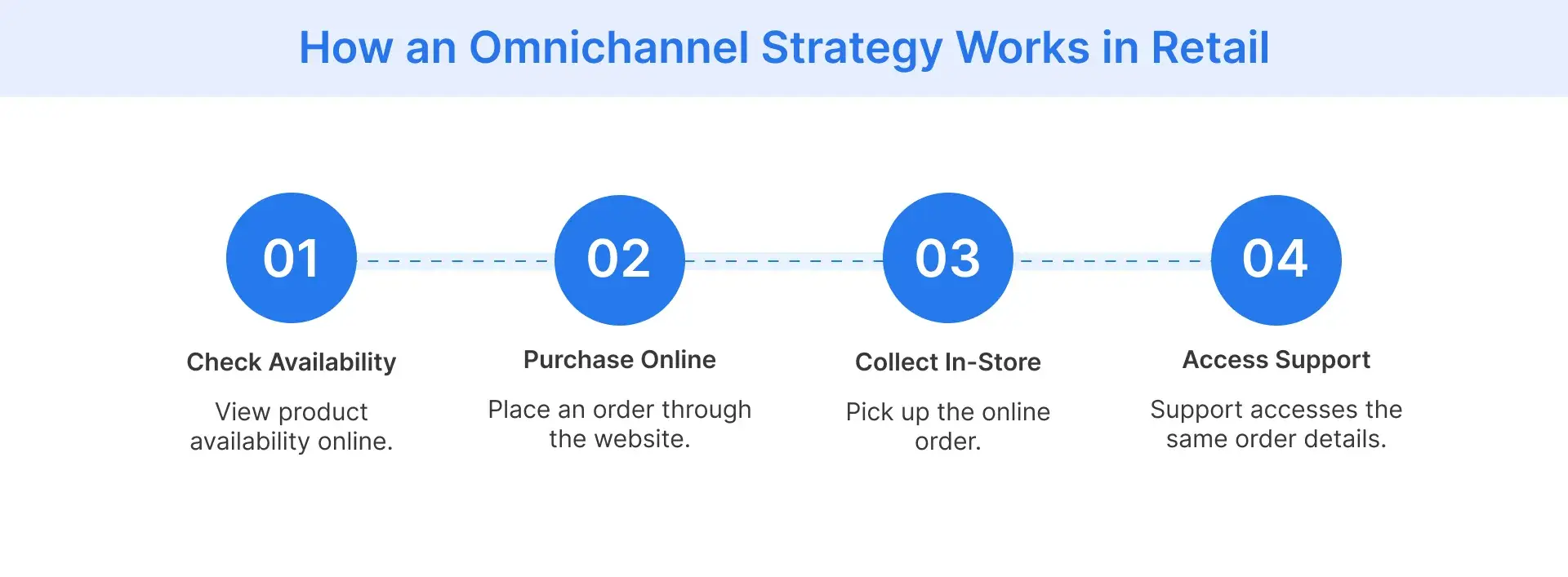
An omnichannel strategy works by connecting retail channels and sharing relevant information about products, inventory, orders, and customer interactions. This coordination allows shoppers to move between physical and digital channels without having to restart their purchasing journey or repeatedly provide the same information.
For example, a customer might check a product’s availability at a nearby store through a retailer’s website and place an order online for in-store pickup. The store receives the order and prepares the item for collection. If the customer later contacts support through the retailer’s mobile app, the support team can access the purchase details to assist them. Depending on the retailer’s capabilities, the customer may also return the product at a physical store.
These interactions are possible when the retailer coordinates information and processes across its sales and service channels. The goal is to provide a connected shopping experience where customers can browse, purchase, collect orders, and receive support through different touchpoints with minimal disruption.
What Is the Difference Between Omnichannel and Multichannel Retail?
The main difference between omnichannel and multichannel retail is how sales and customer service channels are coordinated. Multichannel retail allows businesses to reach customers through multiple channels, such as physical stores, ecommerce websites, and mobile apps, which may operate independently. Omnichannel retail connects these channels to provide a more consistent shopping experience as customers move between touchpoints.
|
Omnichannel vs. Multichannel Retail |
||
|---|---|---|
|
Criteria |
Multichannel Retail |
Omnichannel Retail |
|
Channel integration |
Channels may operate independently with separate systems and processes. |
Channels share relevant information and coordinate processes to support connected customer journeys. |
|
Inventory visibility |
Stock information may be managed separately for each channel. |
Inventory information is coordinated across channels to support product availability and fulfillment. |
|
Customer information |
Customer records and interactions may remain separate across channels. |
Relevant customer information can be shared across channels to provide continuity in customer interactions. |
|
Order management |
Orders are generally processed and managed within individual sales channels. |
Order information and fulfillment processes are coordinated across channels. |
|
Customer experience |
Customers may encounter different processes or need to repeat information when switching channels. |
Customers can move between channels with greater continuity in shopping, purchasing, and support. |
Both approaches provide customers with multiple ways to interact with a retailer. However, offering several channels does not automatically create an omnichannel experience. The distinction lies in how effectively those channels share information and support customers throughout their shopping journeys.
What Are the Key Components of an Omnichannel Retail Strategy?
An effective omnichannel retail strategy requires retailers to coordinate information, technology, and processes across their sales and service channels. While the systems used may vary, several key components help businesses maintain consistent operations and support connected customer experiences.
These components include:
- Connected sales channels: Physical stores, ecommerce websites, mobile apps, and other retail touchpoints need to exchange relevant information. Point-of-sale (POS) systems can connect with ecommerce platforms to help retailers coordinate transactions and sales data across channels.
- Inventory visibility: Retailers need accurate information about product availability across stores, warehouses, and online channels. Inventory management tools help track stock levels and synchronize updates, reducing the risk of displaying unavailable products or accepting orders that cannot be fulfilled.
- Coordinated order management: An order management system (OMS) helps retailers track purchases, order statuses, and fulfillment activities across different sales channels. This coordination supports order processing and gives relevant teams access to the information needed to manage customer purchases.
- Customer data integration: Customer relationship management (CRM) systems can help consolidate purchase histories, preferences, and service interactions across touchpoints. When relevant information is available to authorized teams, retailers can provide more consistent support and better understand customer needs.
- Consistent product information: Product descriptions, specifications, availability, and applicable promotions should remain accurate across channels. Coordinating this information helps customers make informed purchasing decisions and reduces confusion when moving between physical and digital storefronts.
- Coordinated fulfillment: Retailers need processes that connect stores, warehouses, delivery partners, and customer service teams. These processes can support services such as home delivery, in-store pickup, and cross-channel returns where the necessary capabilities are available.
These components work together to support a connected retail experience. Retailers do not necessarily need a single technology platform, but their systems and processes must be able to share the information required for their chosen omnichannel services.
What Are the Benefits of an Omnichannel Strategy for Retailers?
An omnichannel strategy can help retailers create more convenient shopping experiences while improving coordination across sales and service channels. By connecting customer interactions with relevant operational information, businesses can support different shopping preferences and manage retail activities more effectively.
The key benefits include:
- Greater shopping convenience: Customers can move between ecommerce websites, mobile apps, and physical stores without unnecessarily repeating steps or providing the same information. This makes it easier to continue shopping across different touchpoints.
- Flexible purchasing and fulfillment options: Retailers can offer customers more ways to purchase and receive products, including home delivery, in-store pickup, and cross-channel returns where supported. These options allow shoppers to choose services that suit their needs.
- More consistent customer experiences: Coordinated product information, order details, and customer service processes help retailers provide reliable information across channels. Customers can receive support without having to explain their previous interactions repeatedly.
- Improved inventory visibility: Connected inventory information helps retailers monitor stock availability across stores, warehouses, and online channels. This can support more accurate product availability updates and reduce the risk of accepting orders for unavailable items.
- More coordinated order processing: Shared order information allows relevant teams to track purchases, manage fulfillment activities, and respond to order-related inquiries. This can reduce manual coordination and help retailers handle orders across channels more effectively.
- Better use of customer information: Access to relevant purchase histories, preferences, and service interactions can help retailers understand customer needs and deliver more relevant communications. Consistent experiences and useful engagement may also encourage repeat purchases and support customer retention.
These benefits depend on how effectively retailers connect their systems, processes, and teams. An omnichannel strategy creates opportunities to improve customer experiences and retail operations, but successful outcomes require accurate information and consistent coordination across channels.
What Are the Challenges of Implementing an Omnichannel Strategy?
Implementing an omnichannel strategy can be challenging for retailers that already operate multiple sales and service channels. Connecting these operations often requires changes to existing technology, internal processes, and team responsibilities. Without effective coordination, retailers may struggle to maintain accurate information and consistent customer experiences.
Common challenges include:
- Disconnected systems: Retailers may use separate platforms for in-store transactions, ecommerce orders, inventory management, and customer service. Connecting these systems can be difficult, particularly when older technologies have limited integration capabilities or require additional development.
- Inconsistent inventory information: Maintaining accurate stock levels across stores, warehouses, and online channels requires timely updates. Delays or errors in inventory synchronization can lead to incorrect product availability, overselling, and canceled orders.
- Fragmented customer data: Customer purchase histories, preferences, and support interactions may be stored in different systems. Matching customer records across channels while maintaining data accuracy, privacy, and appropriate access controls can add complexity.
- Cross-channel order and returns management: Coordinating online purchases, in-store pickup, deliveries, and returns requires clear processes for tracking orders and updating payment and inventory records. Disconnected workflows can cause fulfillment delays, refund errors, and confusion over order status.
- Technology and integration costs: Implementing connected retail operations may require investment in software, system integrations, data migration, maintenance, and employee training. These expenses can be difficult to manage, especially for businesses with limited technical resources.
- Operational silos and inconsistent processes: Store employees, ecommerce teams, fulfillment staff, and customer service representatives may follow different procedures or work with conflicting information. Without clear responsibilities and communication, customers may encounter inconsistent pricing, policies, or service when switching channels.
Addressing these challenges requires retailers to evaluate their existing operations, identify gaps between channels, and establish reliable processes for sharing information. The extent of these difficulties depends on the retailer’s current systems, organizational structure, and the level of channel integration required.
How Can Retailers Build an Effective Omnichannel Strategy?
Building an effective omnichannel strategy requires retailers to understand how customers interact with their business and determine where better coordination is needed. Rather than connecting every channel at once, retailers can prioritize improvements based on customer needs, existing capabilities, and available resources.
The following steps can guide implementation:
-
Map customer journeys. Examine how customers discover products, compare options, make purchases, and seek support across different touchpoints. Use customer feedback, purchase data, and service inquiries to identify where shoppers switch channels or encounter difficulties.
-
Identify gaps and prioritize channels. Review where disconnected processes create problems, such as inconsistent product availability, repeated customer inquiries, or limited fulfillment options. Prioritize the channels and improvements that address the most relevant customer needs and business objectives.
-
Assess existing technology and data. Evaluate whether current ecommerce, POS, inventory, order management, and customer service systems can exchange the necessary information. Identify integration requirements, data inconsistencies, and operational limitations before introducing new capabilities.
-
Coordinate information and processes. Establish reliable methods for sharing inventory availability, order statuses, product information, and relevant customer records. Define how purchases, fulfillment requests, and returns will be managed when customers interact with multiple channels.
-
Align teams and implement improvements gradually. Establish clear responsibilities across store operations, ecommerce, fulfillment, and customer service, and involve the marketing team in coordinating customer communications. Train employees on connected processes and introduce changes in manageable stages, testing each improvement before expanding it.
-
Monitor performance and refine the strategy. Track key performance indicators (KPIs) such as inventory accuracy, cross-channel order fulfillment, customer satisfaction, and customer retention. Use these findings to identify operational issues, evaluate customer experiences, and determine where further improvements are needed.
Retailers can adapt these steps to their business size, customer expectations, and operational capabilities. The priority is to build reliable connections between the channels customers use, rather than introducing additional services before the business can support them effectively.
Conclusion
An omnichannel strategy helps retailers connect sales and service channels, customer information, and operational processes to provide a more consistent shopping experience. Its effectiveness depends on accurate information, coordinated systems, and clear processes that support customers as they move between touchpoints.
To build a more effective omnichannel strategy, retailers should:
- Identify gaps in customer journeys across sales and service channels.
- Maintain accurate inventory, order, and customer information across relevant touchpoints.
- Introduce improvements gradually and monitor customer satisfaction and operational performance.
Connecting these operations requires technology that supports information sharing across retail channels. Flipkart Commerce Cloud is one option retailers can consider when evaluating CRM integrations and coordinated order and fulfillment workflows.
Explore the Digital Commerce Solution to understand how these capabilities can support more connected retail operations and consistent shopping experiences.

FAQ
Four important pillars of an omnichannel strategy are channel integration, shared customer information, coordinated inventory and order management, and consistent customer experiences. Together, these elements help retailers connect sales and service channels, maintain reliable information, and support customers throughout their shopping journeys.
The key difference is that an omnichannel strategy focuses on coordinating customer experiences across different channels, while unified commerce emphasizes connecting the underlying systems and data that support those experiences. Unified commerce typically brings sales, inventory, orders, and customer information together through a shared technology infrastructure.
Yes, ecommerce-only retailers can implement an omnichannel strategy without physical stores. They can coordinate interactions across websites, mobile apps, social media, email marketing, and customer support channels. Sharing relevant customer and order information helps maintain a consistent shopping experience as customers move between these digital touchpoints.
Yes, small retail businesses can implement an omnichannel strategy by connecting their most relevant sales and customer service channels. They can begin with manageable improvements, such as coordinating online and in-store inventory or sharing order information, before investing in more advanced integrations as their operations grow.