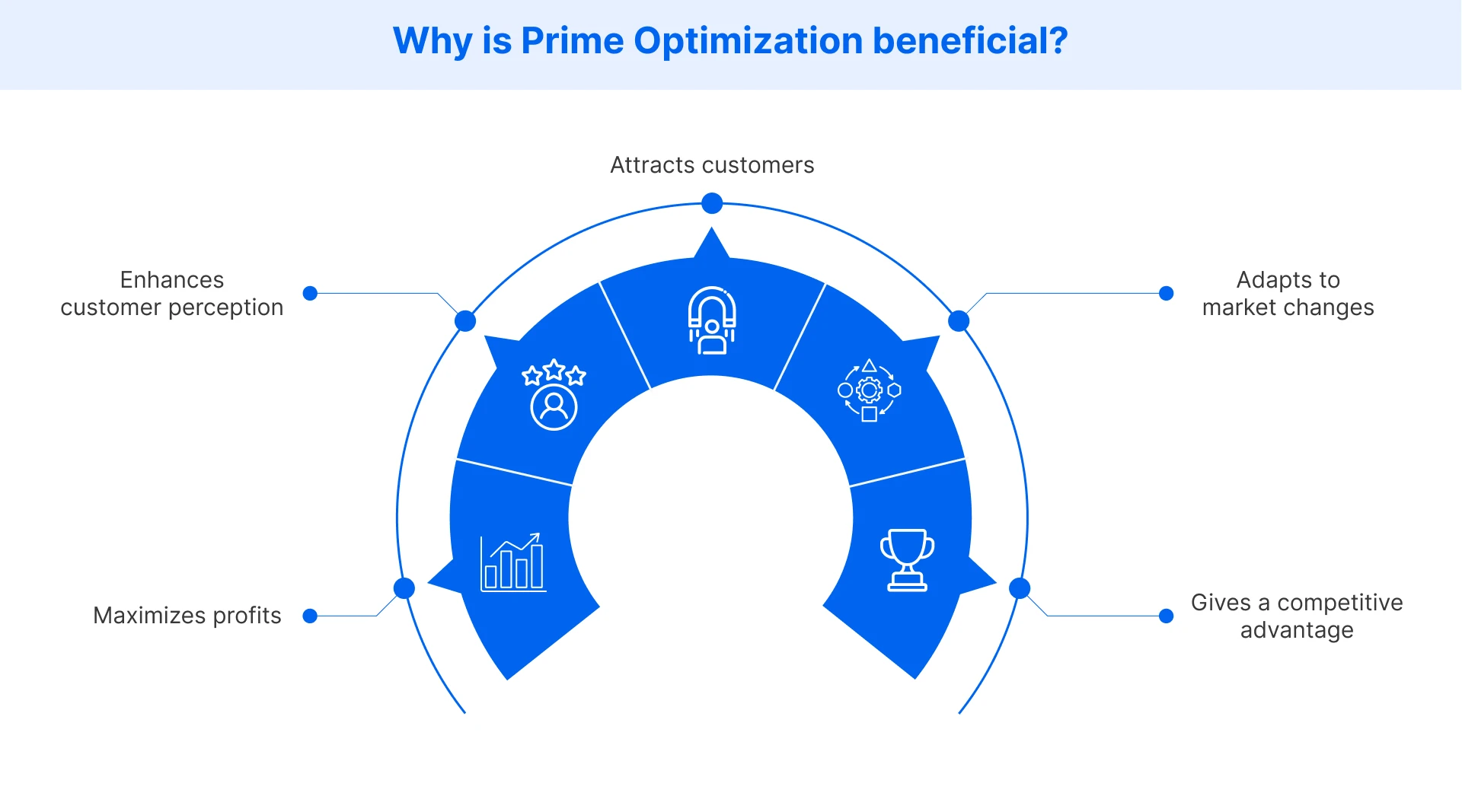
Why is Price Optimization Important?
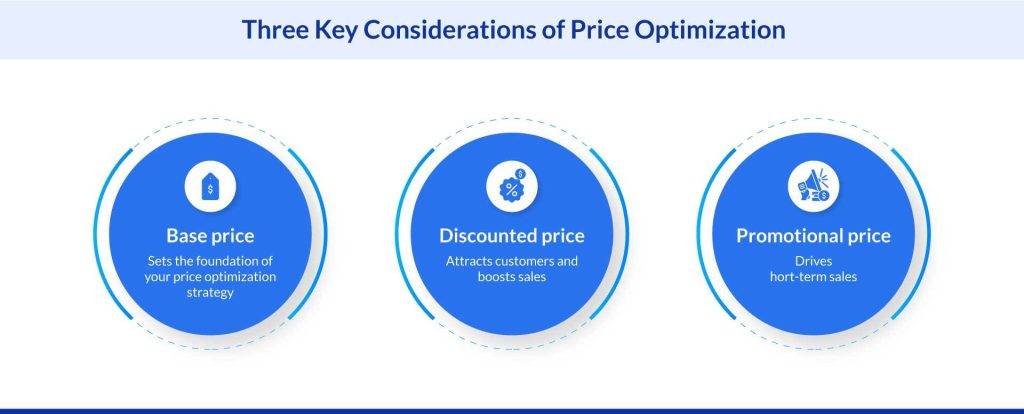
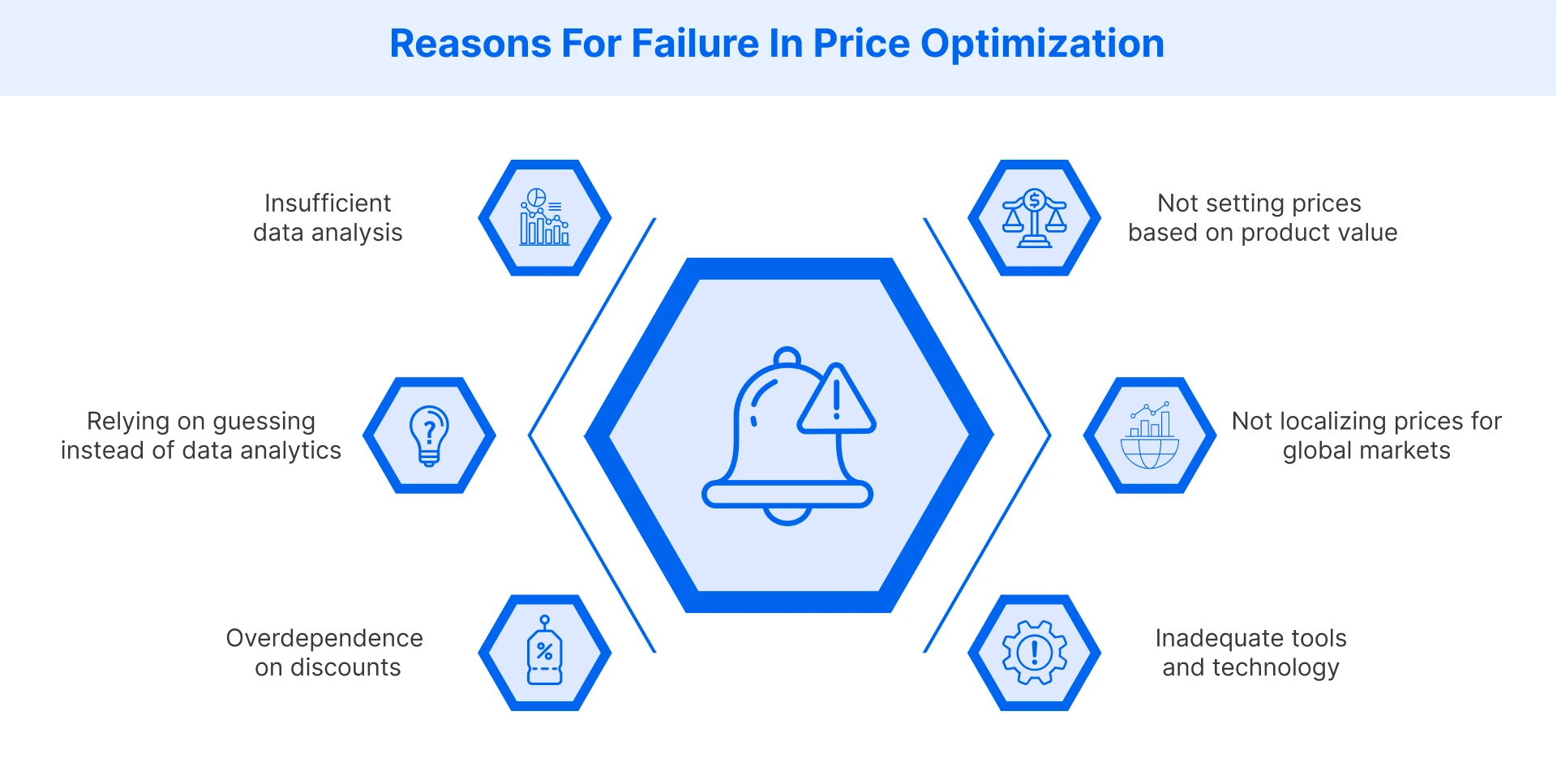
Why do many companies fail in Price Optimization?
How To Optimize Pricing?
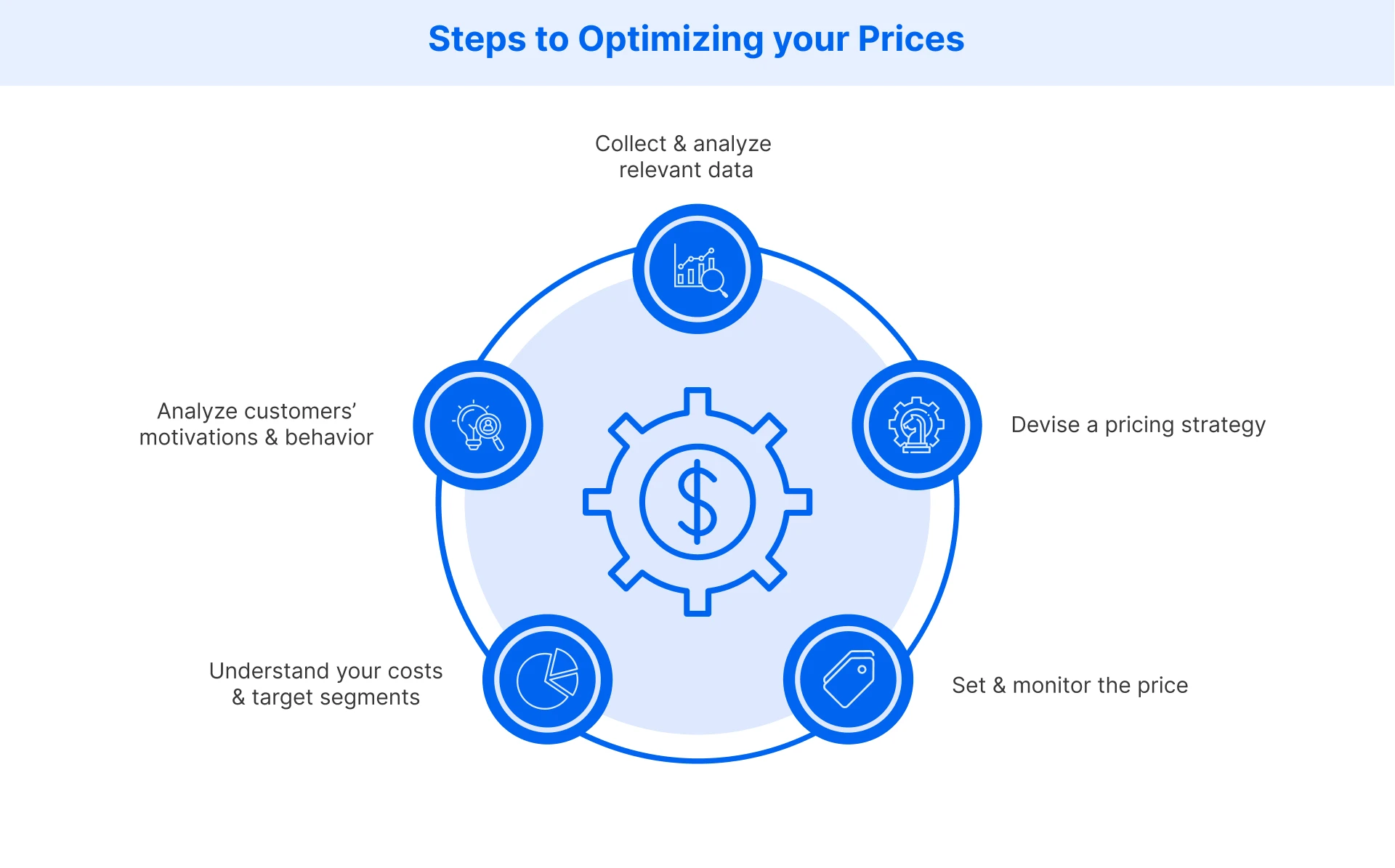
Step 3: Perform comprehensive data analysis
Collect and analyze relevant data, including historical sales data, competitor pricing, market trends, and economic indicators. This data-driven approach enables you to uncover patterns and correlations that inform your pricing decisions. Advanced tools may employ machine learning, game theory and AI algorithms to process and interpret this data effectively.
Step 4: Define the Pricing Strategy
To initiate the process of establishing or adjusting your prices, it's vital to pinpoint a pricing strategy that suits your unique circumstances. The ultimate goal is for this strategy to harmonize with your business objectives and to achieve your desired outcomes through price optimization. For instance, if you're a hospitality business looking to stand out in a crowded market, a tiered pricing model based on exclusive amenities could be advantageous. On the other hand, if you operate in the tech industry, employing a subscription-based pricing strategy could be a more suitable approach to capture recurring revenue from your software solutions.
Step 5: Set and Monitor: Gauge Internal Impact & External Feedback
Implement the pricing strategy by setting prices for your products or services. Regularly monitor the effectiveness of your pricing decisions by tracking key performance indicators such as sales volume, revenue, and profit margins. Continuously evaluate market conditions and customer responses to make necessary adjustments to your pricing strategy over time.

For instance, Kohl's has undertaken a significant transformation in its pricing and promotional approach to enhance its profit margins. The company is shifting away from the extensive use of general promotional offers and cumulative discounts. Instead, it's directing its attention towards price-driven events and tailored, individualized promotions. In addition, Kohl's is introducing a greater selection of premium product lines while carefully distinguishing them from its traditional offerings. Although this new pricing optimization strategy is in its initial phases, it signifies Kohl's proactive response to the evolving retail environment.

Machine Learning's Crucial Role in Pricing Optimization
Machine learning has emerged as an indispensable component within the realm of pricing optimization, revolutionizing the way businesses strategize their pricing models. By leveraging the power of advanced algorithms and data analysis, machine learning offers a comprehensive solution to complex pricing challenges.
Here's a glimpse into how machine learning is reshaping pricing optimization:
- Demand Forecasting: Machine learning leverages a wealth of data sources, including historical sales data and market trends, to predict product demand with exceptional accuracy. Using algorithms like regression models, LSTM, ARIMA, and tree-based models, businesses can anticipate future demand patterns. Armed with these predictions, retailers can make informed, data-driven decisions that optimize pricing strategies, minimizing risk and maximizing revenue.
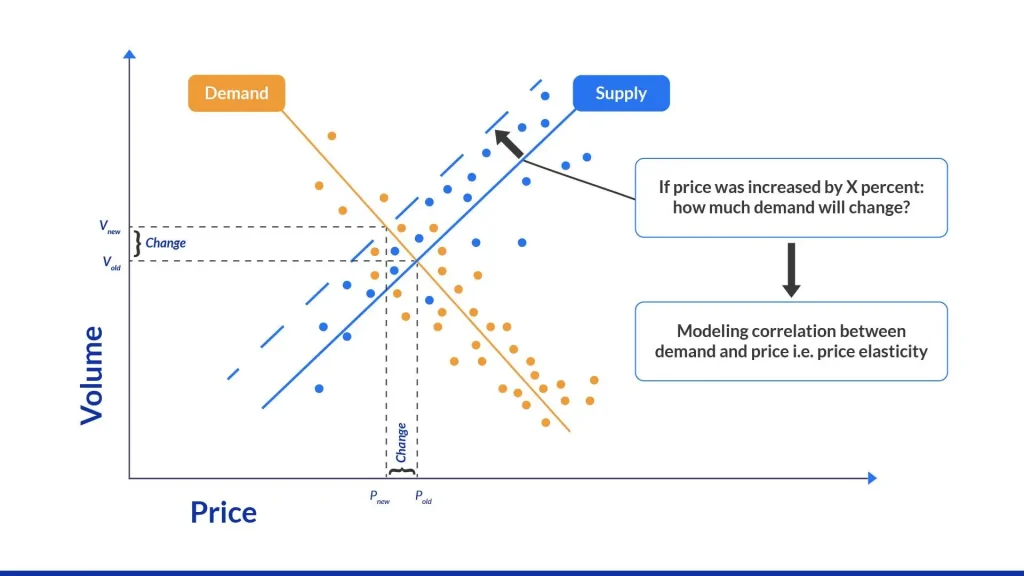
- Price Elasticity: Price elasticity is the measure of how changes in price affect the demand for a product. Machine learning quantifies price elasticity, enabling businesses to set prices that maximize revenue, even if it entails sacrificing some sales. Techniques such as regression models are deployed to analyze this critical facet of pricing optimization.
- Competitive Analysis: Machine learning plays a pivotal role in collecting and dissecting competitor prices, product features, and marketing strategies. This deep understanding of the competitive landscape empowers retailers to strategically adjust their prices to remain competitive in the market.
- Customer Segmentation: Machine learning's ability to segment customers based on purchase history, demographics, and other factors offers retailers a powerful tool for tailoring prices to different customer groups. This personalization not only enhances customer satisfaction but also maximizes profits.
- Real-Time Pricing: The agility of machine learning shines in real-time pricing adjustments. Factors such as demand fluctuations, competitive moves, and inventory levels are dynamically considered. This adaptability enables retailers to respond swiftly to market shifts, optimizing profits and maintaining a competitive edge.
For those eager to unlock the full potential of machine learning in pricing optimization, Flipkart Commerce Cloud introduces a groundbreaking solution - The Pricing Manager. With over 15 years of retail experience and machine learning at its core, this tool combines analytical expertise with category-specific knowledge to craft bespoke and mature pricing strategies for large-scale retail platforms. By applying machine learning and game theory principles, this dynamic pricing engine adapts and evolves, ensuring businesses remain competitive in the ever-evolving world of retail.
Now that we have established the importance of price optimization, let us look at the key features to look for in a price optimization software.
Features To Look For In Price Optimization Software
When considering price optimization software, it's crucial to prioritize features that align with your business goals and needs. For instance, imagine you run a fast-growing e-commerce company specializing in electronics. Your primary business goals are to increase revenue, improve customer loyalty, and streamline your operations. In this scenario, you should prioritize price optimization software that offers dynamic pricing capabilities, real-time market analysis, and integration with your existing inventory management system.
Let us now delve into the key features that should top your checklist when evaluating price optimization solutions.
AI and ML Capabilities
Price optimization software equipped with Artificial Intelligence (AI) and Machine Learning (ML) capabilities stands as a fundamental requirement. These technologies empower the software to process vast amounts of data and unveil patterns that might remain hidden to manual analysis. The machine learning capabilities enable the software to continually learn from past pricing decisions and market trends, enhancing its accuracy over time.
Allow Testing Scenarios
The ability to conduct testing scenarios is another essential feature. A robust price optimization tool should enable businesses to simulate different pricing strategies before implementation. This functionality aids in understanding potential outcomes and mitigating risks associated with price changes. Through testing, businesses can fine-tune their pricing strategies to achieve optimal results.
Offer Real-time Monitoring
Real-time monitoring is a game-changer in the dynamic world of pricing. A capable pricing software solution should provide ongoing monitoring of market changes, competitor pricing, and customer behavior. Real-time insights empower businesses to swiftly adapt their pricing strategies to capitalize on emerging opportunities or counteract potential threats.
Human-in-the-Loop based rule engine
This feature establishes a collaborative synergy between machine learning algorithms and pricing experts. By defining strategic internal rules and guidelines, pricing experts ensure that the outputs generated by algorithms are accurate, efficient, and aligned with overall business strategy. It allows businesses to harness the strengths of both human insights and algorithmic efficiency, resulting in finely tuned pricing decisions that adapt to market dynamics and business goals.
Offer Dynamic and Multichannel Pricing Capabilities
In the modern marketplace, pricing strategies must be flexible and adaptable across various channels. A robust software solution should offer dynamic pricing capabilities, enabling businesses to adjust prices based on real-time data, demand fluctuations, and supply chain changes. Additionally, the software should seamlessly support multichannel pricing, ensuring consistent pricing across different sales channels for a cohesive customer experience.
Here is how FCC has helped Staples, a leading office supplier in the US to improving their price positioning and gaining crucial market share from their competitors.
Unlock Profit Potential with FCC's Pricing Optimization Tools
In the dynamic landscape of pricing strategies, not optimizing can mean leaving money on the table. That's where FCC’s end-to-end price management solution steps in, revolutionizing pricing decisions for your products. Our proprietary pricing algorithm model is based on demand elasticity and principles of game theory to deliver the best pricing performance across categories.
Why FCC's Pricing Platform Stands Out:
- Precision through Micro Parameters with dynamic engine: Achieve significant business impact by managing micro parameters for macro results.
- Proven Algorithmic Excellence: Our algorithms have been tested across millions of SKUs and hundreds of categories, delivering exceptional outcomes for retailers.
- Proprietary Retail Data-Driven: Built on top-notch retail data, our machine learning models ensure higher accuracy and performance.
- Elasticity-Based Optimization: Fine-tune your pricing with a game theory based algorithm that factors in demand elasticity, internal pricing rules, and state-wise variations for accuracy.
- Comprehensive Solution: Elevate your pricing strategy with FCC's suite solutions that encompass market analysis, competition assessment, and demand-supply trend insights.
Ready to maximize your profit potential? Talk to our experts today!

FAQ
You calculate price optimization by using machine learning models that integrate data on price elasticity of demand, competitor prices, inventory levels, and business constraints to solve for the price that yields the highest value for a defined KPI (e.g., maximum profit).
The difference between price management and price optimization is that price management focuses on the operational tasks of setting, maintaining, and updating list prices and discounts, while price optimization is the strategic, data-driven process of calculating the best price to meet a defined business goal.
Economic price optimization is the practice of setting prices by applying microeconomic principles, such as calculating the point where marginal revenue equals marginal cost, often incorporating real-world data on demand curves and elasticity to determine the profit-maximizing price.
There is no single formula for price optimization; instead, it is solved using complex algorithms that typically aim to maximize a specific function, such as Maximize Profit=(Price−Cost)×Volume(Price), where Volume is a function of price elasticity and other variables.
The price optimization theory is based on economic principles stating that for any given product and market conditions, there is an optimal price point that maximizes a specific business objective (usually profit) based on the relationship between price, demand, and cost.
To optimize prices means to strategically and scientifically adjust a product's price from its current level to a new point that is calculated to generate the best possible outcome for a defined business goal, such as increasing market share or profit.
Basic price optimization is a foundational approach that often involves simple analysis like calculating price elasticity for individual products and adjusting prices based on competitor price matching or setting prices at a fixed margin above cost.
The study of price optimization is an interdisciplinary field that draws from economics, statistics, machine learning, and business management to develop models and algorithms for setting dynamic and strategic prices across various product portfolios and market channels.
You find optimal prices for your business by gathering and analyzing historical sales data, understanding the price elasticity of your products, monitoring competitor pricing, and using predictive models to simulate how different price points will impact demand and profit.
More Blogs
See how retailers and brands are winning with FCC
Everything About Price Skimming Strategy Explained
Read More
What is a High-Low Pricing Strategy?
Read More
Ultimate Guide To Dynamic Pricing Strategy In 2026
Read More
Retail Pricing Strategies: Winning with Promotion Pricing in Competitive Markets
Read More
Ad Tags: Enhancing Ad Serving Efficiency in Large-Scale Campaigns
Read More