
December 16, 2024
What is the Price Elasticity of Demand?
Price elasticity of demand measures how the quantity demanded of a product changes in response to a change in its price.
Drishti, Manager - Digital Marketing

Table of Contents
- What is the Price Elasticity of Demand?
- What is the Formula of Price Elasticity?
- Why Price Elasticity of Demand is Important?
- Types of Price Elasticity
- What Makes the Product Price Elastic?
- What Makes the Product Price Inelastic?
- What is the Cross-Price Elasticity of Demand?
- What Factors Affect Price Elasticity of Demand?
What is the Price Elasticity of Demand?
Price elasticity of demand measures the change in quantity demanded of a product as the price changes. If a small price increase leads to a large drop in demand, the product is considered elastic. Conversely, if a price change barely affects demand, the product is inelastic. Price elasticity of demand helps retailers understand how pricing affects sales and subsequently make informed decisions.
For instance, when the price of smartphones or laptops drops, demand often surges as consumers are more likely to upgrade or purchase a new device. This makes these gadgets elastic products. On the other hand, an increase in the price of essential medicines does not reduce their consumption significantly.
This makes essential medicines an inelastic product, as patients need them regardless of the change in prices.
What is the Formula of Price Elasticity?
The formula for price elasticity of demand is a mathematical representation that helps quantify the responsiveness of demand to changes in price.
Price Elasticity of Demand = (% change in quantity demanded) / (% change in price)
Mathematically
- If the result is greater than 1, the demand is considered elastic.
- If the result is less than 1, the demand is considered inelastic.
- If the result is exactly 1, this is known as unitary elasticity.
Why is the Price Elasticity of Demand Important?
Understanding the price elasticity of demand is essential for effective pricing strategies and business planning. It goes beyond setting prices and helps in optimizing revenue without alienating customers. Here are key reasons why demand elasticity is crucial for retail businesses:
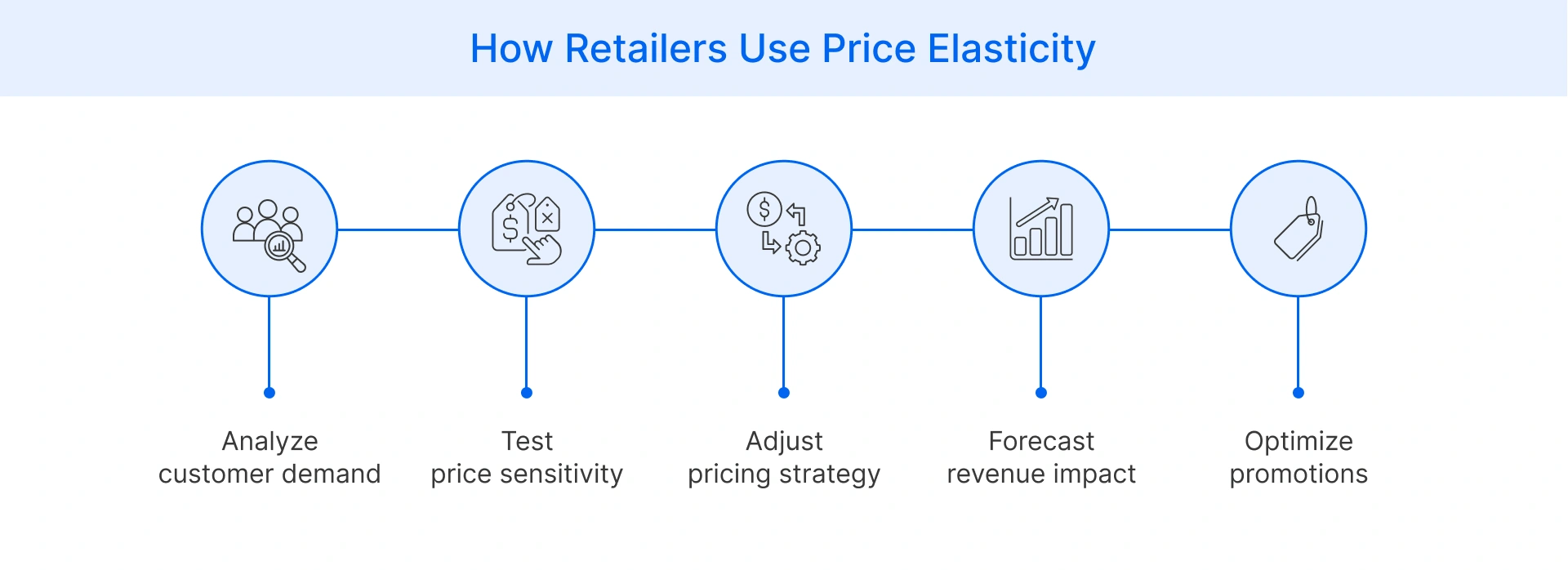
- Optimizing Pricing Strategies: The price elasticity of demand allows you to decide the price point that maximizes your profits. For example, if demand for your product is elastic, a penetration pricing approach can help generate more demand.
- Enhancing Sales Forecasting: By predicting how demand will respond to price adjustments, you can create financial plans that boost profitability and avoid unexpected downturns. For instance, by adjusting prices based on seasonal demand fluctuations, you can ensure a steady revenue stream.
- Planning Promotions and Discounts: Understanding price elasticity helps you plan effective promotions and discounts. If demand is inelastic, running a sale might not significantly increase sales and could reduce your profit margins. However, if demand is elastic, a well-timed discount could deliver a boost in sales.
- Developing Product Strategies: By understanding Price Elasticity of Demand, you can determine how much value customers place on your product's features. If a particular feature has inelastic demand, meaning customers are willing to pay more for it, you can emphasize and market this feature to enhance its perceived value and justify higher prices.
What are the Types of Price Elasticity
Here are three main types of elasticity of demand:
- Elastic demand (elasticity is more than 1): When a small change in price leads to a large change in the quantity demanded, the product demand is considered elastic. This typically occurs with products that have readily available substitutes. For example, if the price of a popular brand increases, consumers might switch to a cheaper alternative, leading to a noticeable drop in demand for the original brand.
- Inelastic demand (elasticity is less than 1): Inelastic demand is a situation when price changes have little to no impact on the quantity demanded for a particular good. This is often seen with essential goods, where consumers continue to purchase regardless of price fluctuations. For instance, families who consume rice as a staple will buy it regardless of price increases. In some cases, luxury goods also exhibit inelastic demand because higher prices can enhance their exclusivity, making them more desirable to certain consumers.
- Unitary Elastic Demand (elasticity is equal to 1): When the percentage change in price leads to an equal percentage change in the quantity demanded, the demand is classified as unitary elastic. In this scenario, the total revenue remains constant because the decrease in the quantity demanded exactly offsets the increase in price. For instance, if a popular smartphone brand increases its prices by 15% and experiences a corresponding 15% decline in sales, the demand for that product is considered unitary elastic.
What is the Cross-price Elasticity of Demand?
The cross-price elasticity of demand measures the sensitivity of the quantity demanded of one good to a change in the price of another good. It can be determined by dividing the percentage change in quantity demanded of one product by the percentage change in the price of the other product. It helps determine if products are substitutes (demand increases when the other's price rises) or complements (demand decreases when the other's price rises).
Cross-Price Elasticity of Demand = (% change in quantity demanded of Product 1) / (% change in price of Product 2)
What Factors Affect the Price Elasticity of Demand?
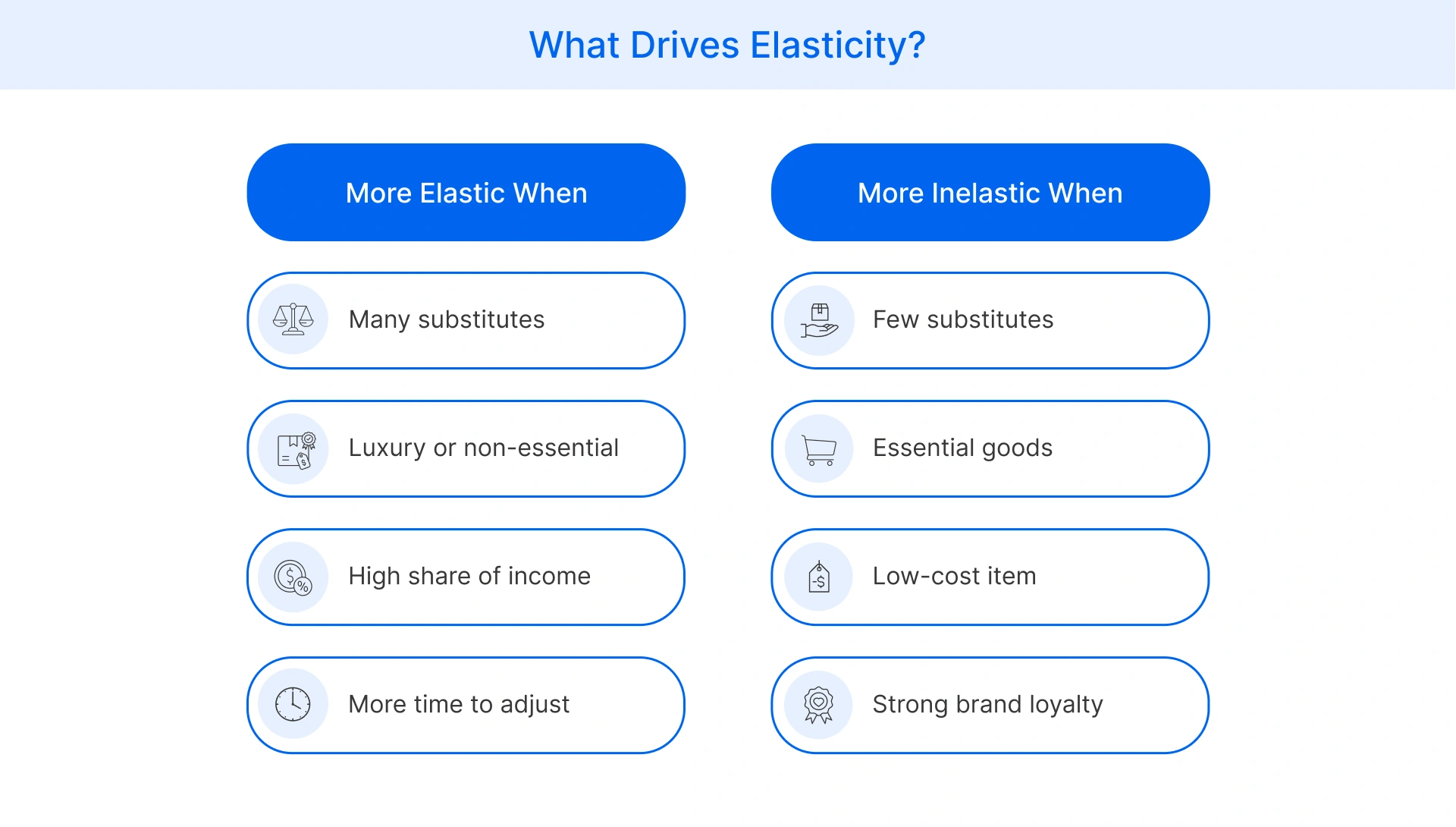
Here are the different factors that act as the determinants of the price elasticity of demand:
- Availability of Substitutes: When multiple similar products are available, consumers have the flexibility to switch based on price, making demand more elastic.
- Proportion of Income Spent: Products that consume a large portion of income are price-sensitive. Even small price changes can significantly impact a consumer's buying decision, leading to higher elasticity.
- Necessity of the Product: Essential goods like food and medicine are in demand. Consumers need these products for survival and will buy them regardless of price.
- Brand Loyalty: Consumers loyal to a brand are less likely to switch to substitutes, even if the price increases, resulting in more inelastic demand.
- Time Frame: Over time, consumers can find substitutes or adjust their consumption habits. Thus, the longer the time since a price change, the more elastic the demand becomes.
Flipkart Commerce Cloud can help you test, track, and optimise pricing decisions. Start by making data-backed pricing moves. Book a demo to see how.

FAQ
Whether it is better to be price elastic or inelastic depends on your goals, but most businesses prefer inelastic demand. Inelasticity allows you to raise prices without losing significant sales volume, which protects your profit margins. Companies use FCC to enhance perceived value, build brand strength, and reduce the high price elasticity of their goods
The 4 types of elasticity of demand are price, income, cross-price, and advertising elasticity. Each type tracks how different variables, such as consumer earnings or marketing spend, impact the total quantity demanded. By monitoring these metrics through the FCC platform, managers can understand exactly what drives their sales performance.
Price elasticity measures how strongly the demand for a product responds to a change in its price. Using the price elasticity of demand formula, businesses calculate this sensitivity to guide their pricing decisions. A product with high elasticity sees large demand swings with small price changes, while low elasticity means demand stays relatively stable.
The importance of price elasticity of demand lies in its ability to inform smarter revenue management and promotional timing. Understanding how customers react to cost changes prevents a business from setting prices that accidentally destroy demand. Retailers rely on FCC to evaluate different pricing scenarios to find the perfect balance between profit margins and market share.
Price elastic means consumer demand shifts significantly when the price changes, while price inelastic means demand stays largely stable despite price movement. Products with close substitutes or non-essential uses tend to be elastic, whereas necessities like medicine or staple foods are typically inelastic, since consumers purchase them regardless of price increases.
Some of the common mistakes managers make with price elasticity include assuming that elasticity remains constant across all time periods and regions. Many also forget to account for competitor price moves that shift consumer behavior. FCC helps teams avoid these errors by providing real-time data to track changing price elasticity trends.
High price elasticity is not inherently good or bad; it signals that consumers respond strongly to price changes. For businesses, it means a small price increase can sharply reduce sales volume. Companies facing high price elasticity must focus on building brand loyalty and delivering clear value to reduce their sensitivity to competitor pricing.
The elasticity of a product price is influenced by factors such as the availability of substitutes, its relative cost, and the time elapsed since the price change. Elastic products are often not essential or can be replaced with a good substitute.
The key factors that determine the price elasticity of demand include the availability of substitutes, the product's necessity, the proportion of consumer income spent on the product, and brand loyalty. Products with many substitutes tend to show higher elasticity, while necessities and strongly branded goods typically display lower, more stable demand elasticity.
A product is deemed inelastic when its demand remains relatively stable despite price fluctuations. This typically occurs when the product is a necessity, has no close substitutions, or is low-priced. Therefore, even significant price changes have minimal impact on the quantity demanded.
Price inelasticity means that a product's demand does not change significantly even when its price rises or falls. This usually applies to essential goods, items with no close substitutes, or products that represent a minor share of consumer spending. Insulin and basic food staples are widely cited real-world examples of price inelastic goods.