Retail Media Platforms vs. Agency Tools

How Functional Retail Media Platforms Are Built Different From Agency Ad Tools

By Flipkart Commerce Cloud

Every retailer needs an effective way to advertise their products to their target audience. For years, retailers have worked with ad agencies and publishers to reach their audience but with the rise of digital tools, brands can now personalize their interaction with their audience.

In recent years, Functional Retail Media Platforms and Agency Ad Tools have gained prominence due to their highly personalized ads. While both serve the purpose of optimizing advertising efforts, they are significantly different in their functionalities, target audience, and overall approach. 

Traditionally, brands worked with agencies who developed advertising plans on their behalf. Agency-led ad strategy often relies on third-party data and targets users through demographics, interests, and keywords. 

However, the advertising scenario is changing with the emergence of retail media which enables brands to target the audience using the retailer’s first-party data. Apart from this, the idea is also to make the advertisements blend in with the original content on the platform to make it less intrusive for the consumers.

In this article, we will explore these differences to help businesses make informed choices about which tool aligns better with their advertising goals and strategies.

Key terminology related to retail media

Before we go into the depths of understanding retail media, here is a quick glance at some of the essential terminologies:  

  1. Retail media: Retail media can be understood as a form of advertising and marketing which includes placing advertisements inside a retailer’s digital channels such as their website, app, or social media pages. It enables retailers to monetise on their online presence by 
  2. Retail media ads: Refer to the specific ads such as display ads, search ads, sponsored ads which are placed on the digital channels for the buyers to see while they are browsing the e-commerce website.
  3. Retail media platform: Refers to the technology platform that enables the advertisers to buy the ad space, manage & deliver the  ads, track their performance, and measure its results. Retailers can either build their own in-house platform or work with existing third-party solutions who can bring the essential expertise. For example, Walmart Connect by the retailer giant is a powerful retail media platform that connects advertisers with its huge consumer base.
  4. Retail media network (RMN): RMN refers to the broader network that connects multiple retailers and advertisers. The network helps advertisers get access to the wider audience and more diverse retail partners.

How retail media platforms are helping businesses

Retail media has been increasingly gaining attention among the e-commerce businesses because of its unique proposition. For its success, the key lies in the fact that the strategy operates on the idea of assisting the customer while they are making purchase decisions with subtle product suggestions and not direct and unrelated advertisement.

For example, let’s take a look at the screenshot below:
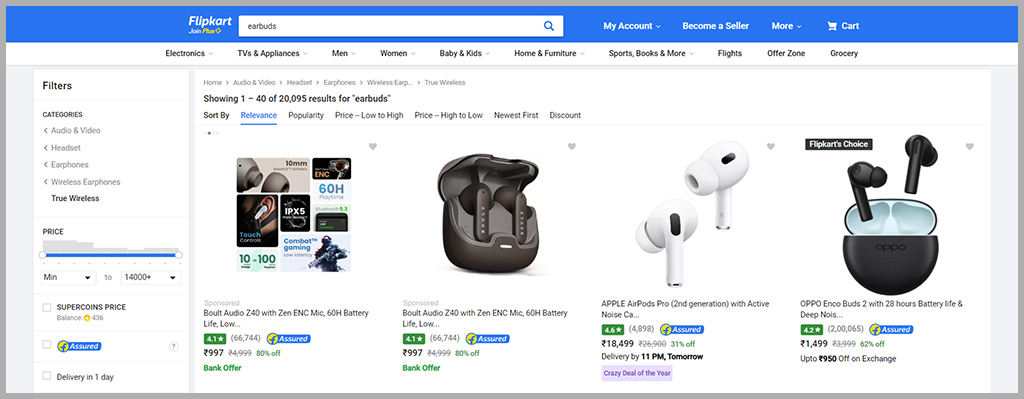
Flipkart’s retail media platform

Here the sponsored ads are so well blended with the main frame content and shows targeted products based on the search that it doesn’t disrupt the purchase flow of the buyer rather helps them choose a well matched product out of the multiple options.  

Another reason behind the growing popularity of retail media also lies in the fact that it targets customers at the point of purchase and thus has the potential to influence a buyer’s purchase decision. 

For e-commerce brands looking to enable retail media advertisements, these are the following benefits that can be unlocked:

  1. Monetizing the digital shelf space: Functional retail media platforms enable retailers to capitalize their digital shelf space on their e-commerce website or apps by lending them to brands for digital advertisements. Advertisers may bid for the ad space and this serves as an additional source of revenue for retailers.
  2. Targeted advertising: Retail media allows advertisers to target their audience by leveraging data related to user behavior, search queries, and product categories. This level of granularity in targeting ensures that ads reach the most relevant audiences.
  3. Leverage retailers first party data: Today, personalisation in advertisements is considered to be the most important aspect that drives conversions. As retailers hold rich consumer data including purchase history, preferences, and shopping behavior, functional retail media platforms allow advertisers to tap into this data for more personalized and effective ad targeting.
  4. Connect retailers with advertisers:  Functional Retail Media Platforms build a direct connection between advertisers and retailers. Advertisers bid on ad space within the retailer’s digital shelves, and when a user clicks on the sponsored product listing, the retailer and the advertising partner share the revenue generated from that click.

Retail Media Platforms vs Agency Tools Across the Shopper Journey

Agency ad tools and retail media platforms swap priorities across the journey: agency tools lead awareness and traffic, while retail media grows in impact as intent rises, driving conversion and repeat purchases.

The difference comes down to data and context. Agency tactics rely on third-party signals and broad targeting to reach shoppers across the open web. Retail media uses retailer first-party data and appears directly within the shopping experience, reaching people while they’re browsing, searching, and comparing products.

1) Awareness: build reach, then reinforce inside the store
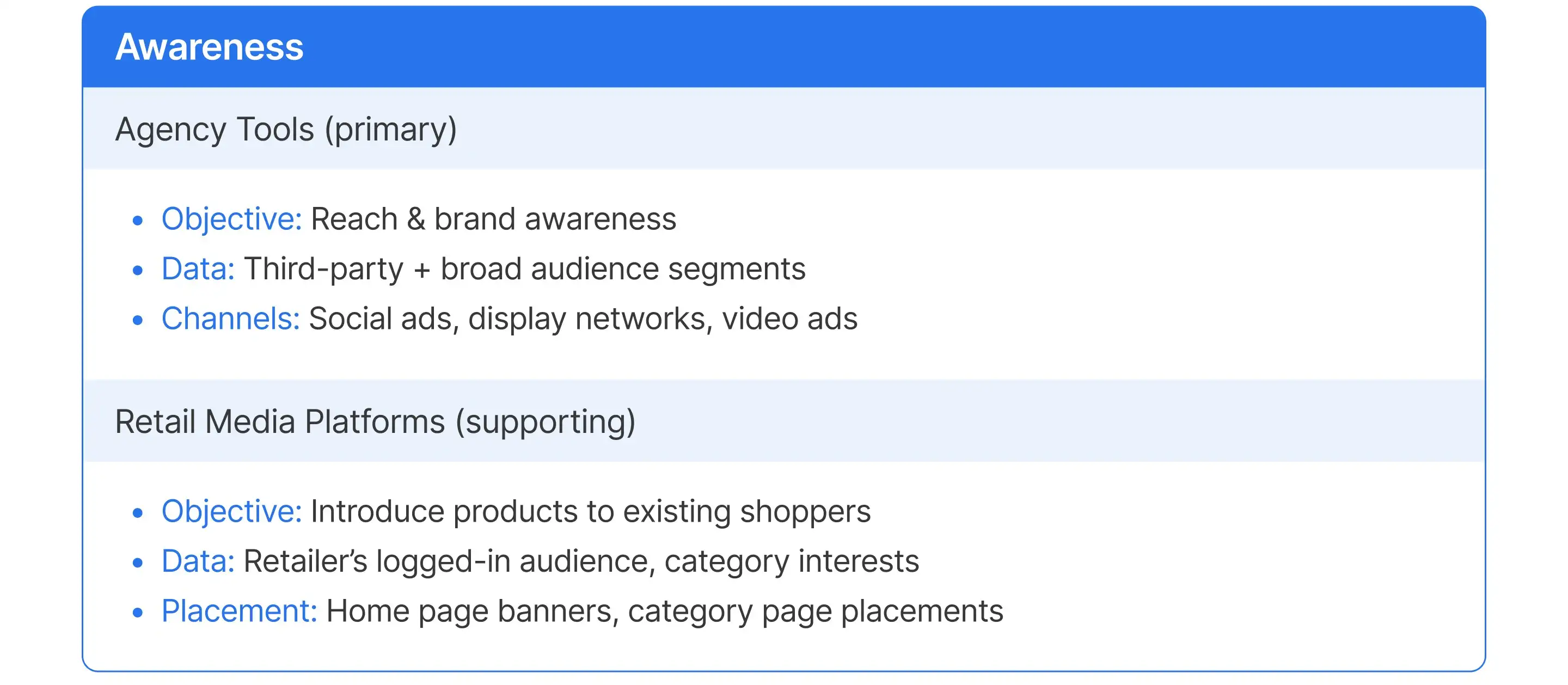
Retail Media Platforms vs Agency Tools at the awareness stage

At the awareness stage, agency tools are typically primary because they’re optimized for scale: reaching new audiences, running broad prospecting, and creating demand through high-impact formats (social, display, video).

Retail media platforms usually play a supporting role here, but they’re still valuable, especially for brands that want early visibility where shopping already happens. Think of this as “introduce and normalize”: showing up on high-traffic retailer placements (like homepage or category entry points) to seed familiarity among existing shoppers before they actively search.

How to use both together: Run broad awareness offsite with agency tools, then mirror the same product story on retailer placements so shoppers recognize the brand when they land on the retailer later.

2) Consideration: retarget offsite, nudge decisions onsite
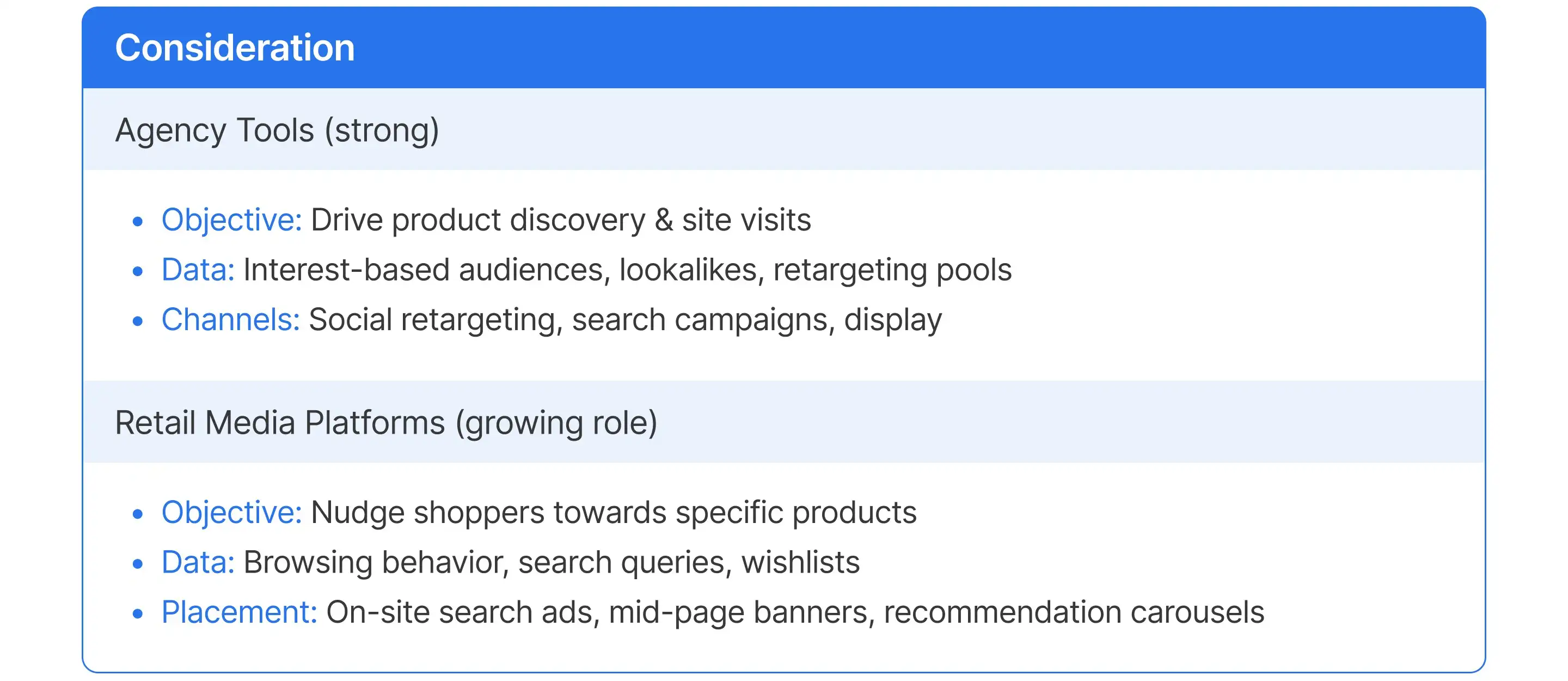
Retail Media Platforms vs Agency Tools at the consideration stage

In consideration, agency tools remain strong because they excel at turning early interest into product discovery and site visits via retargeting, search campaigns, and lookalike audiences across channels.

But this is where retail media’s role grows quickly. With access to retailer first-party behavioral signals (like browsing patterns and search activity), retail media can influence which products shoppers shortlist, especially through placements that appear during high-intent moments (e.g., on-site search results and recommendation modules). This is where “assist, don’t interrupt” becomes practical: the ad is effectively a contextual product suggestion while the shopper is comparing options.

How to use both together: Let agency tools drive return visits and re-engagement, while retail media captures that interest inside the retailer with category/search and consideration-focused placements.

3) Purchase: retail media becomes the conversion engine
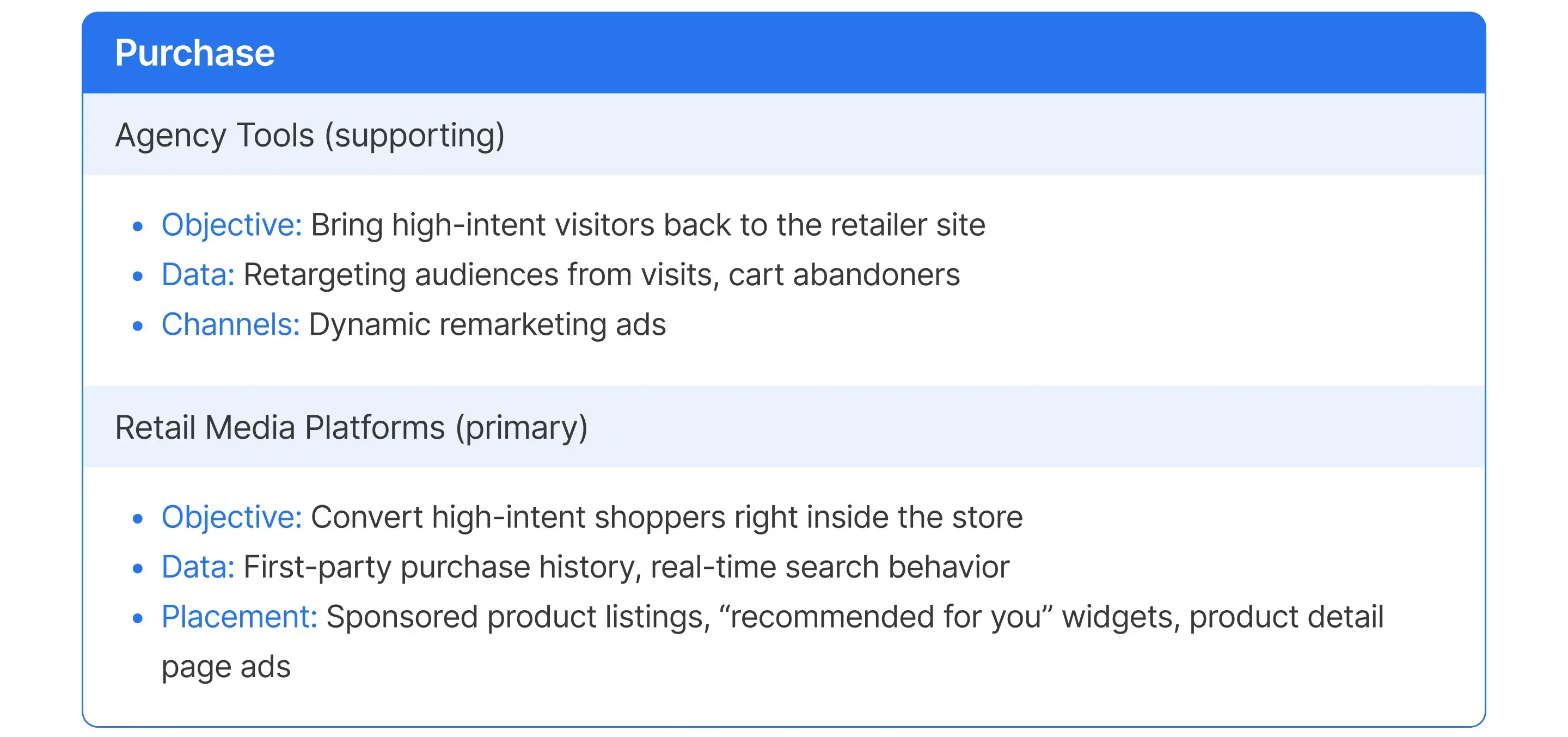
Retail Media Platforms vs Agency Tools at the purchase stage

At purchase, the infographic positions retail media platforms as primary, and that matches how most RMNs are used today: converting shoppers inside the store with placements like sponsored listings and product page ads, powered by first-party intent signals.

Agency tools shift to a supporting role here, mainly through dynamic remarketing and cart-abandoner strategies that bring high-intent visitors back to the retailer environment.

This stage is also where retail media’s measurement advantage stands out: because the retailer can directly observe impressions → clicks → orders, retail media platforms often provide more deterministic conversion reporting and ROAS visibility than purely offsite tactics.

How to use both together: Treat retail media as the “last-mile” conversion layer, and use agency tools to recover leavers (site visitors, cart abandoners) and push them back into high-converting onsite placements.

4) Loyalty and repeat purchase: personalize for known customers
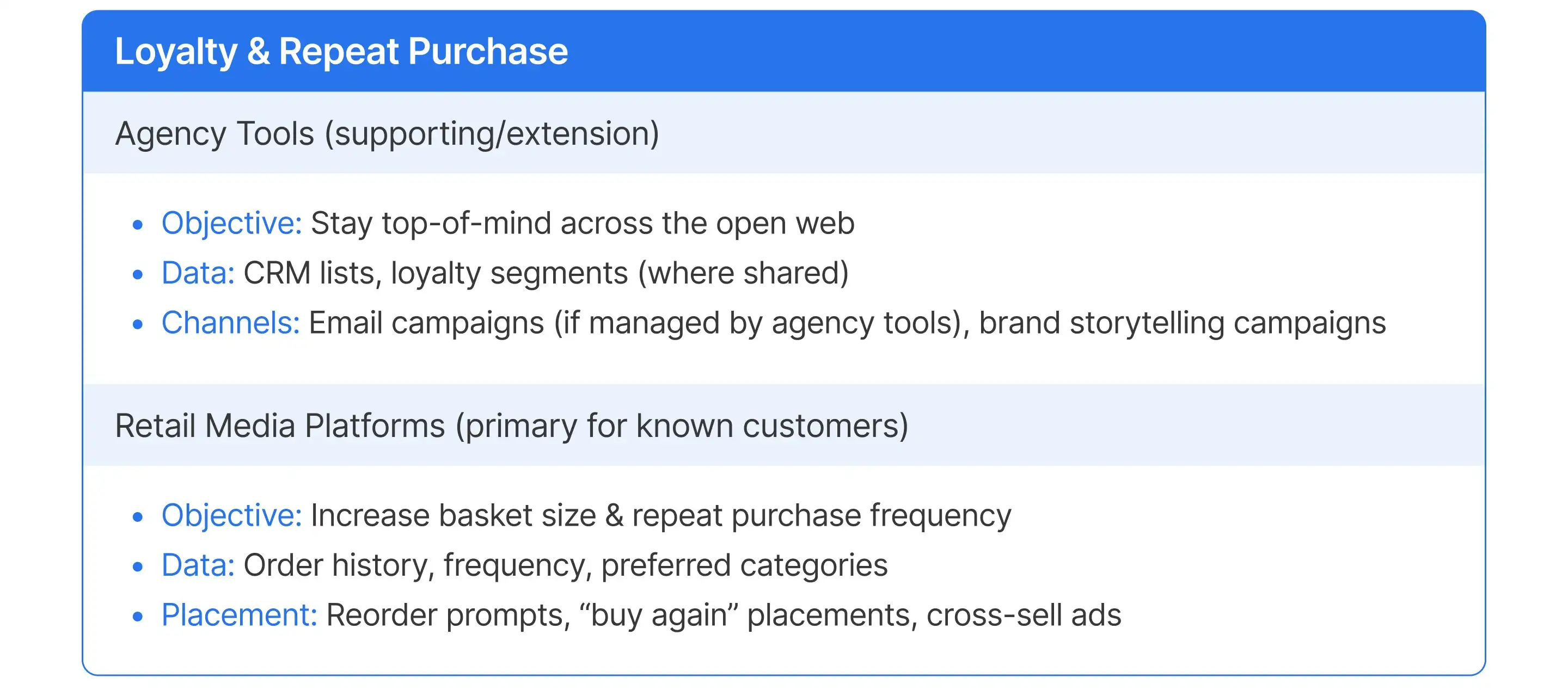
Retail Media Platforms vs Agency Tools at the loyalty stage

For loyalty, retail media becomes primary again for known customers because it can use retailer first-party signals (order history, frequency, preferred categories) to drive repeat buys, replenishment, and cross-sell.

Agency tools act as supporting/extension, keeping the brand top-of-mind across the open web and activating CRM-based audiences where available (e.g., email campaigns or storytelling to maintain affinity between purchases).

How to use both together: Use retail media to trigger “buy again” and personalized upsell moments onsite, and use agency tools to sustain brand memory and reactivation offsite, so customers return already primed.
Why the shift from traditional media to retail media network

Industry data reveals that the growth of RMNs could represent as much as $100 billion in ad spending by 2026 in the US. In fact, in a Mckinsey survey, about 70% of advertisers have responded that they have recorded better performance with RMNs than other channels and almost 82% advertisers say that they will continue to increase their RMN spending.

The concept of retail media is indeed relatively new but it has come a long way since e-commerce giant Amazon began its retail media journey after launching its first network in 2012. Post that, many other retailers including Walmart, Target among others have launched their own networks.

In fact, recent CNBC reports revealed that retail giant Walmart saw a 30% growth in its global ads and Walmart Connect, its U.S. ads business, swelled by 40%.

Offering targeted ads is a crucial part of retail advertising and that is one of the major reasons driving the shift from third-party agencies to retail media platforms. Other reasons propelling its growth, include:

Complex consumer behavior

While making any purchase, the process starting from the trigger to decision making involves a lot of complexities. As products and services become more easily available for buyers online, consumers spend more time researching the product they are looking to purchase and comparing it with their competitors. Here is where retail media advertisements are majorly leveraged by brands to ensure that their products are at the top of the buyer’s mind. Leveraging retail media helps bridge the gap between the purchase trigger and buying decision by assisting the buyer to get hold of the best possible options for the product they are searching for.  

Decline in third party cookies

Third-party cookies also often known as tracking cookies used for targeted advertisement purposes. However, concerns around data privacy and security compliances led to its fall. Moreover, The European Union’s General Data Protection Regulation (GDPR) made it mandatory for adtech companies, advertisers to seek consent from users regarding third-party cookies which led to further decline in its usage. Decline in usage of third-party cookies has left advertisers with no direct data about the consumers. Hence, the retail media platform serves as a great alternative as it helps advertisers create targeted ads based on the first-party data collected by the retailers. You can find more information on retail media is a boon for the cookieless world in our blog.

Profit margins a priority for retailers

Rise of e-commerce has indeed opened up an avenue for digital growth for retailers but this growth does not necessarily translate into profit growth. With uncertainty in the markets, the focus in widening profit margins is now more than ever. 

Functional Retail Media Platforms Vs Agency Ad Tools : The difference you should know

Let us understand the difference between the retail media platform and agency ad tools in more detail so that you can make the best decision for your advertising needs.

Feature Functional Retail Media Platforms Agency Ad Tools
Focus
Retail media platforms help retailers to manage and deliver their retail media campaigns using a single platform.
Agency ad tools are geared towards managing its clients' digital advertising campaigns across multiple platforms.
Data
Have access to first-party data from the retailer's own website and app, as well as third-party data.
Rely on the data that is provided by the client along with third-party data.
Targeting
Offers a variety of targeting options including demographics, purchase history but most important it allows targeting based on customer behavior.
Offer demographics, interests, and keywords based targeting but lack direct connection with customer data.
Measurement
Provides detailed reporting on campaign performance, including impressions, clicks, conversions, and sales under one platform.
Agencies shared detailed reporting on campaign performance with their clients.
Pricing
Involves charging a fee based on the amount of ad spend.
Involves charging a fee based on the number of hours worked.
Examples
FCC Ad Manager, Amazon Advertising, Walmart Connect, Target AdWorks
Google Ads, Facebook Ads, LinkedIn Ads

How FCC’s retail media platform is built for scale

Now that we understand how retail media platform’s impact, it is important to find the right solution to enable this form of advertisements. For e-commerce and retail brands looking to enable a seamless sponsored ad strategy, Ads Manager by Flipkart Cloud Commerce, offers a one stop solution to businesses for building a complete ads ecosystem. Using FCC’s platform, businesses can build ads in any existing format including video ads, rich media and static among others.

The FCC’s ad manager offers seamless user experience with its intuitive interface, advanced targeting capabilities, real-time campaign optimization, detailed performance analytics, and access to a massive customer base. It allows brands to leverage all existing ad formats including video ads, rich media and static with its one-stop solution.

Brands tapping into retail media using FCC’s Ad Manager will be able to get access to:

1. Personalized targeting: Ads appear to be a hassle and a distraction even when it does not serve the end consumer’s needs. Imagine if the buyer is looking to purchase cookware but the retailer website bombards them with ads about buying apparel. Such disconnected advertisements can hamper the buyer’s shopping experience.

FCC’s retail media platform is much appreciated among its users for its advanced targeting enabling brands to deliver relevant ads to the right customers at the right time.  For FCC, the aim is to maintain a balanced organic visibility with paid media and also ensure that the paid media is highly relevant to the shopper’s mission. 

2. Self-serve: Retail media might often need to work with an Ad-Ops team to figure and determine the Nitty-gritties of the advertisement campaigns. However, FCC’s Ad Manager has been designed in a way to eliminate the need for ad-ops wherever possible. With FCC, the aim is to reduce the need for the brand to run a parallel team for enabling retail media. It automates the ad-ops cycles as much as possible. 

3. Audience Manager & AI Powered Relevance Models: Artificial intelligence-powered algorithms can track audience activity in the real time most effective advertisement quickly. Flipkart’s platform is built on a sound data foundation that offers you optimisation based on relevance, user history, search queries and knows how to rank these features for the best optimisation.

4. Contextual targeting: Contextual targeting includes an advertising technique where ads displayed are based on a website’s content. FCC enables Product Contextual Ads (PCAs) which targets users based on their buying intent instead of browser cookies. The platform allows brands to utilise the search bars and tap into every search query to create targeted ads for the consumers.

In the busy world, consumers are often characterized with increased disposable income but limited time span. What is important is to catch the attention of the users to not only bring more business but also meet the user needs. Understanding the difference between retail media platforms vs agency ad tools is the first step to choose the strategy that works best for you.

For those looking to build a robust retail media strategy, Flipkart Cloud Commerce will always be ready to take your business to the next level. Book a free demo today!

FAQ

Retail media platforms are generally better for targeting high-intent shoppers because they leverage the retailer's first-party data to reach consumers who are already in a strong purchase mindset on the retailer's site. Agency tools can target high-intent audiences offsite, but retail media platforms have the unique advantage of placing the ad directly at the point of purchase (e.g., in search results or on product pages), using data that explicitly reveals current shopping behavior and purchase history.

Yes, retail media platforms typically offer better conversion tracking than traditional agency tools because they have direct access to the transaction data (the "closed loop") that proves a sale occurred. Agency tools often rely on third-party cookies or probabilistic modeling to track conversions that happen off-site, which can be prone to data loss and inaccuracies. Retail media platforms provide deterministic, first-party measurement of the entire purchase path from ad impression to final sale, resulting in more accurate Return on Ad Spend (ROAS) figures.

Retail media platforms are not replacing traditional agency ad tools entirely, but they are fundamentally changing the spending mix and the role of agencies. Retail media platforms are becoming the dominant channel for lower-funnel, conversion-focused spend, competing directly with tools historically used for performance marketing. Agencies are now adapting by integrating these retail media platforms into their planning and using their own tools for complementary upper-funnel and brand-building activities, often requiring them to become experts on the new retail-specific platforms like those from FCC.

Yes, agency tools can still be very useful even when using retail media platforms, as they serve different, complementary functions across the marketing funnel. Agency tools are essential for upper-funnel activities such as building brand awareness off-site via social media and display networks, as well as for creative development, strategic planning, and sophisticated audience segmentation across channels. They provide the necessary context and creative assets that ultimately drive high-intent shoppers into the retail media environment.

Yes, you can and should run omnichannel campaigns combining retail media and agency tools for the most effective marketing strategy. Agency tools are used to execute off-site awareness campaigns that drive traffic to the retailer's site, where the retail media platform then takes over to deliver lower-funnel conversion ads (like sponsored products) to those high-intent visitors. The key is to use a unified data strategy and a common attribution framework to measure how the upper-funnel agency spend influences the conversions seen on the retail media platform.

User targeting differs between retail media and agency tools because retail media targeting is based on the retailer's first-party, deterministic purchase data, focusing on high-intent shoppers at the point of sale on the retailer's site. Agency tools, when operating off-site, typically rely on third-party data and broader audience segments for awareness and consideration campaigns across the open web, though modern agency strategies now utilize first-party data through complex integration methods to compete with the accuracy of retail media platforms like those from FCC.

More Blogs

See how retailers and brands are winning with FCC

Everything About Price Skimming Strategy Explained

Read More

What is a High-Low Pricing Strategy?

Read More

Ultimate Guide To Dynamic Pricing Strategy In 2026

Read More

Retail Pricing Strategies: Winning with Promotion Pricing in Competitive Markets

Read More

Ad Tags: Enhancing Ad Serving Efficiency in Large-Scale Campaigns

Read More