
June 15, 2026
What Is an Ecommerce Business License?
Ecommerce business license is an official government permit that grants an online store the legal right to operate, process payments, and sell products online.
Drishti, Manager - Digital Marketing

Table of Contents
- What Is an Ecommerce Business License?
- What Are the Three Levels of Ecommerce Business License Requirements?
- What Are the 4 Core Ecommerce Business Licenses and Registrations You Need?
- Why is Nexus Important for Ecommerce Compliance?
- Marketplaces vs. Owning Your Own Store
- Requirements for Obtaining an Ecommerce Business License
- Steps to Getting Licensed for Your Online Business
- What Happens If You Operate Without an Ecommerce Business License?
- Conclusion
What Is an Ecommerce Business License?
An ecommerce business license is a legal document issued by a government authority that authorizes a digital business to trade online. It establishes your store as a recognized legal entity, grants you the right to collect sales taxes, and is needed to set up payment gateways with major processors.
Many new online sellers assume that operating from home or generating only modest revenue means they are exempt from registration. This assumption is incorrect. Once your intent is to make a consistent profit, most governments classify your activity as a business regardless of revenue size. Operating without the required licenses exposes you to backdated tax penalties, forced store closures, and payment processor bans.
Securing your ecommerce business license is also a prerequisite for buying wholesale inventory, signing supplier contracts, and opening a dedicated business bank account, all foundational steps in running a scalable online store.
What Are the Three Levels of Ecommerce Business License Requirements?
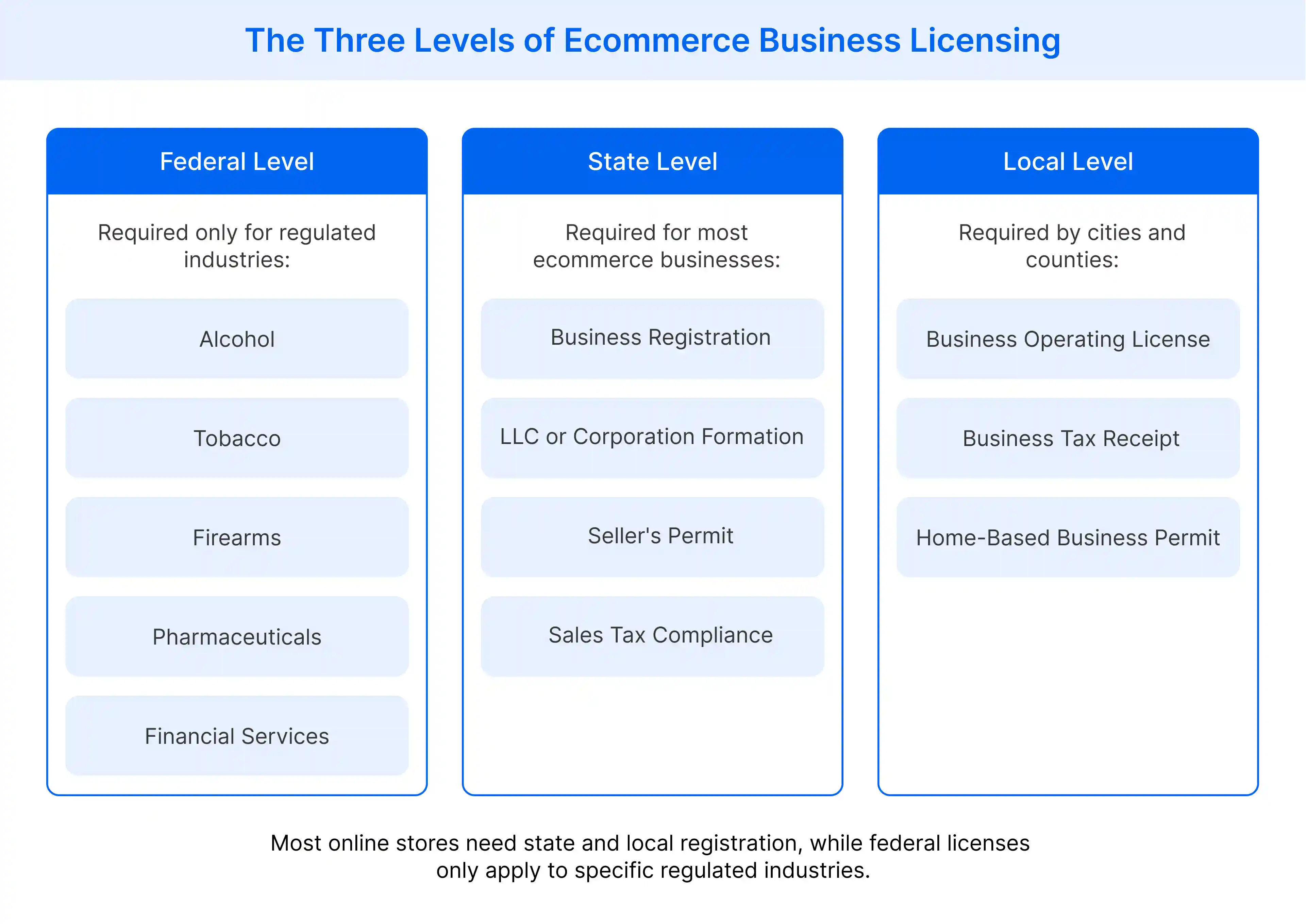
Online businesses in the United States must register and maintain compliance across three distinct government levels. The combination of licenses required depends on what you sell, where you operate, and how your business is structured.
-
Federal Level
Most standard online sellers do not require a federal-level license. Federal registration is mandatory only for businesses selling in heavily regulated product categories: alcohol, tobacco, firearms, pharmaceuticals, dietary supplements, financial products, and agricultural goods. If your product category is unregulated, federal licensing is not a current online business license requirement.
-
State Level
State-level registration is where the majority of ecommerce compliance work happens. At this level, you formally register your legal entity, LLC, corporation, or sole proprietorship, and obtain a seller's permit, which gives you the legal authority to collect sales tax from online buyers. Every state that levies a sales tax requires sellers with nexus in that state to register and remit.
-
Local Level (City and County)
Even home-based online sellers with no physical storefront are typically required to obtain a basic business tax receipt or operating permit from their local city or county government. This local-level permit is often the lowest cost and simplest to obtain, but skipping it is one of the most common compliance oversights among new ecommerce founders.
What Are the 4 Core Ecommerce Business Licenses and Registrations You Need?
These are the baseline compliance requirements that apply to most digital storefronts, regardless of size or sales volume.
1. General Business Operating License
- What it is: The foundational local permit that gives your business the legal right to operate within your city or county limits.
- Who needs it: Any business, including home-based online stores, operating within a municipality that requires general business registration.
- How to get it: Apply directly through your city or county clerk's office, or via your local government's business portal. Fees typically range from $20 to $100 annually.
2. Seller's Permit (Sales Tax License)
- What it is: The most critical ecommerce permit. It gives you the legal authority to collect sales tax from online buyers and remit it to the state. Without it, collecting sales tax is itself unlawful in most states.
- Who needs it: Any online seller with sales tax nexus in a state, whether through physical presence or economic activity (see Nexus section below).
- How to get it: Apply through your state's Department of Revenue website. Most states process applications online at no cost.
3. Employer Identification Number (EIN)
- What it is: A federal tax ID number issued by the IRS, functioning as your business's equivalent of a Social Security Number.
- Who needs it: Any business that hires employees, operates as an LLC or corporation, or needs to open a business bank account. Sole proprietors without employees may still benefit from obtaining one to separate business and personal finances.
- How to get it: Apply for free directly through the IRS website at IRS.gov. Processing is instant online.
4. Home Occupation Permit
- What it is: A zoning clearance that confirms your home-based ecommerce operations, including packing, shipping, and storage, comply with local residential zoning laws.
- Who needs it: Home-based online sellers in jurisdictions that require residential businesses to demonstrate their commercial activity does not disrupt the surrounding neighborhood.
- How to get it: Apply through your local planning or zoning department. Requirements and costs vary significantly by municipality.
Why is Nexus Important for Ecommerce Compliance?
Nexus is the legal term for having a sufficient physical or economic connection to a state that obligates your business to collect and remit sales tax there.
Two primary types of nexus trigger ecommerce compliance obligations:
- Physical Nexus: Triggered by having a tangible business presence inside a state. This includes maintaining an office, employing a remote worker, storing inventory in a warehouse or 3PL fulfillment center, or operating from a physical retail location within that state. Physical nexus has always been a recognized compliance trigger.
- Economic Nexus: Triggered when your total sales volume in a specific state crosses a legally defined threshold, even if you have no physical presence there. In most states, the economic nexus threshold is $100,000 in annual gross sales. Some states, such as California and New York, have a higher threshold of $500,000. Once you cross the threshold, you are legally required to register for a sales tax license in that state and begin collecting tax on all qualifying transactions.
Understanding where you hold nexus is the most technically demanding part of ecommerce compliance, particularly for brands scaling across multiple states or geographies.
Marketplaces vs. Owning Your Own Store
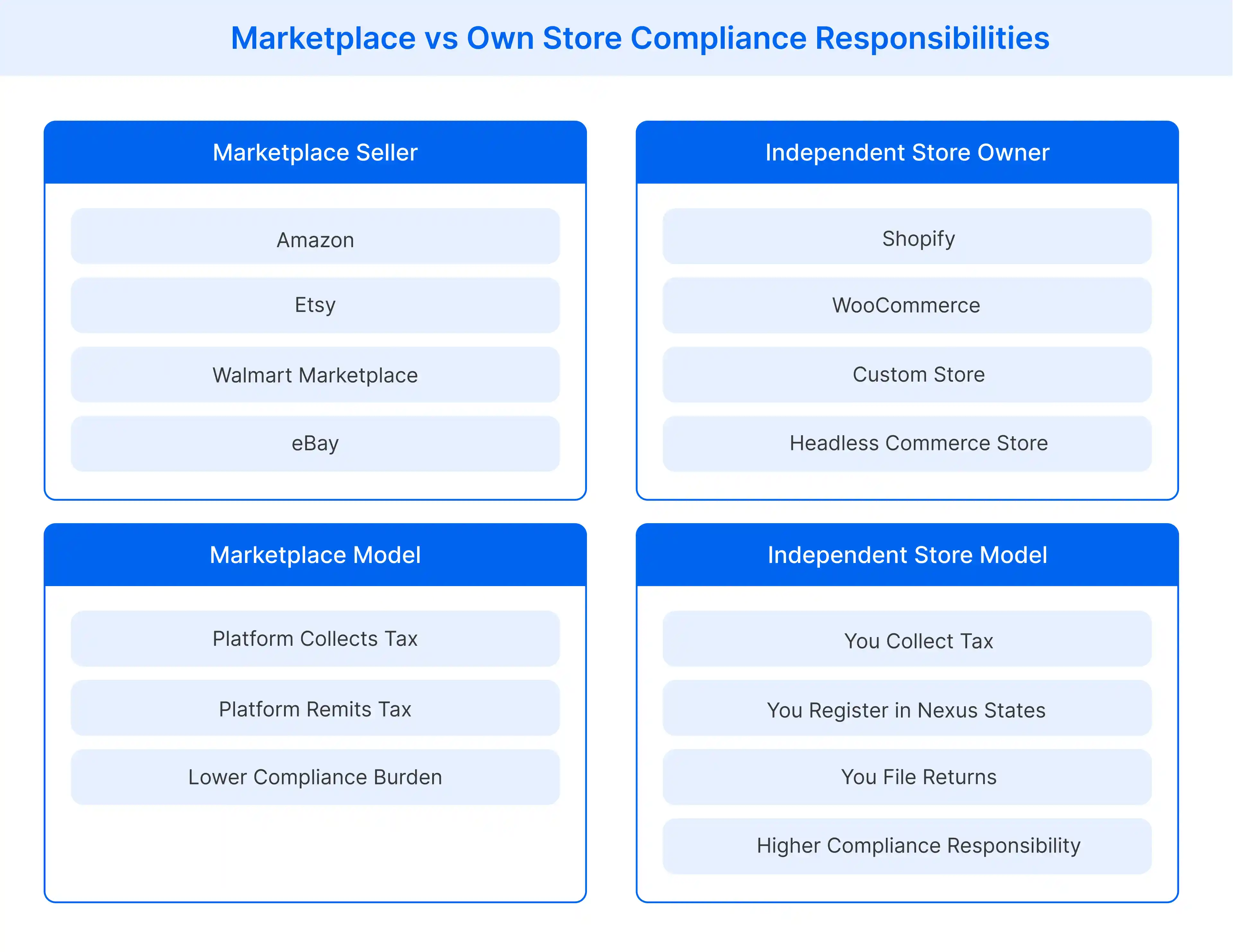
How you sell directly determines your licensing and tax collection responsibilities.
- Selling on Third-Party Marketplaces (Amazon, eBay, Etsy, Walmart): Under marketplace facilitator laws, now enacted in all U.S. states that levy a sales tax, platforms like Amazon, eBay, Etsy, and Walmart are legally required to collect and remit sales tax on behalf of their third-party sellers. This significantly reduces your tax compliance burden. However, it does not eliminate your own obligations: you remain personally responsible for registering a local business license, filing income taxes, and complying with any applicable federal licensing requirements.
- Selling on Your Own Branded Store (Shopify, Custom-Built Sites): When you operate an independent storefront, 100% of tax compliance rests with you. You are responsible for monitoring your sales volume in every state, determining where you have triggered nexus, registering for individual sales tax permits in each of those states, calculating the correct tax rate at checkout, and filing returns on each state's schedule. Using a unified Digital Experience Platform (DXP) helps independent brands keep their regional product data, pricing, and compliance thresholds centrally organized as they scale.
Requirements for Obtaining an Ecommerce Business License
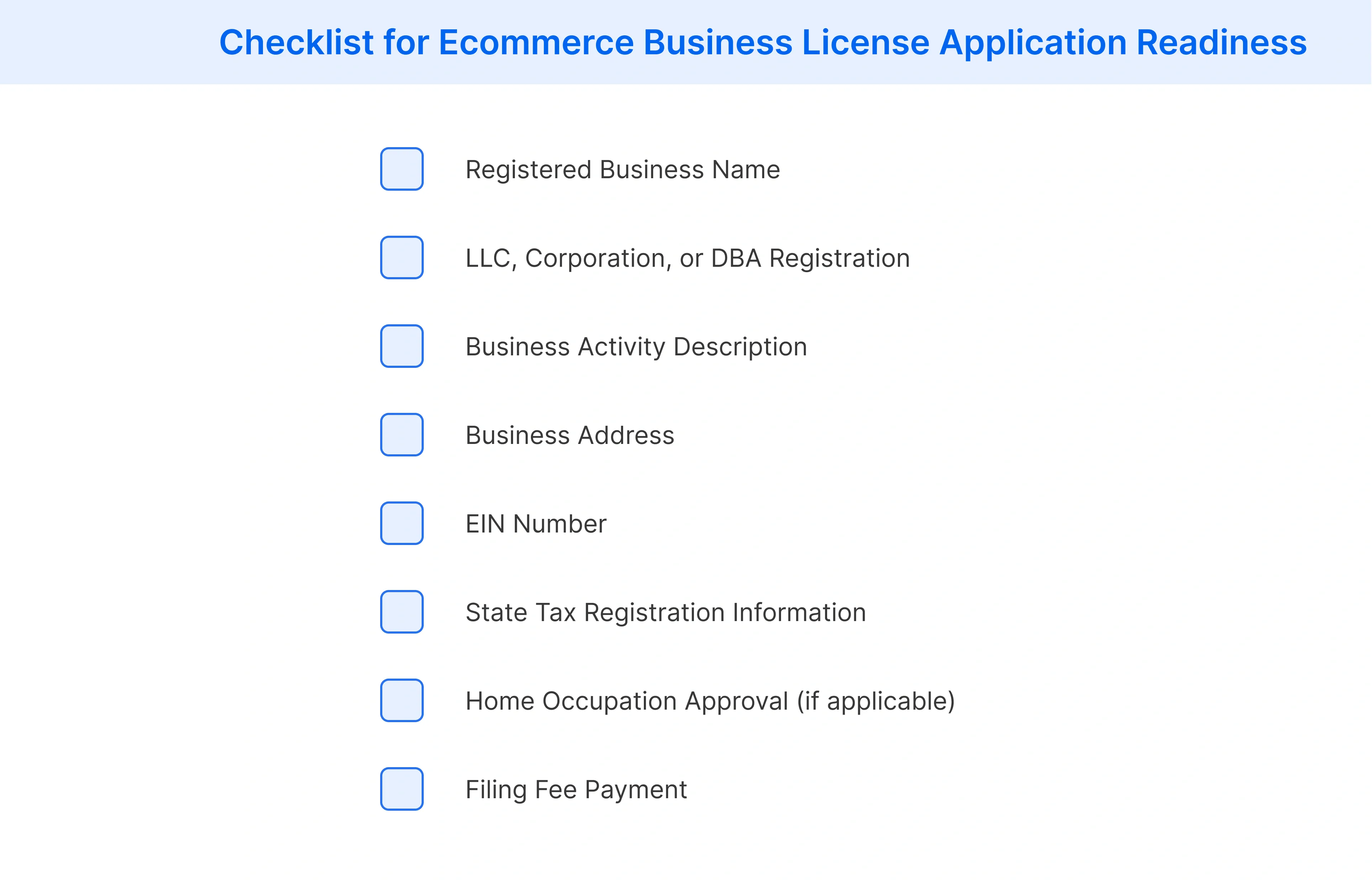
When submitting an application for an ecommerce business license, merchants must prepare the following documentation:
- A formally registered legal business structure and name: LLC, Corporation, or a verified DBA (Doing Business As / Assumed Name) registration.
- A clear written description of your online business activities and the specific product categories you sell.
- A designated physical business address or a verified home address supported by a completed home occupation zoning review.
- Core tax identifiers, including your federal EIN and any existing state sales tax license numbers.
- Payment for nominal filing fees, which typically range from $20 to $100, depending on your jurisdiction.
Most states and municipalities now process applications entirely online through their official Department of Revenue or Secretary of State portals.
Steps to Getting Licensed for Your Online Business
Most states and cities allow merchants to complete these applications online through their Department of Revenue or Secretary of State portals.
- Choose and Register Your Legal Business Structure: Select your entity type, LLC, S-Corp, C-Corp, or Sole Proprietorship, and register it with your state's Secretary of State office. This creates your legal business identity and is the prerequisite for every other license you obtain.
- Obtain Your Employer Identification Number (EIN): Apply for a free EIN through the IRS website (IRS.gov). You will need this number for business bank accounts, vendor contracts, and state tax registrations.
- Apply for Your Local Business Operating License: Contact your city or county clerk's office, or check their online business portal, to apply for a general business operating license. Have your legal business name, address, and a description of your business activities ready.
- Register for a Seller's Permit in Your Home State: Apply through your state's Department of Revenue for a seller's permit (also called a sales tax license). This authorizes you to collect and remit sales tax within your home state.
- Identify All States Where You Hold Nexus: Audit your sales data to identify every state where you have exceeded the economic nexus threshold ($100,000 in sales in most states). Register for a sales tax permit in each of those states.
- Apply for a Home Occupation Permit (If Applicable): If you operate from a residential address, check with your local zoning or planning department to determine whether a home occupation permit is required for your packing and shipping activities.
- Obtain Any Industry-Specific Federal Licenses: If your product category is federally regulated, alcohol, tobacco, firearms, pharmaceuticals, or supplements, research and apply for the applicable federal permit before your store goes live.
- Set Up Renewal Reminders: Most business licenses require annual or biennial renewal. Set calendar reminders 60 days before each renewal deadline to avoid unintentional lapses that can trigger penalties.
What Happens If You Operate Without an Ecommerce Business License?
Running an unlicensed online store is a compliance risk with serious financial and operational consequences:
- Heavy Financial Fines: Government tax authorities can backdate missed taxes, sometimes for multiple years, and add aggressive penalty interest on top of the principal owed.
- Forced Store Closures: Regulatory bodies can issue cease-and-desist orders that shut down your digital operations immediately, with no warning.
- Payment Gateway Bans: Major payment processors, including Stripe, PayPal, and Square, require active business licenses as part of their merchant agreements. Failure to provide documentation can result in account freezes or permanent bans.
- Lost Supplier Partnerships: Reputable wholesale distributors verify business license status before opening trade accounts. Operating without one limits your catalog management options and prevents access to competitive wholesale pricing.
Conclusion
Securing the right ecommerce business licenses is not a one-time administrative task; it is the compliance foundation that every ecommerce operation is built on. Without it, your online store cannot access reliable payment infrastructure, wholesale supply chains, or the partners needed to scale.
As an ecommerce brand grows into a cross-border business, tracking inventory, orders, and sales tax thresholds across multiple states and geographies manually becomes unmanageable. Flipkart Commerce Cloud (FCC) helps brands eliminate these back-office compliance complexities through automated inventory management systems that sync inventory counts, order flows, and geographic channel data in real time.
Book a demo today to maintain an accurate operational backend and reduce compliance risk while increasing the speed of growth of your merchant.
FAQ
Yes, you need a business license for an ecommerce store in most jurisdictions. Once your intent is to generate consistent profit, governments classify your activity as a formal business. Operating without the required licenses risks backdated tax penalties, payment processor bans, and forced store closures regardless of your revenue size.
Selling online typically requires four core licenses: a general business operating license, a seller's permit (sales tax license), an Employer Identification Number (EIN), and a home occupation permit if you operate from a residential address. Selling regulated products, such as alcohol, firearms, or pharmaceuticals, triggers additional federal licensing under ecommerce compliance rules.
Getting an ecommerce business license involves registering your legal entity with your state, applying for a free EIN through the IRS, obtaining a seller's permit from your state's Department of Revenue, and securing a local operating license through your city or county. For brands scaling across multiple states, Flipkart Commerce Cloud's integrated inventory management systems help track the sales thresholds that trigger new licensing obligations.
You need to register your ecommerce business to establish a recognized legal entity, such as a limited liability company or a sole proprietorship. Formal registration protects your personal assets, defines your business structure for tax purposes, and remains a mandatory prerequisite for opening bank accounts and obtaining additional licenses to trade.
Ecommerce business license requirements include registering a legal business; big or small business owners must verify their physical location, secure a seller's permit for each state where they hold sales tax nexus, obtain an EIN from the IRS, and complete state requirements for tax registration. If you operate from home, a home occupation permit may also apply, and you’ll be required to pay business license fees and prepare for periodic renewal of your operating permits.