
September 7, 2026
What Is Market Leader Pricing?
Market leader pricing is a pricing strategy where the prices set by a dominant business influence how other businesses set and adjust their own prices within a market. It gives competitors a pricing reference while allowing them to consider their own costs, margins, target market, and competitive position.
Drishti, Manager - Digital Marketing

Table of Contents
- What Is Market Leader Pricing?
- How Does Market Leader Pricing Work?
- What Are the Benefits of Market Leader Pricing?
- What Are the Risks of Following Market Leader Pricing?
- What Is the Difference Between Market Leader Pricing and Follow-the-Leader Pricing?
- What Are Examples of Market Leader Pricing?
- When Should a Business Use Market Leader Pricing?
- Conclusion
What Is Market Leader Pricing and How Does It Shape Competitive Pricing?
Market leader pricing is a pricing approach influenced by the business that holds a dominant position in a market. As a market leader establishes or changes its prices, competing businesses may consider those decisions alongside their own costs, customers, and market position when setting prices.
Understanding market leader pricing is particularly important in competitive markets, where the pricing decisions of a dominant business can influence how other companies position their products and respond to changing market conditions.
In this article, we discuss how market leader pricing works, its benefits and risks, how it differs from follow-the-leader pricing, examples of market leader pricing, and when businesses should use it.
What Is Market Leader Pricing?
Market leader pricing refers to a strategy where a dominant company’s prices influence how other businesses set and adjust their own prices within a competitive market. A market leader typically has a strong market position and enough influence for its pricing decisions to affect broader pricing patterns among competitors.
Other businesses may monitor the market leader’s prices and decide whether to match them, price above or below them, or respond according to their own costs, target market, and competitive position. This gives competitors a useful reference point without requiring them to copy the leader’s prices exactly.
Follow the leader pricing is closely related to market leader pricing, as businesses use the pricing decisions of a leading competitor as a guide. The distinction is that market leader pricing focuses on the influence of the dominant firm, while follow the leader pricing describes how other businesses respond to that influence.
How Does Market Leader Pricing Work?
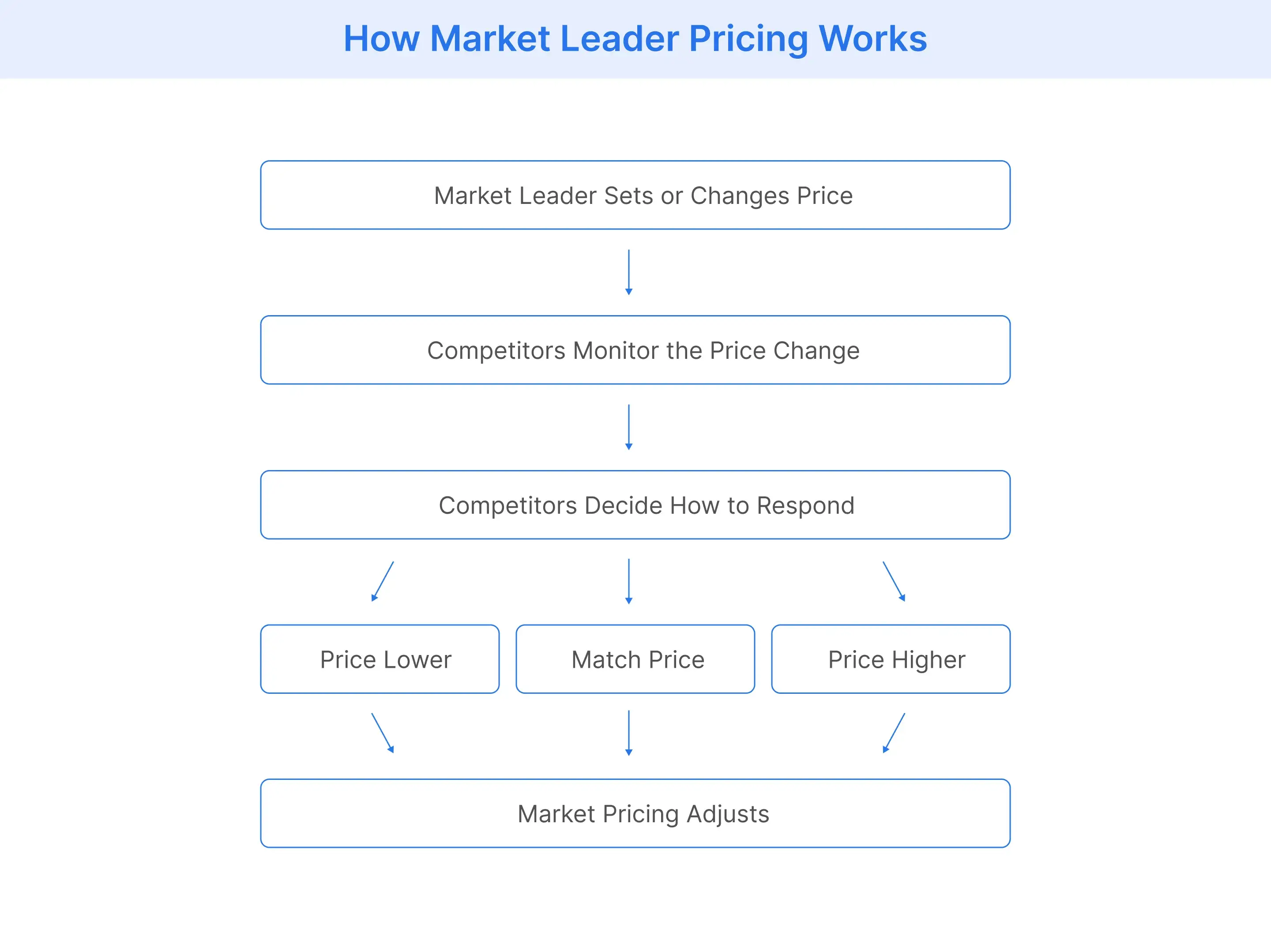
Market leader pricing works through the influence a dominant business has on prices within a market. When the market leader sets or changes its prices, competitors may monitor those changes and assess whether they need to adjust their own prices to remain competitive.
How businesses respond depends on their own circumstances. Some may closely align their prices with the market leader, while others may price higher or lower based on their costs, margins, target market, and overall market position. This allows competitors to respond to changes in the local market without automatically matching every price set by the leader.
The market leader’s decisions are also shaped by factors such as customer demand, operating costs, competitive activity, and its position in the market. Businesses can also use predictive analytics to assess demand and market trends when evaluating pricing decisions. As these conditions change, the leader may adjust its prices, which can influence pricing decisions among other businesses in the same market.
What Are the Benefits of Market Leader Pricing?
Market leader pricing can give businesses a clearer basis for making pricing decisions in competitive markets. Key benefits include:
- Helps businesses remain competitive: Monitoring the market leader can help businesses understand prevailing prices and respond to changes that could affect their competitive position.
- Provides a reference point for pricing decisions: The market leader’s prices can serve as a useful benchmark, helping businesses assess whether their own prices are appropriate for their target market and current market conditions.
- Supports market positioning: Businesses can decide whether to price in line with, above, or below the market leader based on how they want to position their products and the value they offer customers.
- Simplifies pricing decisions: In highly competitive markets, having an established market reference can make it easier to evaluate pricing options while still considering factors such as costs, demand, and profit margins.
What Are the Risks of Following Market Leader Pricing?
Following a market leader’s pricing decisions can help businesses stay competitive, but it can also create challenges when their costs, margins, or market position differ from those of the dominant business. Key risks include:
- Pressure on profit margins: Matching a market leader’s prices can reduce profitability, particularly for businesses with higher operating costs or less flexibility in their margins.
- Potential price wars: Frequent price matching can encourage competitors to continually lower their prices, creating a cycle that puts further pressure on margins across the market.
- Reduced pricing differentiation: Closely following the market leader can make it harder for a business to differentiate its pricing based on product value, customer needs, or its target market.
- Challenges for smaller businesses: Smaller businesses may not have the same cost advantages or resources as a dominant market leader, making it difficult to maintain similar prices without affecting profitability.
What Is the Difference Between Market Leader Pricing and Follow-the-Leader Pricing?
Market leader pricing and follow-the-leader pricing are closely connected, but they describe different sides of the pricing relationship. Market leader pricing focuses on how a dominant business influences prices within a market, while follow-the-leader pricing describes how competitors respond by using the leader’s prices as a guide.
Market Leader Pricing vs Follow-the-Leader Pricing |
||
|---|---|---|
|
Factor |
Market Leader Pricing |
Follow-the-Leader Pricing |
|
Meaning |
Prices set by a market leader influence pricing across the market. |
Businesses use a leading competitor’s prices as a guide for their own. |
|
Primary purpose |
Establish or maintain a strong market position through pricing. |
Remain competitive by responding to the market leader’s prices. |
|
Pricing basis |
Demand, costs, competition, and market position. |
The pricing decisions of the market leader. |
|
Main consideration |
How pricing affects the wider market and target market. |
Whether following the leader supports the business’s own costs and margins. |
|
Key risk |
Pricing decisions can trigger wider competitive responses. |
Closely matching prices can reduce margins and limit pricing differentiation. |
What Are Examples of Market Leader Pricing?
Market leader pricing can be seen in competitive retail markets where the pricing decisions of a dominant retailer influence how other businesses set their prices. Practical examples include:
- Consumer electronics: A dominant retailer reduces the price of a popular smartphone from $800 to $750. Competing retailers may lower their prices, offer a similar discount, or add extra value such as free delivery to remain competitive.
- Grocery retail: A market leader lowers the price of frequently purchased household products. Other retailers in the local market may review their prices and make adjustments to avoid appearing significantly more expensive to customers.
- Seasonal products: A leading retailer introduces lower prices on seasonal products earlier than competitors. Other businesses may respond with their own promotions or price changes to remain competitive during the same selling period.
In each case, the market leader provides a pricing reference for competitors, but businesses can still respond based on their own costs, margins, target market, and market position.
When Should a Business Use Market Leader Pricing?
Market leader pricing can be useful when a business operates in a highly competitive market where a dominant competitor has a strong influence on customer price expectations. Using the market leader as a reference can help businesses evaluate their own prices and respond to changes in demand, competition, and market conditions.
Businesses should avoid directly following the market leader when doing so would reduce profit margins, conflict with their target market, or weaken their competitive positioning. Smaller businesses, in particular, may have different operating costs and may not be able to sustain the same prices as a larger competitor.
The goal is not to match every price change. Businesses should use market leader pricing as one input alongside their own costs, margins, customer demand, and market position to make informed pricing decisions.
Conclusion
Market leader pricing can shape how businesses set and adjust prices in competitive markets. While a market leader can provide a useful pricing reference, businesses should consider their own costs, margins, customer demand, and market position before deciding how to respond.
With Flipkart Commerce Cloud (FCC), retailers can use commerce technology and data-driven insights to better understand market conditions and make more informed pricing decisions. This helps businesses respond to competition while keeping their broader commerce goals in focus.
FAQ
Market leader pricing occurs when the dominant company in an industry sets product price points that competitors subsequently follow. The market leader leverages its large market share, operational economies of scale, and strong brand equity to establish benchmark prices, effectively driving pricing trends across the entire retail sector.
Price leadership works when a dominant retailer changes its product prices, signaling smaller competitors to adjust their rates accordingly. By aligning their overall business plan with the established market rate, secondary businesses avoid unpredictable price volatility, maintain standard industry margins, and prevent destructive price undercutting while remaining competitive.
The difference between price leadership and a price war centers on market stability versus aggressive undercutting. Price leadership fosters market stability through aligned pricing strategies led by an industry leader, whereas a price war involves rapid, retaliatory price cuts between aggressive competitors, severely eroding profit margins across overall marketing efforts.
A business should stop following a market leader’s pricing when rigid price matching erodes operating profit margins or misaligns with its brand positioning. Advanced solutions like Flipkart Commerce Cloud offer a complete suite of tools featuring predictive analytics, empowering brands to build independent pricing models tailored to actual cost structures.
Examples of market leader pricing in retail include dominant big-box retailers setting baseline prices for popular consumer items that regional stores adopt. Smaller competitors monitor these price shifts closely and mirror the leader's rates to maintain perceived market fairness and drive lead generation without losing shoppers to larger enterprise platforms.
An example of leader pricing, often referred to as loss leader pricing, is a retailer selling a popular product below cost to attract shoppers. By taking a small loss on a high-demand item, the store drives foot traffic and customer acquisition, increasing overall sales volume on other profitable, un-discounted products.