
May 18, 2026
Multi-Warehouse Management
Multi-warehouse management is the process of overseeing inventory, orders and logistics operations across two or more warehouse locations from a single unified platform. It gives retailers real-time visibility into stock levels across all sites and automatically routes each order to the most suitable fulfillment location.
Drishti, Manager - Digital Marketing

Table of Contents
- What Is Multi-Warehouse Management?
- How Does Multi-Warehouse Management Work?
- What Are the Different Types of Warehouses in a Multi-Warehouse Setup?
- What Is the Difference Between Multi-Warehouse Management and Single-Warehouse Operations?
- What Are the Benefits of Multi-Warehouse Management?
- What Are the Challenges of Multi-Warehouse Inventory Management?
- What Strategies Help Retailers Manage Multiple Warehouses Effectively?
- Manage Multiple Warehouses with Flipkart Commerce Cloud
Multi-Warehouse Management
Multi-warehouse management has become a core operational capability for ecommerce businesses looking to reduce delivery times and meet customer expectations across key markets. It replaces disconnected warehouse operations with a single system that gives teams complete network-wide visibility.
Retailers managing inventory across different locations near major transport hubs gain a measurable competitive advantage over those relying on a single warehouse. Effective coordination across sites reduces transportation costs and improves overall efficiency throughout the fulfillment process.
- Multi-warehouse management keeps optimal inventory levels distributed across locations to serve local demand efficiently.
- It enables faster delivery by routing each order to the nearest suitable warehouse automatically.
- Retailers gain significant cost savings through reduced last-mile transportation routes and lower shipping costs.
- Real-time inventory data across all sites prevents overselling and reduces delivery delays for customers.
What Is Multi-Warehouse Management?
Multi-warehouse management is the process of overseeing and coordinating inventory, orders and logistics operations across two or more warehouse locations from a unified system. It brings stock data from all warehouse locations into a single platform so businesses can track inventory levels, manage transfers and complete orders accurately.
The approach eliminates siloed warehouse data across locations and creates a single reliable source of truth for inventory information across the entire fulfillment network. This data consistency enables operations teams to make faster, more accurate decisions about stock allocation and order routing without switching between disconnected tools.
Multi-warehouse management connects supply chain management with real-time order processing, enabling retailers to fulfill customer orders from the right place at the right time. It forms the operational backbone of any retailer running fulfillment centers across multiple regions.
How Does Multi-Warehouse Management Work?
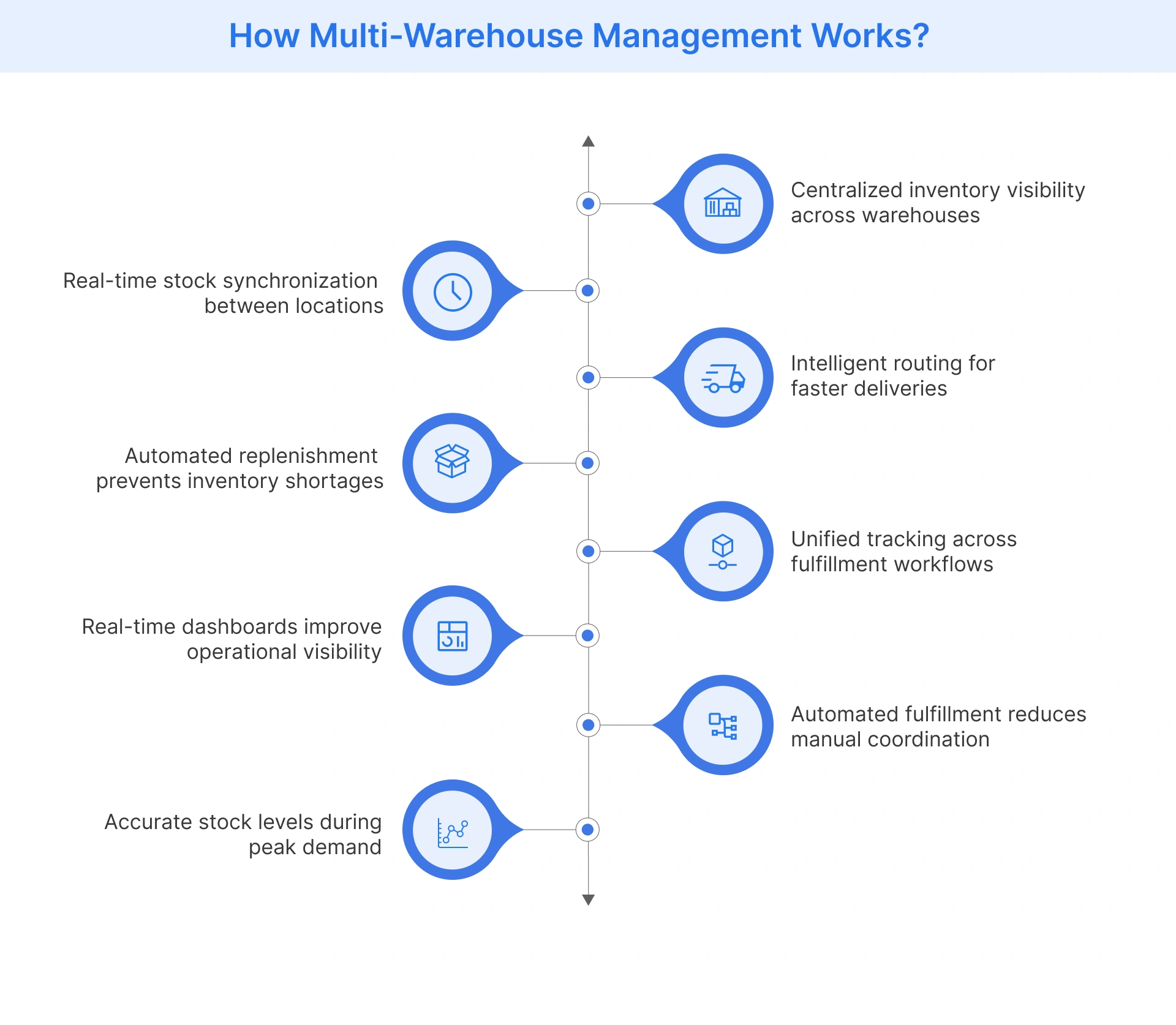
Multi-warehouse management operates through a connected set of systems and automated rules that coordinate inventory and fulfillment across every warehouse location.
- Centralized System Integration: A centralized warehouse management system connects all warehouse locations and synchronizes inventory data across each site in real time. This unified view eliminates the common issues that arise when different warehouses operate on separate, disconnected inventory management software.
- Intelligent Order Routing: When an order is placed, the system identifies the most suitable warehouse based on stock availability, proximity to the customer and shipping cost calculations. This automated routing reduces shipping times and removes the need for manual intervention from warehouse or operations staff on every order.
- Unified Inventory Tracking: Inventory movements, including receiving, storage, picking, packing, and transfers, are recorded across all locations simultaneously within the single platform. This continuous inventory tracking prevents discrepancies between different warehouses and keeps stock levels accurate throughout peak seasons and high-volume fulfillment periods.
- Automated Replenishment: Automated replenishment rules trigger stock transfers or purchase orders when inventory at any location falls below defined minimum threshold. This ensures optimal inventory levels are maintained across storage locations without requiring constant manual monitoring from warehouse management teams.
- Fulfillment Automation: The system routes orders to the optimal warehouse and generates fulfillment instructions. It does not require manual coordination between different locations or communication channels. Automated order management reduces order processing time and supports the consistent delivery performance that ecommerce businesses need to sustain customer satisfaction.
- Real-Time Dashboards: Real-time dashboards give operations teams network-wide visibility into stock levels, order status and fulfillment performance across all warehouse locations simultaneously. These insights surface key performance indicators that help managers identify bottlenecks and improve operational efficiency across the entire warehouse management strategy.
What Are the Different Types of Warehouses in a Multi-Warehouse Setup?
A multi-warehouse network typically combines several facility types, each serving a different role in the overall supply chain and fulfillment process.
- Distribution Centers: Large facilities positioned near major transport hubs receive bulk inventory from suppliers and redistribute stock to smaller fulfillment locations based on regional demand. These centers handle high volumes of inbound goods and play a central role in supply chain management for retailers with national or international reach.
- Fulfillment Centers: Warehouses positioned close to customer populations handle the final picking, packing and shipping of individual orders placed through ecommerce platforms. Proximity of fulfillment centers to end customers is the primary driver of faster delivery times and lower last-mile transportation costs.
- Regional Warehouses: Location-specific facilities store products tailored to the purchasing patterns and preferences of nearby customer segments and local demand signals. By stocking products that reflect regional buying behavior, these warehouses reduce unnecessary transportation routes and improve the speed and relevance of order fulfillment for local customers.
- Dark Stores: Retail locations converted into fulfillment hubs support rapid delivery for online orders in dense urban areas where physical store footfall has declined. These facilities bring inventory closer to urban customers and help retailers reduce shipping times for same-day and next-day delivery commitments.
What Is the Difference Between Multi-Warehouse Management and Single-Warehouse Operations?
Multi-warehouse management distributes inventory across multiple locations to serve customers faster and at lower shipping costs across different regions. A single warehouse consolidates all stock at one central point, simplifying operations but limiting delivery speed and increasing transportation costs for customers in distant areas. When natural disasters or facility disruptions occur, a single-warehouse setup carries a far greater risk of halting all fulfillment activity.
Comparing Multi-Warehouse Management vs Single-Warehouse Operations
|
Basis of Difference |
Multi-Warehouse Management |
Single-Warehouse Operations |
|
Geographic Reach |
Stock distributed across multiple regions |
All inventory held at one central location |
|
Delivery Speed |
Shorter routes from local stock to customers |
Longer distances increase delivery times |
|
Risk Exposure |
Disruptions at one site do not stop operations |
One event can halt all fulfillment activity |
|
Shipping Costs |
Reduced last-mile transportation expenses |
Higher costs for customers in distant regions |
|
Scalability |
New locations added as business grows |
Expansion requires significant single-site investment |
Caption: Comparative Analysis of Multi-Warehouse Management and Single-Warehouse Operations
What Are the Benefits of Multi-Warehouse Management?
Here are the key benefits of multi-warehouse management for retailers:
- Faster Delivery Times: Placing inventory closer to customers reduces transit time and speeds up fulfillment. Retailers can more efficiently meet same-day or next-day delivery expectations across multiple regions.
- Lower Shipping Costs: Shorter delivery routes significantly reduce transportation expenses and improve overall shipping efficiency. Retailers can offer competitive shipping rates without reducing profitability across ecommerce operations.
- Operational Resilience: Distributing inventory across multiple warehouses reduces dependence on a single fulfillment location entirely. Retailers can continue operations during disruptions, delays or unexpected regional supply chain challenges.
- Inventory Optimization: Regional demand insights help retailers allocate stock more accurately across warehouse locations. This reduces stockouts, minimizes excess inventory and improves overall supply chain efficiency significantly.
What Are the Challenges of Multi-Warehouse Inventory Management?
Here are the different challenges that multi-warehouse inventory management poses to retailers:
- Inventory Discrepancies: Disconnected warehouse systems can create mismatched stock counts across different fulfillment locations. These inaccuracies often lead to overselling, delayed shipments, and poor customer experiences overall.
- Higher Coordination Complexity: Managing multiple warehouses increases coordination requirements across teams, processes, and logistics partners. Retailers need standardized workflows and communication systems to maintain operational consistency.
- Increased Carrying Costs: Maintaining inventory across multiple warehouses increases storage and safety stock requirements. Retailers must balance improved fulfillment speed against higher inventory holding and operational expenses.
- Workforce Management: Managing dispersed warehouse teams creates additional challenges around training and performance consistency. Retailers need standardized onboarding and workforce-planning processes across all fulfillment locations.
What Strategies Help Retailers Manage Multiple Warehouses Effectively?
Retailers that apply structured strategies and the right tools achieve greater operational efficiency and inventory accuracy across their warehouse networks.
- Implement a Unified WMS: Deploy a single warehouse management system that provides real-time visibility across all locations, without requiring teams to switch between disconnected systems. A unified platform eliminates the data silos that cause common issues with inventory accuracy and order fulfillment consistency across the network.
- Set Location-Specific Stocking Rules: Define minimum stock levels, replenishment triggers, and maximum capacity thresholds for each warehouse based on its regional demand patterns and historical sales data. These rules maintain optimal inventory levels at each site and reduce the need for manual oversight.
- Standardize Processes Across Sites: Apply consistent workflows for receiving, picking, packing and cycle counting at every location to reduce errors and simplify staff training across the network. Standardized best practices also make it easier to onboard new warehouse locations quickly.
- Use Demand Forecasting: Analyze historical sales data by region to allocate the right products to the right warehouses before future demand spikes occur across key markets. Demand forecasting powered by the latest technology allows retailers to reduce the emergency stock transfers that drive up transportation costs.
- Enable Real-Time Tracking: Implement barcode scanning or RFID technology across all sites to keep inventory data accurate and synchronized throughout the day across every storage location. Real-time tracking reduces delivery delays caused by inaccurate stock counts.
Manage Multiple Warehouses with Flipkart Commerce Cloud
The Warehouse Management System from Flipkart Commerce Cloud provides a composable platform that delivers real-time tracking of stock movements across all warehouse locations from a single unified system. It replaces fragmented warehouse operations with one source of truth for inventory data across the entire fulfillment network.
FCC WMS enables smart storage assignments with automated quality checks at each facility, ensuring product accuracy before orders leave any location. The system provides end-to-end product history and traceability visibility across the network. It gives operations teams the warehouse data they need to maintain operational efficiency and meet customer demands.
To further strengthen multi-warehouse coordination, our Inventory Management System provides centralized control across all distribution points. It synchronizes stock levels in real time to prevent overselling and eliminate discrepancies between locations. FCC's Order Management System extends this connected ecosystem by intelligently routing orders to the most suitable warehouse based on stock availability, customer proximity and shipping costs.
Book a demo to see how FCC powers multi-warehouse fulfillment at scale.

FAQ
Multiple warehouses reduce shipping times by placing inventory closer to customers across different regions and key markets. They improve operational resilience by ensuring that a disruption at one location does not halt order fulfillment across the network. Retailers also benefit from lower transportation costs and greater accuracy in meeting local demand.
The best solution integrates warehouse management, inventory tracking and order management into a single platform with real-time visibility across all locations. It should support automated replenishment, intelligent order routing and standardized workflows that scale as new warehouse locations are added. Flipkart Commerce Cloud's WMS and Inventory Management System are purpose-built for this requirement.
Standardize receiving, picking, and cycle-counting workflows across all warehouse locations using a unified warehouse management system that applies the same rules everywhere. Set location-specific stocking rules and replenishment triggers that reflect local demand patterns rather than applying a single network-wide threshold. Regular cycle counts and barcode or RFID scanning keep inventory data accurate across every site.
Deploy a centralized inventory management system that synchronizes stock levels across all warehouse locations in real time without manual reconciliation between sites. Implement barcode scanning or RFID technology in every facility to accurately capture inventory movements at each stage of the fulfillment process. Automated alerts for discrepancies allow teams to investigate and correct stock errors before they affect order fulfillment.
The four main types are standalone WMS, which focuses solely on warehouse operations; supply chain module WMS, integrated within broader supply chain management software; enterprise resource planning-integrated WMS, embedded within an ERP system; and cloud-based WMS, which delivers warehouse management capabilities via a hosted platform with real-time access across all locations.