
April 7, 2025
What is a Fulfillment Center?
A fulfillment center is a logistics facility that manages inventory storage, order processing, and shipping for businesses. It plays a crucial role in streamlining e-commerce operations, ensuring faster deliveries, reducing operational costs, and enhancing customer satisfaction through efficient supply chain management.
Drishti, Manager - Digital Marketing

Table of Contents
- What Is a Fulfillment Center?
- What Are the Key Functions of a Fulfillment Center?
- What Are the Types of Fulfillment Centers?
- What Is the Difference Between a Fulfillment Center and a Traditional Warehouse?
- How Do You Choose the Right Fulfillment Center?
- What Are the Benefits of Using a Fulfillment Center?
- What Are the Challenges of Fulfillment Center Operations?
- Conclusion
Fulfillment Centers and Their Role in Modern Ecommerce Operations
As ecommerce companies grow, managing inventory, processing orders, and meeting customer expectations around delivery times can become more complex. The systems and facilities supporting these activities can directly affect order speed, accuracy, and the overall customer experience.
Fulfillment centers play an important role in helping retailers manage these operational demands more efficiently. Their value extends beyond storing products, supporting businesses with order processing, picking and packing, shipping, inventory visibility, and the ability to scale during periods of higher demand.
In this article, we discuss what a fulfillment center is, how it works, its key functions and types, how it differs from a traditional warehouse, and the benefits and challenges businesses should consider when using one.
What is a Fulfillment Center?
A fulfillment center is a facility that stores inventory and helps businesses process and ship orders to customers. It supports activities such as receiving products, storing inventory, processing orders, picking and packing items, and coordinating shipments to customers.
Unlike a traditional warehouse, which is primarily designed for longer-term storage, an ecommerce fulfillment center is built around faster order movement and distribution. This makes it especially useful for ecommerce and retail businesses that need to process orders efficiently and meet customer expectations around delivery speed.
Fulfillment centers can also help businesses scale operations by providing the infrastructure, technology, and logistics support needed to manage growing order volumes without handling every fulfillment activity in-house.
What Are the Key Functions of a Fulfillment Center?
A fulfillment center manages several core operations that move inventory from receiving through to customer delivery. These include:
- Receiving Inventory: The primary goal of a fulfillment center is to accept incoming shipments from manufacturers or suppliers. They inspect goods for quality and accuracy, log received items into the inventory management system and assign storage locations for efficient retrieval.
- Storage: Products are systematically stored in designated locations within the fulfillment center, allowing for efficient inventory tracking and quick retrieval during order processing.
- Order Processing: When customers place retail or wholesale orders, the fulfillment center receives the order details, confirms stock availability, and prepares the items for the next steps.
- Picking and Packing: Warehouse staff or automated systems pick ordered items, inspect them for accuracy, and securely pack them using appropriate materials to prevent damage during transit.
- Shipping: Once packed, orders are labeled, sorted, and handed over to shipping carriers for last-mile delivery, ensuring prompt and reliable shipment to customers.
What Are the Types of Fulfillment Centers?
As the ecommerce business landscape evolves, various types of fulfillment centers have emerged to cater to different business needs:
- In-House Fulfillment Centers: Businesses that manage their own warehousing, inventory, and order processing operate in-house fulfillment centers. This model offers complete control over logistics but requires significant investment in infrastructure, technology, and personnel. It is ideal for companies with consistent order volumes and specialized fulfillment needs.
- Third-Party Logistics (3PL) Fulfillment Centers: 3PL fulfillment centers provide outsourced logistics services, handling inventory storage, order processing, packing, and shipping on behalf of businesses. These centers leverage advanced logistics networks to optimize costs and delivery speed. They are well-suited for a growing online store looking for scalable fulfillment solutions without maintaining its own warehouse facilities.
- Dropshipping Fulfillment: In this model, the retailer forwards the customer’s order to a supplier or manufacturer, which ships the product directly to the customer. This reduces inventory holding costs and can suit businesses looking for a lower-risk, flexible ecommerce fulfillment model.
- Hybrid Fulfillment Centers: These centres combine elements of different fulfillment models. Companies might use in-house fulfillment for core products and 3PL services for seasonal items or international orders. This approach offers flexibility and can be tailored to specific business needs.
What Is the Difference Between a Fulfillment Center and a Traditional Warehouse?
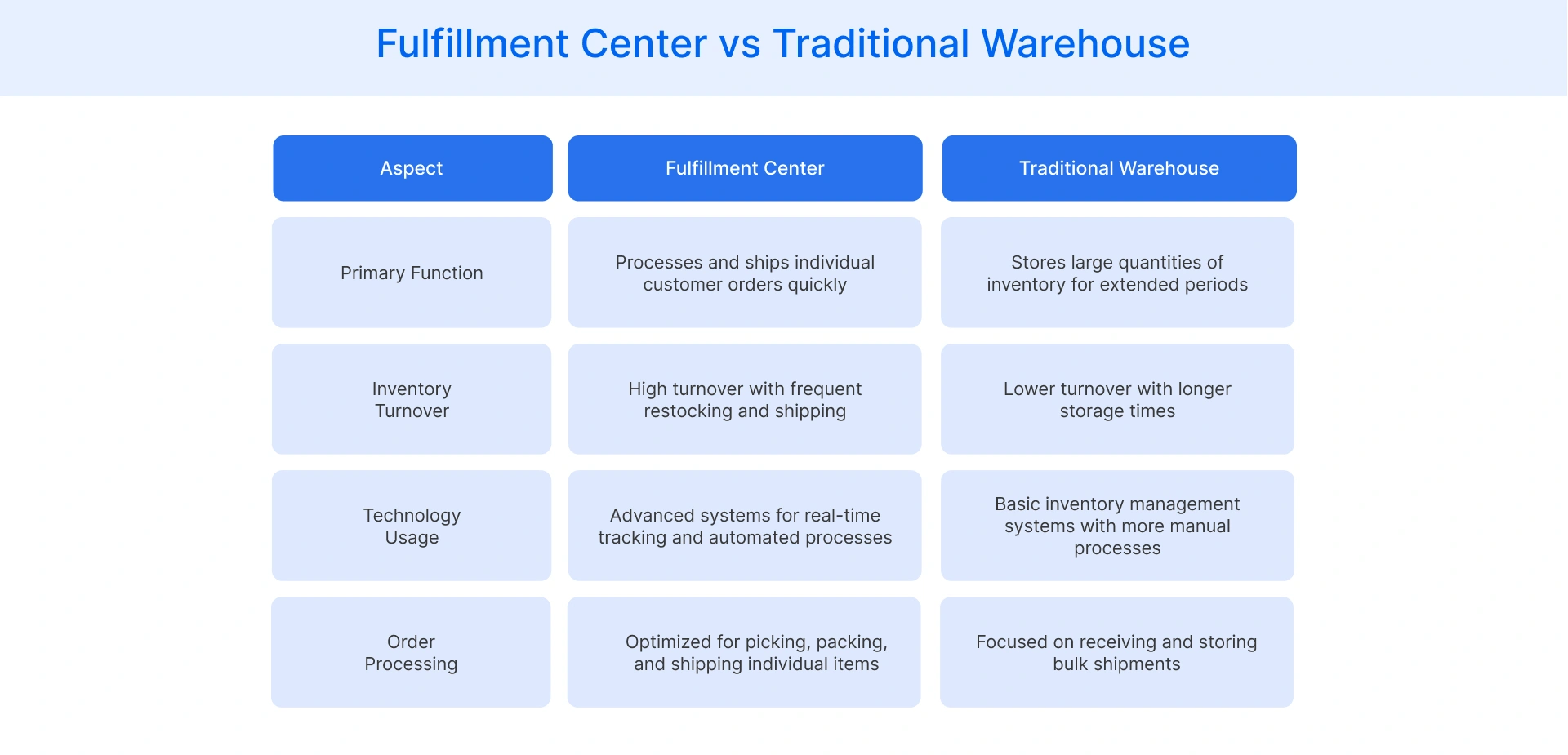
A fulfillment center and a traditional warehouse serve different roles in the supply chain, with distinct functions, operations, and technology usage. While both store inventory, their core purpose differs significantly.
A typical warehouse primarily offers storage space for extended periods without immediate order processing. It is designed for bulk storage and wholesale distribution, often requiring manual inventory tracking and fewer technological integrations.
In contrast, fulfillment centers focus on fast order processing, packaging, and shipping, ensuring timely deliveries to customers. They operate with advanced technology, such as warehouse management systems (WMS) and automation, to optimize real-time order fulfillment. These centers offer a wide range of services to handle high inventory turnover and prioritize last-mile delivery.
How Do You Choose the Right Fulfillment Center?
Here are the key factors to consider when choosing a fulfillment center for your business:
Assess Business Needs
Evaluate your current order volume and product types to determine specific fulfillment requirements. Consider your growth projections and seasonal fluctuations to ensure the center can accommodate future needs. Analyze your customer demographics and shipping destinations to align with the fulfillment center’s capabilities.
Consider Strategic Locations
Choose fulfillment centers strategically located near your customer base to reduce shipping times and costs. Consider proximity to major transportation hubs and shipping carriers for efficient order processing. Evaluate multiple locations to create a network that optimizes delivery speed and minimizes transportation expenses.
Evaluate Technology Capabilities
Assess the fulfillment center’s technological infrastructure, including their warehouse management system and inventory tracking tools. Ensure their order processing software solutions can handle your business’s unique requirements and order complexities. Look for centers that provide visibility into inventory levels and order statuses in real time to enhance operational control.
Verify Scalability Options
Confirm that the fulfillment center can accommodate your business growth without disrupting business operations. Ensure they offer flexible storage options to handle inventory fluctuations during peak seasons or promotional periods. Verify their ability to scale order processing capacity to meet sudden increases in demand without compromising service quality.
Check Integration Capabilities
Ensure the fulfillment center’s systems can seamlessly integrate with your e-commerce platforms and marketplaces. Verify compatibility with your inventory management software to maintain accurate stock levels across all sales channels. Confirm that the center supports your preferred shipping carriers and can handle any special packaging or handling requirements.
What Are the Benefits of Using a Fulfillment Center?
Here are the key benefits ecommerce businesses can gain from using a fulfillment center:
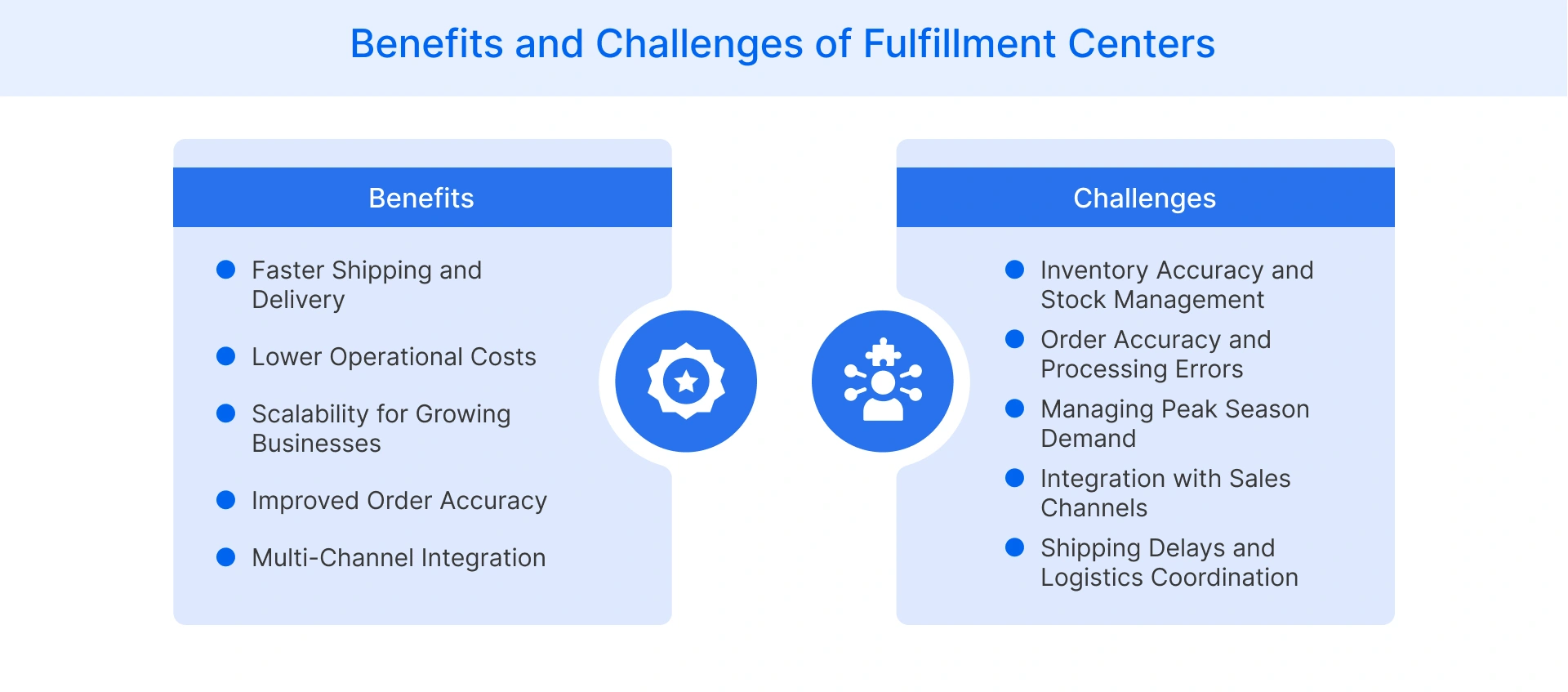
- Faster Shipping and Delivery: Fulfillment centers store a seller’s inventory near key markets, reducing transit times and ensuring a quick order fulfillment process. This improves delivery speed, enhances customer experience, and increases the likelihood of repeat purchases.
- Lower Operational Costs: Outsourcing fulfillment eliminates the need for warehouse space, staffing, and in-house logistics. Businesses can reduce overhead expenses and overall fulfillment costs while leveraging fulfillment centers’ bulk shipping discounts for cost-effective distribution.
- Scalability for Growing Businesses: A fulfillment center allows businesses to scale efficiently by adjusting storage and fulfillment capacity based on demand. This ensures seamless order processing during peak seasons without investing in additional infrastructure.
- Improved Order Accuracy: Advanced Warehouse Management Systems (WMS) and automation tools enhance order picking, packing, and inventory tracking, reducing human errors and minimizing returns caused by incorrect shipments.
- Multi-Channel Integration: Fulfillment companies integrate e-commerce platforms, marketplaces, and shipping carriers, ensuring synchronized inventory management and seamless order processing across multiple sales channels.
What Are The Challenges in Fulfillment Center Operations
Fulfillment center operations can involve several challenges that affect inventory accuracy, order processing, and delivery performance. These include:
- Inventory Accuracy and Stock Management: Poor inventory tracking can lead to overselling or stockouts, disrupting order fulfillment. Implementing real-time inventory management systems helps businesses maintain accurate stock levels and prevent fulfillment delays.
- Order Accuracy and Processing Errors: Picking and packing errors can result in incorrect shipments and customer dissatisfaction. Fulfillment centers rely on automation and barcode scanning to ensure accuracy and minimize returns.
- Managing Peak Season Demand: Sudden spikes in order volume during holidays or sales events can overwhelm fulfillment centers. Scalable storage and staffing solutions help manage increased demand efficiently without affecting processing times.
- Integration with Sales Channels: Syncing inventory and orders across multiple platforms requires robust integration. To avoid discrepancies, fulfillment centers must ensure seamless connectivity between e-commerce websites, marketplaces, and logistics providers.
- Shipping Delays and Logistics Coordination: Reliance on third-party carriers can lead to delays beyond the fulfillment center’s control. Strong partnerships with reliable shipping providers and advanced tracking systems help mitigate delays and improve delivery reliability.
Conclusion
Fulfillment centers help ecommerce businesses manage inventory, process orders, and move products from storage to customers more efficiently. Their value depends on how well warehousing, order management, inventory visibility, picking and packing, and shipping operations work together across the fulfillment process.
Flipkart Commerce Cloud supports these operations through its Warehouse Management System and Order Management System. FCC’s WMS provides real-time inventory visibility, multi-location warehouse management, and pick, pack, and handover orchestration, while its OMS helps retailers manage complex order workflows and fulfillment operations from a centralized system. Together, these capabilities can help businesses improve fulfillment efficiency, maintain better visibility across operations, and support growing order volumes.
FAQ
A fulfillment center focuses on processing individual customer orders, managing inventory, picking, packing, and shipping. A distribution center, however, primarily serves as a hub for bulk storage and large-scale product distribution to retailers or wholesalers.
Yes, a fulfillment center helps small businesses by reducing warehousing costs, managing inventory efficiently, and ensuring faster deliveries. It allows businesses to scale operations without investing in logistics infrastructure, improving customer experience and operational efficiency.
Fulfillment centers handle returns and reverse logistics by inspecting returned merchandise, updating inventory databases, and initiating customer replacements. Partnering with a professional fulfillment provider or using modern platforms like Flipkart Commerce Cloud helps merchants automate reverse logistics workflows, streamline refunds, and secure lower shipping rates on returned packages.
Fulfillment does not mean delivered, as it encompasses every step of the fulfillment process from inventory receiving to order packing. Delivery is simply the final shipping stage, where fulfillment service providers hand off the parcel to a major carrier, who transports it from the fulfillment warehouse to the end customer's doorstep.
A fulfillment center makes money through a multi-tiered fulfillment center business model that charges online retailers for logistics operations. Revenue streams include storage fees for available space, order processing charges, inventory handling, and markup margins applied to fulfillment services and shipping costs provided to ecommerce merchants.
The cost to use a fulfillment center varies based on order volume, storage needs, and specific logistics requirements. Operating an ecommerce store typically involves paying setup fees, monthly inventory storage charges for physical space, per-unit pick and pack costs, packaging materials, and optional additional services requested by the merchant.