
May 20, 2026
Cyber Monday
Cyber Monday is an annual online shopping holiday in the United States that takes place on the Monday after Thanksgiving. It was introduced in 2005 by the National Retail Federation and has since become one of the biggest online shopping days of the year.
Drishti, Manager - Digital Marketing

Table of Contents
- What Is Cyber Monday?
- Why Is Cyber Monday Important for Retailers?
- What Is Cyber Week and How Does It Relate to Cyber Monday?
- Which Products Are Best Suited for Cyber Monday Deals?
- What Is the Difference Between Cyber Monday and Black Friday?
- How Can Online Retailers Prepare for Cyber Monday?
- Power High-Volume Sales Events with Flipkart Commerce Cloud
Cyber Monday
Cyber Monday has evolved from a niche marketing initiative into a significant online shopping event on the retail calendar. Originally observed in the United States, it now drives billions in online sales across global markets each year and has become one of the biggest shopping days of the year for digital commerce.
Major online retailers use this day to launch their most competitive online deals, run special promotions, attract new shoppers and clear seasonal inventory at scale. Retailers who plan strategically for Cyber Monday consistently outperform those who treat it as a standard promotional day.
- Online spending on Cyber Monday 2025 reached a record-breaking $14.25 billion in the United States.
- US consumers spent $8.2 billion through their mobile devices on Cyber Monday 2025, making mobile readiness essential.
- Electronics, apparel and household appliances are among the top-performing categories during the event.
- Cyber Monday generates online sales that can exceed average daily revenue by more than 264%.
What Is Cyber Monday?
Cyber Monday is an online shopping holiday that falls on the Monday after Thanksgiving and Black Friday in the US. Online retailers use this day to offer deeper discounts, flash sales and limited-time promotions exclusively through digital channels. The term Cyber Monday was first used in a 2005 press release by Ellen Davis, a PR executive at Shop.org, which is a division of the National Retail Federation.
The origins of what is Cyber Monday trace back to the early 2000s when the National Retail Federation noticed a consistent spike in online spending on the Monday following Thanksgiving as office workers and job seekers returned to faster workplace internet connections. Retailers quickly turned this trend into a dedicated eCommerce shopping event and a new kind of holiday tradition centered around digital purchasing behavior.
What is Cyber Monday today looks very different from its early beginnings and reflects the rapid growth of major online retailers over the past two decades. It now influences online shopping trends across North America, Europe and parts of Asia. The first Cyber Monday generated roughly $484 million in online sales.
Why Is Cyber Monday Important for Retailers?
Here is why Cyber Monday has emerged as a crucial event for online retailers:
- Revenue Generation: Cyber Monday sales drive a scale of online revenue that no ordinary promotional day can replicate. American consumers spent nearly $16 million every minute at peak hours in 2025. For retailers, this represents a window to recover margins and clear inventory volumes in a single trading day.
- Customer Acquisition: The promise of deeper discounts attracts first-time shoppers who have not previously purchased from the brand. These initial transactions create an opportunity for retailers to build loyalty through post-purchase engagement, turning one-time bargain hunters into repeat buyers.
- Holiday Shopping Kickoff: Cyber Monday anchors the start of the most commercially significant period in retail. Retailers that perform well on this day set the tone for their holiday-season revenue and establish brand recall during the period when consumer spending intentions are at their highest.
- Competitive Positioning: Participation in Cyber Monday is no longer optional for online retailers seeking relevance during the highly competitive holiday shopping season dominated by Black Friday deals and digital-first campaigns. Retailers that sit out the event risk losing market share to larger businesses and marketplace competitors running aggressive Cyber Monday deals.
What Is Cyber Week and How Does It Relate to Cyber Monday?
Cyber Week refers to the five-day period beginning on Thanksgiving Thursday and ending on Cyber Monday. It includes major retail events such as Black Friday and Small Business Saturday. During this period, retailers launch large-scale discounts and sales promotions as consumer shopping activity peaks during the holiday season.
- Scale of the Event: Cyber Week generated $44.2 billion in global online revenue in 2025. The spending was spread across all five days rather than concentrated on a single date. This distribution reflects a shift in how both retailers and shoppers approach the holiday weekend.
- Extended Promotions: Retailers now launch Cyber Week campaigns as early as the week before Thanksgiving. Plenty of people begin browsing hottest deals before the official event. This means promotional windows have expanded considerably beyond what the first official Cyber Monday covered in 2005.
- Cyber Monday as the Peak: Despite shopping activity spreading across Cyber Week, Cyber Monday remains the biggest online shopping event in the holiday retail calendar. Retailers often reserve their strongest digital offers, app-exclusive deals and special promotions for this day.
- Retail Strategy Implications: Retailers that treat Cyber Week as an integrated campaign rather than a series of isolated days see stronger results. Sustained promotional momentum across the week builds urgency and keeps shoppers returning for new online deals across categories.
Which Products Are Best Suited for Cyber Monday Deals?
The following categories consistently drive the most significant results during Cyber Monday:
- Electronics: Electronics had the largest average discount at 31% on Cyber Monday 2025, with computers, televisions and headphones driving the highest traffic volumes. A lot of shoppers specifically search their favorite stores for electronics Cyber Monday deals, making this category a proven traffic driver for online retail platforms.
- Apparel and Accessories: Clothing and fashion items offered average discounts of 25%, attracting shoppers who plan gift purchases for the holiday season. This category benefits from gift card bundling and free shipping incentives that increase average basket size.
- Household Appliances: Kitchen gadgets, vacuum cleaners and home improvement products see strong demand as shoppers replace or upgrade items ahead of the new year. These products pair well with bundle promotions that increase order value above the free shipping threshold.
- Health and Beauty: Cosmetics, skincare and personal wellness products attract deal-seeking shoppers looking for premium brands at reduced prices. This category responds particularly well to flash sales with countdown functionality that creates urgency.
- Home Furnishing: Furniture, bedding and home decor items represent a growing Cyber Monday segment as shoppers increasingly use the event to make considered purchases they have been delaying.

What Is the Difference Between Cyber Monday and Black Friday?
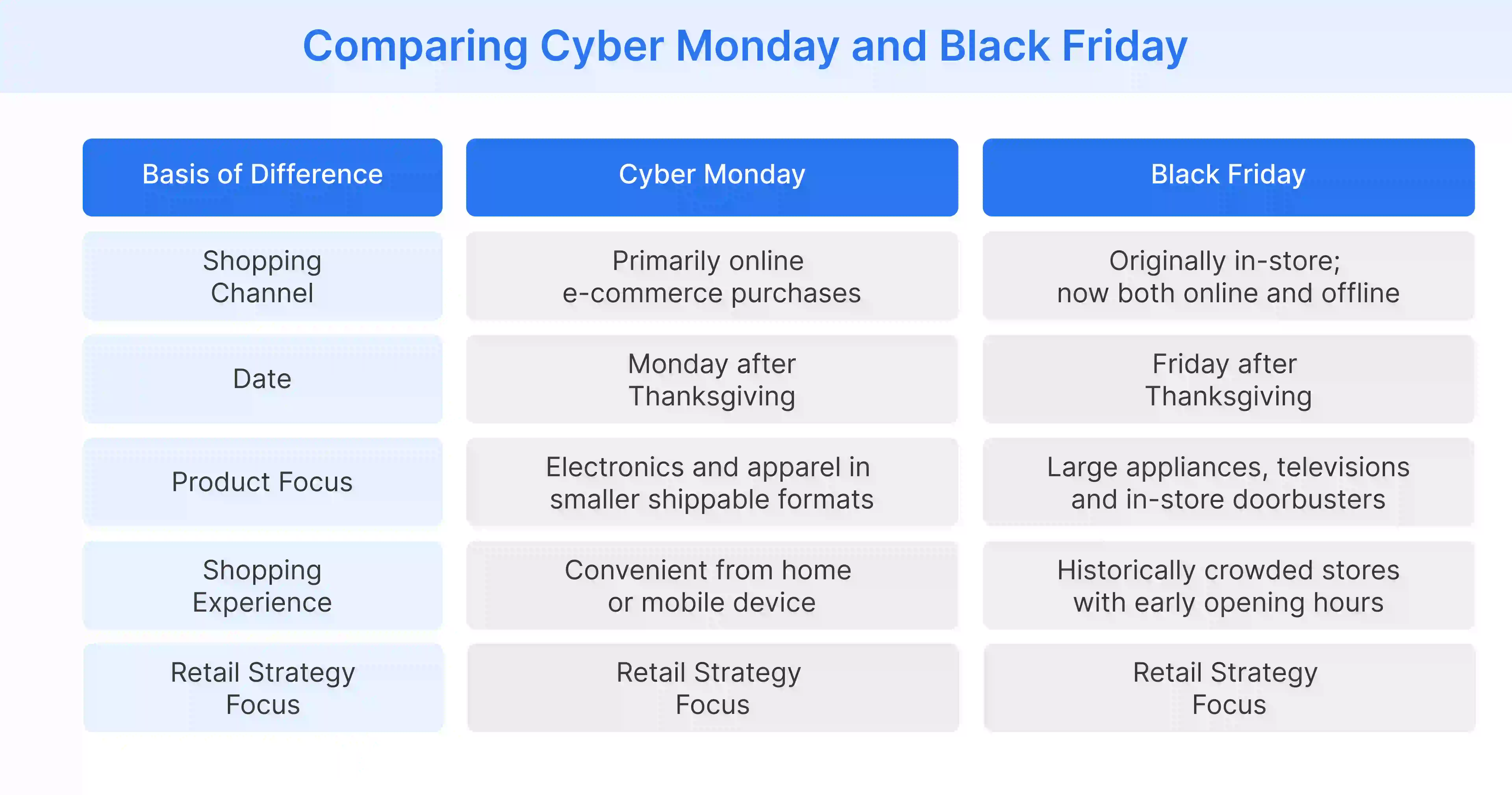
Cyber Monday and Black Friday began as distinct events with separate purposes, audiences and shopping channels. Black Friday was historically an in-store event tied to doorbuster chaos and early-morning queues at physical retail locations for the best ‘Black Friday deals’.
Cyber Monday emerged as the online counterpart, designed for shoppers seeking convenience and digital marketplace access. While the two events have converged significantly, meaningful differences remain relevant for retail planning.
How Can Online Retailers Prepare for Cyber Monday?
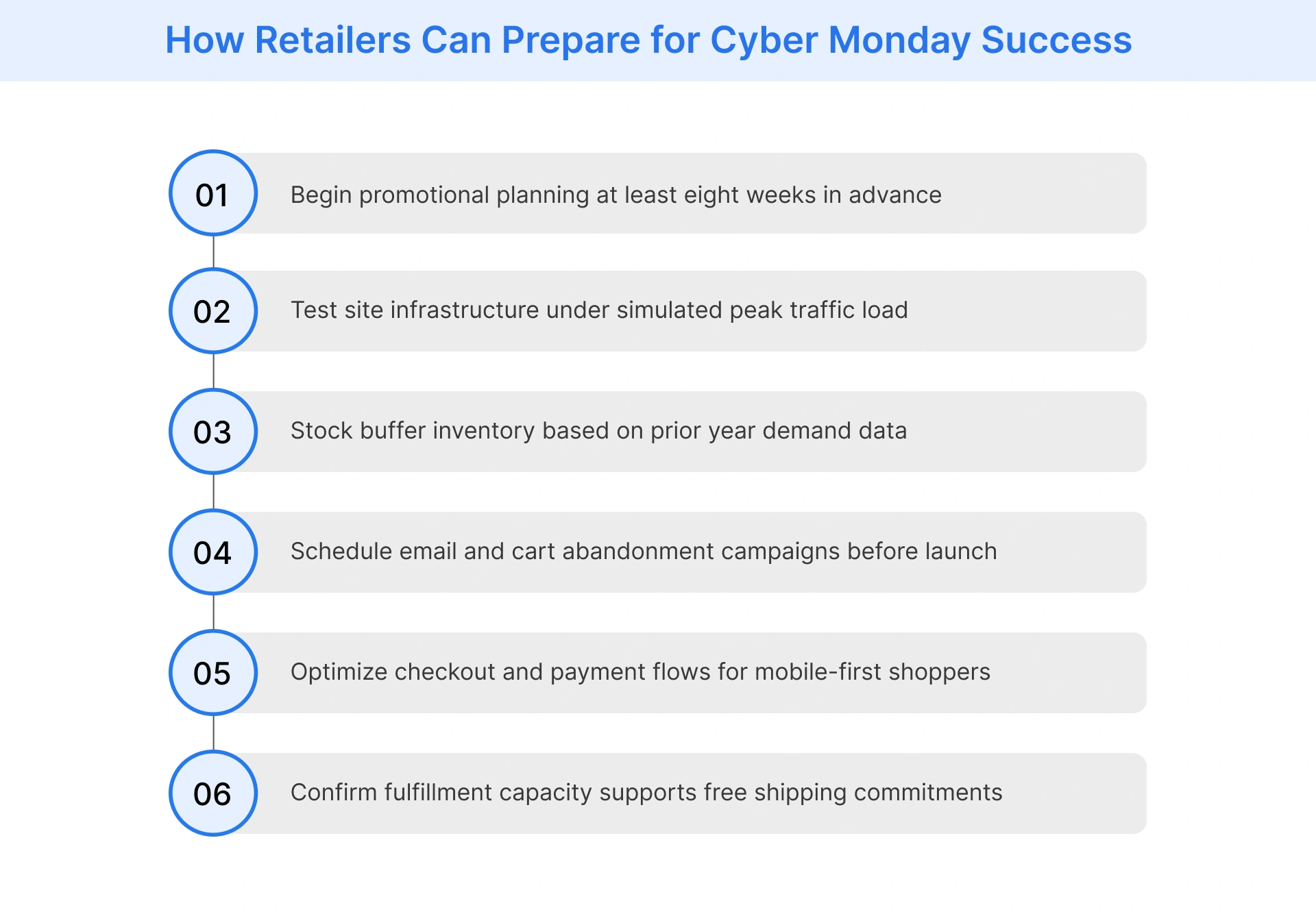
Preparation for Cyber Monday must begin well before the event itself. The following steps cover the most critical preparation areas:
- Plan Promotions Early: Finalize your discount pricing strategy and promotional calendar at least eight weeks before Cyber Monday. Numerous expensive marketing strategies fail because they are executed without sufficient lead time for testing and campaign setup.
- Optimize Website Performance: Test your platform for site speed, server capacity and checkout flow stability under simulated peak load. Significant challenges arise when traffic spikes reveal infrastructure gaps that could have been resolved before the event.
- Increase Inventory: Stock high-demand SKUs with buffer quantities based on previous year sales data and demand forecasting. Sellouts during Cyber Monday drive shoppers toward larger competitors and reduce the positive impact the event can have on seasonal revenue growth.
- Set Up Email Campaigns: Schedule promotional emails, cart abandonment sequences and deal alerts in advance. Email and social media remain two of the highest-converting digital marketing channels during Cyber Monday, particularly for loyal customers expecting communications from their favorite stores.
- Enable Mobile Shopping: With a large volume of Cyber Monday orders placed through mobile devices, a seamless mobile shopping experience is non-negotiable. Ensure that product pages, checkout flows and payment systems are fully optimized for mobile-first interactions.
- Coordinate Logistics: Arrange additional warehouse capacity, carrier agreements and customer service staffing ahead of the event. Free shipping is a key purchase driver during Cyber Monday, and retailers must ensure fulfillment operations can support it profitably at scale.
- Test Payment Systems: Verify that payment gateways, Buy Now Pay Later integrations and fraud detection tools function reliably under load. A daily record of BNPL spending exceeding $1 billion was set on Cyber Monday 2025, reflecting how critical these integrations have become to conversion.
Power High-Volume Sales Events with Flipkart Commerce Cloud
Cyber Monday demands infrastructure capable of handling billions of transactions without degrading performance, and retailers need technology that keeps pace with consumer demand. Flipkart Commerce Cloud delivers enterprise-grade digital commerce solutions built on 15 years of scale-tested experience powering some of the world's largest online shopping events, for retailers ranging from fast-growing brands to mighty companies.
FCC's Promotion Management platform enables retailers to design and deploy complex Cyber Monday campaigns across flash sales, tiered discounts and personalized offers without manual intervention. Our Dynamic Pricing solution monitors competitor pricing in real time and adjusts your SKU-level offers automatically, so your Cyber Monday deals remain competitive throughout the day.
Beyond pricing, FCC's Smart Search and Personalization engine ensure that every shopper arriving on Cyber Monday finds relevant products quickly, reducing bounce rates and increasing average order values at peak load.
Book a free demo to explore how Flipkart Commerce Cloud helps you turn Cyber Monday traffic into sustained revenue growth.

FAQ
Cyber Monday drives concentrated online spending by prompting consumers to act on deal urgency during the holiday shopping season. Online retailers use the event to accelerate sales of electronics, apparel and other high-demand categories. The day consistently generates the highest single-day online sales figures in the United States.
Black Friday and Cyber Monday are related but distinct online shopping events separated by three days. Black Friday originated as an in-store shopping event, while Cyber Monday was created specifically to drive online sales. Both now include significant online retail activity, though Cyber Monday typically generates higher total online revenue.
The term Cyber Monday was coined in a 2005 press release by Ellen Davis from the National Retail Federation's division, Shop.org. The name reflected the growing trend of online shopping, with cyber referencing internet-based activity. The marketing term stuck after major media coverage accelerated its adoption among online retailers.
Electronics consistently receive the deepest discounts on Cyber Monday, averaging 31 percent off in 2025. Toys, apparel, household appliances and home furnishing also feature prominently with significant markdowns. Retailers across categories participate, making it one of the broadest online deals events of the holiday season.
Shoppers choose Cyber Monday for the convenience of accessing major online deals without visiting crowded physical stores. Mobile shopping allows purchases from any location, removing the friction of traditional Black Friday in-store experiences. The concentration of promotions across a single day also helps shoppers finish their leftover shopping lists more conveniently through online retailers.
Consumers in the United States spent $14.25 billion on Cyber Monday 2025, which represents a 7.1% increase over the previous year. An average American adult spent $187 during the event. Global Cyber Week spending reached $336.6 billion across all five days of the holiday weekend.