
May 28, 2026
What Is Visual Commerce?
Visual commerce is a retail strategy that uses rich visual content, including images, videos, 3D models, and augmented reality, to help shoppers evaluate products and make confident purchase decisions online. It transforms static product pages into immersive, confidence-building shopping experiences that replicate the in-store shopping experience.
Drishti, Manager - Digital Marketing

Table of Contents
- What Is Visual Commerce?
- What Are the Main Types of Visual Commerce?
- How Does Visual Commerce Work in Ecommerce?
- How Technology Enables Visual Commerce at Scale
- What Are the Benefits of Visual Commerce for Retailers?
- What Are the Challenges of Visual Commerce for Retailers?
- What Is the Difference Between Visual Commerce and Visual Search?
- Implement Your Visual Commerce Strategy with Flipkart Commerce Cloud
Visual Commerce Meaning and Role in Modern Ecommerce
Visual commerce has become a core strategy for online retailers competing in crowded digital markets where product visuals directly influence purchase decisions. It serves as an umbrella term for all strategies retailers use visual media to communicate product value and reduce shopper hesitation.
Ecommerce companies across fashion, home decor and electronics now treat visual commerce technology as a core part of their marketing strategy. Hesitant buyers who cannot physically touch or try a product rely heavily on the quality and depth of the visual experience a retailer provides.
- Visual commerce gives online shoppers greater insight into products through immersive and interactive visual formats.
- It reduces the gap between the online shopping experience and the physical store environment.
- Retailers use visual commerce tools to improve customer engagement and shorten the sales cycle significantly.
- Strong visual commerce strategy increases customer satisfaction and supports long-term brand loyalty across competitive markets.
What Is Visual Commerce?
Visual commerce is a retail approach that uses product visuals to help shoppers understand, compare, and evaluate items before purchase. It uses formats such as images, videos, three-dimensional models and interactive views to make digital product discovery more useful.
In online retail, shoppers cannot touch or inspect products in person. Visual commerce helps close this gap by showing product scale, texture, usage context and appearance through richer formats across the shopping journey.
Retailers across fashion, home decor, and electronics categories rely on visual commerce to reduce uncertainty in decision-making. Clothing brands, for example, use virtual try-on tools and on-model product photos to help hesitant consumers visualize fit and style without visiting a physical store, directly improving conversion rates and customer satisfaction.
What Are the Main Types of Visual Commerce?
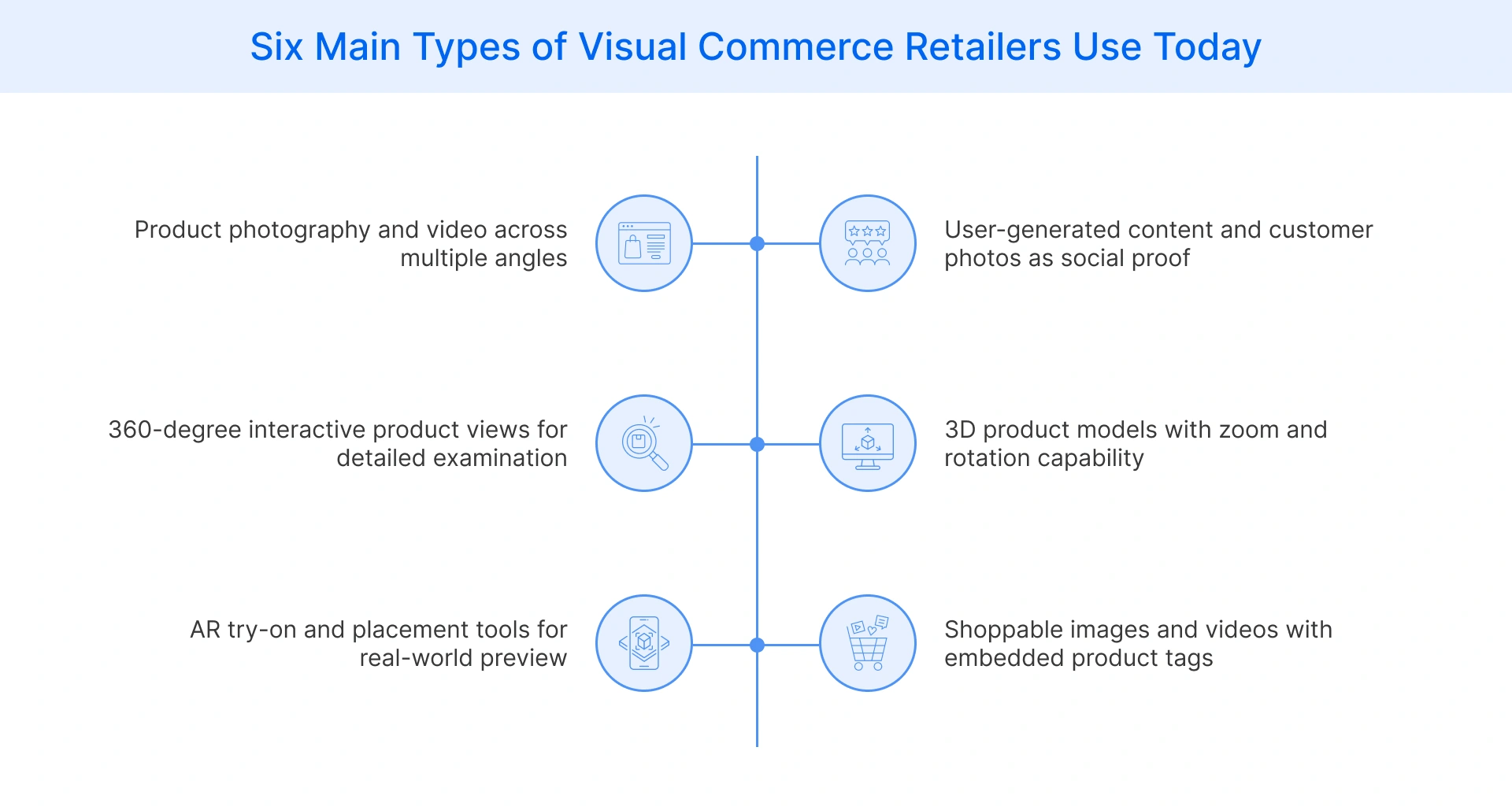
Retailers use different formats based on product type, customer need, and the role visuals play in purchase decisions.
- Product Photography and Video: High-resolution product images and short-form product videos show scale, texture, and functionality from multiple angles for online shoppers. Product videos reduce uncertainty for hesitant buyers by demonstrating the final product in motion and in real-world use.
- User-Generated Content (UGC): Customer photos, social media posts, and client reviews show products in real-life contexts, building social proof through authentic peer validation. UGC from social media accounts gives potential customers an honest view of how products perform outside of studio conditions.
- 360-Degree Product Views: Interactive rotations let shoppers examine a product from every angle without needing to visit a physical store or request samples. This format is effective for footwear, electronics, and furniture, where shape and proportion are critical to the purchase decision.
- 3D Product Models: Digital three-dimensional representations allow customers to rotate, zoom and interact with products directly on the product page. Visual configurators built on 3D technology also allow shoppers to customize color, material or configuration before adding to cart.
- Augmented Reality Try-On and Placement: AR technology lets customers visualize how a product looks on themselves or within their physical space using a smartphone camera in real time. This capability is used by fashion brands for virtual try-ons and by home decor retailers for room placement previews.
- Shoppable Content: Shoppable images and product videos embed product tags directly into visual media, allowing shoppers to move from discovery to checkout without leaving the content. This format turns social media platforms and campaign content into direct sales channels for ecommerce companies.
How Does Visual Commerce Work in Ecommerce?
Visual commerce starts with the creation, enrichment and organization of product images, videos and interactive assets. Retailers add these assets across product pages, category pages, campaign banners, and other store touchpoints to support product evaluation.
The next layer connects those visuals with catalog data. Product attributes, category information, and variant details help the system match visuals with the right products, filters, and recommendations across the online store.
Discovery systems then use shopper behavior, search intent, and visual signals to show relevant products. Visual search lets shoppers upload an image and find similar items without having to describe the product.
Retailers also track how shoppers interact with visual elements across the journey. Click behavior, time spent, add-to-cart activity and conversion outcomes help teams refine their visual commerce strategy for future campaigns.
How Technology Enables Visual Commerce at Scale?
Visual commerce technology helps retailers create, organize and deliver richer product visuals across large catalogs without relying on manual work alone.
- Image Enrichment and Generation: AI can improve product images and create contextual backgrounds for stronger product presentation. It helps retailers maintain consistent visual content across the product page and campaign assets.
- Model and Pose Transformation: Retailers can convert flat-lay apparel visuals into on-model formats and adjust poses for better product visualization. This supports fashion brands that need useful visuals without having to repeat photoshoots.
- Video Generation and Try-Ons: AI can turn static images into product videos that show fit and movement. Try-on tools help hesitant buyers understand products better before making a purchase decision.
- Catalog Data Improvement: AI can read product photos and extract useful product details from them. Better catalog data helps search systems and filters show more relevant products across the online store.
- Visual Quality Checks: Automated checks can detect blurred images and watermarks before they affect the shopping experience. This helps retailers maintain cleaner product visuals across websites and marketplaces.
- Smarter Product Discovery: Visual search and personalization help connect product visuals with shopper intent. Flipkart Commerce Cloud enables this through multimodal search, adaptive storefronts, and conversational product discovery. It allows retailers to guide shoppers from visual inspiration to relevant product choices.
What Are the Benefits of Visual Commerce for Retailers?
Visual commerce delivers measurable improvements across conversion and brand perception for online retailers.
- Higher Conversion Rates: Rich visual content reduces hesitation and helps shoppers make faster purchase decisions, directly improving ecommerce conversion rates across product categories. Shoppers who can interact with 3D models or watch product videos convert at significantly higher rates than those viewing static images alone.
- Lower Return Rates: Accurate visual representation of products through AR technology and 360-degree views sets realistic expectations before purchase. Shoppers who understand exactly what they are buying through immersive visual commerce experiences are far less likely to return items after delivery.
- Improved Product Discovery: Shoppable content, visual search and AI-curated visual feeds help customers find relevant products faster without relying on text-based search queries alone. Better product discovery translates directly into higher session engagement and increased revenue per visit across the ecommerce store.
- Stronger Brand Perception: Consistent, high-quality visual content across all touchpoints builds a premium brand identity that supports customer loyalty and repeat purchase behavior over time. Ecommerce companies that invest in immersive visual commerce signal professionalism and product confidence to online shoppers evaluating multiple competing options.
What Are the Challenges of Visual Commerce for Retailers?
While visual commerce drives strong commercial results, it also introduces operational and technical challenges that retailers need to plan for carefully.
- High Content Production Demands: Creating high-quality product visuals, videos and interactive experiences across large catalogs requires significant creative resources and ongoing investment from the retail team. Without automation or AI-assisted visual commerce tools, maintaining content quality at scale becomes difficult and expensive.
- Technology Integration Complexity: Integrating visual commerce tools with ecommerce platforms, product catalogs, and inventory systems creates technical and operational challenges for retail teams managing multiple systems. Misalignment between visual commerce technology and the existing tech stack can delay deployment and reduce the overall strategy's effectiveness.
- Performance and Loading Issues: Heavy visual assets can slow website performance and negatively affect the mobile shopping experience if content is not properly compressed and optimized. Slow-loading product pages increase bounce rates and reduce the conversion gains that visual commerce is designed to deliver for online retailers.
- Content Consistency Management: Maintaining consistent product imagery, branding and visual quality across marketplaces, websites and social media platforms becomes difficult as catalog size and channel count grow. Retailers without centralized visual commerce management processes often end up with inconsistent product photos and visual elements, undermining brand identity across channels.
What Is the Difference Between Visual Commerce and Visual Search?
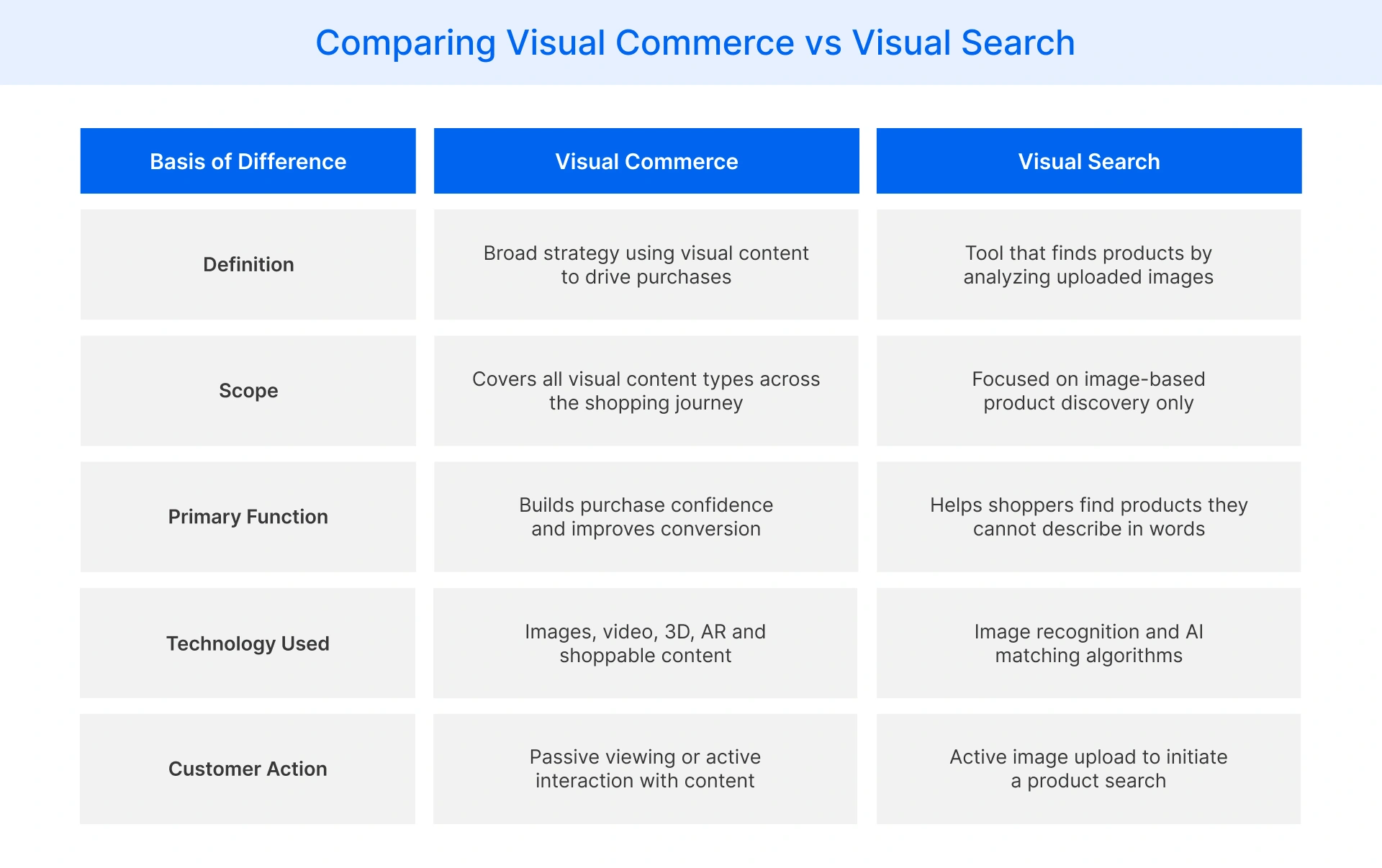
Visual commerce is a broad retail strategy that uses visual content to support product discovery, customer engagement and purchase decisions across the online shopping experience. It includes formats such as product images, videos, 3D views, shoppable content, and augmented reality.
Visual search is one tool within this wider strategy. It helps shoppers find similar products by uploading an image instead of typing a search query.
The key difference is scope. Visual commerce encompasses the full range of techniques across the shopping journey, while visual search supports a specific moment in product discovery.
Implement Your Visual Commerce Strategy with Flipkart Commerce Cloud
Delivering a strong visual commerce experience requires personalization, search and catalog capabilities that work together as a unified system. Flipkart Commerce Cloud's Personalization Engine enables intuitive product discovery through visual search and conversational AI, dynamically adapting storefronts to match each shopper's behavior and preferences across every session.
FCC's Smart Search supports multimodal search including visual inputs, allowing shoppers to find products by uploading images rather than typing queries. This capability delivers measurable improvements in product discovery for visually driven categories such as fashion, home decor and electronics where typed search queries fall short of capturing shopper intent accurately.
FCC's Composable Storefront and Catalog Management solutions let retailers build media-forward shopping experiences and maintain consistent, enriched product visuals at scale across all selling channels. Together, these tools give ecommerce companies the visual commerce platform they need to compete effectively and convert hesitant buyers into loyal customers.
Book a demo to explore FCC's visual commerce capabilities today.

FAQ
A visual commercial is a video or motion-based advertisement that promotes a product or brand through dynamic imagery rather than static visuals. In the context of visual commerce, it refers to short-form product videos and shoppable video content embedded across ecommerce stores and social media platforms. These formats combine brand storytelling with direct product discovery to drive purchase intent.
Visual commerce reduces the uncertainty shoppers feel when they cannot physically touch or try a product before buying it. Interactive formats such as 3D models, AR try-ons and product videos give shoppers the confidence to make faster purchase decisions without hesitation. Higher confidence at the point of decision directly reduces cart abandonment and improves overall conversion rates for online retailers.
Online shoppers cannot physically examine products before buying, which makes high-quality visual content the primary tool for communicating product value and fit. Visual commerce bridges the gap between the physical store experience and online shopping, reducing hesitation among potential customers. Retailers that invest in a strong visual commerce strategy consistently achieve lower return rates and stronger customer satisfaction scores.
Ecommerce stores integrate visual commerce by combining professional product photos, user-generated content and interactive formats across product pages and category listings. AI-powered visual search and personalized storefronts surface the most relevant visuals for each shopper based on individual behavior. Performance tracking across visual assets helps teams identify which formats drive the strongest engagement and conversion results.
3D product models let shoppers rotate and interact with products from every angle on the product page. AR technology enables virtual try-ons for fashion brands and room placement previews for home decor retailers, replicating real-world evaluation online. Both formats reduce return rates and give hesitant consumers the confidence to complete purchases they would otherwise abandon.