Every e-commerce platform is sitting on a revenue stream it has not yet fully unlocked. Homepage slots, search result pages, category listings, and product detail pages are high-intent environments that brands actively want to reach and that retailers are leaving unmonetized. Flipkart Ads Manager, the retail media solution from Flipkart Commerce Cloud (FCC), is purpose-built to change that. This blog breaks down what Flipkart Ads Manager does, how it works, and what results ecommerce platforms have seen when they deploy it at scale.
What Is Flipkart Ads Manager?
Flipkart Ads Manager is Flipkart Commerce Cloud's end-to-end retail media management platform. It gives e-commerce platforms the tools to build, operate, and scale a fully functional advertising business without building the technology from scratch or maintaining a large ad operations team.
The platform brings together ad serving, audience targeting, brand self-serve campaign management, and full-funnel performance reporting into a single unified system. It is the same core technology that powers advertising at some of the world's most sophisticated retail environments, built on over 14 years of Flipkart's own e-commerce and retail media experience.
Platforms that deploy Flipkart Ads Manager are not just adding an ad server, they are adopting a complete retail media operating model, backed by FCC's consulting team and proprietary ML/AI algorithms.
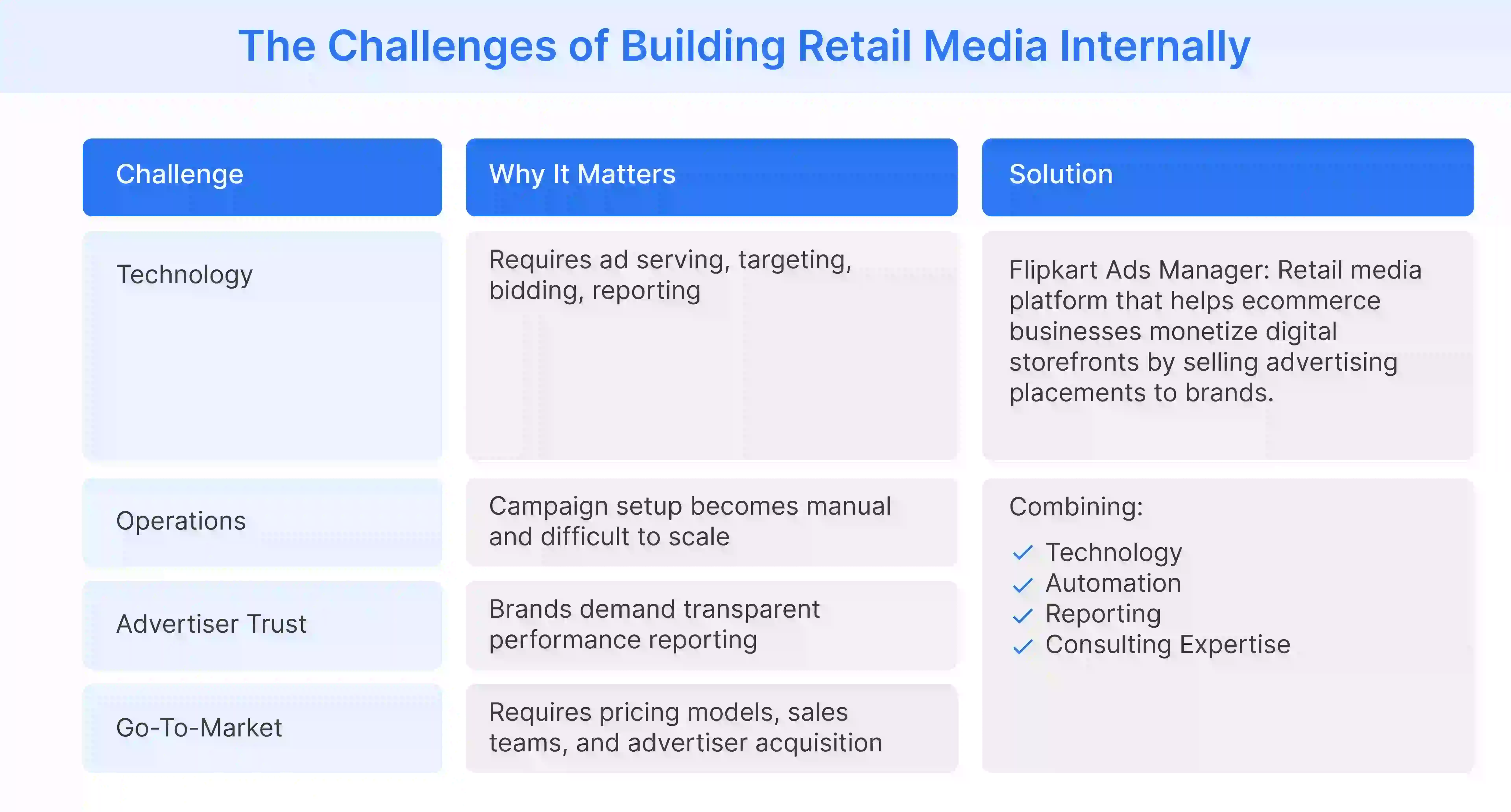
Why Retail Media Is Hard to Build Alone?
Building a retail media business sounds straightforward. In practice, it requires solving several complex, interconnected problems simultaneously:
- Technology: You need an ad server, a campaign management interface, audience segmentation, real-time bidding, and reporting dashboards. Building this in-house takes years and significant engineering investment.
- Operations: Without self-serve tools, every brand campaign requires manual setup, trafficking, and reporting by your team. This creates a bottleneck that caps how many advertisers you can serve.
- Advertiser trust: Brands will only invest serious ad budgets if they can see transparent, full-funnel performance data. Opaque reporting kills spend growth.
- Go-to-market: Even with the right technology, most platforms don't have the playbooks, pricing models, org structures, or sales motions to acquire and retain brand advertisers at scale.
Flipkart Ads Manager addresses all four. That is what makes it different from a point solution.
Also read: How the Advanced Audience Manager powers high-intent ad targeting.
How Flipkart Ads Manager Works?
- End-to-End Campaign Management
The platform manages display campaigns across all digital inventory from a single interface, homepage banners, category pages, search placements, and product detail pages. Campaign setup, audience targeting, budget management, bidding, delivery, and reporting all happen in one place, eliminating the fragmented toolset most platforms currently rely on. - Brand Self-Serve Dashboard
Brands and advertisers get direct access to their own campaign dashboard. They can independently launch campaigns, set budgets, define targeting criteria, and monitor performance in real time, without needing support from the platform's operations team. This is the capability that allows retail media businesses to scale revenue without proportionally scaling headcount.
For more on how self-serve transforms ad operations, see our guide to self-serve advertising platforms. - FCC Proprietary ML/AI Algorithms
Ad relevance and delivery are optimized in real time by FCC's machine learning models. These algorithms ensure that ads reach the right shopper at the right moment in their purchase journey, improving click-through rates and conversion for advertisers, while keeping the shopping experience relevant and non-disruptive for customers. To understand how audience data powers this, read the guide on how Advanced Audience Manager drives high-intent retail media ads. - Full-Funnel Performance Reporting
Brands get complete visibility from impression through to conversion, not just top-of-funnel metrics. This level of transparency builds advertiser confidence, justifies higher campaign investment, and creates a self-reinforcing cycle where better data leads to better performance, which leads to higher spend. - Go-To-Market Consulting
Flipkart Commerce Cloud's consulting team works with platform clients to build the entire advertising business, not just the technology layer. This includes designing the right org structure for an internal ad sales team, developing competitive CPM pricing and auction mechanics, defining ad inventory supply strategy, establishing revenue recognition best practices, and building category and sales playbooks for brand acquisition. This is the layer that accelerates time-to-revenue.
Also read: 5 essential retail media ads features every platform needs.
Ad Formats Supported By Flipkart Ad Manager
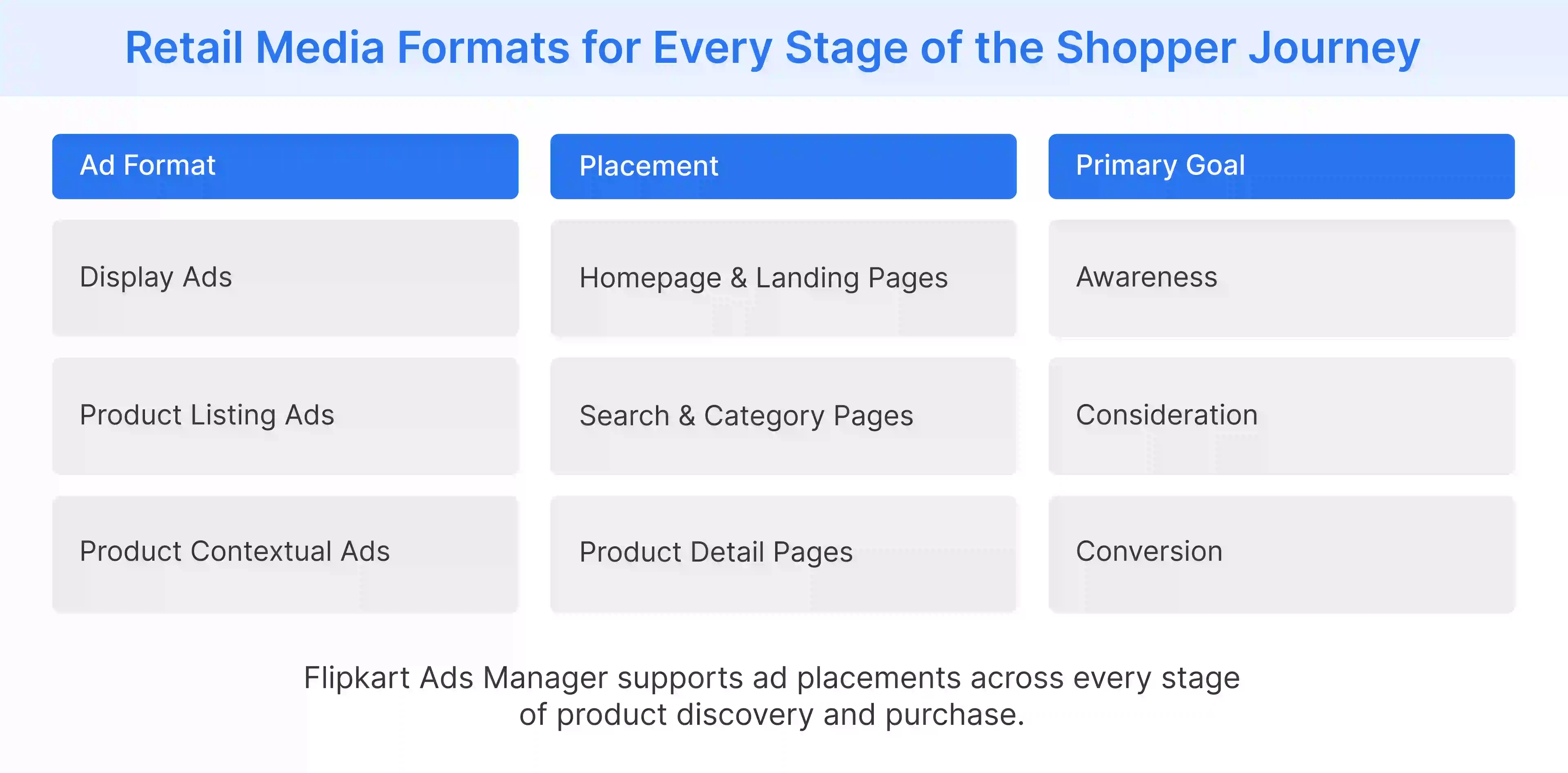
Flipkart Ads Manager supports a full range of retail media ad formats, covering every stage of the customer journey from a single platform.
-
Display Ads
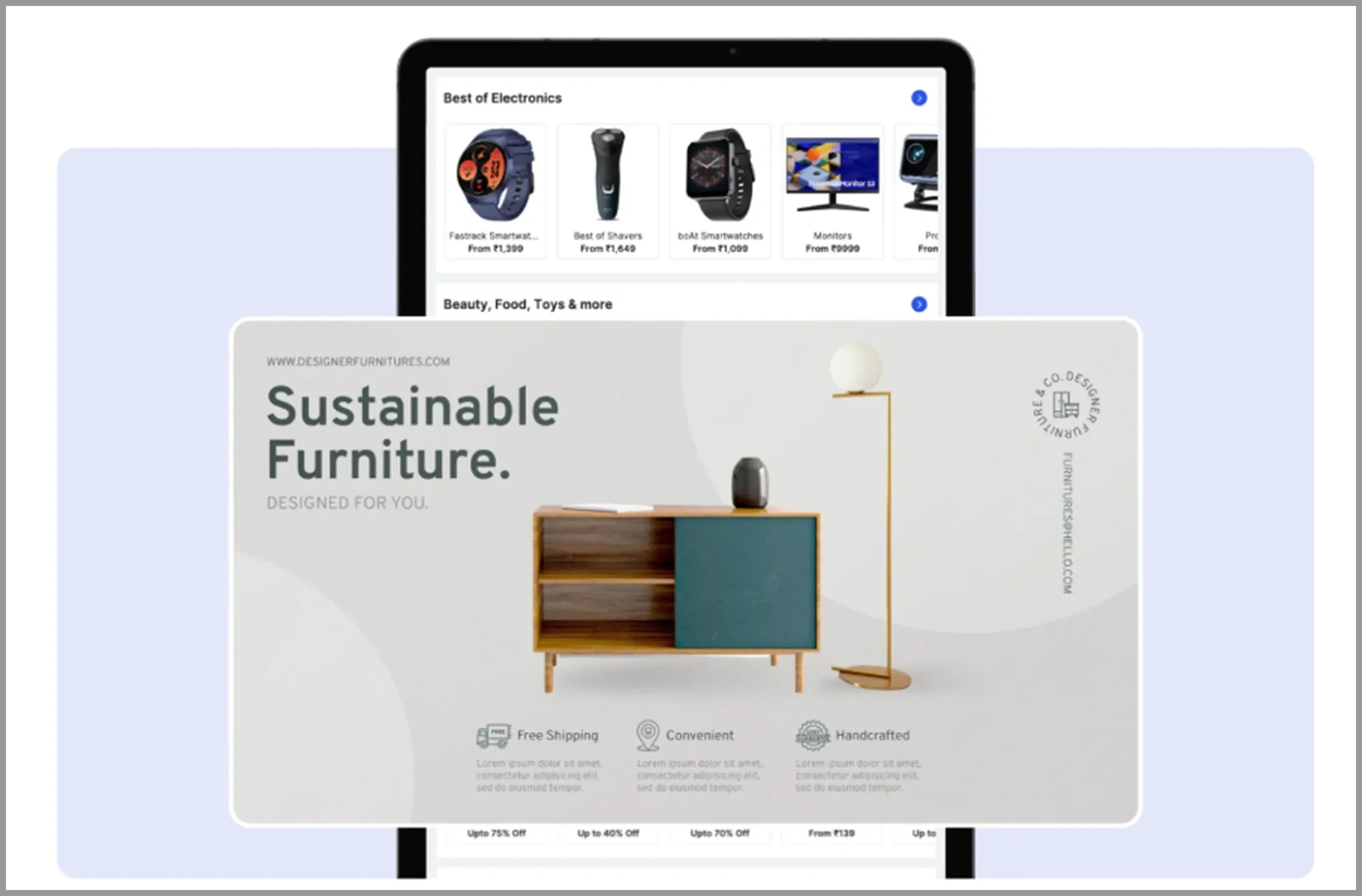
Display ads serve visually rich banners across high-traffic pages, homepages, category pages, and promotional landing pages. Best for brand awareness, product launches, and seasonal campaigns.
-
Product Listing Ads

Product listing ads appear within search results and category listings, reaching shoppers with active, real-time purchase intent. Because they sit naturally within the product discovery flow, they drive incremental sales without feeling intrusive.
-
Product Contextual Ads
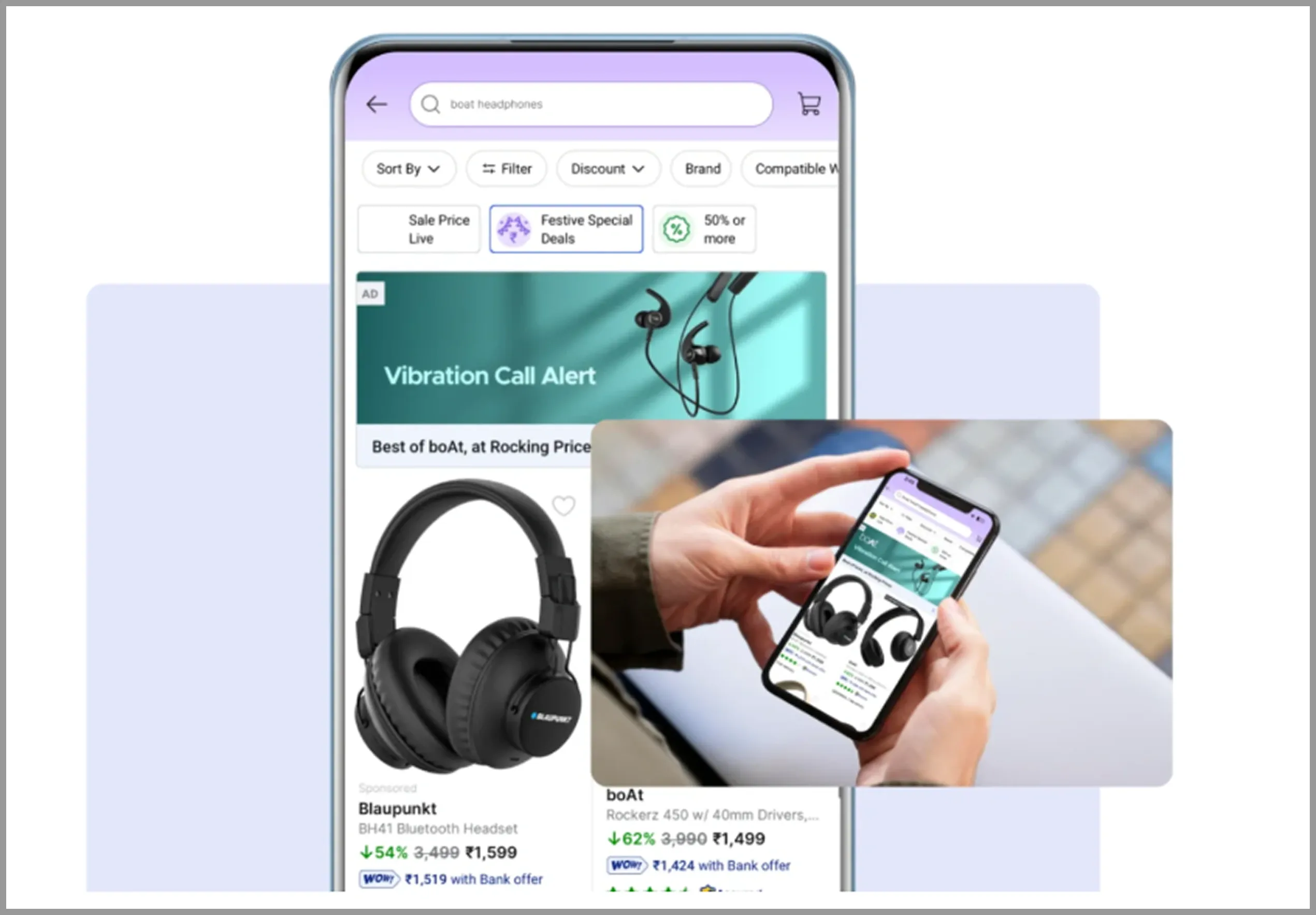
Product contextual ads are AI-driven placements on product detail pages, targeting shoppers based on what they are actively browsing. They are highly effective for cross-sell and upsell campaigns because they appear precisely at the moment of product evaluation.
Together, these formats give advertisers the tools to engage shoppers at every stage, awareness, consideration, and conversion, all managed from one interface.
What Retailers See When They Deploy Flipkart Ads Manager
The numbers below reflect performance benchmarks observed across retail media deployments using Flipkart Ads Manager. They are not tied to a single client story; they represent what the platform consistently delivers when implemented with FCC's recommended operating model.
|
Metric |
Benchmark |
|
CPM vs. market average |
Up to 40% higher CPM |
|
CTR vs. standard merchandising content |
1.2x improvement |
|
ROAS improvement |
Up to 120% |
|
Ad revenue growth (year-on-year) |
300%+ for platforms that deploy self-serve at scale |
What drives these numbers:
The CPM premium reflects advertiser's willingness to pay more for inventory with superior targeting precision and audience quality. When advertisers see better results, they bid higher.
The CTR improvement reflects the impact of contextual relevance. Shoppers click on ads that feel helpful, not interruptive. FCC's ML algorithms optimize for this continuously.
The ROAS improvement is the outcome that matters most to brand advertisers, and it is what drives reinvestment and budget growth on the platform over time.
The YoY revenue growth benchmark reflects what happens when self-serve removes the operational ceiling. Platforms no longer grow ad revenue by hiring more account managers; they grow it by enabling more brands to spend independently.
Why Retail Media Monetization Matters for E-Commerce Platforms?
Every e-commerce platform is sitting on valuable, untapped digital real estate. Homepage slots, search result pages, category listings, and product detail pages are all high-intent environments where brands actively want to reach shoppers.
Building a retail media business converts that real estate into recurring, high-margin revenue. Beyond direct revenue, a well-structured retail media network creates value across the entire ecosystem:
- Shoppers see more relevant, personalized product recommendations that improve their discovery experience
- Brands gain direct access to high-intent audiences at the precise moment of purchase decision
- The platform generates a new revenue stream that grows with GMV, without proportionally increasing costs
The key is executing the right technology, the right audience targeting, and the right go-to-market strategy working together. Retailers that get this right create a compounding advantage: better data leads to better targeting, which leads to better advertiser results, which leads to higher ad budgets reinvested on the platform.
For a broader look at how digital advertising technology is reshaping retail, see How Digital Advertising Technology is Reshaping the Retail Landscape.
What Makes Flipkart Ads Manager Different From Generic Ad Tech
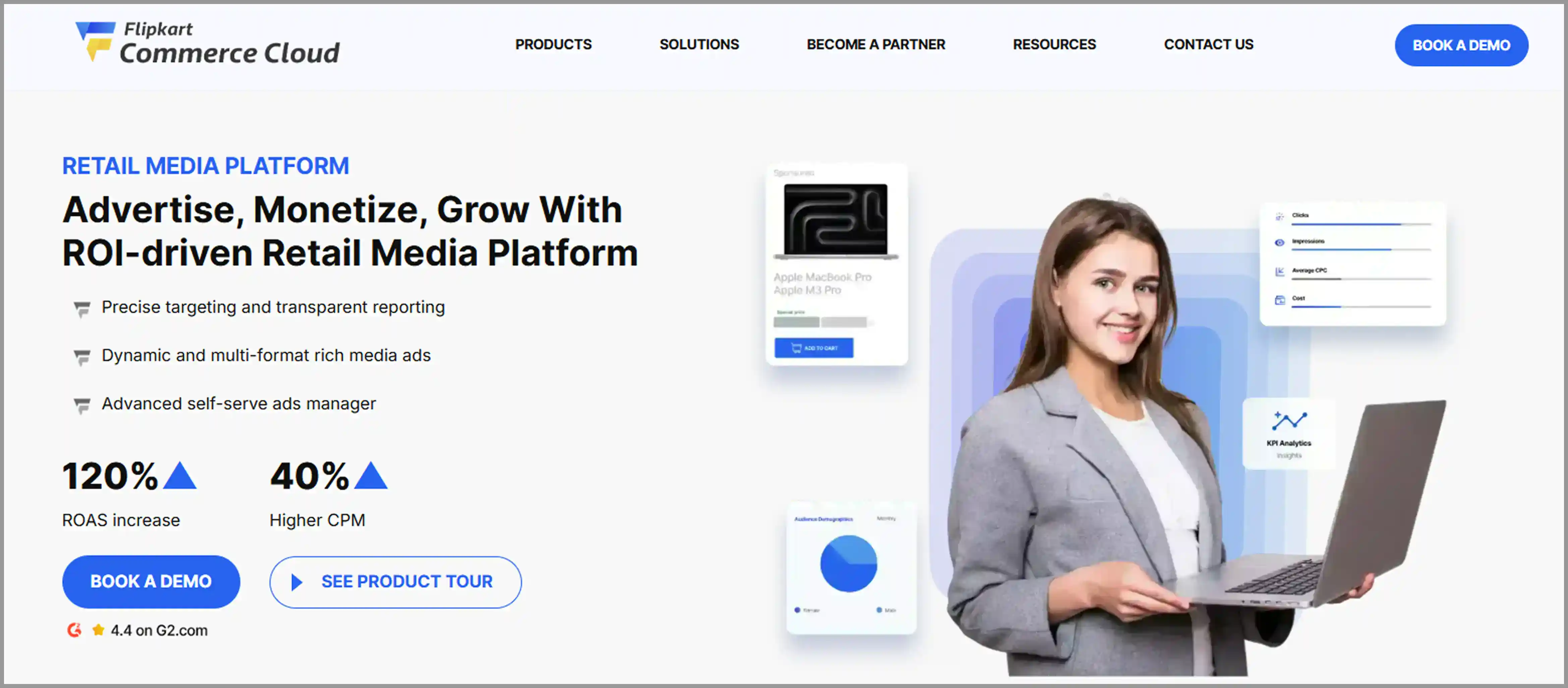
Most ad tech platforms are built for publishers or agencies. Flipkart Ads Manager is built specifically for e-commerce platforms that want to own their advertising business end-to-end. The distinction matters because the requirements are fundamentally different.
A retail media platform needs to reconcile shopper experience with advertiser performance, showing ads that help customers discover relevant products, not just ads that maximize impressions. FCC's algorithms are trained on billions of e-commerce transactions from Flipkart's own marketplace, which means the relevance models understand retail purchase behaviour at a depth that general-purpose ad platforms cannot replicate.
Flipkart Ads Manager is the fastest path to a fully operational, scalable retail media business, without the years of in-house engineering and trial-and-error that building it alone requires. It brings the technology, the algorithms, and the go-to-market expertise together in one deployment.
Book a demo with FCC to see the platform in action and understand what it can realistically deliver for your advertising revenue.
FAQ
Targeting the right audience requires activating advanced machine learning models that analyze actual shopper intent and historical transactional behaviors. Deploying the Flipkart Ads Manager allows e-commerce platforms to automatically deliver contextually relevant product recommendations to active consumers at the exact moment they evaluate items on your digital storefront.
The difference between a Business Manager and an Ads Manager lies in the scope of operational control they offer. A Business Manager serves as an overarching hub for controlling organizational permissions and tracking multi-brand assets, while a tool like Flipkart Ads Manager directly creates, optimizes, and serves individual retail media campaigns.
Setting up billing and adding a payment method involves navigating to your account settings tab within your central administrative dashboard portal. The secure backend interface allows corporate administrators to input corporate credit lines or digital payment structures, ensuring zero disruptions when launching self-serve advertising campaigns.
An Ad Manager is a comprehensive retail media software solution designed to help digital marketplaces monetize their owned properties by serving targeted advertisements. Platforms that integrate the Flipkart Ads Manager utilize a unified system to handle complex inventory placements, automated pricing rules, real-time bidding, and transparent attribution reporting.
You can use an ad manager on your phone by logging into mobile-responsive administrative interfaces or utilizing native software applications designed for pocket-sized screens. This responsive accessibility empowers your operations team to monitor ongoing retail campaign metrics, adjust spending caps, and oversee active ad inventory performance from anywhere.
Creating an ad manager from scratch requires heavy infrastructure investments, but utilizing modern technology like Flipkart Ads Manager provides an immediate plug-and-play alternative. Partnering with Flipkart Commerce Cloud lets you launch a white-labeled, self-serve advertising network instantly, avoiding years of internal engineering testing and trial-and-error roadblocks.
More Blogs
See how retailers and brands are winning with FCC
Everything About Price Skimming Strategy Explained
Read More
What is a High-Low Pricing Strategy?
Read More
Ultimate Guide To Dynamic Pricing Strategy In 2026
Read More
Retail Pricing Strategies: Winning with Promotion Pricing in Competitive Markets
Read More
Ad Tags: Enhancing Ad Serving Efficiency in Large-Scale Campaigns
Read More