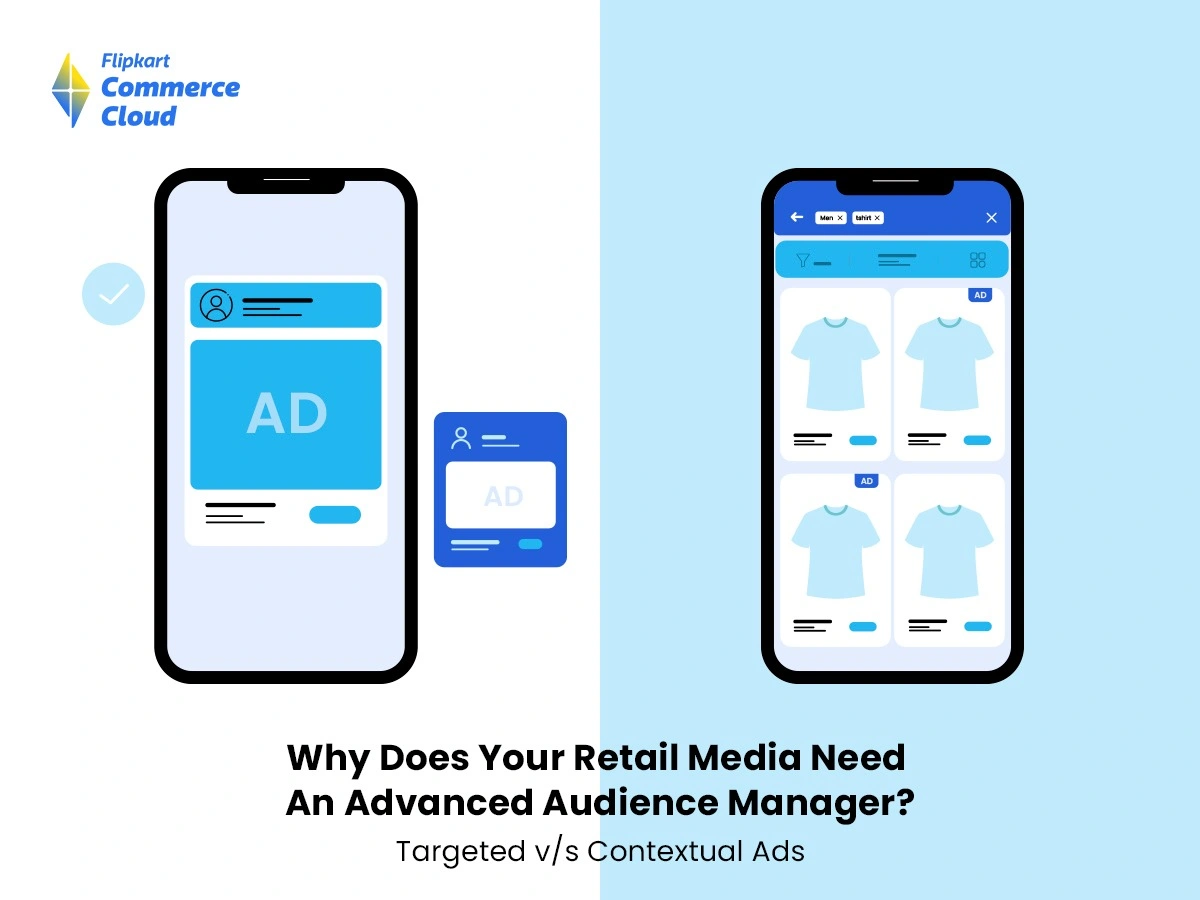
Retail media has quickly moved from a side revenue stream to a core growth channel for e-commerce marketplaces and brands alike. As competition for shopper attention increases and third-party cookies fade out, success now depends less on reach and more on relevance. This is where an advanced audience manager becomes essential, turning first-party shopper data into precise, actionable audiences that can be activated at the exact moment of purchase intent. To understand why this capability matters so much today, it helps to first look at how retail media itself has evolved and why it now sits at the center of digital commerce.
Retail Media With Advanced Audience Manager
Retail media advertising is a type of marketing where advertisers pay an e‑commerce marketplace to showcase their products at or close to the point of sale. These placements appear near search results, home pages, category pages, and product detail pages.
Retail media advertising is the marketing strategy where brands pay e-commerce platforms to showcase their products right at or near the point of sale. These high-impact placements appear in key areas like search results, home pages, category pages, and product detail pages.
With nearly 44% of product searches now starting directly on marketplaces, brands are following buyer intent instead of chasing attention elsewhere. This is where an advanced audience manager becomes critical, not to push products shoppers don’t want, but to connect shoppers with products they are already looking for.
Rather than manipulating demand, retail media works best when it improves discovery, relevance, and user experience. The ability to accurately connect partner brands with high‑intent consumers is now one of a marketplace’s most valuable capabilities.
How Contextual Advertising Fuels Retail Media Performance
To get to the heart of why retail media is so attractive, let’s understand how contextual targeting drives retail media growth.
Contextual advertising is a type of advertising that involves placing ads on web pages based on what a user is actively viewing or searching for. Retail media is one of the purest forms of contextual advertising.
Here’s how it works. Typically, search engines collect third-party data and advertise for another person. Retail marketplaces, on the other hand, already own transactional, browsing, and search data. This enables an advanced audience manager to create high‑accuracy segments rooted in real buying behavior, not assumptions.
So while search engine ads leverage third-party and cookie data, online retail platforms connect users with the right product at the right time through advertisement. This makes it profitable for retailers and brands.
The Common Retail Media Ad Formats
Retail media ad formats define how and where brands appear within an e-commerce marketplace. These formats are designed to capture shopper attention at different moments of the buying journey, from early discovery to high-intent search. The two most common and revenue-driving formats in retail media are display ads and search ads, each serving a distinct purpose in influencing shopper behavior.
1. Display Ads
Display ads are primarily used to drive visibility and brand recall within a retail environment. They appear across high-traffic areas of a marketplace, helping brands influence shoppers before a specific purchase intent is fully formed. These placements work especially well for new product launches, seasonal promotions, and category expansion because they reach shoppers while they are browsing, not actively searching.
Advanced audience managers play a critical role here by controlling who sees these ads. Instead of serving banners to every visitor, they ensure display ads are shown to relevant shopper segments based on browsing behavior, past purchases, and category interest. This improves recall and engagement while reducing wasted impressions.
Display ads include banners and inventory placements across home pages, category pages, and featured sections of an e-commerce marketplace.
2. Search Ads
Search Ads are intent-driven by design. They appear when shoppers actively search for products within the marketplace, making them one of the most conversion-focused retail media formats. Because shoppers are already signaling what they want, search ads directly influence product discovery, conversion rates, and GMV growth.
What separates basic search ads from effective retail media search ads is audience intelligence. Advanced audience managers ensure that search ads are not only triggered by keywords, but also refined by shopper intent signals such as purchase history, frequency, and brand affinity. This prevents over-serving ads to low-intent users and helps brands prioritize high-value shoppers.
Search ads include product listing ads and product catalog ads shown to consumers when they run a specific search within the marketplace.
Why Retail Media Ads Are Winning Over Traditional Digital Advertising
Retail media has become one of the strongest contextual advertising channels available today. Unlike traditional digital advertising, where ads are often placed based on inferred interests, retail media uses first‑party behavioral data collected directly from shopper activity on the platform. This allows brands to reach users at the exact moment of purchase consideration.
This shift explains why retail media advanced audience manager capabilities are now central to campaign performance, not a supporting feature.
If you think traditional digital ads are still the most effective way to reach your target audience, it’s time to reconsider. Here’s why:
1. Higher Relevance at the Digital Shelf: Retail media ads ensure that potential customers see only the relevant ads near the content they have searched for.
This strategy effectively boosts a brand’s visibility on the e-commerce shelf and facilitates engagement in a brand-safe environment. As a result, shoppers can easily find and gain awareness of the product at a time when purchase intent is the highest.
Advanced audience managers go beyond keywords, enabling campaigns based on shopper history, category affinity, and purchase frequency. In traditional digital advertising, however, campaigns are primarily set up from a keyword perspective. This means that ads will still be served to customers who have not expressed an interest in the product.
2. More Effective than Browser Search Ads: Retail media ads on the e-commerce marketplace are native or display ads that seamlessly blend with the search results.
Native ads seem like another product on the list. The small ‘sponsored’ label at the top or bottom of the ad gives a clue. The display ads support more impactful messaging with dynamic features such as real-time pricing.
Since retail media ads are focused on buying intent and the contextual ads are native, it appeals to the buyers. In contrast, traditional digital ads are served based on interests and user behaviour without regard for context or intent.
Retail media ads typically feature on search results, category, home, or product detail pages. This way, they reach potential customers at a critical point of purchase intent.
3. Built for a Cookie‑Less Future: As third-party cookies get phased out shortly, retail media ads will infuse a new wave of confidence among advertisers in a time of third-party cookie ban.
Unlike traditional digital ads, retail media ads do not target specific user profiles. Instead, its effectiveness lies in meeting its audiences’ unique needs by leveraging contextual advertising. Advanced audience managers enable precise targeting without tracking users across the open web, making campaigns resilient to changes in privacy.
Contextual retail media ads enable brands to implement campaigns that rely on first-party data, rather than third-party cookies. This gives it an edge over traditional digital advertising as it is not affected by changes in user browsing behaviour.
4. Preferred by customers: Internet audiences are more responsive to retail media ads than targeted traditional digital ads. This is because retail media ads can better relate to the product or service being featured in the context of their current need.
Moreover, retail marketplaces leverage first-party data. This approach does not come across as intrusive and creepy. At the same time, it allows brands to target customers more accurately.
Staying ahead of the Curve with an Advanced Audience Manager
As per Nielsen's annual marketing report, marketers depend on access to reliable, high-quality data that underpins their strategies and enables them to reach out more effectively to their target audiences.
With digital channel engagement continuing to rise, advertisers must ensure that they’re up to speed with understanding the customers making those interactions and hit the right notes for that particular audience.
What is An Advanced Audience Manager?
As retail media gets more competitive, advanced audience managers can help deliver successful campaigns. Also, as the ROI buzzword continues to increase, digital media advertisers want to get more out of their budget and maximise reach. An advanced audience manager provides the tools to do this.
An audience management system enables brands and retailers to source, define, manage, analyze, and activate customer data for cost‑effective campaigns. It transforms raw behavioral signals into actionable audience segments.
An advanced audience manager empowers digital advertisers and publishers with the essential tools to manage and leverage data assets and boost sales.
Resources like audience reports help to improve the range and accuracy of target audience awareness, identify new trends and tendencies, potential segment matches, and more.
With advanced audience management, advertisers can tailor customer experiences through timely, contextual messaging that enhances, not disrupts, the shopper journey.
Also Read: How Flipkart Ads Manager Helped
Advanced Audience Managers for Retail Media
A robust audience management platform for retail media is a combination of the following capabilities:
1. Collection and Centralization: Superior data collection and centralization capabilities enable seamless data consumption, highly accurate graphing, and data collection across devices. This helps create a unified view of customer data across multiple channels and devices.
The granular user-level targeting helps organise user information based on user browsing interests and history. This facilitates monetisation using contextual relevance and highly targeted campaigns.
2. Segmentation and Management: A good audience management platform offers superior segmentation capabilities, leveraging artificial intelligence, a segment size estimator, and more. It helps arrange and segment data systematically. This supports easier targeting and engagement opportunities down the line.
3. Targeting and Enhancing Output: Audience analytics and lab for A/B testing help advertisers measure and optimise campaigns by leveraging insights from real-time customer data.
In addition, it addresses security and compliance needs, thereby minimising the risk of negative user experiences.
Audience management solutions also help advertisers to offer increased personalisation.
Common Challenges in Implementing Advanced Retail Media Audience Managers
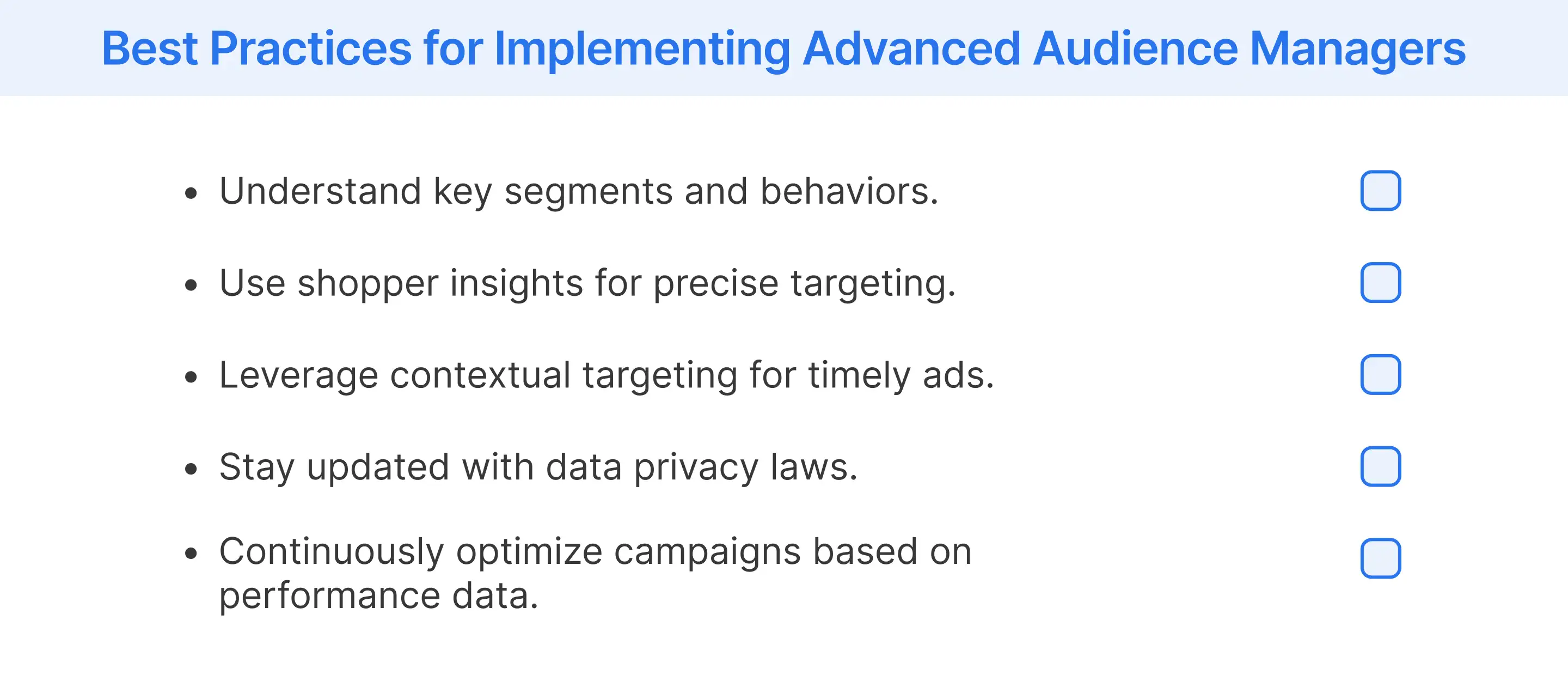
Implementing an advanced audience manager in retail media is not without its challenges. Retailers and brands often face obstacles when trying to leverage audience data to its full potential. These challenges can hinder the effectiveness of campaigns, leading to wasted resources and missed opportunities. Below, we address some common challenges, and practical solutions to overcome them.
|
Challenge |
What Goes Wrong |
How to Address It |
|
Data Fragmentation |
Customer data is often siloed across various platforms (e.g., website, mobile, in-store), making it difficult to build a unified view of customer behavior. |
Implement a centralized data management system and solution like Flipkart Commerce Cloud that integrates data from all touchpoints, providing a 360-degree view of the customer for more precise targeting and segmentation. |
|
Inaccurate Segmentation |
Audience segments may be too broad or poorly defined, leading to mis-targeting and wasted ad spend. |
Use AI and machine learning to dynamically adjust audience segments based on real-time behavioral data. This improves accuracy and ensures better targeting and ad performance. |
|
Slow Real-Time Adjustments |
Without the ability to make adjustments quickly, campaigns can become irrelevant, or ads may be shown too frequently, reducing effectiveness. |
Implement real-time optimization features that allow marketers to adjust campaigns on the fly based on new data, ensuring ads stay relevant and effective. |
|
Privacy Compliance Issues |
Increasing privacy regulations (e.g., GDPR, CCPA) can limit how data is collected and used, leading to potential legal risks and customer trust issues. |
Leverage privacy-first data management systems that use first-party data, ensuring compliance with privacy regulations while maintaining accurate targeting. |
|
Lack of Cross-Channel Consistency |
Disconnected data across multiple platforms leads to inconsistent messaging and targeting, reducing campaign effectiveness. |
Use omnichannel audience management platforms that synchronize data and messaging across all touchpoints, ensuring consistency and a cohesive customer experience. |
|
Resource-Intensive Setup |
Implementing an advanced audience management system can be time-consuming and require significant technical expertise, especially for smaller teams. |
Choose user-friendly audience management tools that simplify integration and setup, reducing the need for technical expertise and resource-heavy implementations. |
|
Limited Ability to Measure Impact |
Without proper measurement and analytics tools, it’s difficult to evaluate campaign success, identify areas for improvement, and optimize performance. |
Utilize advanced reporting and analytics features to track campaign performance in real time, allowing for continuous optimization based on actionable insights. |
Conclusion
The role of advanced audience managers in retail media has become indispensable as they allow brands to reach highly targeted consumers at the exact moment of purchase intent. This shift to more relevant, personalized advertising is essential for maximizing both engagement and sales. As e-commerce platforms continue to rely on first-party data for precision targeting, solutions like the Advanced Audience Manager by Flipkart Commerce Cloud further enhance the ability to identify high-intent consumers. This ensures smarter, more effective campaigns while driving long-term growth. By leveraging advanced audience management, brands can not only stay competitive but also navigate the evolving digital advertising landscape with confidence, ensuring that every marketing decision is data-driven and customer-centric.
Book a demo with FCC to leverage first-party data for precise audience segmentation and drive higher conversions with smarter, high-intent ads.

FAQ
What an audience manager does is to organize, segment, and activate customer data to create targeted groups for advertising campaigns. The primary task involves taking raw data from various sources and turning it into actionable segments based on user behaviors, demographics, or purchase history. By centralizing this information, an audience manager ensures that the right message reaches the right person at the most opportune time.
An advanced audience manager in retail media is a platform feature or software solution that leverages a retailer’s first-party transactional and behavioral data to build precision audience segments for brands. It enables targeting based on real purchase activity, such as SKU-level behavior, rather than inferred interests. Technology providers like FCC offer these capabilities to help retailers transform their shopper insights into high-value segments that can be activated across on-site and off-site channels.
Several platforms offer advanced audience management solutions for retail media, allowing brands to leverage first-party data for precise targeting. These platforms help retailers and advertisers create actionable audience segments, optimize campaigns, and drive greater ROI. Notable solutions include offerings from major e-commerce platforms and technology providers like Flipkart Commerce Cloud, which help retail media advertisers manage, analyze, and activate audience data with a focus on precision and relevance.
An advanced audience manager is important for retail media campaigns because it enables closed-loop marketing and reduces wasted ad spend by focusing on shoppers with proven purchase intent. Without a sophisticated manager, campaigns often suffer from over-targeting or reaching consumers who have already purchased the product elsewhere. This tool ensures that a brand's budget is focused on the most likely to convert individuals, which is essential for maintaining a competitive edge in a crowded marketplace.
An advanced audience manager improves ad targeting by enabling real-time audience updates and cross-channel consistency for every segment. It supports negative targeting, such as excluding recent buyers from seeing an ad for the same product, while simultaneously identifying lapsed buyers or high-propensity shoppers who are due for a replenishment reminder, which creates a unified view of the customer journey, making every ad impression more relevant.
The types of data an advanced audience manager uses include a mix of first-party data, such as point-of-sale transactions, browsing behavior, and loyalty program activity, along with select second- and third-party signals where appropriate. It integrates data points like average order value (AOV), frequency of visit, and specific category preferences to paint a complete picture of the shopper. In a privacy-conscious environment, these managers often utilize Seller-Defined Audiences to pass these valuable signals to advertisers without compromising individual privacy standards.
Yes, an advanced audience manager can help improve ROI by increasing conversion rates of every campaign through higher relevance and reduced media waste. By focusing spending on high-value shoppers and reducing exposure to disinterested groups, marketers see a much higher Return on Ad Spend (ROAS). Also, by automating the optimization process, these tools save time and resources, allowing teams to focus on creative strategy rather than manual data entry.
The role of AI in an advanced audience manager is to provide predictive analytics and automated segmentation that would be impossible to perform manually at scale. AI algorithms can identify hidden patterns in shopper behavior, such as predicting when a customer is about to switch brands or identifying which users are most likely to respond to a specific discount. This intelligent automation, often integrated into platforms like Flipkart Commerce Cloud, allows for dynamic audience adjustment, ensuring that segments stay accurate even as consumer trends shift rapidly.
More Blogs
See how retailers and brands are winning with FCC
Everything About Price Skimming Strategy Explained
Read More
What is a High-Low Pricing Strategy?
Read More
Ultimate Guide To Dynamic Pricing Strategy In 2026
Read More
Retail Pricing Strategies: Winning with Promotion Pricing in Competitive Markets
Read More
Ad Tags: Enhancing Ad Serving Efficiency in Large-Scale Campaigns
Read More