A recession is a period characterized by a significant decline in economic activity spread across the economy and lasting more than a few months. Economic downturns are scary for any retail business. When consumer spending drops and every competitor seems to be slashing prices, it's easy to panic and start making reactive decisions that hurt your business long-term. But the retailers who thrive during recessions aren't necessarily the ones with the lowest prices. They're the ones who understand their customers, make data-driven decisions, and stay strategically flexible.
Despite all the economic uncertainty we've seen, global eCommerce sales are still projected to hit $8.1 trillion by 2027. That's enormous growth, even in challenging times. Understanding how to optimize your eCommerce pricing strategy is more critical than ever because people don't stop buying during recessions; they just become far more deliberate about where and how they spend their money.
We're going to walk through everything you need to know about pricing during economic downturns. First, we'll look at how consumer behavior actually shifts when money gets tight, then explore which product categories tend to stay strong when everything else is struggling. From there, we'll dive into specific pricing strategies that balance staying competitive without destroying your margins, examine how eCommerce businesses have unique advantages that physical retail can't match, and finally get into the advanced optimization techniques that separate businesses that merely survive from those that actually gain ground.
The goal isn't to give you a one-size-fits-all formula, because that doesn't exist. Instead, we want to help you understand the principles and strategies so you can make smarter decisions for your specific business and market.
How Consumer Behavior Shifts During Economic Downturns
Before you start adjusting prices or revamping your entire strategy, you need to understand what's actually happening with your customers. Recessions don't just reduce spendings, they change how people shop and what drives their purchase decisions.
The first major shift is price sensitivity. Customers who barely glanced at prices during good times now compare them obsessively. They'll open five different tabs, check reviews, wait for promotions, and generally treat every purchase decision like a major investment. It's not irrational; it's adaptive behavior when budgets are tight and financial uncertainty is high.
What's particularly challenging for established brands is watching their hard-earned loyalty start to crack. A customer who's bought from you for years will still consider switching if a competitor offers significantly better value. It's not that they don't appreciate your brand anymore; it's that survival instincts kick in. The flip side of this, though, is opportunity. If you can position your value proposition correctly, you can capture customers from premium competitors who are stubbornly maintaining high prices.
Another thing you'll notice is that people take much longer to make purchase decisions. The research phase extends significantly. They're reading more reviews, watching more unboxing videos, comparing more specifications, and seeking validation from other buyers. For you as a seller, your product content, descriptions, images, customer reviews, and educational materials become more important for actually closing sales.
The final behavioral shift is the obvious one, where people cut discretionary spending and focus on necessities. But the definition of "necessary" expands to include small comforts and affordable luxuries that help people cope with stress. That $15 face mask or $20 bestselling novel or $30 premium coffee subscription might not be "necessary" in the strict sense, but they provide emotional value that makes them feel essential. Understanding this psychological dimension is crucial for positioning your products effectively.
When you understand these behavioral shifts deeply, you can adapt proactively instead of just reacting to declining sales numbers. The businesses that come out stronger aren't the ones racing to be cheapest; they're the ones offering the right value at the right time to customers whose needs they truly understand.
Steady Product Retail Price Optimisation in Recession
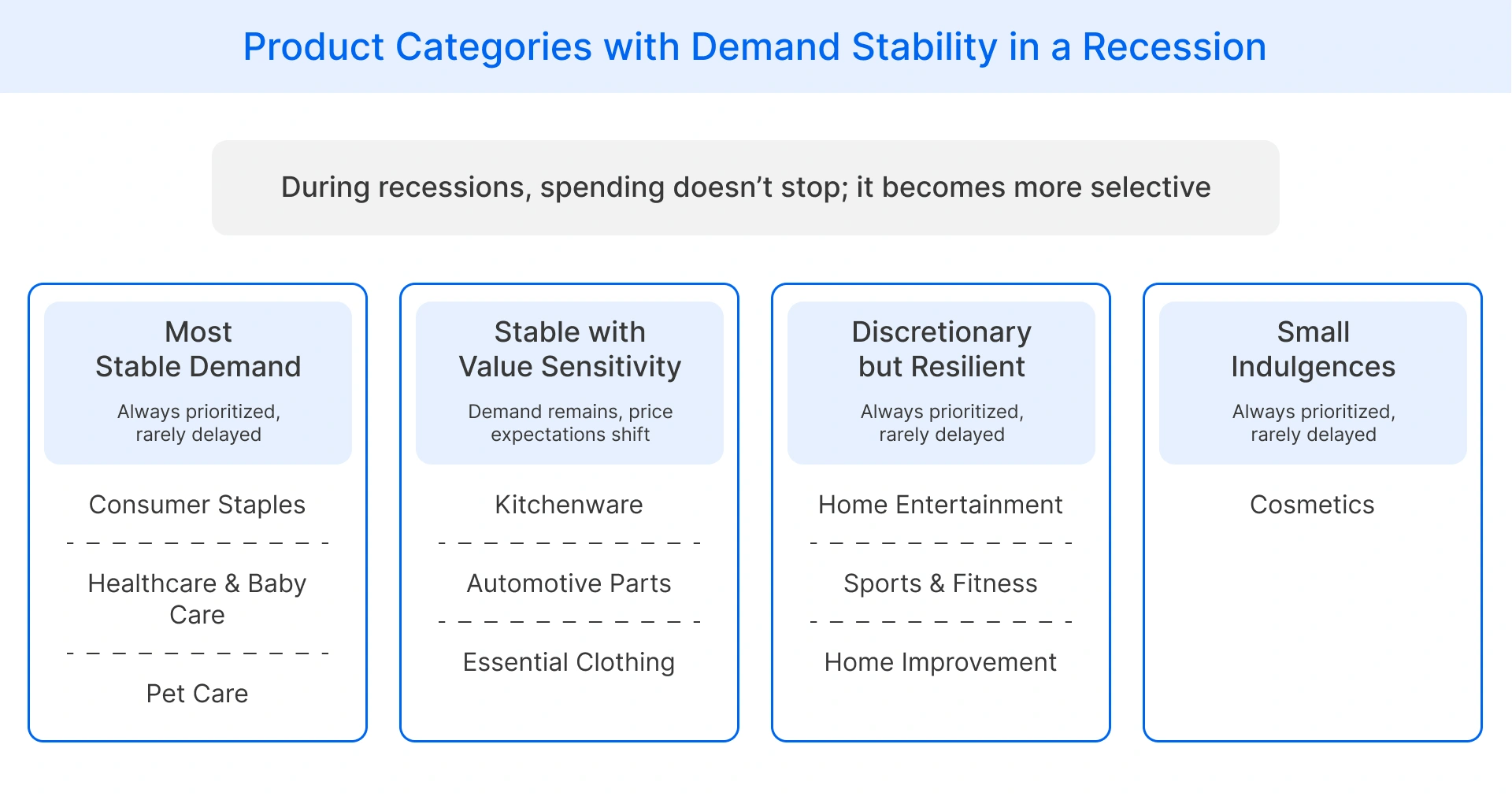
Not all product categories suffer equally during economic downturns. Some maintain steady demand, while others can actually experience growth. Understanding which categories are recession-resistant helps you optimize your product mix, allocate resources more effectively, and identify potential expansion opportunities when competitors are retreating.
Consumer Staples
People need to eat, clean their homes, and maintain basic hygiene regardless of what the economy is doing. Food, beverages, household essentials, and personal care products maintain remarkably steady demand during recessions.
But certain premium items within this category actually see sales increases during downturns. As the demand for these products doesn’t fluctuate significantly, businesses selling consumer staples generally see stable revenues and perhaps even some steady growth.
In the food and drink category, luxury and drink products often do well as they are cheaper than dining out. Likewise, comfort food like chocolates and luxury products like cosmetics do well too.
Essential Clothing
High-end fashion typically takes a beating during recessions, but basic clothing holds up surprisingly well. The reality is that people can only delay replacing worn-out t-shirts, jeans, or undergarments for so long. These are genuine needs, not wants.
What changes during downturns is the price point consumers gravitate toward. Premium denim brands might struggle while value retailers offering similar quality at lower prices gain market share. The product itself, comfortable, durable basics, remains in demand. It's just about meeting customers at the price point they can manage.
Home Improvement
In almost every recession, housing markets freeze up as people prefer not to buy houses, choosing to improve their present home instead. This was witnessed even during the pandemic when people were stuck indoors.
The elaborate home renovation includes details like granite counters and bathroom enhancements. On the other hand, many home renovations can be done using affordable products, quickly sold online, for example, pillows, lighting, and bathroom accessories.
Sports and Fitness
When budgets tighten, expensive gym memberships become easy targets for cuts. However, those committed to their fitness routine may want to continue the exercises at home. Yoga mats, resistance bands, Swiss exercise balls, sports apparel, and similar products sold online allow people to maintain their active lifestyle without feeling the brunt of the recession.
Beyond the pure economics, there's real added value in home workouts that persists even after people can afford gym memberships again, like no commute time, no waiting for equipment, complete schedule flexibility, privacy, and comfort.
Home Entertainment
Entertainment spending doesn't disappear during recessions; it just relocates from outside the home to inside it. People prefer to reduce outdoor entertainment options, such as movies and theatres, in a recession. For example, Covid-19 lockdowns pushed demand for streaming services, video games, and home viewing equipment.
For eCommerce businesses, this shift creates opportunities in gaming accessories, books, puzzles, board games, craft supplies, and anything that enhances the home entertainment experience. People need distractions, relaxation, and enjoyment regardless of economic conditions. They're just seeking those things in more affordable formats.
Pet Care
Pet ownership shows remarkable stability during economic downturns. The emotional bonds between people and their pets create spending patterns that are largely independent of economic conditions. Pet owners consistently prioritize food, grooming supplies, toys, and medicine for their animals, often before considering their own discretionary purchases.
Pets provide emotional support and companionship during stressful times, potentially making them feel even more valuable during recessions.
Healthcare and Baby Care
These might be the most recession-resistant categories that exist. Parents cannot defer buying diapers or formula. People with chronic health conditions must continue purchasing necessary medications and medical supplies. These purchases are genuinely non-negotiable.
What does shift during recessions is brand preference. Consumers may trade down from premium brands to value alternatives, but the overall volume of purchases remains stable. Well-positioned value brands can gain significant market share by offering quality products at lower price points than premium competitors.
Kitchenware
As restaurant spending drops, and it almost always does during recessions because dining out is obvious discretionary spending, food consumption shifts dramatically toward home cooking.
Practical items like good quality skillets, mixing bowls, measuring tools, and storage containers see the most consistent demand.
Automotive Parts
When recessions hit, new vehicle sales crater as people defer major financial commitments. But existing vehicles still need maintenance and occasional repairs to remain functional and safe.
DIY automotive maintenance products benefit particularly during downturns as people look for ways to reduce labor costs. Online marketplaces for parts offer transparent pricing and convenient delivery, making this category well-suited for e-commerce even though it's traditionally been dominated by physical auto parts stores.
Cosmetics
The "lipstick effect" has been documented in recession after recession, consumers spend money on small indulgences during recessions or when they have little cash. During economic hardship, consumers continue purchasing, and sometimes increase purchases of, small luxury items like cosmetics and personal care products. As a result, companies in this space often cope well during recessions.
E-commerce Pricing in Economic Downturn: Unique Digital Advantages
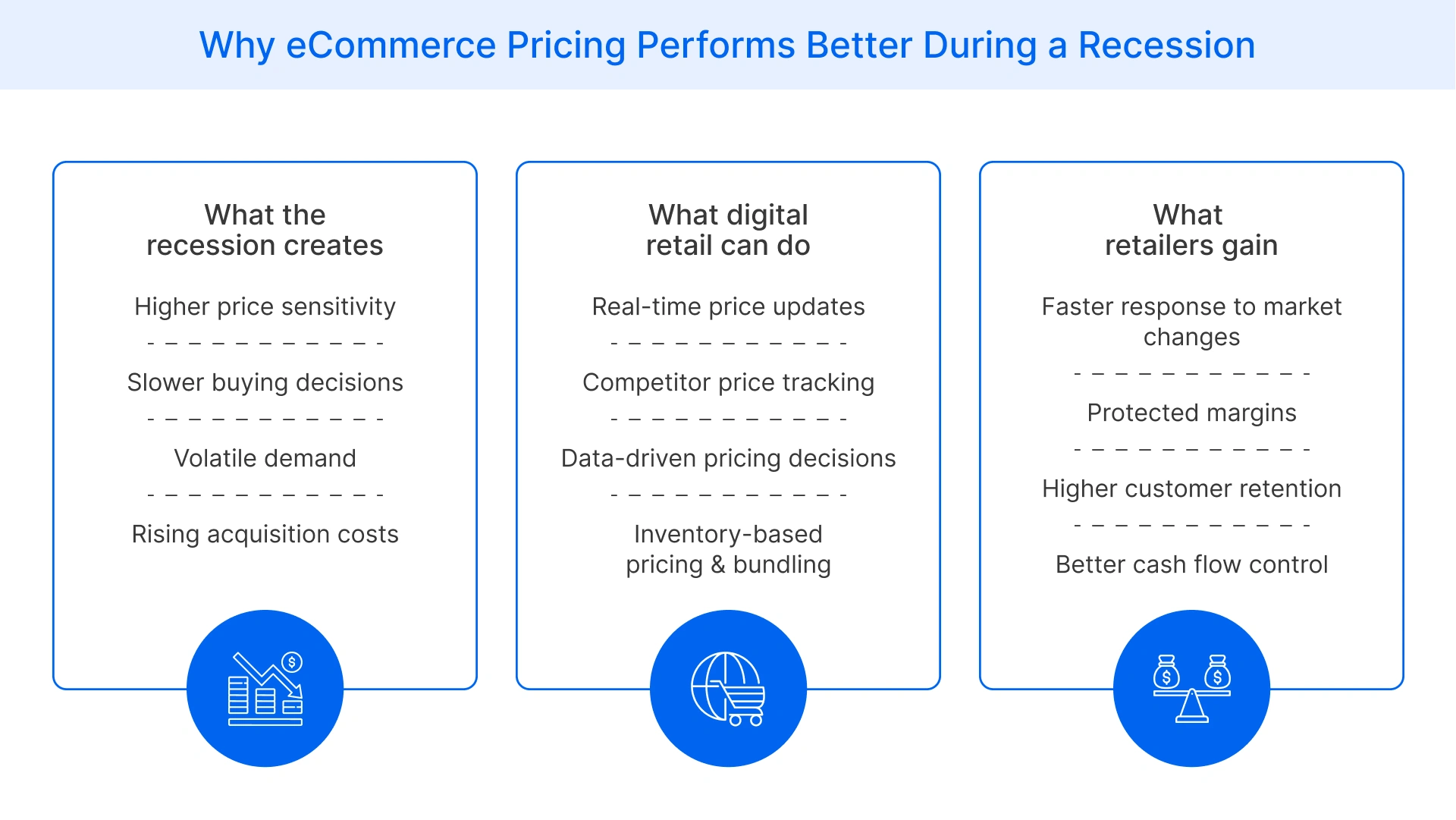
eCommerce businesses have some genuine advantages during recessions that physical retail simply cannot replicate. Understanding and leveraging these advantages can be the difference between struggling and thriving when conditions get tough.
For eCommerce brands, pricing is an intricate science. Price optimization strategies help businesses capture more sales while maximizing margins. Let's look at the key strategies that help eCommerce brands stay competitive during a recession.
Reward repeat customers: Focus on customer lifetime value and retention. Loyalty programs are a great way to achieve customer loyalty. Reward your repeat customers with personalized deals, exclusive discounts, and bonuses that help them save money. You needn't go overboard offering discounts on every product. Instead, leverage creative ways to reward shoppers. For example, you can offer discounts to shoppers who review your products or participate in quizzes to enable you to understand their preferences better.
Competitive pricing. Price is an emotionally charged topic, and customers always look for bargains or deals. Pricing software helps automate pricing decisions by collecting data from competitor websites and marketplaces. This ensures the prices you set for your products are competitive with those of other merchants. Pricing software allows you to keep track of competitor pricing, product availability, and discounts so you can adjust your prices accordingly. The real advantage of eCommerce is that you can change prices in minutes, something that takes physical retailers days or weeks to accomplish across multiple store locations.
Data-driven decision-making. Niggles such as returns, slow shipping, or a high cost per unit, which can hinder business growth even in regular times, can make a considerable dent during a recession. Regularly assessing and reviewing your pricing, product quality, shipping, and customer service helps ecommerce stores make data-driven decisions, partner with reliable vendors, identify customer buying patterns, and understand their preferences. You'll also be able to improve your cash flow and minimize wastage. When you analyze data across different dimensions simultaneously, sales velocity, return reasons, shipping costs, customer acquisition costs, patterns emerge that reveal optimization opportunities you'd otherwise miss.
Managing stock: Consider dropping products that rarely sell from your store, as they tie up cash that you could have spent on more in-demand inventory. It can be challenging if you have leftover inventory. However, considering a sale or bundle offer can help you shift your slow-selling products. Pricing software helps you craft these offers by analyzing which products have natural affinity and which bundle combinations optimize for both conversion and margin. By releasing unsold stock, you'll have the much-needed cash flow to adapt to consumer needs.
Cost controls: Recessions generally hit the bottom line hard. And the higher your overhead costs, the more sales you need to make to generate a profit. Your pricing strategy should also factor in cost controls. It will help you find the right balance between margins and customer satisfaction. By reducing overheads, you will not only increase profitability but also have some extra cash to invest in revenue-generating aspects of your store. It can also give you some space to test new winning products. These initiatives can help you boost margins or even reduce pricing to attract more customers. The dual benefit is powerful: you increase profitability while creating the pricing flexibility to respond to competitive threats more effectively.
Increase Return on Advertising Spend (ROAS): ROAS indicates how much revenue you earn for every dollar spent on advertising. Optimizing your ad campaigns and targeting the right audiences will also help you understand which products to keep at what prices.
The formula for calculating ROAS is as follows:
ROAS = Revenue (Total Income From Advertising) ÷ Cost (Total Ads Spend)
One of the most efficient ways to improve ROAS is streamlining your ad targeting and displaying your ads only to your target audiences. Targeting could be based on your customers' location, interests, demographics, purchase behavior, devices, and other criteria. Also, regularly audit your ad campaigns to ensure your budget is diverted towards relevant clicks only.
Simply put, if you generate good ROAS, you can further boost your ad spend, capitalize on lesser competition, and establish yourself as a brand leader in your space. While competitors pull back on marketing due to poor returns, strong ROAS lets you capture disproportionate market share.
Optimize your marketing budget: Instead of straightaway slashing budgets, explore ways to adapt your marketing strategy to the evolving needs of your customers. Notably, as consumers get pickier about budgets during a recession, they invest more time researching a particular product before making purchasing decisions. Disseminating more product information among your customers will help you validate your pricing and make your products seem more attractive. Content marketing that addresses heightened research needs, detailed product descriptions, comparison guides, and educational resources often delivers better returns than paid advertising during downturns.
The digital nature of e-commerce also enables personalization that physical retail can't match. You can segment customers based on their value to your business: identify high-value customers for premium service and exclusive offers, target price-sensitive segments with promotional codes while maintaining full pricing for others, and create loyalty tiers with differentiated benefits. This optimization maximizes revenue while improving satisfaction by matching what you offer to what different segments actually value.
Navigating Retail Pricing During Recession with FCC
A recession shouldn't mark the end of your business. Companies that establish robust pricing infrastructure proactively possess decisive advantages when markets tighten. They respond faster, capitalize on opportunities competitors miss, and maintain profitability while others struggle.
Flipkart Commerce Cloud Pricing Manager brings together competitive monitoring, demand forecasting, margin optimization, and promotional analytics into one unified platform. The AI-driven engine continuously learns from market dynamics, automatically adjusting your strategies as conditions change, giving you the sophisticated pricing capabilities you need without constant manual oversight.
Ready to optimize your pricing strategy for any economic condition? Learn how FCC Pricing Manager can help your business thrive during uncertainty and beyond.

FAQ
Recession pricing in retail involves adjusting price points to reflect the economic landscape shifts and declining consumer spending. This strategy requires understanding consumer behavior across different customer segments to maintain market share. Flipkart Commerce Cloud helps brands find the correct pricing strategy that balances the business value proposition with margin protection.
A recession affects pricing strategy by increasing price sensitivity among even your most loyal customers. As inflationary pressures mount, retailers must analyze customer data to avoid a downward spiral of price wars. Implementing retail price optimisation in recession periods allows businesses to protect their cost structure while still delivering a great customer experience.
Different pricing tactics like value-based bundling and promotional marketing campaigns work best when consumer confidence is low. Using dynamic pricing helps retailers identify profitable products and manage supply chain disruptions in real time. Flipkart Commerce Cloud provides the most powerful levers to achieve business objectives without damaging your long-term brand image.
Retail prices during a recession often undergo significant fluctuations as companies react to economic uncertainty and volatile market conditions. While some might board price cuts to move inventory, others may face higher prices due to supply chain issues. Successful ecommerce pricing in economic downturn environments requires advanced analytics to set competitive prices.
The pricing strategy during a recession should focus on the value of the product rather than just lower prices. Brands like the dairy brand Amul or those selling cheese products often emphasize quality to retain different customer segments. Also, integrate market trends and price elasticity to sustain a dominant market share.
Prices go down during a recession for many non-essential goods, but essentials may actually see higher prices due to inflation. Unlike the great depression, modern retail uses pricing strategies for recession that involve the company’s cheaper brands to offer alternatives. Flipkart Commerce Cloud ensures your sales team has the data to maintain a strong online presence.
More Blogs
See how retailers and brands are winning with FCC
Everything About Price Skimming Strategy Explained
Read More
What is a High-Low Pricing Strategy?
Read More
Ultimate Guide To Dynamic Pricing Strategy In 2026
Read More
Retail Pricing Strategies: Winning with Promotion Pricing in Competitive Markets
Read More
Ad Tags: Enhancing Ad Serving Efficiency in Large-Scale Campaigns
Read More