
December 18, 2024
Display Advertising
Display advertising aims to visually showcase products and promotions to a wider audience across various digital platforms.
Drishti, Manager - Digital Marketing

Table of Contents
- What is display advertising?
- Types of digital display advertising
- What are the most common display ad sizes?
- How to measure display ads performance?
- What are the benefits of display advertising?
- Display advertising best practices?
- Conclusion
What is display advertising?
Display Advertising is a strategic form of advertising where visual ads are placed on web pages, social media platforms, or mobile devices. These ads, which can be static images, rich media ads, or interactive ads, are designed to capture user attention and drive them to a website or landing page. Common placements for these ads include the top, bottom, or sides of a webpage.
Display advertising leverages a variety of targeting options to ensure that the right audience sees the ad. These targeting options include:
- Contextual targeting: Based on the content and keywords of the website.
- Site placement targeting: Manually selecting the sites for running ads.
- Audience or interest targeting: Based on user interests or previous behavior.
- Retargeting: Re-engaging users who previously visited your site but didn't convert.
Types of digital display advertising
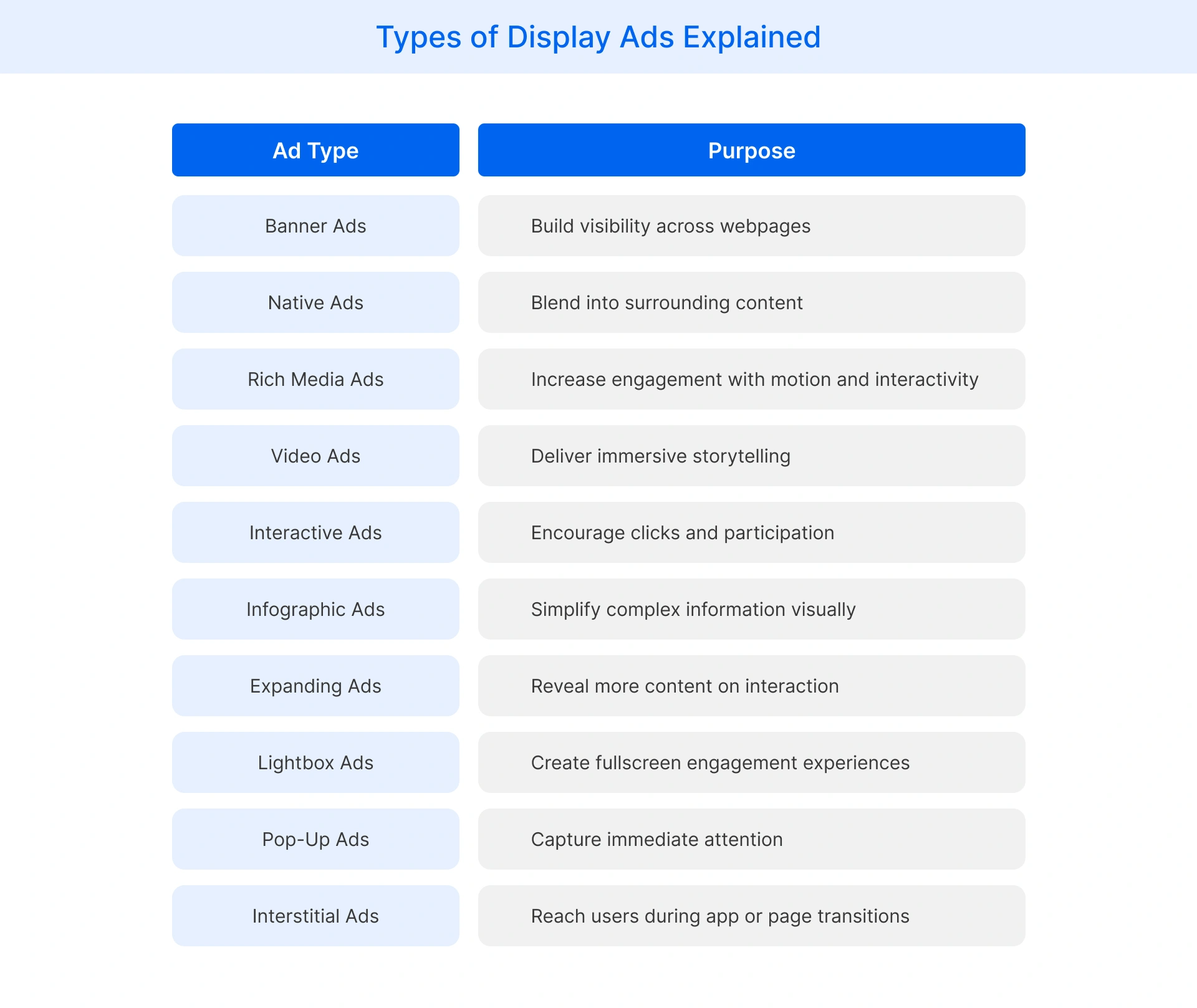
There are several types of display ads, each offering unique ways to engage users and enhance brand awareness:
- Web Banner Ad: A traditional and versatile banner ad format that typically appears at the top, bottom, or sides of a webpage.
- Native Ads: Blended with the content of the site or app, these ads provide a seamless experience.
- Infographic: Educates users through graphics, simplifying complex information.
- Rich Media Ads: Combines video, audio, and interactive elements to create engaging content.
- Interactive Ads: Encourages user interaction with clickable elements.
- Video Content: Delivers a rich, immersive experience through video.
- Expanding Ads: Grows with user interaction, revealing more information.
- Lightbox Display Ads: Offers a full-screen experience for greater engagement.
- Pop-up Displays: Sudden, small ads that capture immediate attention.
- Interstitial Ads: Interstitial ads appear during transitions in a website or app, offering high visibility.
Each type of advertising offers distinct advantages, and understanding the different ad formats is key to creating a successful display ad campaign. This form of advertising is a crucial part of any digital advertising strategy, enhancing brand awareness and driving campaign performance.
What are the most common display ad sizes?
The most common display ad sizes were traditionally based on pixels:
- Medium Rectangle: 300 x 250 px
- Leaderboard: 728 x 90 px
- Wide Skyscraper: 160 x 600 px
- Large Rectangle: 300 x 600 px
- Mobile Leaderboard: 320 x 50 px
However, with the rise of responsive design, ad networks like the Google Display Network now recommend flexible ad units that are compatible with multiple screen sizes. These ad formats help ensure that your ads display perfectly on desktop as well as mobile devices.
How to measure display ads performance?
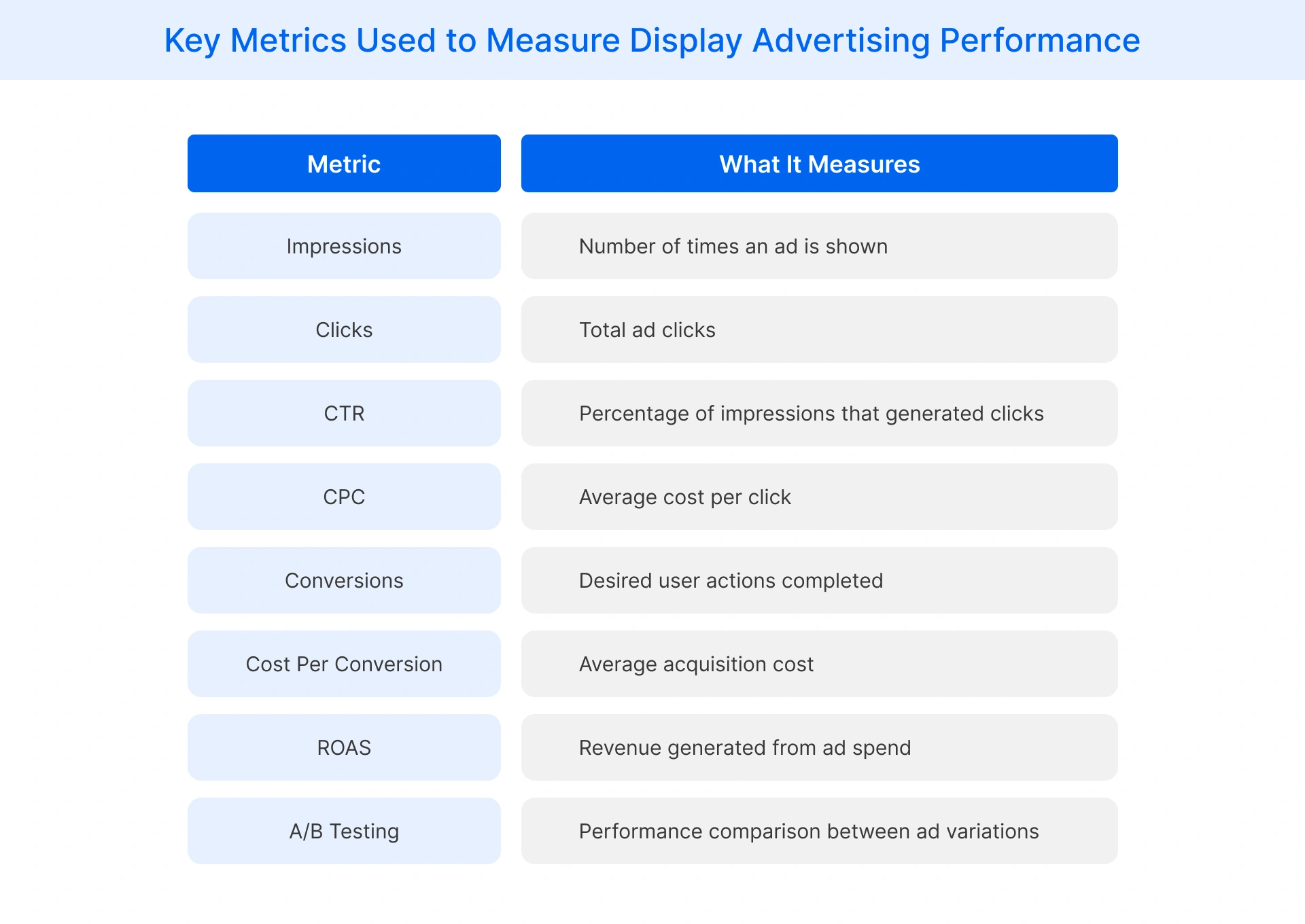
To optimize your display marketing efforts, measuring campaign performance is essential. Here are some key metrics that can help you in this process:
- Impressions: This measures how often your ad is shown.
- Clicks: This measures the total number of users who clicked your ad.
- Click-Through Rate (CTR): This is the percentage of impressions that resulted in a click.
- Conversions: This tracks how many clicks led to a desired action, such as a purchase or sign-up.
- Conversion Rate: This calculates the revenue generated for each dollar spent on advertising.
- Cost Per Click (CPC): This is the average cost of each click.
- Cost Per Conversion: This is the average cost of each conversion.
- Return on Ad Spend (ROAS): This determines the revenue earned for every dollar expense on advertising.
- A/B Testing: This determines the return on ad spend (ROAS) by measuring the revenue generated per dollar of advertising expenditure.
These metrics provide valuable insights to help you understand user behavior, measure campaign success, and make data-driven decisions for future campaigns.
What are the benefits of display advertising?
Display advertising offers numerous advantages, making it a vital tool in a marketer's arsenal. Here are some of the key benefits:
- Full Funnel Effectiveness: Display ads are not only excellent for enhancing brand visibility but also for driving traffic and boosting conversions. Their versatility in formats and targeting options enables advertisers to accomplish different objectives.
- Cross-Channel Compatibility: Display ads can be utilized across various platforms, including websites, social media, and apps. This makes them perfect for delivering a consistent, cross-channel user experience.
- Cost Efficiency: Display ads offer real-time or near real-time measurement and adjustment capabilities, making them a cost-effective strategy. If an ad or a set of ads underperforms, modifications can be made during the campaign to optimize results and maximize returns.
- Measurability: Display advertising provides precise metrics. Advertisers can track the exact number of clicks and conversions from each campaign, enabling easy calculation of ROI. This transparency allows for informed decision-making and strategy refinement.
By integrating display ads with other online display advertising methods, you can enhance your overall marketing strategy significantly.
Display advertising best practices?
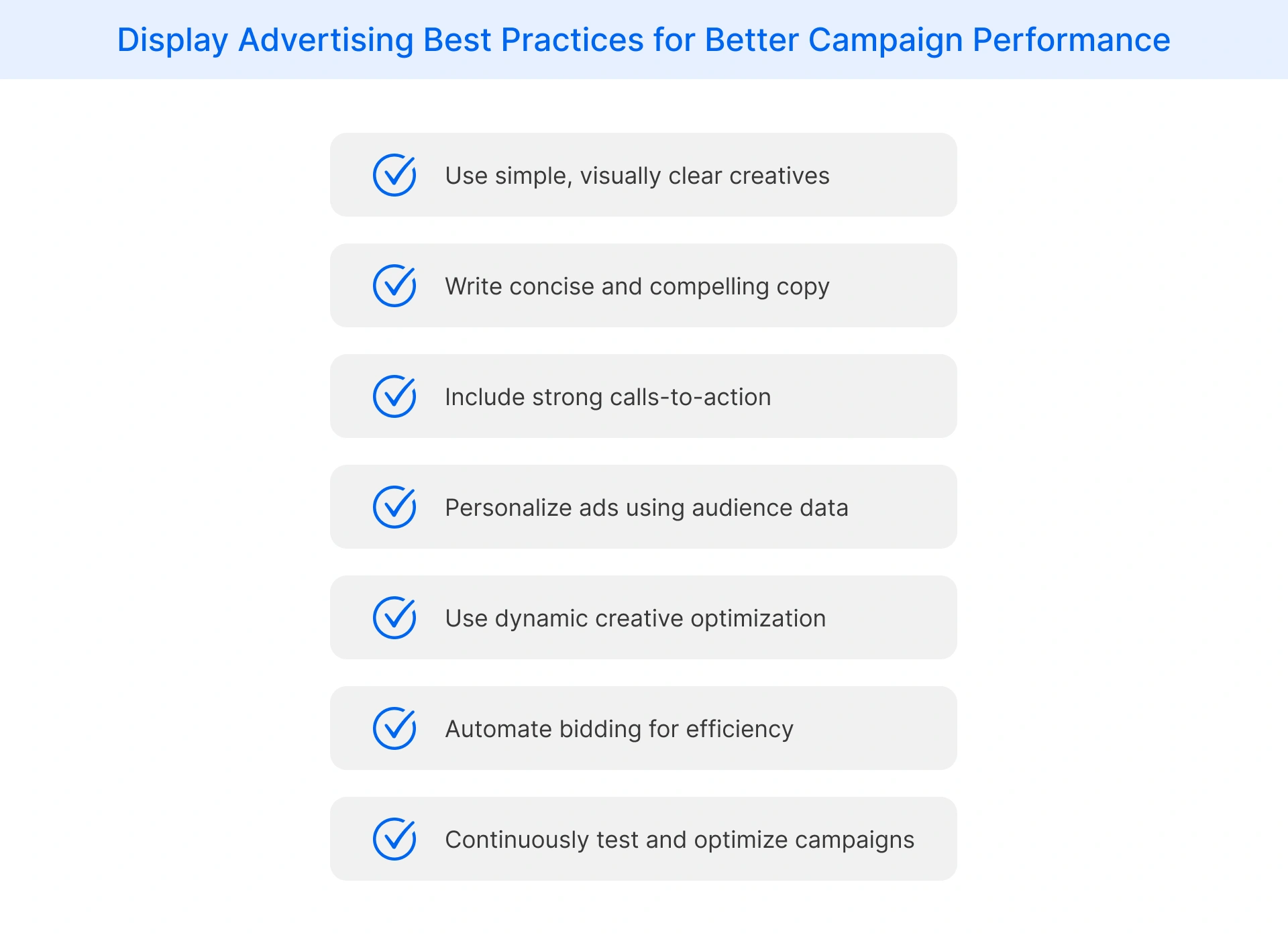
To ensure a successful display advertising campaign, consider the following best practices:
- Simplicity is Key: Your ad creative should be striking yet uncluttered. The copy should be concise yet powerful. Calls to Action (CTAs) should be straightforward and explicit.
- Personalization through Dynamic Creative Optimization: Opt for a display advertising partner that provides dynamic creative optimization technology. This leverages machine learning to tailor ad content and design for each individual based on their preferences and browsing history.
- Efficiency through Automated Bidding: Manual bidding can be time-consuming and requires constant attention. Automated bidding, on the other hand, employs AI technology to adjust Cost Per Click (CPC) as necessary to maintain a specific Key Performance Indicator (KPI), such as Cost of Sale (COS).
These practices help ensure that your online ads reach the target market and generate the best results.

Conclusion
Display advertising remains one of the most versatile tools in a digital marketer's arsenal, reaching audiences across websites, apps, and social platforms, all while delivering measurable, real-time results. But running display ads is only half the equation. The real challenge lies in making those ads relevant enough to convert, targeted enough to avoid wasted spend, and optimised continuously to deliver genuine returns.
Without the right technology, display advertising quickly becomes costly guesswork, generic creatives are shown to broad audiences with little personalisation, and limited insight into what is actually working.
Flipkart Commerce Cloud (FCC) solves this directly. FCC's AI and machine learning-powered advertising platform delivers personalised display ads based on individual shopping intent, ensuring your ads reach the right audience at the right moment, not just any audience. From real-time campaign optimisation to traffic monetisation and eCommerce revenue maximisation, FCC gives advertisers the intelligence and control to turn display advertising from a spend line into a growth engine.
Book a demo and discover how FCC AI-powered display advertising can increase your campaign conversions, eliminate wasted ad spend, and build the kind of brand visibility that actually drives revenue.

FAQ
A common example of display advertising is a banner ad; a visual ad appearing at the top or sides of a webpage promoting a product or offer. Other examples include video ads on YouTube, native ads blended into editorial content, and retargeting ads that re-engage users who visited a website without completing a purchase.
The three core components of display advertising are the visual creative (image, video, or rich media), the ad copy (headline and call-to-action text), and the targeting parameters (who sees the ad and where). Together, these elements determine whether a display ad captures attention, reaches the right audience, and successfully drives the intended action.
To start display advertising, define your campaign objective whether brand awareness, traffic, or conversions. Identify your target audience, select an ad network such as the Google Display Network, and design creatives in recommended sizes. Set your budget, choose a bidding strategy, launch the campaign, and consistently monitor key performance metrics to optimise results over time.
Yes, display advertising is a paid marketing channel. Advertisers pay to place visual ads across websites, apps, and social media platforms. Common pricing models include Cost Per Click (CPC), Cost Per Thousand Impressions (CPM), and Cost Per Acquisition (CPA). Flipkart Commerce Cloud helps businesses maximise returns on display ad spend through AI-powered personalisation and real-time campaign optimisation.
Yes, display advertising continues to be an effective and vital part of the digital marketing toolbox. Despite its inception in the mid-1990s, it has evolved with the digital landscape. In 2025, US advertisers are projected to spend over $180 billion on programmatic digital display advertising.
Display ads are scalable, reaching a broad audience for brand visibility. They offer advanced targeting options and cost-efficiency and complement other marketing channels. While some point to low click-through rates as evidence of their ineffectiveness, this oversimplifies their role within the broader advertising ecosystem.