
June 21, 2026
What Is Life Cycle Pricing?
Life cycle pricing is a dynamic pricing strategy that adjusts a product's price at each stage of its product life cycle (launch, growth, maturity, and decline), ensuring the right price is applied at the right time to protect margins and maximize sell-through.
Drishti, Manager - Digital Marketing

Table of Contents
- What Is Life Cycle Pricing?
- Life Cycle Pricing Strategies Across the Four Product Stages
- Real-World Examples of Life Cycle Pricing in Retail
- Key Components of a Modern Lifecycle Pricing Ecommerce Model
- Major Challenges of Manually Executing Life Cycle Pricing
- Life Cycle Pricing vs. Dynamic Pricing vs. Cost-Plus Pricing
- Best Practices for Implementing Life Cycle Pricing
- Aligning Your Life Cycle Pricing Strategy With Automated Retail Engines
What Is Life Cycle Pricing?
Life cycle pricing is an active pricing strategy where a brand adjusts the price of a product as it moves through each stage of its product life cycle, from launch through growth, maturity, and decline.
Unlike static pricing, which keeps a single price fixed from launch to retirement, life cycle pricing responds to shifting demand signals, competitive pressure, and inventory levels at each phase. Getting the right price at the right time protects margins during peak demand and prevents capital from being trapped in aging, slow-moving stock.
What Life Cycle Pricing Strategies Across the Four Product Stages
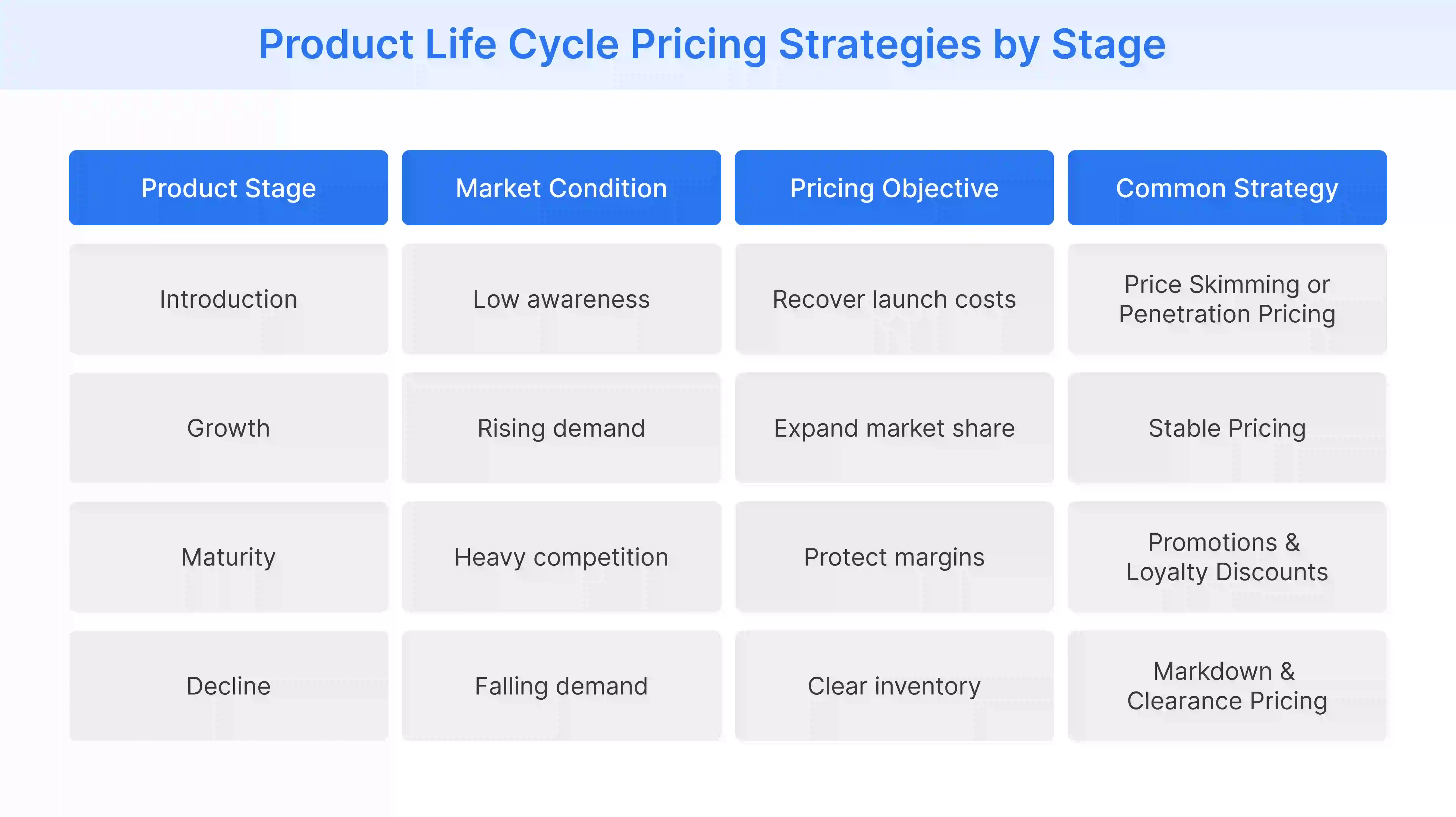
Each stage of the product life cycle calls for a different pricing strategy. Applying the wrong approach at the wrong stage either sacrifices margin or stalls sell-through.
1. Introduction Stage(Launch)
A new product enters the market with low awareness and no established customer base. Two core product life cycle pricing strategies apply here:
-
Price Skimming: Set a high launch price to capture early adopters and recover development costs. Works best for innovative or category-defining products with limited direct competition.
-
Penetration Pricing: Set a lower price to build market share quickly and attract price-sensitive buyers. Works best for highly competitive categories where volume matters more than early margin.
2. Growth Stage(Scaling)
Sales rise, demand signals strengthen, and competitors begin entering the market. The pricing goal shifts to maintaining market share while protecting margin. Brands typically stabilize the product's price here or make minor adjustments based on competitor moves and customer base expansion.
3. Maturity Stage(Mainstream)
Sales volume peaks, and the market fills with similar products from competing brands. Competitive pressure intensifies, making it harder to hold prices. At maturity, lifecycle pricing strategy focuses on strategic promotions, loyalty-based pricing privileges, and targeted discounts to defend market share without triggering a margin-eroding price war.
4. Decline Stage(Phase-Out)
Demand falls permanently as newer alternatives take over. At the decline stage, the pricing goal shifts from protecting profitability to maximizing inventory sell-through. Aggressive markdowns, product bundling, and clearance pricing clear remaining stock and recover capital before the product is retired.
Real-World Examples of Life Cycle Pricing in Retail
Consumer Electronics: A smartphone launches at $999 (Introduction, skimming). As sales grow and similar products enter from competitors (Growth), accessories are bundled to maintain perceived value. At maturity, the base price drops to $799 as competitive pressure builds. At decline, ahead of the next-generation model, the price is cut to $499 to clear warehouse inventory.
Seasonal Fashion: A winter coat debuts in October at full retail (Introduction). Weekend promotional discounts run through December as demand peaks and rivals compete for the same customer base (Growth/Maturity). By February, as the season ends, the coat moves to clearance at 60% off to free shelf space for spring inventory (Decline).
Video Games and Software: A new title launches at $70 (Introduction). A 15% holiday discount six months later pulls in casual players (Growth). After two years, the permanent price drops to $40 as the player base plateaus (Maturity). On the sequel announcement, the original is steeply discounted or bundled to clear remaining units (Decline).
Key Components of a Modern Lifecycle Pricing Ecommerce Model
- AI Demand Forecasting: Predictive models use historical sales data and real-time demand signals to anticipate purchase volumes at different price points across each lifecycle stage, enabling proactive pricing decisions rather than reactive ones.
- Life Cycle Price Elasticity: Measures how sensitive shoppers are to a change in a product's price at each lifecycle stage. Price elasticity is typically low at introduction (early adopters are less price-sensitive) and high at maturity (when similar products from competitors create direct price comparison pressure).
- Algorithmic Markdown Optimization: Calculates the precise timing and discount depth needed to clear end-of-lifecycle inventory without sacrificing unnecessary revenue. Automated markdown logic removes the guesswork from decline-stage clearance and reduces the risk of over-discounting.
Major Challenges of Manually Executing Life Cycle Pricing
- Identifying Stage Transitions in Real Time: Pinpointing the exact moment a single SKU shifts from growth to maturity, or from maturity to decline, across multiple sales regions requires continuous data monitoring that manual merchandising teams cannot reliably maintain at scale.
- Tracking Competitor Price Movements: Competitors adjust pricing constantly. Manually matching market conditions across a large catalog is inefficient and introduces delays that cost margin.
- Catalog and Assortment Complexity: Applying manual lifecycle pricing rules across thousands of SKUs in a product catalog increases the risk of pricing errors, inconsistent markdowns, and margin leaks that compound over time.
Benefits of Life Cycle Pricing for Ecommerce Brands
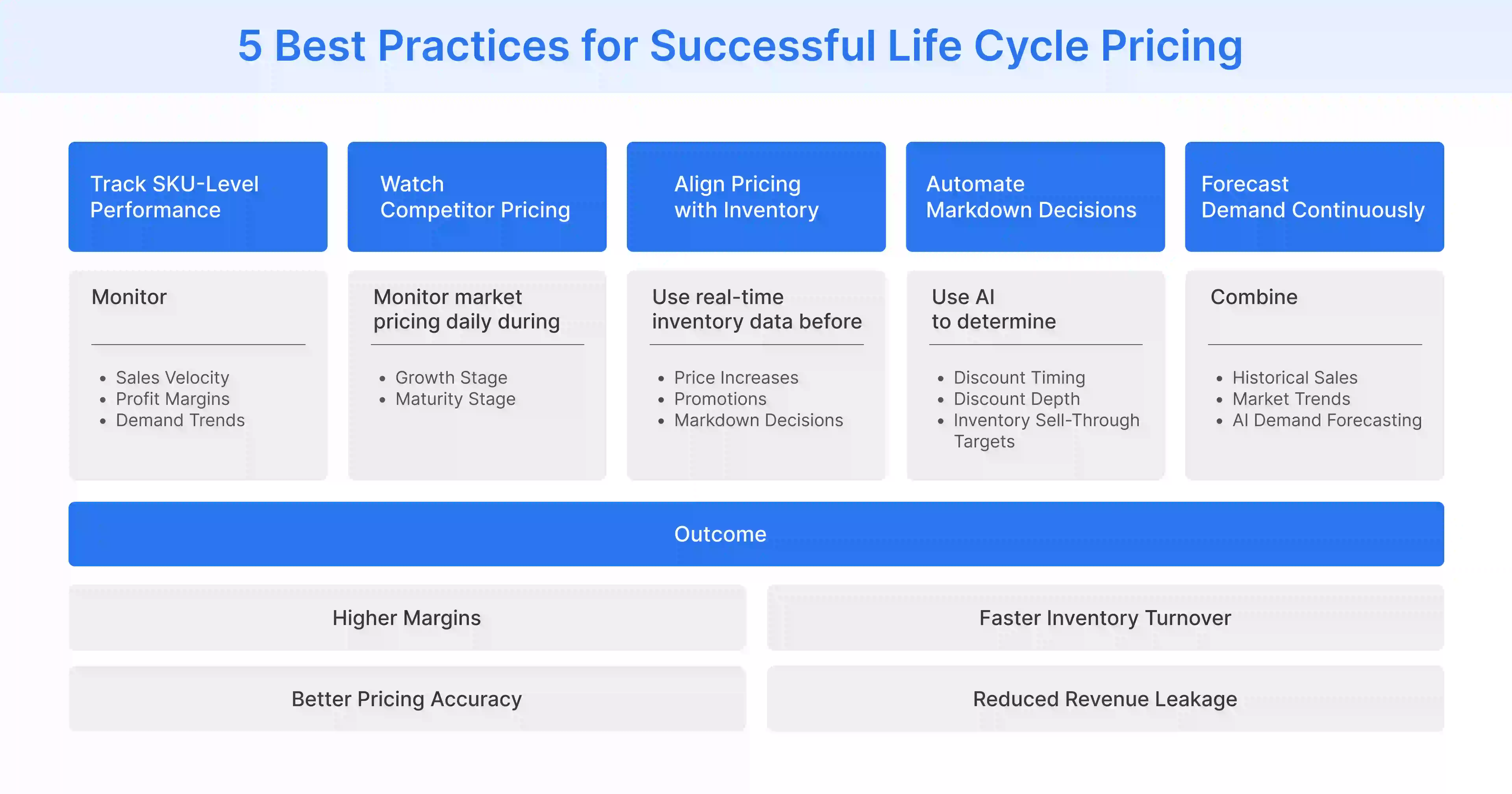
For ecommerce brands managing large catalogs across multiple channels, these are the core advantages it delivers.
- Maximizes Revenue at Every Stage: Because the pricing strategy adapts to where a product sits in its life cycle, brands capture the highest possible margin at launch when demand is strong and willingness to pay is high, rather than leaving money on the table with a flat, conservative price held across all stages.
- Prevents Dead Stock: Proactive markdown management at the decline stage ensures slow-moving inventory is cleared before it becomes a write-off. Brands that apply life cycle pricing avoid the costly scenario of aging stock tying up warehouse space and working capital with no path to recovery.
- Strengthens Competitive Position: At the maturity stage, when similar products from competitors flood the market, and competitive pressure peaks, lifecycle pricing gives brands a structured response, strategic promotions, and targeted price adjustments rather than reactive, margin-eroding price cuts made under pressure.
- Improves Demand Forecasting Accuracy: Tracking how a product's price performs at each stage generates consistent, stage-specific data on customer price sensitivity. This feeds directly into more accurate demand forecasting over time, making future product launches and markdown decisions more precise.
- Protects Long-Term Profitability: Static pricing optimizes for one moment in a product's life. Life cycle pricing optimizes for the entire commercial lifespan, balancing margin capture, market share, and sell-through in a way that compounds into stronger overall profitability across the full catalog.
Life Cycle Pricing vs. Dynamic Pricing vs. Cost-Plus Pricing
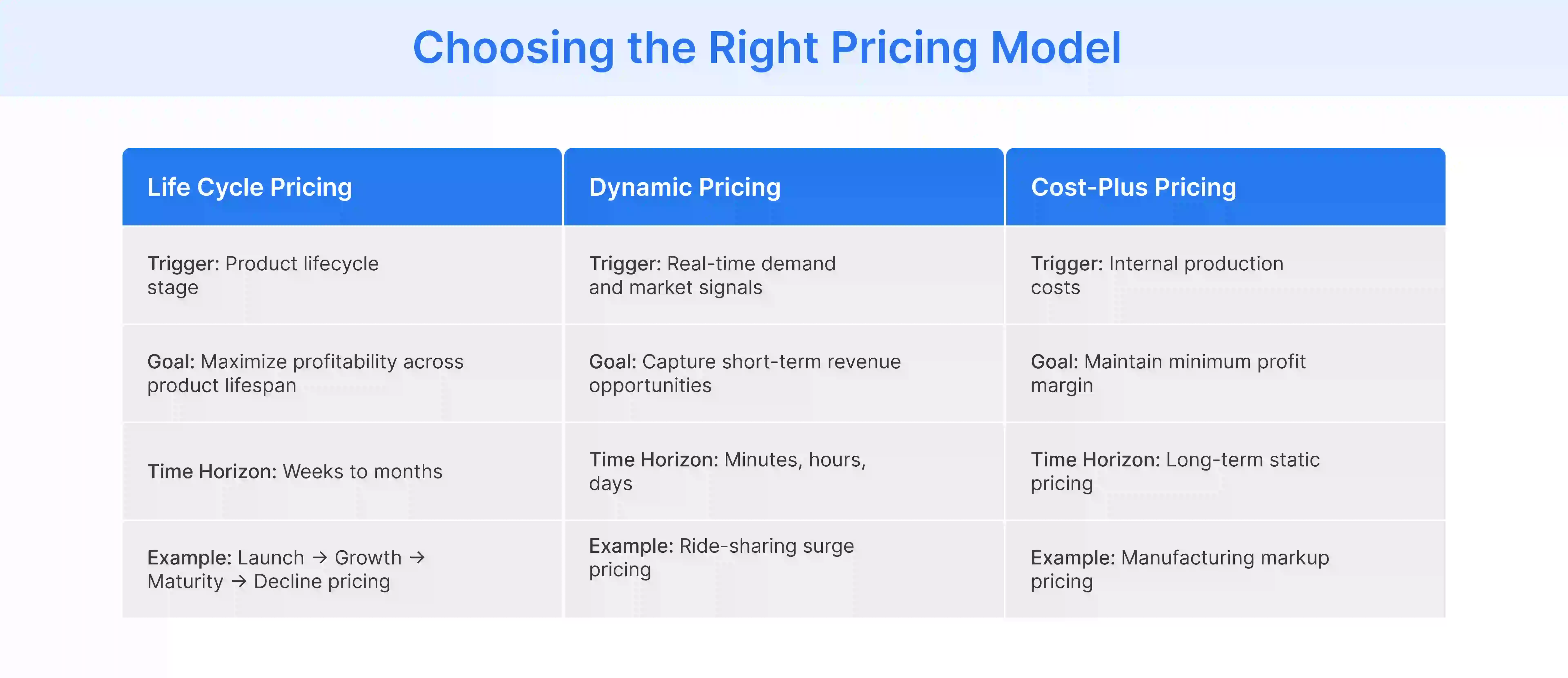
All three pricing strategies determine what a product sells for, but their triggers, timeframes, and business goals are different. Life cycle pricing operates on product age and market stage. Dynamic pricing reacts to real-time signals within hours or days. Cost-plus pricing anchors on internal costs with no market adjustment built in.
Cost-Plus Pricing
Sets a product's price by adding a fixed profit margin on top of production and overhead costs. It is the simplest of the three, internally focused, static, and unresponsive to market conditions. It does not account for where a product sits in its life cycle or what competitors are charging. Brands using cost-plus pricing alone risk overpricing at decline and underpricing at peak demand.
Dynamic Pricing
Responds to real-time demand signals, adjusting a product's price within hours or even minutes based on competitor moves, traffic spikes, or inventory levels. It is highly reactive and short-term by nature. While it shares life cycle pricing's flexibility, it operates on a much shorter time horizon and does not follow the structured arc of a product's market journey.
Life Cycle Pricing
Takes the broadest view. It adjusts a product's price deliberately across weeks and months, guided by which stage of the product life cycle the product is in, not just what is happening in the market right now. It accounts for competitive pressure at maturity, demand elasticity at introduction, and sell-through urgency at decline.
Where they overlap: All three strategies can coexist within the same catalog. A brand may use cost-plus pricing to set a margin floor, dynamic pricing to react to short-term demand spikes, and life cycle pricing to govern the longer-term trajectory of a product's price from launch to clearance. The key difference is the time horizon; cost-plus is static, dynamic is minute-to-minute, and life cycle pricing is stage-to-stage.
Aligning Your Life Cycle Pricing Strategy With Automated Retail Engines
Life cycle pricing ensures that a product's price is always aligned with where it actually sits in the market, capturing maximum margin at launch and peak demand, staying competitive at maturity, and recovering capital cleanly at decline. Brands that price reactively, using static rules, consistently leave revenue on the table.
Executing a life cycle pricing strategy across a large catalog requires automation. Tracking price elasticity and stage transitions manually across thousands of SKUs creates operational gridlock. Flipkart Commerce Cloud provides the analytical foundation for managing these shifts precisely, combining ML-powered pricing tools with advanced demand forecasting to identify when products move between lifecycle phases automatically. This keeps your catalog management and inventory management systems synchronized, protecting margins during peak demand and automating markdowns seamlessly through the decline stage.
Book a demo to discover how FCC's automated, ML-driven pricing infrastructure can protect your margins and optimize inventory turnover across your entire catalog lifecycle.

FAQ
Life cycle pricing is a dynamic approach to managing a product's price across its entire market lifespan. It is important because a product's perceived value and competitive position change at every stage, and a static price cannot respond to those shifts. Brands that apply the right pricing strategy at the right time protect margins and avoid trapping capital in slow-moving stock.
A clear example of life cycle pricing in action is consumer electronics. A smartphone launches at a premium price during introduction to recover development costs, stabilizes during growth as the customer base expands, drops at maturity as similar products from competitors enter the market, and is steeply discounted during decline to clear inventory before the next model launches.
The key components of a lifecycle pricing ecommerce strategy are AI-powered demand forecasting, life cycle price elasticity tracking, and algorithmic markdown optimization. Together, these tools ensure pricing decisions are driven by real demand signals and actual inventory levels, not manual estimates, at every stage of the product life cycle.
Lifecycle costing is calculated by summing all costs associated with a product across its full lifespan: development and manufacturing, marketing and launch spend, operational and distribution costs, and end-of-life markdown or disposal costs. In ecommerce, lifecycle costing also incorporates return rates, storage costs, and the revenue recovered through clearance pricing at the decline stage.
Product life cycle pricing is the practice of setting and adjusting a product's price based on its current stage in the product life cycle. It covers four stages: introduction, growth, maturity, and decline, each requiring a distinct pricing strategy. The goal is to maximize profitability across the product's entire market life rather than optimizing for a single point in time.
A life cycle pricing strategy is a structured framework for adjusting a product's price as it moves through introduction, growth, maturity, and decline. At each stage, the strategy responds to changes in demand signals, competitive pressure, and inventory levels to protect margin, maintain market share, and maximize total revenue over the product's full commercial lifespan.
Lifecycle costs in retail include every expense tied to a product from development through final clearance: design, production, warehousing, marketing, returns handling, and end-of-life markdown losses. Understanding total lifecycle costs helps retail brands set a realistic price floor at each stage and avoid discounting below the point where sell-through recovers sufficient margin.
Contextual AI supports life cycle pricing by analyzing real-time demand signals, competitor price movements, and inventory depletion rates to recommend stage-specific price adjustments automatically. Rather than relying on manual stage identification, AI flags the precise moment a product transitions between lifecycle phases. Flipkart Commerce Cloud integrates ML-powered pricing tools with demand forecasting to deliver this capability at catalog scale.