
September 25, 2026
What Is PPC Management and How Does It Work in Retail?
PPC management is the process of planning, monitoring, and optimizing pay-per-click advertising campaigns to manage ad spend and improve campaign performance.
Drishti, Manager - Digital Marketing

Table of Contents
- What Is PPC Management?
- How Does PPC Management Work?
- What Are the Key Components of PPC Management?
- Why Is PPC Management Important for Retailers?
- What Metrics Are Used to Measure PPC Performance?
- How Can Retailers Optimize PPC Campaigns?
- Conclusion
What Is PPC Management and How Does It Work in Retail?
Paid advertising gives retailers a direct way to reach shoppers across search engines, social media, and other digital channels. But launching PPC campaigns is only the beginning. As shopper behaviour, competition, and campaign results change, retailers need to keep a close eye on their target audiences, bids, ad spend, and overall performance.
This ongoing attention helps ensure that ad campaigns remain aligned with business goals instead of continuing to spend budget on approaches that are no longer delivering results. PPC management brings that continuous oversight into a retailer’s broader digital marketing efforts.
In this article, we discuss how PPC management works, its key components, the metrics used to measure performance, and how retailers can optimize their campaigns for better results.
What Is PPC Management?
PPC management is the ongoing process of overseeing and optimizing pay-per-click campaigns to improve performance while controlling ad spend. It involves making informed decisions about who to target, which keywords to use, how much to bid, where to allocate budgets, and how campaigns should be adjusted based on their results.
For retailers, effective PPC management can involve reaching relevant target audiences through search ads, display advertising, social media advertising, and other PPC platforms. It also requires monitoring campaign performance and refining elements such as bids, budgets, ad copy, and targeting as shopper behaviour and business goals change.
PPC management is closely related to PPC advertising, but the two terms do not mean exactly the same thing. PPC advertising is an advertising model in which an advertiser pays when someone clicks an ad. PPC management is the continuous process of managing and improving the campaigns that use this model. In other words, PPC advertising describes the model, while PPC management focuses on how those ad campaigns are run over time.
|
PPC Management vs. PPC Advertising |
|
|---|---|
|
PPC Advertising |
PPC Management |
|
The advertising model where advertisers pay when someone clicks an ad |
The ongoing process of managing and optimizing PPC campaigns |
|
Focuses on running paid ads |
Focuses on decisions around targeting, bids, budgets, and performance |
|
Describes the advertising method |
Describes how campaigns are managed over time |
How Does PPC Management Work?
PPC management works as a continuous cycle of planning, launching, monitoring, and improving paid advertising campaigns. It starts with setting clear campaign objectives based on business goals, such as increasing product visibility, driving traffic, or generating sales. Retailers can then identify the right keywords and target audiences, choose suitable PPC platforms, create ads, and determine how their bids and budgets will be allocated.
Once PPC campaigns are live, the focus shifts to performance. Retailers monitor how their ads are performing and use campaign data to identify where adjustments are needed. This could mean refining keywords and audience targeting, changing bids, reallocating ad spend, or adjusting ads that are not delivering the expected results.
The process continues throughout the life of the campaign. Rather than treating PPC campaign management as a one-time setup, retailers can use performance data to make ongoing adjustments and keep their PPC strategy aligned with changing shopper behaviour, campaign results, and business goals.
What Are the Key Components of PPC Management?
Effective PPC management combines several activities that determine who sees an ad, where it appears, how much a retailer spends, and how the campaign performs. The main components include:
- Keyword and audience targeting: Keyword research helps retailers identify relevant search terms, while audience targeting helps ads reach shoppers based on factors such as their interests, behaviours, or intent.
- Channel selection: Retailers can choose PPC platforms and ad formats based on where their target audiences are most likely to engage. Depending on the campaign, this can include Google Ads, Microsoft Advertising, social media advertising, search ads, and display ads.
- Campaign structure: Organizing campaigns and ad groups clearly makes it easier to manage keywords, ads, targeting, and budgets while keeping each campaign aligned with its objectives.
- Bid management: Bids influence how much a retailer is willing to pay for clicks or other campaign outcomes. They can be adjusted according to campaign performance, competition, and the value of different audiences or search terms.
- Budget allocation: Retailers need to decide how advertising budgets are distributed across campaigns, channels, products, or audiences. Regular adjustments can shift ad spend toward areas delivering stronger results.
- Ad optimization: Testing and refining elements such as ad copy can help retailers understand which messages resonate with shoppers and improve campaign performance over time.
- Negative keywords: Adding negative keywords prevents ads from appearing for irrelevant search terms, helping retailers reduce wasted ad spend and focus on more relevant searches.
- Performance monitoring: Retailers need to track campaign results continuously to understand what is working and where changes are needed. These insights inform decisions across targeting, bids, budgets, and ad optimization.
These components work together as part of a broader PPC management strategy. For example, strong targeting can bring an ad in front of the right people, but poor budget allocation or ineffective ad copy can still limit its performance. Managing the components together helps retailers make better use of their advertising spend and focus resources on campaigns with stronger potential.
Why Is PPC Management Important for Retailers?
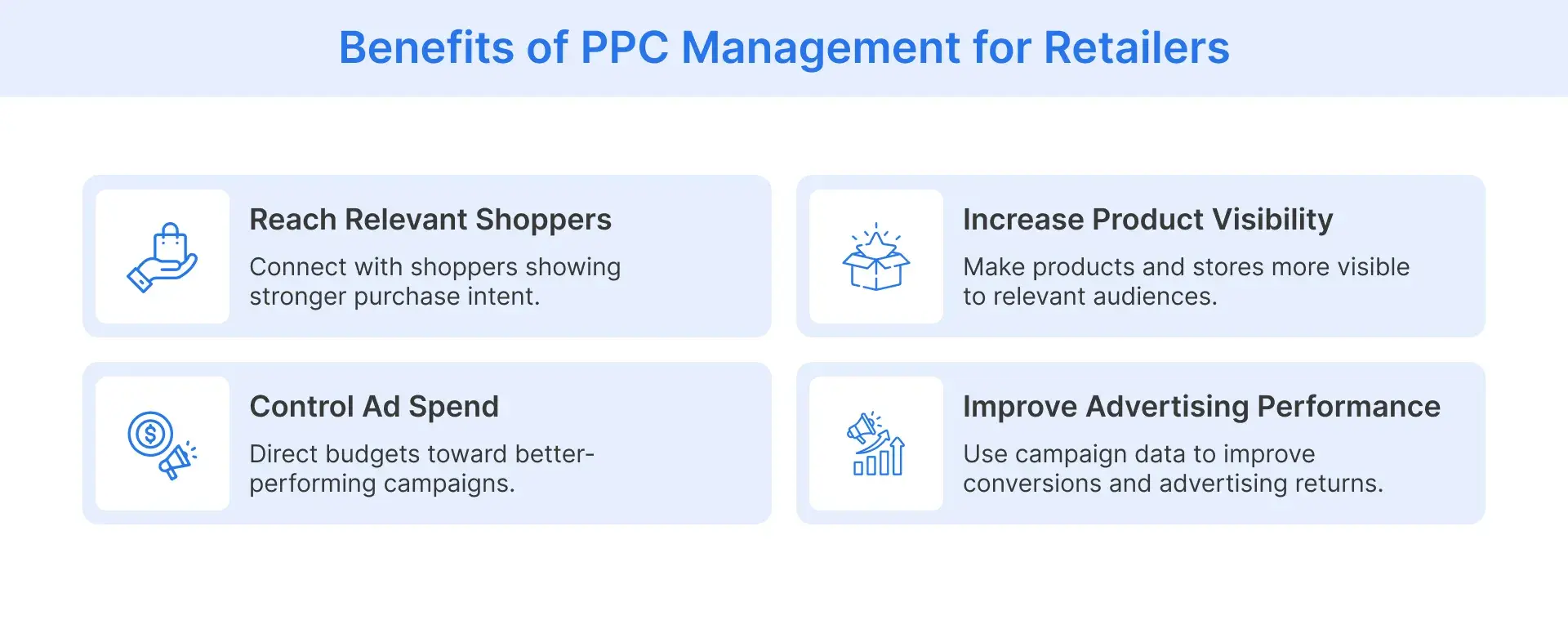
PPC management helps retailers make more deliberate use of paid advertising by connecting their campaigns with shoppers who are more likely to be interested in their products. With the right targeting, retailers can increase product or store visibility, reach high-intent shoppers, and direct paid traffic to product pages and other destinations designed to drive conversions.
It also gives retailers greater control over how their advertising budgets are used. Instead of spreading ad spend evenly across campaigns regardless of performance, retailers can identify where their budget is generating results and adjust their investment accordingly. This is particularly valuable when managing multiple products, audiences, or marketing campaigns competing for the same budget.
Another advantage is measurability. PPC advertising gives retailers access to campaign data that can show how shoppers are responding to their ads and whether that activity is contributing to conversions. With continuous PPC management, retailers can use these insights to make better advertising decisions, reduce inefficient spending, and improve their return on ad spend over time.
What Metrics Are Used to Measure PPC Performance?
Retailers can use a combination of PPC metrics to understand how their campaigns are performing, from how often ads are seen to whether those interactions ultimately lead to conversions. Some of the key metrics include:
- Impressions: The number of times an ad is displayed. Impressions help retailers understand the visibility and reach of their ads.
- Clicks: The number of times people click an ad. This provides a basic measure of how much traffic an ad is generating.
- Click-through rate (CTR): The percentage of impressions that result in clicks. CTR can indicate how effectively an ad captures the attention of its target audience.
- Cost per click (CPC): The average amount paid for each click. Tracking CPC helps retailers understand the cost efficiency of driving traffic through PPC advertising.
- Conversions: The number of desired actions completed after someone interacts with an ad, such as making a purchase or completing another campaign goal.
- Conversion rate: The percentage of interactions that result in conversions. It helps retailers understand how effectively paid traffic turns into desired actions.
- Cost per acquisition (CPA): The average cost of generating a conversion or acquiring a customer through a campaign. It can help retailers assess whether the cost of achieving results is sustainable.
- Return on ad spend (ROAS): The revenue generated in relation to the amount spent on advertising. ROAS helps retailers evaluate the financial return generated by their ad spend.
No single metric provides a complete picture of PPC performance. A campaign may generate a high number of clicks, for example, but still have a low conversion rate or an unsustainable CPA. Looking at these metrics together gives retailers a clearer view of campaign visibility, engagement, cost efficiency, and conversion performance, allowing them to make more informed PPC management decisions.
How Can Retailers Optimize PPC Campaigns?
PPC optimization is an ongoing process. As campaign results change, retailers can use performance data to identify what is working, what is consuming budget without delivering results, and where adjustments could improve performance. Some practical ways to optimize PPC campaigns include:
- Refine keywords and audience targeting: Review search terms and audience performance regularly to identify which ones are attracting relevant shoppers. Retailers can focus more of their budget on stronger keywords and audiences while reducing spend on those that consistently underperform.
- Use negative keywords: Negative keywords can prevent search ads from appearing for irrelevant queries. Reviewing and updating them regularly can reduce wasted ad spend and keep campaigns focused on more relevant searches.
- Adjust bids and budgets: Bids and budgets should reflect campaign performance rather than remain fixed. Retailers can shift more spend toward campaigns, keywords, or audiences producing stronger results and reduce investment in weaker areas.
- Test different ad variations: A/B testing different versions of ad copy, headlines, or calls to action can help retailers understand which messages generate better responses from their target audiences.
- Improve landing and product pages: The experience after a shopper clicks an ad also affects campaign performance. Landing pages and product pages should be relevant to the ad, easy to navigate, and designed to help shoppers complete the intended action.
Optimization works best when these decisions are based on campaign data rather than assumptions. By continuously testing and refining their PPC strategy, retailers can improve how their advertising budget is allocated and respond to changes in shopper behaviour and campaign performance.
Conclusion
PPC management gives retailers a structured way to continuously manage paid campaigns as shopper behaviour, competition, and campaign performance change. By keeping track of targeting, advertising spend, and results, retailers can make more informed decisions about where to invest their budgets and where adjustments are needed.
Effective PPC management also turns campaign data into insights that can support broader retail media decisions. Rather than relying on assumptions, retailers can use performance signals to refine their advertising strategy, allocate spend more effectively, and improve results over time.
With Flipkart Commerce Cloud, retailers can bring these data-driven decisions into their wider retail media strategy, using advertising technology and insights to better manage and improve campaign performance. Book a demo to see how FCC can help you make better use of your ad spend and improve advertising performance.

FAQ
PPC management refers to the strategic process of overseeing and optimizing a company’s pay-per-click ad campaigns. It involves conducting keyword research, managing bid strategies, structuring campaigns, and monitoring performance analytics to ensure advertising budgets maximize conversion rates and deliver a strong return on ad spend across digital networks.
PPC stands for pay-per-click, an online advertising model where advertisers pay a fee each time a user clicks on one of their digital ads. Rather than paying purely for ad impressions, merchants utilize this model to drive targeted traffic directly to their e-commerce product pages and digital storefronts.
A PPC manager oversees pay-per-click advertising accounts, refining campaign strategies to maximize advertising efficiency. Their primary responsibilities include conducting keyword research, setting daily ad budgets, testing ad creatives, optimizing bidding structures, and analyzing campaign data to lower acquisition costs while continuously scaling conversion rates for retail businesses.
Retailers should spend on PPC campaigns based on their specific profit margins, customer lifetime value, and overall revenue goals. Generally, online businesses allocate 5% to 15% of their total revenue toward digital marketing, adjusting campaign budgets dynamically as performance data identifies high-converting ad groups and profitable sales channels.
Retailers can tell if their PPC campaigns are working by monitoring key performance indicators like click-through rates, return on ad spend, and conversion rates. Utilizing advanced retail tools like Flipkart Commerce Cloud gives merchants clear visibility into revenue attribution, ensuring ad campaigns generate measurable revenue growth efficiently.