
June 12, 2026
What Is Social Commerce?
Social commerce lets customers find and buy products directly within social media apps without being redirected to an external website. inventory management system
Drishti, Manager - Digital Marketing

Table of Contents
- What Is Social Commerce?
- How Does Social Commerce Work for Online Brands?
- Common Types and Examples of Social Commerce Platforms
- Benefits and Challenges of a Social Commerce Strategy
- Social Commerce vs. Traditional Ecommerce vs. Social Selling
- Social Commerce Best Practices
- Conclusion
What Is Social Commerce?
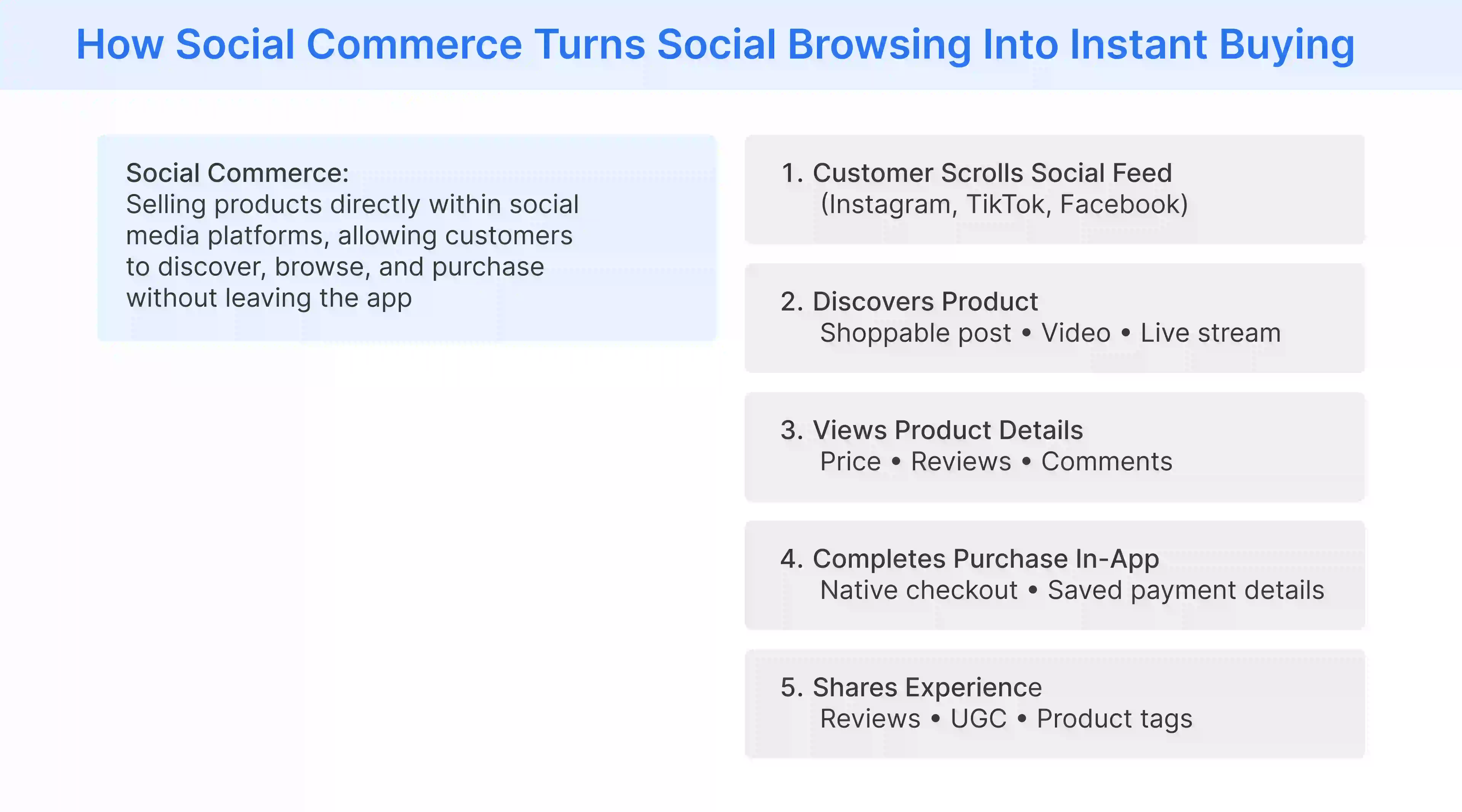
Social commerce is the practice of selling products directly inside social media platforms such as Instagram, TikTok, and Facebook so that online shoppers can discover, browse, and complete a purchase without ever leaving the app.
This is different from traditional ecommerce, where a shopper clicks a link on social media and is redirected to an external website to complete the transaction. That extra step creates friction, and friction kills conversions. Social commerce eliminates it by keeping the customer inside the platform from the first scroll to the final payment.
How Does Social Commerce Work for Online Brands?
The strategic use of social media relies on secure API connections and product feeds to pull product data directly from a brand's catalog and display it natively inside the app. When a shopper taps a product tag or a buy button, they check out using the platform's built-in payment system without redirects or re-entering card details.
The native customer journey typically moves through four stages:
- Product Discovery: A shopper encounters a product through a product listing shown on their mobile device feed, a paid ad, a live stream, or an explore page.
- Consideration: They stay in the app to learn more, tapping product tags, reading comments, checking reviews, or sending a DM to the brand.
- Purchase: They complete the transaction instantly using the platform's native checkout with saved payment credentials.
- Advocacy: Satisfied customers post content about the product, tag the brand, and organically extend its reach to new audiences.
Maintaining real-time inventory sync across every connected social channel is essential at these stages of the customer journey. If a product sells out on your main store but remains purchasable on your Instagram Shop, you risk overselling and the trust damage that follows.
Also read: What is Mobile Commerce
Common Types and Examples of Social Commerce Platforms
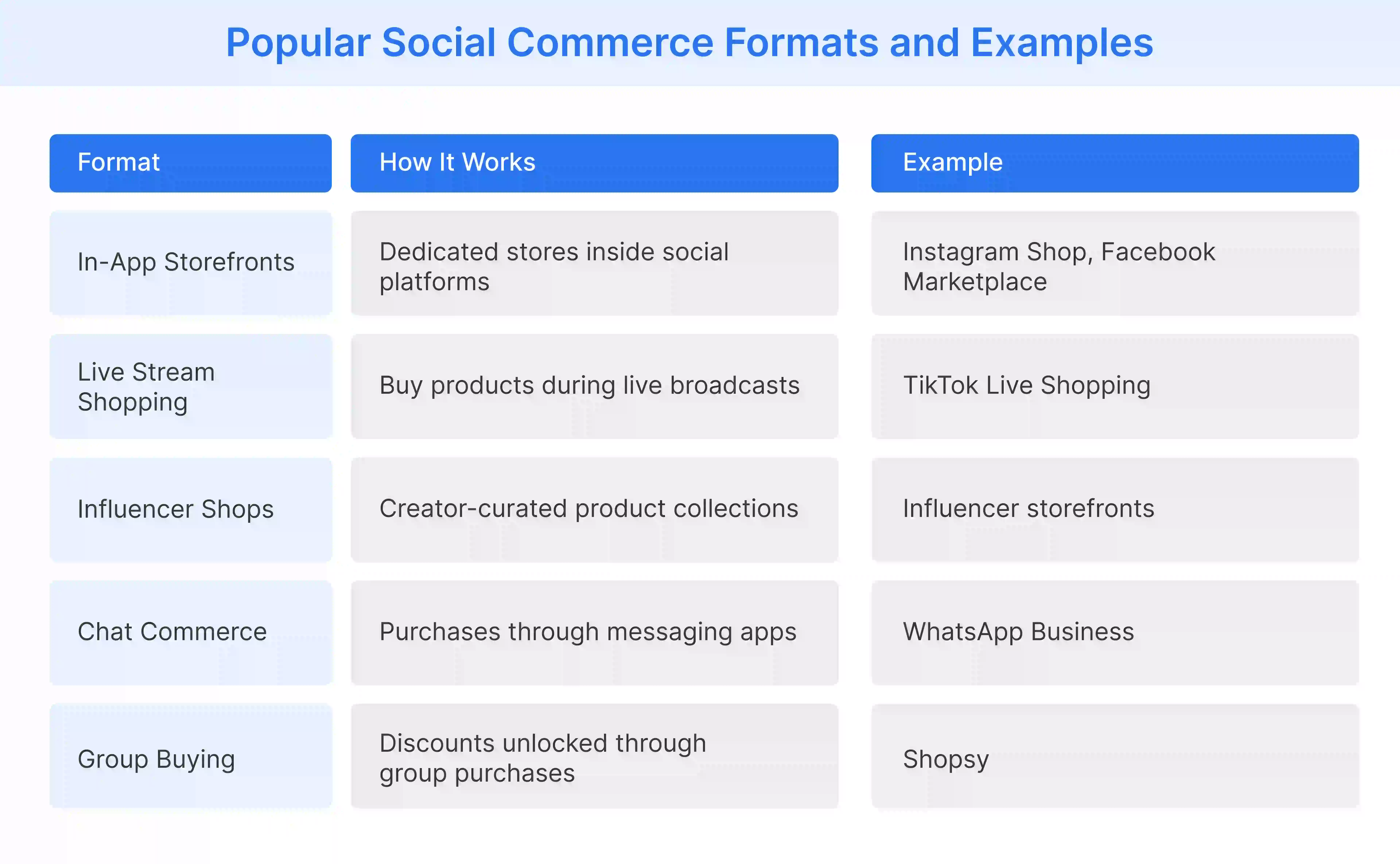
Brands execute social commerce strategies across these several formats:
- In-App Storefronts: Dedicated digital shops for online shopping built inside platforms like Facebook Shops(marketplace), Instagram Shops, TikTok Shop, and Facebook Marketplace, where customers can browse and buy without leaving the app.
- Live Stream Shopping: Real-time broadcast sessions where hosts demonstrate products and viewers tap on-screen purchase buttons to buy instantly. This format dominates in Asia-Pacific markets and is growing rapidly in the West.
- Influencer Shops: Creators capitalize on the booming creator economy to curate product collections, utilizing influencer marketing to drive high-intent traffic directly to shoppable product pages.
- Chat & Group Buying: Products sold through messaging platforms like WhatsApp, or via group-deal models such as Shopsy, where users buy together to unlock lower prices.
Benefits and Challenges of a Social Commerce Strategy
Social commerce can significantly grow revenue, but it also introduces operational complexity. Using a unified Digital Experience Platform helps brands manage product feeds, customer data, and order workflows across every channel from a single backend.
Benefits
- Frictionless Conversions: Removing multi-step redirects dramatically reduces cart abandonment. Shoppers who can buy in one tap are far more likely to complete the purchase.
- Hyper-Targeted Distribution: Social platforms use behavioral data and algorithms to surface your old and new products to potential buyers(the exact audience most likely to buy), with no additional ad targeting required.
- Higher Social Proof: Reviews, user-generated content, and checkout all exist inside one trusted environment, which accelerates purchase decisions and improves overall ROI.
- Rich Audience Insights: Combining social engagement metrics with direct transaction data gives brands a fuller picture for refining their broader digital experience platform (DXP) and targeting strategy.
Challenges
- Inventory Fragmentation: Managing stock levels across multiple social storefronts alongside your primary ecommerce site creates data silos and risks of overselling.
- Order Orchestration Complexity: Returns, customer service queries, and order status updates must be centralized across all social channels through an integrated backend to avoid confusion.
- Data Security and Control: Brands become dependent on third-party platform policies, algorithm changes, and evolving privacy compliance standards, which are outside their direct control.
- Platform Dependency: A policy change, algorithm update, or platform outage can directly disrupt sales, underscoring the importance of owning your primary ecommerce channel in parallel.
Social Commerce vs. Traditional Ecommerce vs. Social Selling
These three terms are frequently confused, but they describe distinct strategies:
- Traditional Ecommerce is selling through your own website or marketplace storefront. The customer always leaves social media to complete the purchase on an external site.
- Social Commerce is buying natively inside a social media app. The entire journey: discovery, consideration, and checkout happens without leaving the platform.
- Social Selling is using social media to build relationships, establish credibility, and generate leads. It is most common in B2B sales, and it does not involve a native checkout at all.
|
Feature |
Traditional Ecommerce |
Social Commerce |
Social Selling |
|
Main Goal |
Drive sales on an owned storefront |
Convert buyers natively inside social platforms |
Generate leads and nurture relationships |
|
Consumer Journey |
Discovers via search, ads, or social, clicks lead to a website |
Discovers and purchases entirely within the social app |
Discovers through content, DMs, and referrals; converts later |
|
Key Format |
Product pages, search results, email campaigns |
Shoppable posts, in-app storefronts, live streams, influencer shops |
Content, direct outreach, thought leadership |
|
Checkout Location |
External website or marketplace |
Native in-app checkout |
Off-platform (website, call, demo) |
|
Cart Experience |
Standard ecommerce cart with multi-step checkout |
One-tap purchase with saved social payment credentials |
No cart; purchase is handled externally |
Social Commerce Best Practices
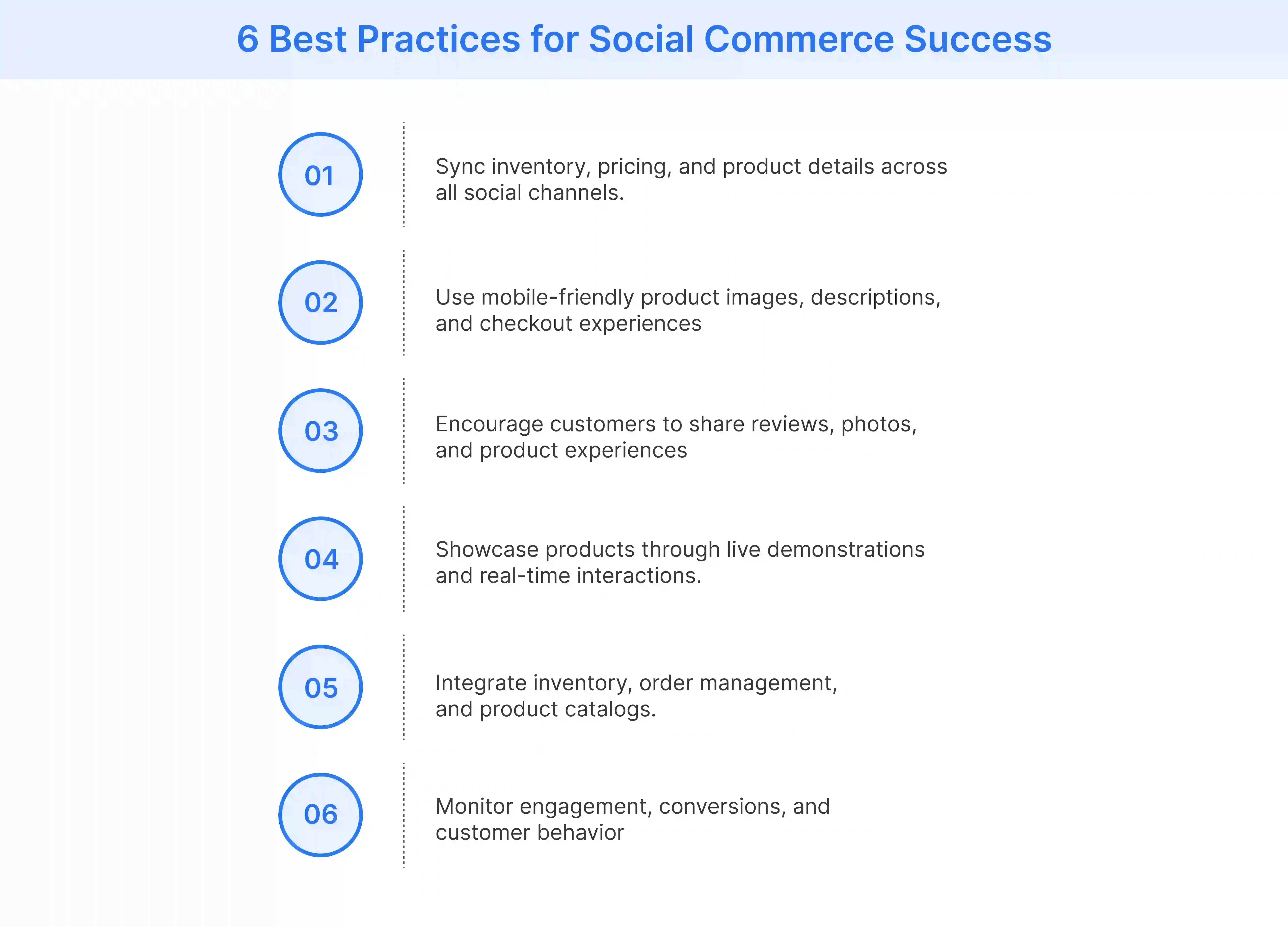
- Keep product feeds accurate and updated. A stale product feed showing out-of-stock items or incorrect prices erodes trust fast. Automate feed syncing so every social storefront reflects your live catalog.
- Prioritize mobile-first design. Most social commerce happens on a smartphone, heavily driven by Gen Z shoppers. Product images, descriptions, and checkout flows must be optimized for small screens and fast load times.
- Leverage user-generated content. Encourage customers to tag your brand after purchase. UGC is the highest-performing trust signal in social commerce environments; it functions simultaneously as a review, an advertisement, and a word-of-mouth referral.
- Run live shopping events. Live stream shopping consistently drives higher average order values and conversion rates than static posts. Schedule regular events around product launches, seasonal promotions, or collaborations.
- Integrate your backend before scaling. Social commerce strategy fails when backend systems can't keep up. Before expanding to additional platforms, ensure your inventory management system, order management, and customer data are unified, not siloed by channel.
- Use platform analytics alongside your own data. Platform-native analytics reveal engagement patterns, but they only show part of the picture. Connect social data to your digital experience platform (DXP) to understand how social commerce activity feeds into your broader customer journey.
Conclusion
Social commerce is now a core component of any effective omnichannel retail strategy. It meets customers inside the platforms where they already spend their time, removes the friction of being redirected to an external site, and compresses the path from discovery to purchase into a single seamless experience.
Running social stores at scale, however, requires a backend that keeps everything synchronized. Flipkart Commerce Cloud (FCC) helps brands effortlessly connect their catalog and inventory management systems with major social networks, keeping product feeds accurate, tracking stock in real time, and ensuring that every social checkout is backed by a reliable, integrated fulfillment operation.

FAQ
Social commerce means the direct buying and selling of products inside social media platforms like Instagram and TikTok. This native strategy allows online shoppers to discover and buy items without website redirects. Utilizing these social commerce trends eliminates checkout friction, speeding up the buying process and boosting digital marketing conversion rates.
An example of social commerce is TikTok Shop, where users tap an in-app button to buy items directly from video content. Similarly, brands use Instagram to tag products in posts, creating highly engaging shoppable content. These social commerce examples successfully turn casual social media content into immediate direct sales.
WhatsApp functions as a social commerce channel by letting businesses showcase items via the WhatsApp Business Catalog. While it lacks a full built-in storefront, it utilizes social media tools to support conversational selling. Brands leverage this messaging app to engage potential customers and fulfill specific customer needs directly through chat.
The future of social commerce points toward a rapid upward trajectory driven by live stream shopping and AI personalization. Brands are increasingly adopting robust social commerce tools to connect interactive social media sites with backend engines. Flipkart Commerce Cloud positions retailers perfectly for this evolution by synchronizing backend catalogs with frontend storefronts.
Social commerce is important because it capitalizes on growing social media presence to meet buyers where they already spend time. This channel removes external redirects, optimizes customer engagement, and drives brand awareness. For modern retail brands, launching tailored social commerce campaigns serves as a high-ROI method to acquire new customers.
The difference between social commerce and ecommerce lies entirely in where the transaction occurs. Traditional ecommerce forces online shoppers to visit an external website to finish a checkout. Conversely, social commerce keeps the entire journey within social media apps, simplifying the buying process and providing frictionless shopping experiences for modern consumers.
The challenges of social commerce center around inventory fragmentation and backend synchronization across various social media sites. Without centralized control, brands face overselling and broken customer experiences. Implementing Flipkart Commerce Cloud solves this by unifying your inventory management system with all storefronts to eliminate data silos and manual tracking errors.
Handling returns in social commerce requires routing all multi-channel return requests into a single, centralized order management system. Unifying your logistics backend ensures that returns initiated on social platforms trigger the same automated workflows as your main website. Flipkart Commerce Cloud helps brands.
Small businesses can start using social commerce by setting up a Facebook page or Instagram Shop to list their inventory. Merchants should focus on target audience preferences, utilize product pins, and incentivize customer reviews. Seamlessly integrating backend tools ensures small brands can scale up operations and achieve long-term social commerce success.