
September 30, 2026
Co-Marketing and the Power of Collaborative Brand Partnerships
Co-marketing is a collaborative marketing strategy in which two or more businesses combine resources, audiences, or promotional efforts to achieve shared marketing goals.
Drishti, Manager - Digital Marketing

Table of Contents
- What Is Co-Marketing?
- How Does Co-Marketing Work?
- What Are the Different Types of Co-Marketing?
- What Are the Benefits of Co-Marketing?
- What Are the Challenges of Co-Marketing?
- What Is the Difference Between Co-Marketing and Co-Branding?
- What Are Examples of Co-Marketing?
- How Can Businesses Choose the Right Co-Marketing Partner?
- How Can Businesses Build a Successful Co-Marketing Campaign?
- Conclusion
Co-Marketing and the Power of Collaborative Brand Partnerships
Businesses do not always have to reach new audiences or build brand awareness on their own. By working with complementary brands, they can extend their marketing efforts beyond their existing audiences while sharing some of the resources involved in planning and promoting a marketing campaign.
These collaborations can bring together audiences, expertise, resources, and promotional efforts around shared objectives. This gives participating businesses an opportunity to increase their reach while contributing different strengths to the same campaign.
Co-marketing provides a way for businesses to put this collaborative approach into practice. In this article, we discuss how co-marketing works, its different types, benefits and challenges, real-world examples, and how businesses can choose the right partner and build a successful campaign.
What Is Co-Marketing?
Co-marketing is a collaborative marketing strategy in which two or more businesses work together to promote products, services, content, or campaigns to their respective audiences. The businesses remain separate companies with their own brand identity, but share resources, expertise, audience reach, or promotional channels to achieve common marketing objectives.
The collaborative effort is designed to create mutual benefits for the businesses involved. Each partner contributes something valuable to the campaign while gaining access to resources, expertise, or audiences that the other partner brings to the collaboration.
How Does Co-Marketing Work?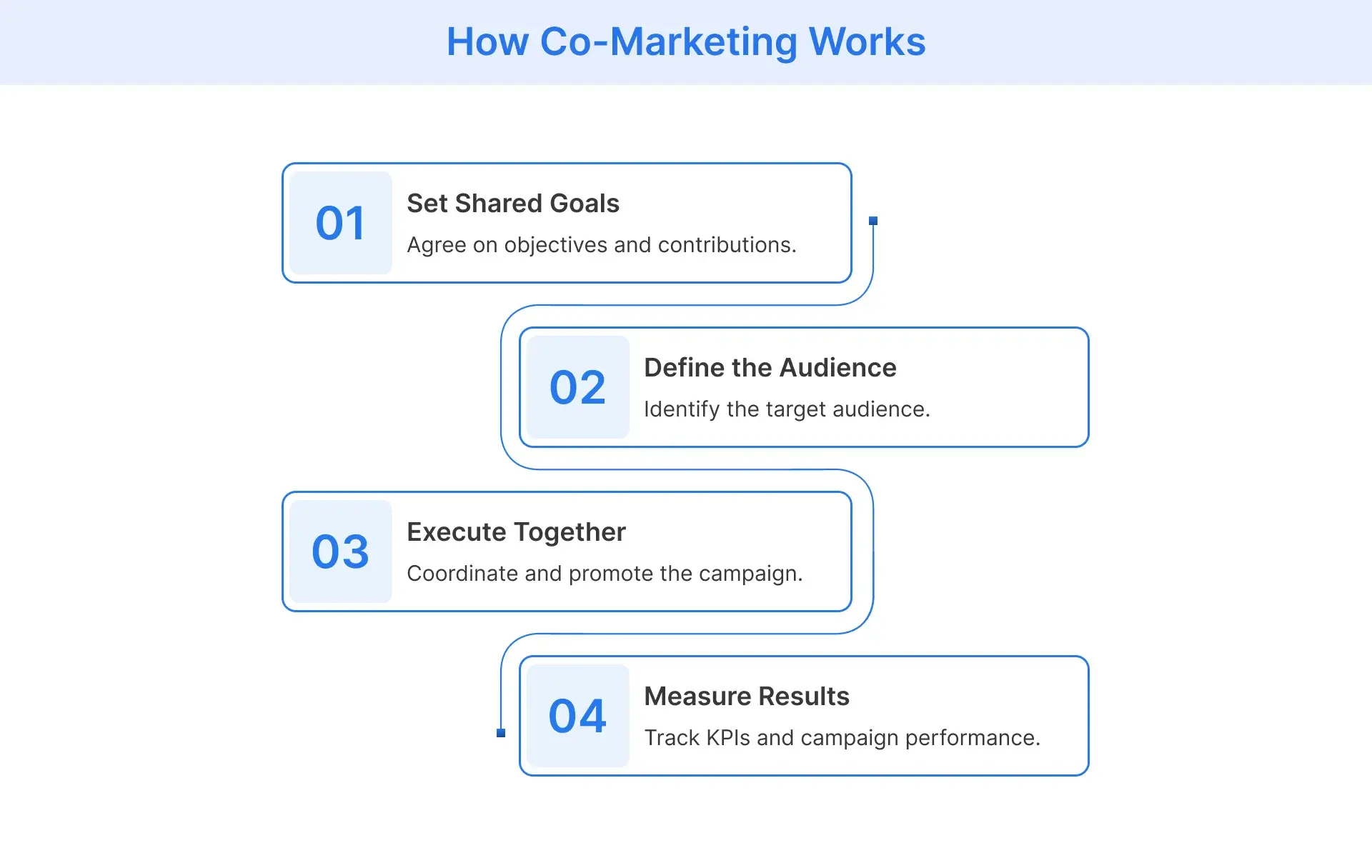
Co-marketing begins when businesses identify shared business goals and agree on what each partner company will contribute to the campaign. These contributions can include content, expertise, budget, audience reach, or access to promotional channels such as email and social media platforms.
The partners then coordinate the joint promotional campaign around a defined target audience. Depending on the agreement, they may share responsibilities for content creation, costs, campaign execution, and promotion. They can also establish key performance indicators to measure outcomes such as leads, traffic, sales, or engagement and evaluate the campaign’s performance.
What Are the Different Types of Co-Marketing?
Co-marketing can take different forms depending on the campaign objective, target audience, and resources each business can contribute. Common types include:
- Joint content: Businesses collaborate on content marketing campaigns such as articles, reports, videos, ebooks, or other resources and promote the content to their respective audiences.
- Email marketing: Partners promote a shared campaign, offer, or piece of content through their email channels.
- Social media collaborations: Brands coordinate social media marketing activities such as shared posts, videos, or other campaigns across their social media channels.
- Events and webinars: Businesses jointly organize or participate in physical or virtual events, combining their expertise and audiences.
- Cross-promotions: Each business promotes the other partner’s products, services, or offers to its audience as part of their joint promotional efforts.
- Giveaways: Partners contribute products, services, or other incentives to a shared promotional campaign.
- Product bundles: Complementary businesses package their products or services together as part of a joint offer.
The appropriate format depends on what the businesses want to achieve, the audience they want to reach, and the resources available for the collaboration.
What Are the Benefits of Co-Marketing?
Co-marketing can help businesses extend their reach by introducing each brand to the other partner’s customer base. This creates opportunities to connect with potential customers and build brand awareness without relying entirely on their existing audiences.
Key benefits include:
- Expanded audience reach: Each business can gain exposure to new customers through the other partner’s audience.
- Shared costs and resources: Partners can divide campaign costs and contribute different resources, reducing the burden on one business.
- Access to complementary expertise: Each partner can contribute skills, knowledge, or capabilities that strengthen the campaign.
- Greater brand awareness: Exposure across both brands’ marketing channels can increase visibility among relevant audiences.
- Customer acquisition opportunities: Reaching potential customers through a trusted partner can create new opportunities to attract and engage them.
- Credibility through association: Working with a relevant and reputable brand can strengthen how audiences perceive the businesses involved.
A successful partnership should ultimately create mutual benefits for both businesses while also providing something relevant or valuable to the customers they are trying to reach.
What Are the Challenges of Co-Marketing?
While co-marketing allows businesses to combine their strengths, coordinating a campaign between separate companies can also introduce challenges. Differences between marketing teams, priorities, and marketing goals can affect how effectively the partnership operates.
Common challenges include:
- Partner misalignment: Potential partners may have different priorities, audiences, expectations, or approaches to the campaign.
- Conflicting objectives: Businesses may enter the collaboration expecting different outcomes, making it difficult to agree on campaign decisions.
- Unclear responsibilities: Without defined roles, tasks may be duplicated, delayed, or left incomplete.
- Inconsistent messaging: Differences in tone, positioning, or brand identity can make the campaign feel disconnected across channels.
- Resource demands: Coordinating approvals, content, budgets, and schedules between businesses can require additional time and effort.
- Attribution and measurement difficulties: Partners may find it difficult to determine how leads, sales, or other results should be attributed between them.
- Dependence on another business: Delays or changes from one partner can affect the entire campaign.
- Reputational risk: The actions or standards of one business can influence how customers perceive the other brand involved in the partnership.
Before launching a campaign, partners should agree on their objectives, responsibilities, communication processes, and expectations. Establishing these details early can reduce misunderstandings during campaign execution.
What Is the Difference Between Co-Marketing and Co-Branding?
Co-marketing and co-branding both involve collaboration between businesses, but they differ in what the partnership is designed to produce. In co-marketing, separate companies collaborate on marketing activities while maintaining their individual brand identity. Co-branding typically brings two brands together around a shared product, service, or branded offering.
Co-Marketing vs. Co-Branding |
||
|---|---|---|
|
Co-Marketing |
Co-Branding |
|
|
Purpose |
Collaborate on promotional activities to achieve shared marketing objectives |
Combine two brands around a shared offering |
|
Brand identity |
Each business maintains its individual brand identity |
Both brands are associated with the resulting offering |
|
Output |
A joint campaign, content, event, or other promotional activity |
A jointly branded product, service, or offering |
|
Example activity |
Two businesses jointly promoting a webinar to their respective audiences |
Two brands collaborating to launch a product featuring both brand names |
The simplest distinction is that co-marketing focuses on marketing together, while co-branding focuses on creating a jointly branded offering.
What Are Examples of Co-Marketing?
Real-world co-marketing campaigns can take different forms, from educational content and joint campaigns to content production and cross-promotion. In each case, the participating businesses contribute different resources while working toward shared marketing objectives.
HubSpot and Moz
HubSpot partnered with Moz through a co-marketing campaign on HubSpot Academy. Moz created a video lesson for HubSpot’s Content Marketing Course that demonstrated how its Keyword Explorer tool could be used for topic clusters and pillar pages. HubSpot provided the educational platform and audience, while Moz contributed its SEO expertise and product demonstration.
The collaboration also delivered measurable results. According to HubSpot, the lesson generated 8,000 views, 6,000 clicks to Moz, and 1,460 new contacts for Moz within four months. This makes it a clear example of content-based co-marketing, with both businesses contributing different resources to create educational content and reach a relevant audience.
GoPro and Red Bull
GoPro and Red Bull formed a global partnership involving content production, distribution, cross-promotion, and product innovation. GoPro became Red Bull’s exclusive provider of point-of-view imaging technology for its media productions and events. The companies also shared rights to co-produced content, which could be distributed across their respective digital channels.
The collaboration demonstrates co-marketing through shared content and cross-promotion. GoPro contributed its imaging technology and content capabilities, while Red Bull contributed its events, media network, and audience, allowing both brands to extend the reach of the content they produced together.
These examples show that co-marketing does not have to follow a predefined format. Businesses can collaborate through educational content, media production, cross-promotion, and other activities depending on their audiences, resources, and objectives.
How Can Businesses Choose the Right Co-Marketing Partner?
Choosing the right partner is important because the success of a co-marketing campaign depends on what both businesses bring to the collaboration. Potential partners should have complementary offerings and enough overlap in their target audience to make the partnership relevant without being direct competitors.
Businesses should consider:
- Audience alignment: Determine whether the partner’s audience is relevant to the customers the campaign is intended to reach.
- Shared business goals: Make sure both businesses agree on what the collaboration should achieve.
- Complementary capabilities: Look at the expertise, channels, technology, content capabilities, or other resources each business can contribute.
- Brand compatibility: Consider whether the businesses have compatible values, positioning, and standards.
- Reputation: Assess how the potential partner is perceived by customers and whether the association is appropriate for the brand.
- Available resources: Confirm that both businesses have the time, budget, people, and other resources required to fulfil their responsibilities.
The right partner is not necessarily the business with the largest audience. A strategic partnership is more likely to work when both businesses are relevant to each other’s audiences and can contribute meaningful value to the collaboration.
How Can Businesses Build a Successful Co-Marketing Campaign?
Building a successful co-marketing campaign requires both businesses to agree on how the collaboration will work before execution begins. This starts with setting measurable marketing goals and defining what each partner will contribute to the campaign.
Businesses should:
- Set shared objectives: Define what the marketing campaign should achieve and establish key performance indicators for measuring success.
- Define the target audience: Agree on who the campaign is intended to reach and how that audience aligns with both businesses.
- Choose the campaign format: Determine whether the collaboration will involve content, email, social media, events, cross-promotion, or another format.
- Establish roles and responsibilities: Decide what each partner and their marketing teams will handle throughout the campaign.
- Agree on campaign details: Set the messaging, budget, timelines, promotional channels, approval processes, and other requirements before launching.
- Plan attribution and measurement: Establish how leads, sales, traffic, engagement, and other outcomes will be tracked and attributed between the partners.
After the campaign, both businesses should review performance against the agreed objectives. The results can show which promotional efforts were effective, where the collaboration encountered challenges, and what can be improved in future campaigns.
Conclusion
Co-marketing allows businesses to combine complementary strengths, resources, and audiences around shared marketing objectives. However, the success of a marketing partnership depends on choosing a relevant partner, creating mutual benefits, defining clear responsibilities, and coordinating the campaign effectively.
For retailers, collaboration is only one part of creating a consistent customer experience across digital channels. Flipkart Commerce Cloud provides digital commerce capabilities that help retailers engage customers across different touchpoints and deliver connected shopping experiences.
Book a demo to see how FCC can help you create more connected commerce experiences across your customer touchpoints.

FAQ
Co-marketing refers to a collaborative strategy where two complementary businesses team up to promote a shared offer or campaign. By pooling marketing resources and cross-promoting content, both organizations expand their audience reach, generate qualified leads, and split promotion costs far more efficiently than running independent marketing initiatives.
An example of co-marketing occurs when two non-competing brands host a joint webinar or co-author an industry whitepaper. Each business promotes the shared asset to its existing audience, allowing both companies to gain exposure to new prospective buyers while sharing campaign creation and distribution expenses.
The difference between co-marketing and co-branding lies in campaign execution versus product creation. Co-branding involves two companies partnering to build an entirely new physical product or service together, whereas co-marketing focuses solely on joint promotional efforts to advertise existing, separate products to each other's customer bases.
The difference between co-marketing and partner marketing comes down to collaboration style and scope. Co-marketing involves equal partners creating joint promotional campaigns for mutual audience growth, while partner marketing is a broader strategy that includes affiliate programs, reseller networks, and channel distribution agreements to drive indirect sales.
You choose the right co-marketing partner by evaluating brand alignment, audience overlap, and shared business goals. Retail technology platforms like Flipkart Commerce Cloud help enterprise merchants analyze market data to identify compatible channel partners, ensuring joint marketing initiatives target relevant customer segments and deliver measurable return on investment.
You measure the success of a co-marketing campaign by tracking key metrics such as joint lead generation, website referral traffic, conversion rates, and total acquisition costs. Comparing these performance results against shared pre-campaign benchmarks helps both partner companies determine overall campaign profitability and future collaboration value.