
May 29, 2026
Understanding Minimum Order Value
Minimum order value (MOV) is the lowest total cart amount a customer must spend before a retailer will process their order or offer benefits such as free shipping or a promotional discount. Retailers set this threshold to ensure each transaction covers fulfillment costs and contributes positively to profit margin.
Drishti, Manager - Digital Marketing

Table of Contents
- What Is Minimum Order Value?
- How Is Minimum Order Value Different from Minimum Order Quantity?
- Why Do Retailers Use Minimum Order Value?
- How Do Retailers Set the Right Minimum Order Value?
- Why Retailers Need to Know Minimum Order Value?
- What Are the Challenges of Minimum Order Value?
- How Does Minimum Order Value Affect Cart and Checkout Behavior?
- Implement Minimum Order Value with Flipkart Commerce Cloud
Understanding Minimum Order Value
Minimum order value has become a standard commercial policy across e-commerce and retail, shaping how shoppers build their carts and how retailers protect profitability on every transaction. Retailers in categories from fashion to grocery use MOV thresholds to maintain healthy cash flow across high order volumes.
Profitability depends on more than pricing alone. The order size, logistics cost and average order value on each transaction all determine whether an online store earns or loses margin on the orders it fulfills.
- Retailers who set MOV policies reduce their exposure to high-cost, low-revenue transactions that erode profitability at scale.
- MOV thresholds work alongside free shipping incentives to motivate shoppers to increase their cart value before checkout.
- Well-calibrated minimum order value requirements improve fulfillment efficiency by filtering out orders too small to process profitably.
- Retailers across B2C and B2B sectors use MOV to align promotional offers with commercially viable spending thresholds.
What Is Minimum Order Value?
Minimum Order Value is the lowest total order value a customer must reach before a retailer processes an order or unlocks a defined benefit. This threshold may apply to order acceptance, free shipping or a promotion linked to the shopping cart.
Retailers often display the minimum order value requirement on product pages and in the cart before payment is made. When the cart total falls short, the checkout message usually shows the exact amount still needed to qualify.
MOV is common across B2C ecommerce, wholesale portals, and marketplace selling models. It helps online sellers ensure that smaller orders recover the handling, shipping, and packaging costs before the order enters fulfillment.
How Is Minimum Order Value Different from Minimum Order Quantity?
Minimum order value and minimum order quantity are related but distinct concepts that retailers and suppliers use for different commercial purposes. MOV measures the total currency value of an order while MOQ measures the number of units a buyer must purchase.
Understanding the difference helps retailers apply the right policy for their business model and supply chain structure.
|
Basis of Difference |
Minimum Order Value (MOV) |
Minimum Order Quantity (MOQ) |
|
Definition |
Minimum spend amount required per order |
Minimum number of units required per order |
|
Measurement |
Measured in currency value |
Measured in item count or units |
|
Primary Use |
E-commerce retail and B2C transactions |
Wholesale, manufacturing and B2B procurement |
|
Customer Impact |
Prompts shoppers to add more items by value |
Requires shoppers to buy a fixed number of units |
|
Retailer Goal |
Protect margins and increase average order value |
Ensure production or supply efficiency at volume |
Why Do Retailers Use Minimum Order Value?
Retailers use Minimum Order Value to keep every transaction commercially workable while guiding shoppers toward higher cart totals. The following are the primary reasons MOV is applied:
- Cover Fulfillment Costs: Processing, packing and shipping each order carries a fixed cost that smaller orders cannot recover. Setting an MOV above the per-order fulfillment cost ensures every transaction at least covers its own logistics and packaging expense.
- Increase Average Order Value: MOV thresholds prompt shoppers to add more items to their cart to qualify for free shipping or order acceptance, directly lifting average transaction size. Retailers who combine MOV with upselling prompts at checkout consistently see higher AOV across their customer base.
- Qualify Promotional Offers: Retailers tie discounts, free gifts, and free delivery to an MOV threshold to ensure promotions remain commercially viable and are not exploited on small purchases. This approach protects campaign profitability while still rewarding shoppers who meet the minimum order amount.
- Reduce Operational Strain: Filtering out very low-value orders lowers the volume of transactions that consume warehouse, logistics and customer service resources disproportionately. Fewer smaller orders means fulfillment teams handle fewer shipments per dollar of revenue, improving overall operational efficiency.

How Do Retailers Set the Right Minimum Order Value?
Here are the steps that retailers follow to determine the right minimum order value:
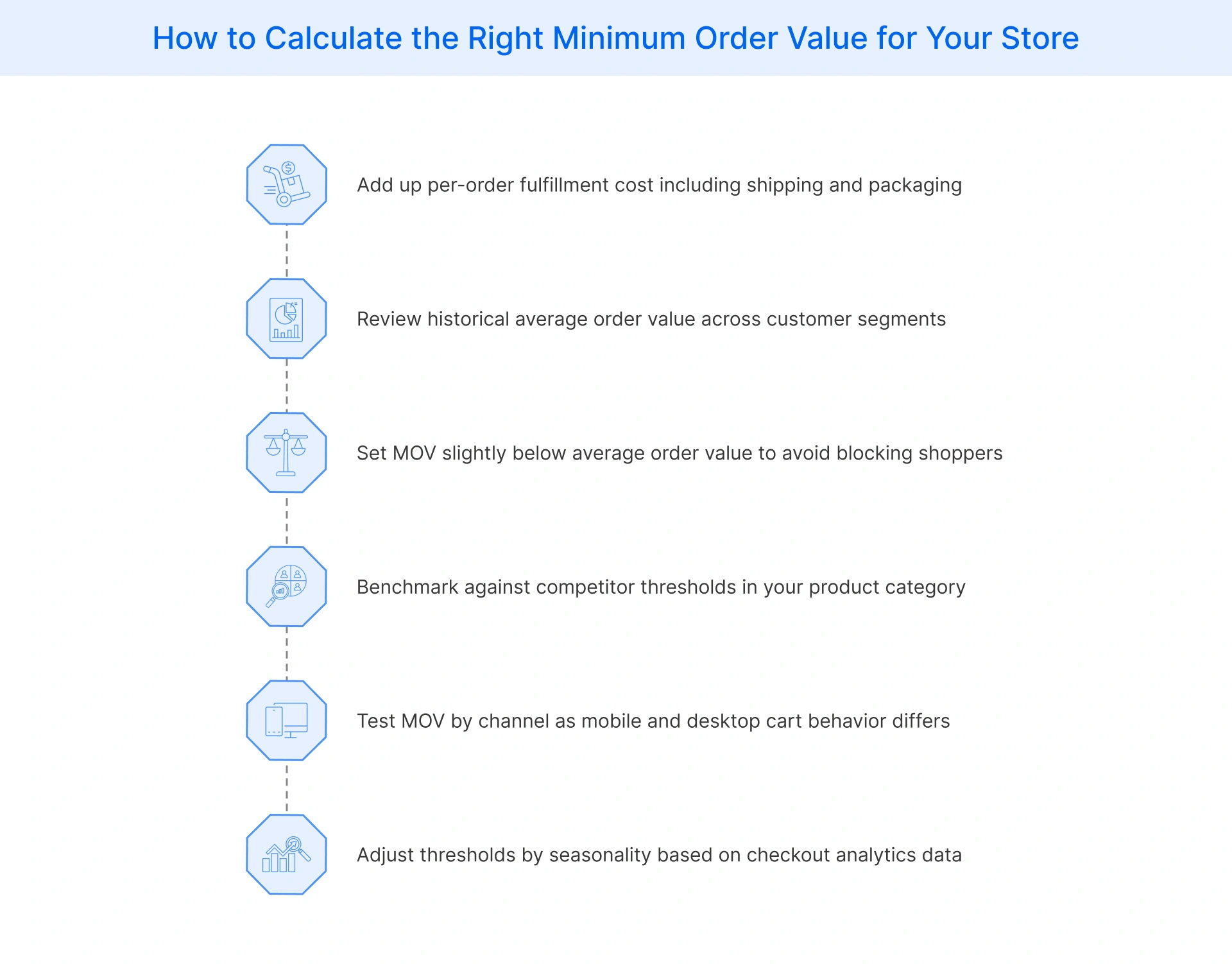
- Calculate the Break-Even Order Size: Add up the fulfillment cost per order, including picking, packing, and last-mile delivery. Then, set MOV above that figure to ensure each order contributes to the margin. This baseline calculation should account for packaging materials and the cost of any free shipping service offered above the threshold.
- Analyze Average Order Value Data: Review historical Average Order Value (AOV) across customer segments and set MOV slightly below it to avoid blocking most genuine shoppers. Analytics tools that surface AOV by channel, device and seasonality provide the most reliable basis for this decision.
- Benchmark Against Competitors: Check the MOV thresholds applied by competing online sellers in the same product category. This helps avoid setting a figure that drives price-sensitive shoppers to alternatives. A competitive advantage is often lost when an MOV is even marginally higher than that of similar online retailers.
- Test and Adjust by Channel: MOV thresholds that work on a desktop storefront may need adjustment for mobile shoppers or marketplace listings. Retailers on Shopify and Google Merchant Center can configure channel-specific shipping settings that reflect the purchasing patterns of each audience.
- Communicate the Threshold Clearly: Display the MOV requirement prominently on the cart page, product pages and at checkout with a real-time progress indicator showing how close shoppers are to qualifying. Clear communication at every stage reduces the number of customers who reach checkout unaware of the MOV requirement.
Why Retailers Need to Know Minimum Order Value?
Retailers need to understand Minimum Order Value because it affects pricing decisions, checkout behavior and fulfilment economics. Here is why this knowledge matters:
- Margin Protection: Orders above the MOV threshold support gross margin and reduce losses from high-cost transactions. Retailers also protect cash flow by avoiding frequent smaller orders with poor contribution.
- Higher Average Order Value: Shoppers seeking free shipping often add more items to reach the required threshold. A well-set minimum order value can lift AOV without extra discounts or added marketing spend.
- Simplified Logistics Planning: A predictable minimum order amount helps fulfillment teams plan labor and delivery capacity. It also supports better packaging estimates across routine order volumes.
- Improved Promotion Viability: Linking offers to MOV keeps promotions from applying to orders that cannot cover costs. Retailers using inventory management software can track eligibility and reduce margin leakage.
What Are the Challenges of Minimum Order Value?
MOV creates measurable operational and commercial benefits, but it also introduces friction points that retailers must actively manage. The following challenges arise most frequently:
- Cart Abandonment Risk: Shoppers may abandon carts when the MOV threshold feels difficult to reach. Retailers should track checkout analytics to see whether the minimum order value requirement causes drop-offs.
- Customer Friction: A high MOV can feel unfair when it exceeds category norms or shopper expectations. Customer satisfaction improves when the threshold feels reasonable and easy to understand.
- Marketplace Complexity: Multi-seller platforms often include online sellers with different cost structures. A single MOV rule may create inconsistent profitability levels and uneven shopper experiences.
- Promotional Abuse: Shoppers may add filler items to qualify for a free shipping minimum offer. Strong return rules help retailers protect margin when such items are returned later.
How Does Minimum Order Value Affect Cart and Checkout Behavior?
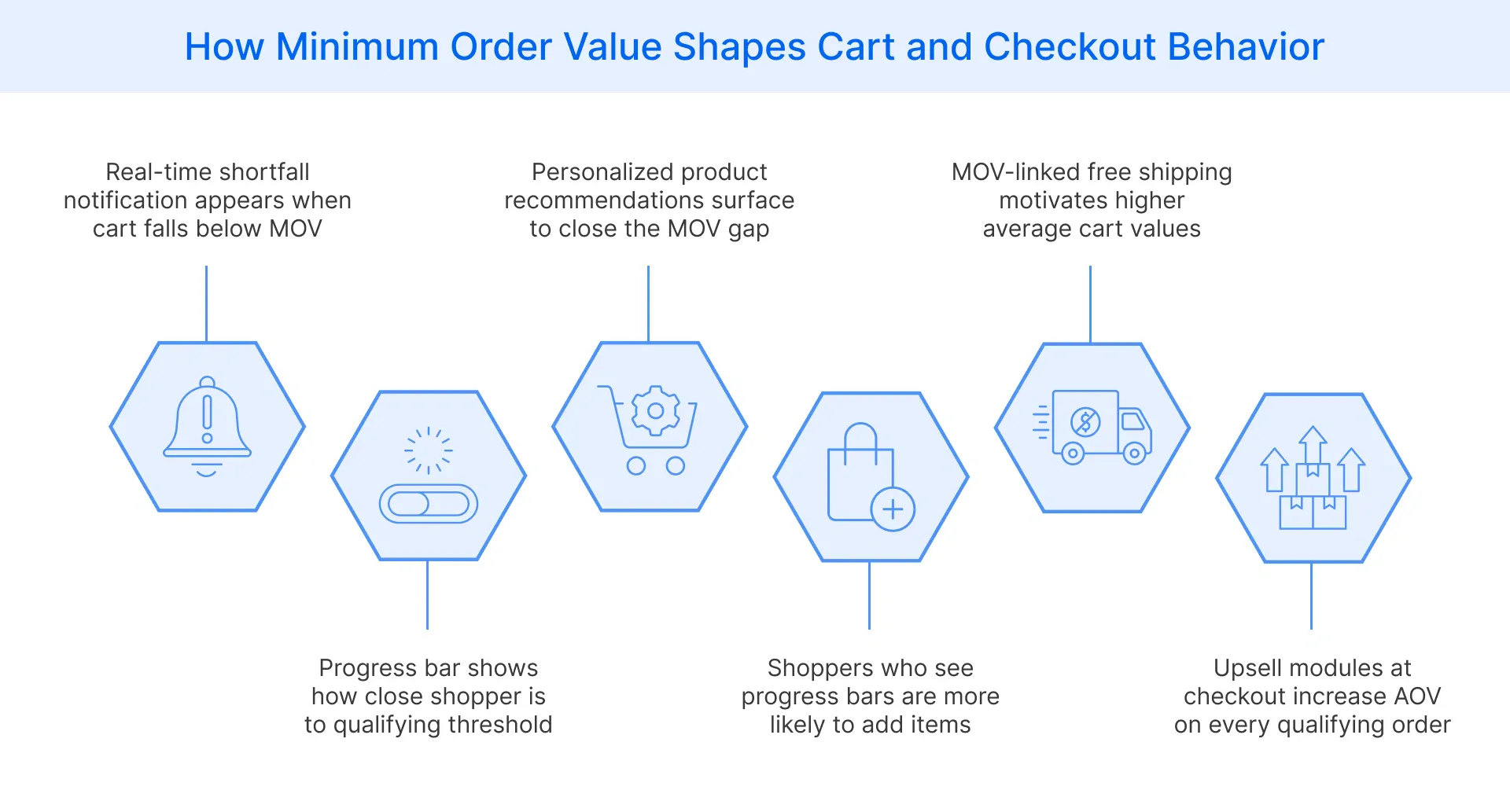
Minimum order value shapes how shoppers respond once their shopping cart total is checked against the threshold. When the cart falls short, checkout can show the exact gap before payment. This helps shoppers decide whether to add products or leave.
Retailers often use cart-stage recommendations to help shoppers reach the required minimum. These suggestions work best when they reflect browsing behavior or purchase history. Upselling feels more useful when the suggested item closes the gap without increasing spend too much.
A progress bar can show how close shoppers are to free shipping or another offer. This visual cue makes the benefit easier to understand than a static message. It also reduces friction when the remaining amount feels small enough to add.
Strong MOV communication can improve profitability and customer satisfaction together. Shoppers get clear guidance before payment, while retailers protect the economics of each order. The result is a checkout flow that feels transparent rather than restrictive.
Implement Minimum Order Value with Flipkart Commerce Cloud
Enforcing minimum order value across a high-volume e-commerce operation requires a technology platform that can apply conditional rules in real time, across multiple channels and customer segments without manual configuration for each scenario. Flipkart Commerce Cloud provides the infrastructure to set, manage and optimize MOV thresholds as part of a unified commerce strategy.
Our Promotion Management solution lets retailers configure MOV-based conditions for discounts, free shipping and promotional offers through one rules engine. Teams can set different thresholds by customer segment or product category, which helps control promotions without custom development.
Once the rule is active, our Cart and Checkout solution applies the MOV threshold before payment. Then FCC Personalization Engine surfaces relevant product suggestions when shoppers fall short, helping them reach the required minimum without making the checkout journey feel forced.
This creates a smoother path from cart review to order completion. Our analytical capabilities help teams monitor MOV performance, track AOV trends and adjust thresholds by channel or seasonality, so minimum order value supports both conversion and margin.
Book a demo to see how FCC Cloud helps you turn minimum order value into a consistent revenue growth tool.

FAQ
MOQ, or minimum order quantity, is the smallest number of units a buyer must purchase in a single order. MOV, or minimum order value, is the minimum spend amount required to complete or qualify for benefits on a transaction. MOQ is common in wholesale and manufacturing while MOV is standard practice in B2C e-commerce and online retail.
Retailers calculate the fulfillment cost per order including shipping, packaging and handling, then set the MOV above that figure to ensure profitability on every transaction. Historical average order value data, competitor benchmarking and channel-specific cart behavior inform the final threshold. Platforms like Shopify and Google Merchant Center allow retailers to configure MOV directly within their shipping settings.
Retailers facing high MOQs from suppliers can negotiate pooled orders with other buyers to distribute the minimum order quantity across multiple accounts. Alternatively, they can adjust their economic order quantity calculations and increase the product's price to account for higher per-unit inventory management costs. Working with distributors rather than manufacturers directly often reduces the minimum order threshold to a more commercially manageable level.