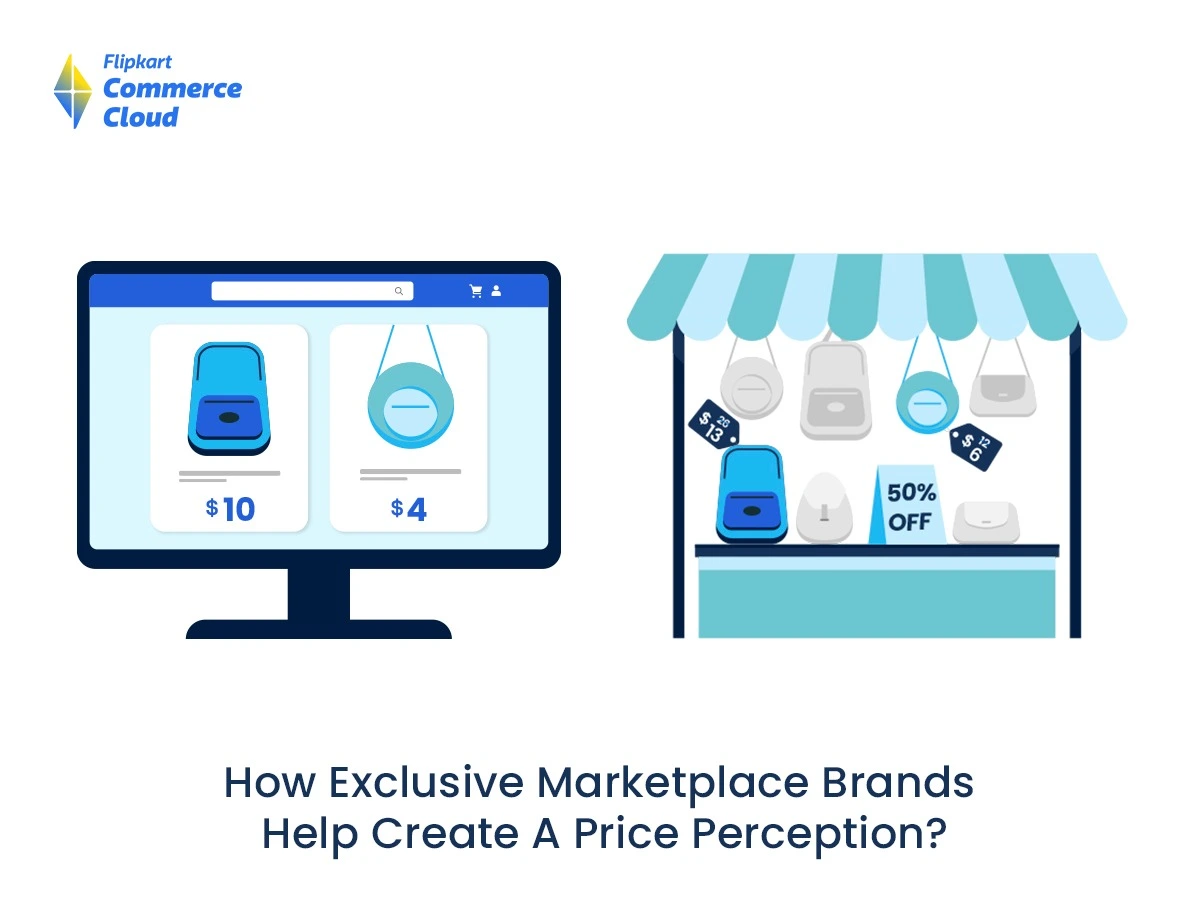
Everyone likes to feel they are getting good value, but “value” is not only about the lowest number on a price tag. Exclusive marketplace brands are often built as a private label brand or “own brand”. Own private label brand shapes how shoppers judge quality, fairness, and affordability within a marketplace, often influenced by consumer behavior. When a product is available only in one ecosystem, the marketplace and the seller gain much control over how that product is discovered, compared, promoted, and priced. This article explains what exclusive marketplace brands are, why they matter, and how they influence private label pricing and price perception, plus why they can become a great way to build brand loyalty through consistent value signals and a clear marketing strategy.
What Are Exclusive Marketplace Brands?
Exclusive marketplace brands are products that a seller agrees to offer on only one online marketplace rather than distributing the same items across multiple marketplaces. In many cases, these exclusives are a private label product, meaning the product is manufactured for a brand that owns the listing and customer experience, even if the brand does not own the factory, often working with private label manufacturers. Some exclusives can still be sold through the brand’s own website or physical stores, but they are restricted from listing on competing online marketplaces.
Exclusivity changes the competitive environment. With national brands, shoppers can easily compare the same item across retailers and marketplaces, which intensifies price competition. With exclusive marketplace items, comparisons become less direct. Shoppers may compare similar products within a category instead of matching the identical SKU elsewhere. That difference alone can influence perceived value, the “right” price point, and how large or small a price gap feels versus alternatives, including the lower price point gap shoppers expect between private label options and a comparable national brand.
Exclusivity can also help a marketplace curate a broader assortment of product categories without relying only on national vendors, giving the marketplace much control over discovery and presentation across a wide range of products. For sellers, it creates a clearer lane to build recognition, earn reviews, and develop repeat purchasing behavior without immediately competing against identical listings in multiple places, making exclusivity a great way to shape price comparison behavior and guide consumer behavior inside the platform.
Why Sellers Choose Exclusivity
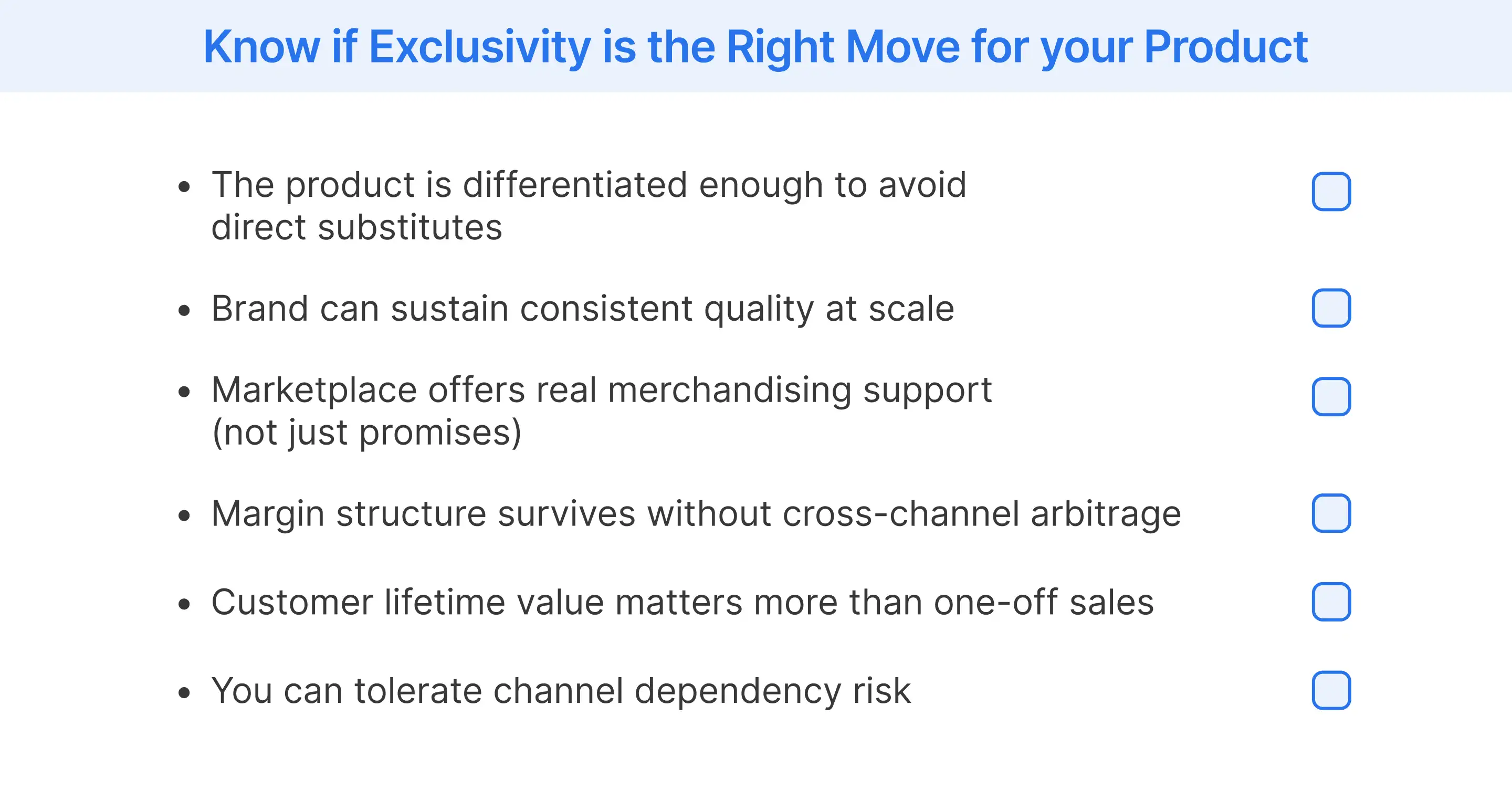
Exclusive arrangements appeal to sellers because they can simplify growth and improve differentiation, but they also bring trade-offs in dependency and reach. In practice, sellers choose exclusivity for various reasons tied to brand loyalty, discoverability, and long-term private label strategy.
1. Increased visibility and marketplace support.
A marketplace may provide stronger merchandising opportunities for exclusive items through search placements, recommendation modules, email programs, and deal pages. Because shoppers are less likely to find the same product elsewhere, they may spend more time exploring that brand’s catalog within the platform, which can lift private label sales over time.
2. Greater control over positioning.
Exclusivity allows tighter alignment between brand story, images, content, and on-page merchandising. When the brand controls the listing end-to-end, it can signal quality and value through product claims, comparison charts, bundles, and variants. This kind of control supports more deliberate private label brand pricing that matches the intended perception (premium, mid-tier, or value).
3. Potential for stronger profit economics.
When a seller is not forced into constant identical-SKU price matching across marketplaces, it may preserve profit margins and reduce the need for aggressive discounts that damage long-term willingness to pay. This does not guarantee profitability, but it creates more room to manage promotions intentionally and protect the bottom line.
4. Loyalty and repeat purchase potential.
Exclusive products can feel special or “found here only,” which can increase the likelihood of customers returning to the same marketplace. That effect is strongest when the product experience is consistent and quality is reliable, not merely when the item is hard to find elsewhere.
5. Operational and brand protection benefits.
Selling in a single marketplace can simplify monitoring for counterfeit listings, unauthorized resellers, and inconsistent detail pages. It can also streamline forecasting, fulfillment decisions, and coordination across the supply chain, especially if the marketplace offers strong logistics capabilities.
A commonly cited example in fashion is the way large marketplaces and platforms incubate in-house labels that cover different styles and budgets. In India, Myntra is often discussed as a platform where homegrown labels support a broad positioning across affordability and trend relevance, which can reinforce price expectations within the app rather than forcing shoppers to compare identical SKUs across multiple channels.
Understanding Price Perception in Retail
Price perception is the way shoppers feel about a price relative to what they expect, what they have seen before, and what they believe the product is worth. It is not the same as the actual numeric price. Two products can have identical prices while creating very different reactions depending on brand trust, reviews, imagery, and the surrounding set of alternatives.
Shoppers build “reference prices” from memory and context. If a marketplace consistently highlights deals, fast shipping, and strong selection, customers may assume it has good prices even when some items are not the cheapest available on the internet. That is why retailers invest heavily in signals that communicate value, badges, comparison messaging, bundles, and clear delivery promises.
This is where private label pricing becomes especially influential. Private labels often compete on value relative to national brands, but value can be communicated through more than a low number. A well-designed private label can justify a higher price than expected if it convincingly signals better materials, better design, or better customer outcomes.
How Comparison Context Shapes Price Perception
|
Shopper behavior |
National brand context |
Exclusive brand context |
|
How price is judged |
Compared across sites |
Compared within category |
|
Reference anchor |
Lowest price found online |
Marketplace price ladder |
|
Sensitivity to small gaps |
Very high |
Moderate |
|
Trust driver |
Brand reputation |
Platform + reviews |
|
Willingness to trade down |
Low |
Higher |
How Do Exclusive Marketplace Brands Influence Price Perception?
Exclusive marketplace brands shape price perception by changing what shoppers can compare, how they interpret quality cues, and how pricing appears across the platform. The marketplace context becomes part of the product’s perceived value.
1. They reduce direct cross-site price matching. When shoppers cannot find the exact item elsewhere, they typically compare within-category substitutes rather than identical products. That makes competitor pricing less of a direct anchor and gives the seller more flexibility in managing price changes without triggering immediate “this is cheaper somewhere else” behavior.
2. They create clearer value ladders within a category. Marketplaces often present assortments as a spectrum: entry-level, mid-tier, and premium. Exclusive brands can be positioned deliberately to fill the “right brand gap,” such as offering comparable features at a slightly lower price point than national brands. When this ladder is consistent, customers perceive pricing as reasonable because the platform feels structured and predictable.
3. They use quality signals to justify the price. Exclusive brands can strengthen perceived quality through tighter quality control, consistent packaging, better listings, and clearer warranties or support. When execution is strong, customers may accept a smaller price advantage versus national brands because the “risk” feels lower.
4. They enable faster, more contextual pricing adjustments. Some marketplaces and sellers use forms of dynamic pricing to respond to demand, inventory, and broader market conditions. While dynamic pricing can improve revenue, it should be governed carefully; frequent or erratic changes can reduce trust and make customers feel pricing is arbitrary. The goal is not constant change, but changes that are explainable (seasonality, limited-time deals, stock constraints) and consistent with the brand promise.
5. They link promotions to perceived savings. Exclusives benefit from on-site merchandising levers (deal placements, coupons, bundles). However, overusing discounts can train shoppers to wait and can weaken perceived quality. Disciplined promotional strategy and management that uses selective private label promotions, rather than perpetual markdowns, tends to create stronger long-term price perception.
Inside Factors Influencing Private-Label Brand Pricing Perception
Several factors consistently determine whether shoppers view a private label as “cheap,” “good value,” or “worth paying for.” These drivers matter even more for exclusives because the marketplace itself becomes the main context for evaluation.
Quality and consistency.
Shoppers often assume a higher price implies higher quality, but they will reverse that belief quickly if they encounter durability problems, sizing inconsistencies, or recurring quality issues. For a private label, consistent quality is one of the most reliable ways to protect price perception over time.
Category expectations.
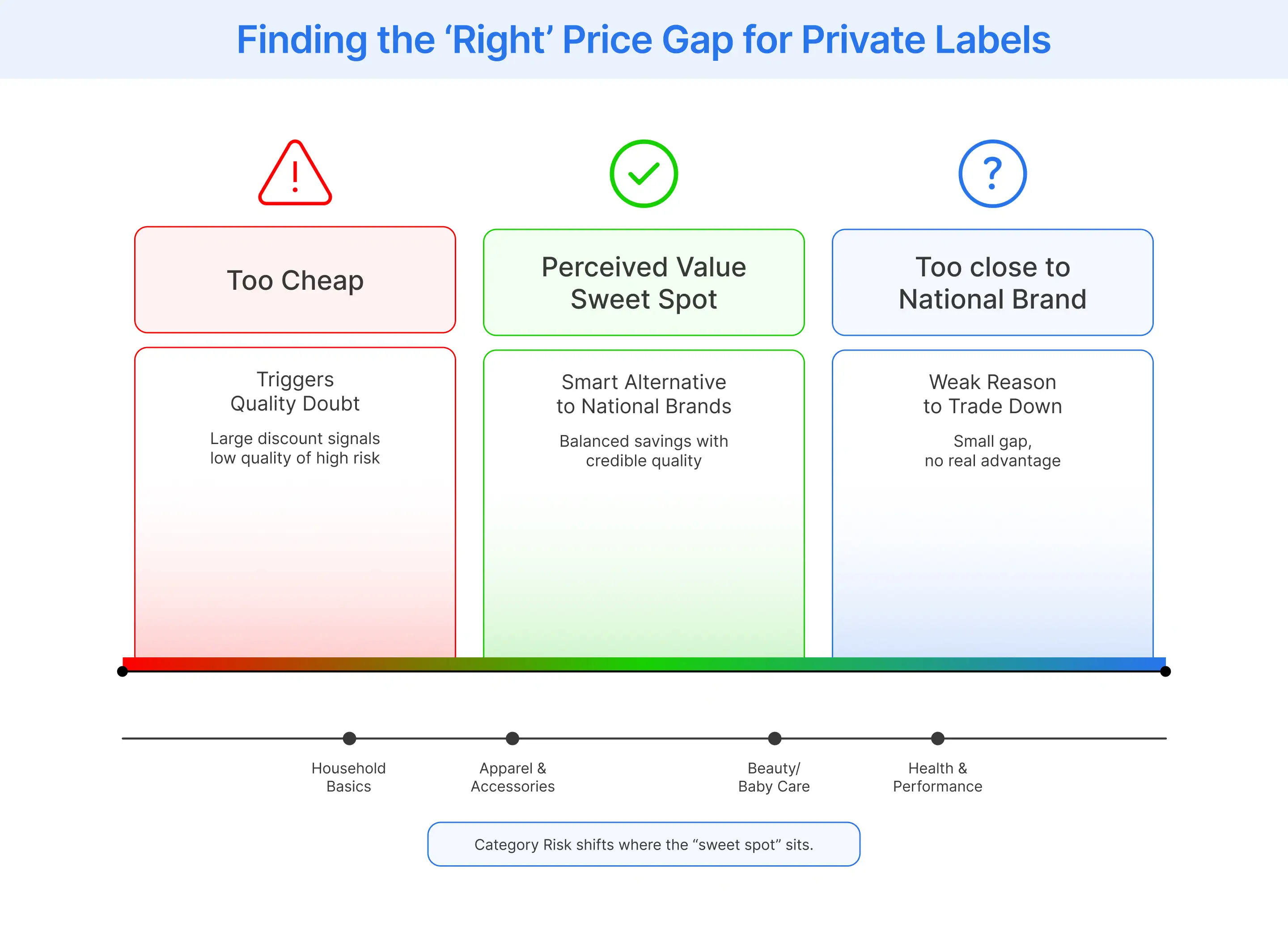
Price sensitivity differs by category. In some product categories (basic household items), customers expect a larger discount versus national brands. In others (skin care, baby products, performance gear), trust and performance may matter more than the lowest price. Effective private label pricing reflects how customers evaluate risk and reward within that category.
The size and visibility of the price gap.
A small price gap can be enough when the private label offers comparable quality and better convenience, but a narrow gap without a clear benefit can make the private label feel “not worth it.” Conversely, an extremely large gap can raise suspicion about quality. The perceived “right” gap is tied to brand trust and the shopper’s reference points.
Promotion discipline.
Deep discounts can drive short-term volume, but they can also reset reference prices downward. If customers routinely see 40–60% off, they may treat the discounted number as the “real” price and view the full price as inflated. Thoughtful promotion pacing preserves credibility.
Broader market conditions.
Inflation, shipping constraints, and supply variability affect what shoppers expect. When costs rise due to the supply chain, transparent messaging and stable price architecture can preserve trust better than frequent unexplained spikes.
How to Build a Sustainable Private Label Pricing Strategy
A strong pricing plan for exclusives balances customer value with profitability and long-term brand trust. The goal is not simply to undercut national brands, but to create a pricing system that supports your business goals and avoids eroding perceived quality.
-
Start with business objectives, not just competitor benchmarks: A practical private label pricing strategy should specify what success looks like: expanding market share, hitting contribution targets, funding innovation, or building a repeat-purchase base. Without clear objectives, pricing becomes reactive and promotion-heavy.
-
Design a coherent price architecture across the catalog: If you sell a wide range of items, build a ladder that makes sense: entry products, hero products, and premium options. This gives customers “anchors” and reduces confusion. It also makes it easier to introduce new items without disrupting perception.
-
Use competitor pricing intelligently: Even exclusives are compared to alternatives. Track the realistic substitutes customers consider, not just the closest-looking SKU. Use competitor benchmarks to validate your ladder, but avoid mirroring competitors so closely that you lose differentiation.
-
Plan promotions with profitability visibility: Promotions should have a strategic purpose: acquisition, trial, basket-building, or seasonal clearance. To avoid margin leakage, evaluate the true profitability of each promotion, including ad spend, fulfillment costs, and returns. If you rely on markdowns, create clear markdown plans so discounts do not feel random or permanent.
-
Avoid extreme swings in pricing: Small, justified adjustments are easier for customers to accept than sudden changes. If you must raise prices due to costs, do it in a way that fits the brand story and category norms. When price increases are paired with improved packaging, features, or reliability, they are often perceived as fairer.
-
Protect trust through quality control and customer experience: Pricing cannot compensate for poor execution. Reliable fulfillment, accurate product content, and consistent build quality reduce perceived risk and support a stronger willingness to pay.
Also read: What Is Pricing Intelligence & Its Importance In Retail
FCC Turns Price Perception Into a Scalable Advantage
Exclusive marketplace brands succeed or fail on how well pricing, assortment, and execution stay aligned with shopper expectations. When private labels are priced thoughtfully, supported by consistent quality, and positioned within a clear value ladder, they shape price perception in ways that national brands often can’t match.
Flipkart Commerce Cloud pricing solution for online retail omnichannel & brands gives retailers the tooling to operationalize this, helping you manage pricing, promotions, and performance insights in one place, so you can make faster decisions with clearer promotional performance results. Instead of relying on traditional merchant methods or fragmented tools, teams can respond to consumer demand change, test optimal brand gap structures, and maintain promotional control without eroding trust or margins.
For retailers exploring new private label opportunities or looking to strengthen existing own-brand portfolios, the advantage comes from systems that support experimentation, consistency, and scale, without forcing constant discounting or reactive pricing.
Book a demo for more controlled, measurable private label pricing and promotions.
FAQ
“Private labels” are products that are owned or controlled by a retailer or marketplace and sold under their own brand, often positioned as value-for-money alternatives to national brands. In online marketplaces, these can also be exclusive marketplace brands that only appear on one platform, giving retailers more control over pricing, margins, and assortments; pricing and assortment engines like Flipkart Commerce Cloud can help manage these at scale using first-party data.
Best practices for optimizing private label pricing include defining the role of each product (traffic driver, margin driver, premium tier), benchmarking against national and competing private labels, and regularly testing price points to understand elasticity. Retailers often segment customers, track price perception, and adjust prices by channel or region; platforms like Flipkart Commerce Cloud can support this by automating A/B tests and price recommendations based on real-time marketplace signals.
The latest trends in private label pricing strategies include dynamic and algorithmic pricing, sharper “good–better–best” price ladders, and more granular differentiation by region, device, and customer segment. Retailers are also using richer first-party data and retail media insights to align private label prices with promotions and ad spend, something solutions like Flipkart Commerce Cloud are designed to streamline.
The cost to launch a private label product typically includes product development, sourcing, packaging, quality checks, compliance, listing, content creation, and initial marketing, and can range from relatively modest for simple categories to substantial investments for complex or regulated ones. Retailers often model these launch costs against expected margins and price positioning upfront, using demand forecasts and marketplace analytics to avoid over-investing in low-potential SKUs.
To analyze private label pricing performance, retailers track sales volume, revenue, margins, share of category, price elasticity, and how price changes affect both their own and competing brands. It’s also useful to monitor search, conversion, and basket metrics alongside price; analytics platforms such as Flipkart Commerce Cloud can combine these signals so teams can quickly see which prices are driving profitable growth and which need correction.
Private label prices typically sit below comparable national brand prices, often by 10–30%, to signal value while still offering attractive margins to the retailer. In some premium tiers, private labels may price closer to or even at parity with national brands, but they still rely on a perception of smart value rather than prestige or heavy branding.
Retailers use strategic optimization to improve private label pricing by continuously adjusting prices based on competitor moves, demand patterns, and customer segments instead of setting them once and leaving them static. By leveraging tools like Flipkart Commerce Cloud for automated repricing, promotion planning, and scenario modeling, they can keep private label offers competitive while protecting margins and category health.
Key steps for an effective private label pricing strategy include defining brand positioning, mapping the competitive set, setting clear margin targets, testing initial price points, and then refining prices using ongoing data. Retailers also build a structured price ladder across entry, mid, and premium tiers, and may rely on platforms such as Flipkart Commerce Cloud to operationalize these rules across thousands of SKUs and categories.
In the context of private-label products, “price perception” refers to how customers feel about the price, whether they see it as cheap, fair, or overpriced, rather than the exact number itself. For private labels, strong price perception usually means shoppers believe they’re getting similar quality to national brands at a smarter, more economical price, which can drive loyalty and repeat purchases.
Yes, private-label price perception can vary significantly by age, income, and location, because different demographic groups weigh risk, brand trust, and savings differently. Younger or more value-conscious shoppers might view private labels as smart bargains, while some higher-income or older groups may still be more cautious, especially in categories where brand heritage matters.
Some consumers still prefer national brands over private labels at similar price points because they associate national brands with higher or more consistent quality, stronger warranties, social proof, and long-standing trust. In categories like health, baby care, or premium beauty, this perceived risk reduction can outweigh any modest price advantage that private labels might offer.
To ensure positive price perception, retailers typically price private-label items slightly below comparable national brands, while clearly communicating quality, benefits, and guarantees. Transparent promotions, smart bundling, and clear on-page comparisons can help shoppers see private labels as the “savvy choice,” and tools like Flipkart Commerce Cloud can coordinate pricing with retail media campaigns to reinforce that message.
Packaging, design, and presentation are very important in shaping private-label price perception because they signal quality and value before the shopper ever tries the product. Clean, modern design, clear claims, and consistent branding can help private labels look as trustworthy as national brands, supporting slightly higher price points and better margins.
In developed markets, private-label perception has shifted toward quality and value, with many shoppers seeing them as credible alternatives or even premium options in some categories. In many emerging markets, private labels can still be perceived primarily as low-cost choices, though improved product quality and better branding are gradually closing the gap with national brands.
Pricing private-label items starts with defining their role in the assortment, benchmarking against national brands and other private labels, and deciding on a target price gap that balances value perception with margin. From there, retailers monitor performance and iteratively refine price points often with the help of data-driven solutions like Flipkart Commerce Cloud to respond to competition, demand shifts, and promotion cycles.
More Blogs
See how retailers and brands are winning with FCC
Everything About Price Skimming Strategy Explained
Read More
What is a High-Low Pricing Strategy?
Read More
Ultimate Guide To Dynamic Pricing Strategy In 2026
Read More
Retail Pricing Strategies: Winning with Promotion Pricing in Competitive Markets
Read More
Ad Tags: Enhancing Ad Serving Efficiency in Large-Scale Campaigns
Read More