1. Fashion retail with FCC's Pricing Manager
How Flipkart Commerce Cloud’s Pricing Manager combines Dynamic Pricing with AI/ML for enhanced margins
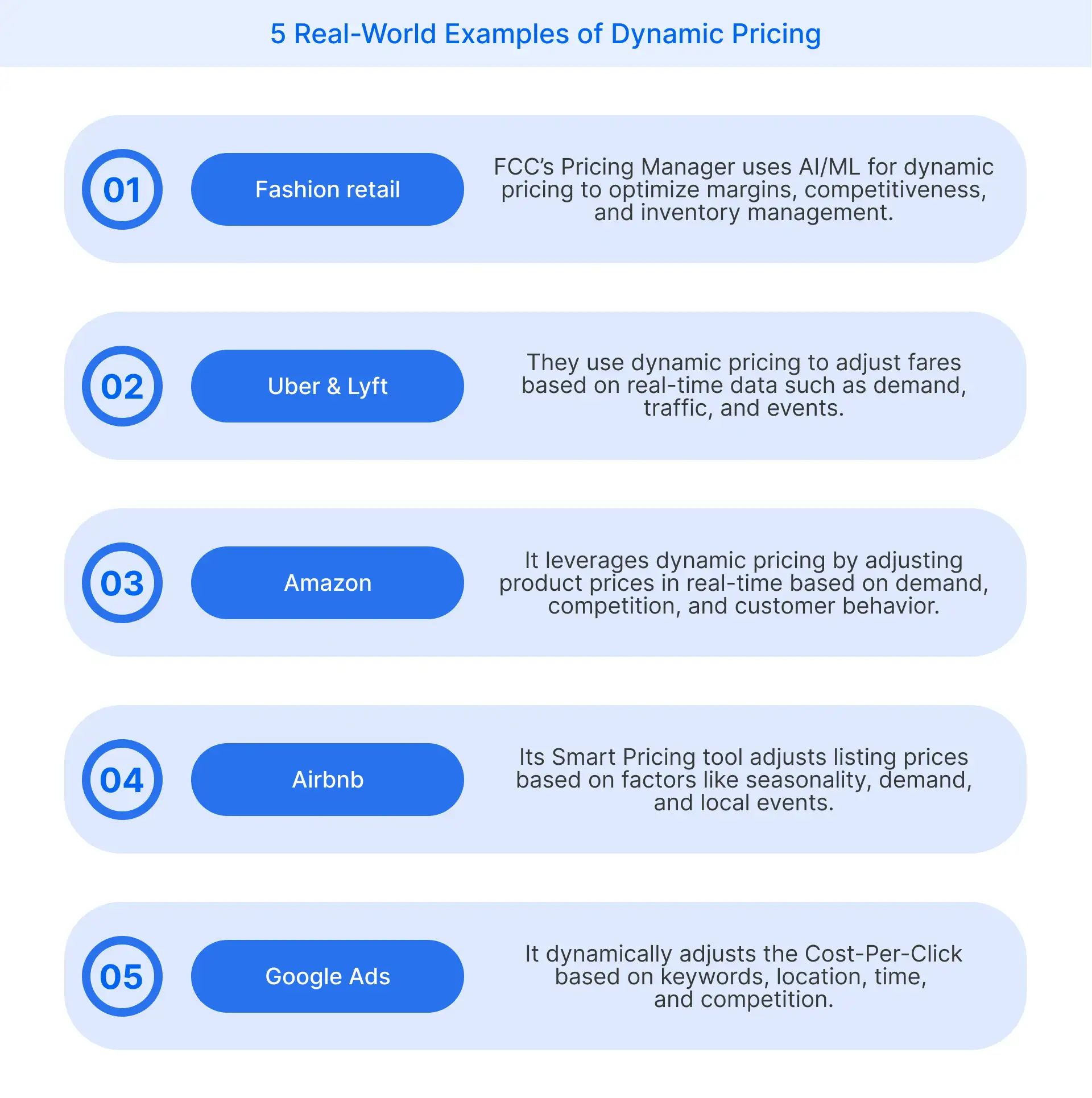
As a robust retail media platform, Flipkart Commerce Cloud (FCC) has been at the forefront of helping online retailers improve pricing performance. Flipkart Commerce Cloud’s Pricing Manager combines dynamic pricing with AI/ML for enhanced margins. Leveraging AI and machine learning within its Pricing Manager, FCC implemented a successful dynamic pricing strategy for a client in the fast-growing fashion accessories category. Previously, the client struggled to maintain competitive pricing against the aggressive pricing and promotional strategies of their competitors. Moreover, they were finding it difficult to manually track the SKUs for cost and inventory changes, as well as competitive pricing.
To meet its commercial objective of improving margins while staying competitive, the brand adopted FCC’s Pricing Manager. The solution employed rule-based and predictive pricing strategies, adjusting prices in line with market conditions, competitor behavior, and internal thresholds, including minimum price limits.
By combining automated pricing rules with human-in-the-loop oversight, the brand strengthened its existing pricing practices. The result was a 30% margin improvement and a 500 bps increase in competitiveness, achieved without disrupting topline growth. This use case is a great example of how structured dynamic pricing systems can outperform manual pricing approaches. You can check out the complete case study here.
2. Ride-sharing platforms like Uber & Lyft
Uber and Lyft have achieved large-scale adoption by relying on dynamic pricing algorithms to manage supply and demand.
These platforms analyze real-time data to determine fares based on:
- Time and distance
- Predicted route
- Estimated traffic
- Peak hours
- Current rider-to-driver demand
- Seasonal holidays and major events
Uber's dynamic pricing algorithm leverages machine learning to factor in weather conditions, historical demand patterns, and real-time traffic data. This enables the platform to encourage more drivers to operate during high-demand periods while maintaining service availability.
Surge pricing helps address capacity constraints by increasing fares temporarily. Uber applies a multiplier model, where a higher multiplier leads to a higher fare, while Lyft uses a percentage-based increase. Although there are cons of surge pricing, including customer sensitivity to price jumps, these models remain effective for balancing demand across public transportation alternatives and private mobility services.
3. Amazon
Amazon is one of the most cited Dynamic Pricing Examples in eCommerce. The company adjusts prices frequently based on demand trends, competitor pricing, inventory availability, and customer behavior. This approach has played a major role in maintaining its competitive edge.
On average, Amazon changes prices millions of times per day, allowing it to offer a lower price when demand softens and raise prices when demand strengthens. Rather than relying on penetration pricing alone, Amazon uses dynamic pricing strategy to protect margins while remaining attractive to customers.
By continuously analyzing buying behavior, profit margins, and supply constraints, Amazon demonstrates how dynamic pricing can outperform static pricing in high-volume online retail.
4. Airbnb
Airbnb operates across the hotel industry and short-term rental market, offering hosts an automated dynamic pricing tool known as Smart Pricing. This tool helps hosts adjust listing prices in response to demand fluctuations while remaining competitive.
Hosts can define a minimum price and a maximum range, ensuring profitability even during low demand periods. Airbnb reports that hosts who price within 5% of its recommendations are significantly more likely to secure bookings.
To recommend optimal prices, Airbnb evaluates factors such as:
- Seasonality
- Supply and demand
- Day of the week
- Special events and festivals
- Booking lead time
- Historical listing performance
- Competitor occupancy and pricing
- Review volume and quality
This model shows how dynamic pricing strategies can be applied effectively to bnbs and individual property owners through a simple app-based interface.
5. Google Ads
Google leverages dynamic pricing to optimize the prices of its Google Ads. Its sophisticated algorithms consider multiple factors to determine the Cost-Per-Click (CPC) for each ad placement. This complexity ensures that advertisers and end-users get maximum value from the interaction. The following factors are taken into consideration while deciding the dynamic price range: Google uses dynamic pricing to determine the cost-per-click (CPC) for ads displayed across its network. Prices fluctuate based on auction dynamics and advertiser competition.
Key factors influencing CPC include:
- Keywords: High-demand keywords have a higher cost, driven by the principle of supply and demand.
- Location: Businesses that target heavily populated areas often encounter more competition, which results in higher costs.
- Time: Ad costs can vary based on the time of day, week, or even season, year-end holidays.
- Audience: Advertisers can target specific audiences based on age, gender, region, and interests. Highly targeted audiences result in a higher CPC.
- Quality Score: Google's Quality Score includes relevance and quality along with the bid amount. A high-quality score ad may spend less than competitors while still achieving higher placement.
- Competition: Ad space rates rise as competition increases.
This system reflects value-based price discrimination, where advertisers pay based on perceived opportunity rather than a fixed rate.
Also read: Dynamic Pricing Advantages and Disadvantages
6. Airline Industry
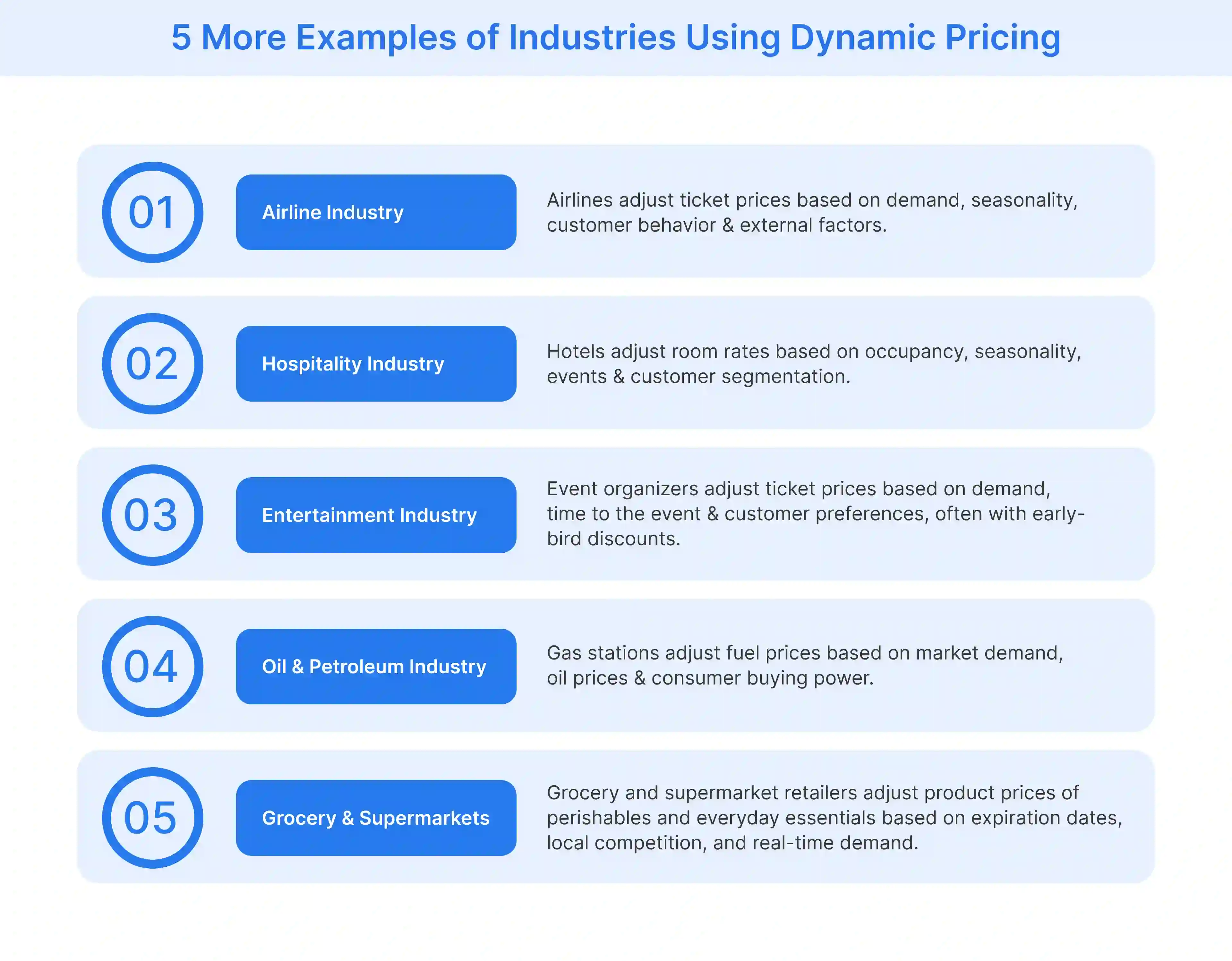
Airlines often adjust ticket prices based on various factors, including demand, seasonality, flight time, customer booking patterns, competitor prices, weather and popular events, availability, and seasonal peaks. They also consider external factors such as fuel price fluctuations to set competitive fares for their customers.
Today, airlines increasingly turn to context pricing to maximize their profits with dynamic pricing. This involves personalizing prices based on browsing history, purchase patterns, the type of device used for booking, and peak/off-peak travel times. Airline service providers also leverage customer segmentation to separate leisure from business users. Business travelers are more likely to book last-minute flights, so airlines often use behavioral data to motivate customers with bargaining opportunities.
7. Hospitality Industry
Dynamic pricing has become a norm for the hospitality industry, as customers of platforms like Airbnb have grown accustomed to regular rate changes. During peak periods, hotels increase their rates to capitalize on high demand, while during slower periods, they lower their prices to attract more guests.
They use internal factors such as current and past reservations, occupancy and cancellations, booking behavior, daily rates, room types, and external factors like time of booking, seasonality, local events, competitor pricing, and even weather forecasts to decide room rates. The industry also leverages personalization to maximize margins, such as segmenting customers into business and leisure travelers. This helps them tailor the price as business travelers are more likely to accept higher price points.
8. Entertainment Industry
Demand pricing is becoming increasingly popular in the entertainment industry due to its ability to adjust prices based on seasonality and demand. Event organizers often use a combination of supply, demand, and time variables to determine ticket prices. Generally, the closer it is to an event, the higher the price rises. Early-bird tickets are usually the most cost-effective option for buyers.
Companies can leverage more advanced algorithms to adjust ticket prices based on real-time demand. Incorporating customer data like location and preferences can fuel sales by offering value-based pricing. In addition, targeting the most dedicated fans with value-based pricing can help increase sales without compromising purchase probability.
9. Oil and Petroleum Industry
The oil industry is another brilliant example of an industry using dynamic pricing. Factors such as the popularity of a gas station, oil prices, and consumer buying power influence how much a customer will pay for fuel. This makes it difficult to predict the fuel cost on any given day, as prices are constantly shifting to match demand and adequately accommodate the market's needs.
10. Grocery and Supermarket
Grocery retailers are increasingly turning to dynamic pricing to manage perishable inventory and respond to shifting demand throughout the day. Unlike airlines or ride-sharing, where prices often rise with demand, grocery dynamic pricing frequently works in reverse, reducing prices on perishables like produce, bakery items, and meat as their sell-by dates approach to minimize waste and recover margin that would otherwise be lost.
Supermarkets use electronic shelf labels (ESLs) connected to centralized pricing engines, allowing prices to update instantly across hundreds of stores without manual relabeling.
Key factors influencing grocery dynamic pricing examples include:
- Expiration and sell-by dates
- Local competitor pricing
- Store-level supply and demand
- Weather (e.g., surging prices on umbrellas or bottled water during storms)
- Time of day (discounts on bakery items in the evening)
- Regional purchasing power and foot traffic
The grocery and supermarket shows how dynamic pricing isn't only about maximizing revenue during high demand; it's equally effective as a margin-protection and waste-reduction tool in low-margin, high-volume retail environments.

Don't lose out on profit: Start using dynamic pricing with FCC
Flipkart Commerce Cloud (FCC) transforms retail business with its revolutionary Dynamic Pricing Engine. Powered by cutting-edge machine learning technology and a proprietary game-theory-based algorithm, our advanced dynamic pricing engine gives retailers more control over their pricing strategies by allowing them to craft personalized models and set their own rules and guidelines.
The user-friendly dashboards and insightful analytics reports are easy to use and can be scaled to an unlimited number of products and categories, which allows businesses to continuously evaluate pricing performance and make strategic refinements.
With the FCC’s Dynamic Pricing Engine, businesses are poised to increase sales by staying agile and responsive in an ever-changing marketplace.
Some of the key features of FCC’s dynamic engine are:
- Highly customizable rule engine: Our highly customizable rule engine offers a tailored pricing strategy based on specific business targets and guidelines. This makes it easy to manage many categories and thousands of SKUs without sacrificing efficiency.
- Scalability: FCC algorithm is designed to handle large volumes and has been tested across millions of SKUs and hundreds of categories, ensuring scalability and trust.
- Output simulator: With this feature, you can simulate various possibilities and ensure that your decisions are well-informed and will result in the best possible results.
- Volume and value filtration: With volume and value filtration, our engine can sift through large amounts of data to identify the most valuable categories and products. Coupled with FCC's other solutions, businesses can have an up-to-date strategy based on market trends, competition, and supply and demand.
By replacing static pricing with adaptive models, FCC helps businesses stay responsive in competitive markets.
Schedule a call with our pricing expert to know more!