
December 19, 2025
Direct-to-Consumer Ecommerce: What is It and How It Works?
D2C ecommerce is a business model where manufacturers sell directly to the end consumer without intermediaries. It allows brands to control the entire customer journey and retain higher profit margins.
Drishti, Manager - Digital Marketing

Table of Contents
- D2C ecommerce: What is it and how it works
- What is Direct-to-Consumer (DTC) Ecommerce?
- DTC vs. Traditional Retail vs. Marketplaces: What’s the Difference?
- What are the benefits of pivoting to D2C?
- Challenges of D2C
- Key Trends Shaping DTC in 2026
- Success Stories
- Enterprise DTC with Flipkart Commerce Cloud
Direct-to-Consumer Ecommerce: What is It and How It Works?
For decades, the retail playbook was rigid, with manufacturers producing goods while wholesalers distributed them. The rigid structure of this traditional model meant D2C ecommerce was non-existent, and brands had zero direct connection with the final buyer. Traditional retail relied heavily on third parties.
The digital age has collapsed those walls and changed how people shop forever. Now, innovative brands bypass the middleman to reclaim their relationship with the consumer. This shift toward direct-to-consumer ecommerce demands a new strategic approach to selling in the modern economy.
- It transforms the supply chain by allowing brands to sell products directly to the end user.
- This model gives manufacturers complete ownership of their customer data and full control over the brand narrative.
- Retailers adopt this strategy to increase their profit margins by eliminating the costs associated with wholesale distribution.
- It enables rapid testing of new products through direct feedback loops that traditional retail channels cannot match.
What is Direct-to-Consumer (DTC) Ecommerce?
Direct-to-Consumer Ecommerce is a retail business model in which a brand sells its products directly to end consumers. This process occurs through its own digital channels or physical locations. It completely bypasses third-party wholesalers, traditional retailers, and online marketplaces to establish a direct line of communication with the buyer.
In a traditional retail model, a brand might sacrifice nearly half of its margin to distributors in exchange for distribution. In the D2C ecommerce model, the brand retains full control over the profit margins and the valuable customer data. It also manages the entire brand identity experience without outside interference.

DTC vs. Traditional Retail vs. Marketplaces: What’s the Difference?
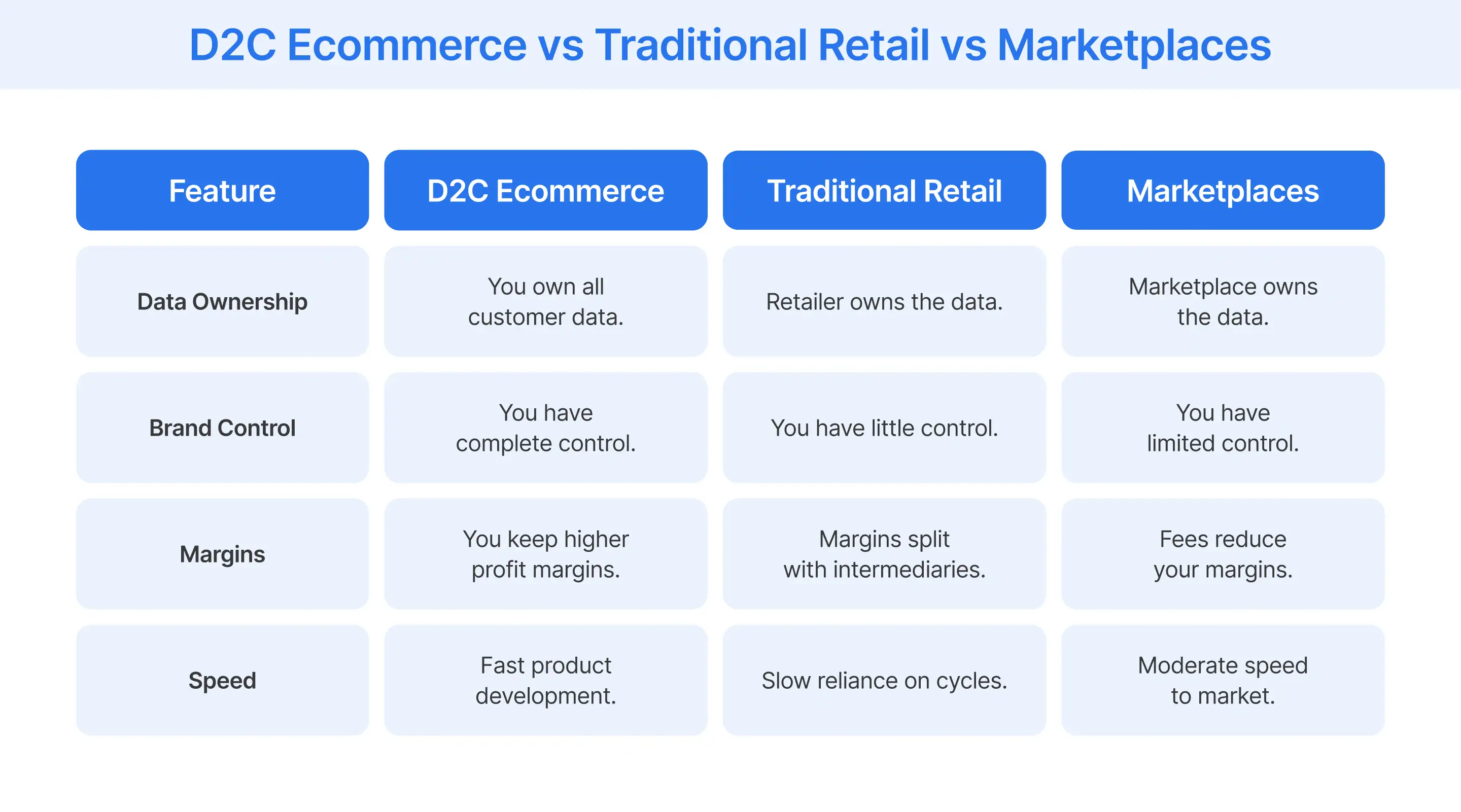
Understanding the nuances between these models is vital for planning your distribution strategy effectively. While traditional retailers own the relationship, direct models offer autonomy. Marketplaces provide traffic but often strip away your brand identity. Here is how they compare across key metrics.
What are the Benefits of Pivoting to D2C Ecommerce?
Shifting to the direct-to-consumer ecommerce model offers distinct advantages that help you grow sustainably in a competitive market.
- Ownership of First-Party Data: You gain direct access to granular insights regarding purchasing habits and browsing behavior. This ownership of first-party customer data allows for precise segmentation. It enables personalized marketing efforts that traditional retail channels simply cannot provide to manufacturers effectively.
- Control Over the Brand Narrative: You maintain brand control over how your story is told across all sales channels. This consistency ensures the brand identity remains strong. It prevents dilution from conflicting retailer promotions or poor placement on third-party online retailers' sites.
- Agility and Speed to Market: You can launch new products and test fresh concepts rapidly based on real-time customer feedback. This agility enables faster product development cycles than waiting for retail giants to approve shelf space for your innovative goods.
What are the Challenges of D2C Ecommerce?
While the rewards are high, you must navigate significant operational hurdles to succeed under the D2C ecommerce model.
- Rising Customer Acquisition Costs (CAC): Relying solely on paid ads has become expensive due to saturation on social media platforms. You must diversify your marketing strategy to keep customer acquisition costs sustainable as you scale your D2C customer base.
- Logistics & Fulfillment Complexity: You become responsible for every step of the order fulfillment process from warehousing to shipping. Managing this requires robust inventory management systems to ensure fast delivery. You must avoid expensive shipping errors that damage customer satisfaction.
- The ‘Operations’ Gap: You need to bridge the gap between marketing promises and actual operational execution capabilities. Failing to align your ecommerce website performance with supply chain management results in a poor shopping experience and lost ecommerce sales.
What are the Key Trends Shaping D2C Ecommerce in 2026?
Staying ahead in the direct-to-consumer ecommerce required you to adapt to evolving consumer behaviors and technological advancements in the sector.
- Omnichannel is the New DTC: Pure players are opening mortar stores to create a seamless shopping experience across all touchpoints. This omnichannel approach ensures you meet customers wherever they prefer to shop. It maximizes DTC sales opportunities by integrating physical and digital worlds.
- Community Over Commodity: Successful brands focus on building deep customer relationships rather than just pushing transactions. You create loyalty by fostering a sense of belonging through exclusive content. Direct engagement on social media channels helps retain users for the long term.
- Subscription Models: Implementing a subscription service generates recurring revenue and increases customer lifetime value significantly. This strategy turns one-time buyers into a loyal customer base. It provides a predictable cash flow for your business plan growth and ensures financial stability.
Real-World Success Stories of D2C Ecommerce
Examining the strategies of market leaders reveals actionable insights for executing your own direct-to-consumer ecommerce pivot effectively.
- Nike: They aggressively shifted focus from wholesale partners to their own ecosystem to boost profit margins. This strategic move enabled them to own customer data and deliver a superior digital experience through their ecommerce store. Their ability to connect directly with athletes has set a new standard for legacy brands.
- Warby Parker: They disrupted the eyewear industry by offering home try-ons and bypassing expensive retail middlemen entirely. Their approach proved that selling complex products online is viable with the right customer support. Transparency about product details helped them build trust and a loyal following without initially relying on physical showrooms.
- Dollar Shave Club: This brand changed the grooming sector by using a subscription model to disrupt retail giants. They focused heavily on humorous video content to build brand awareness. They acquired customers at scale through digital marketing and proved that a simple value proposition can topple established market leaders.
- Glossier: They built a massive empire by listening to customer feedback on their blog before launching products. This community-first strategy ensured high demand for new products immediately upon release. They succeeded without traditional advertising or retail partners by leveraging authentic user-generated content and strong engagement.
Enterprise DTC with Flipkart Commerce Cloud
Scaling a Direct-to-Consumer channel demands more than just a website; it requires a robust ecosystem. Flipkart Commerce Cloud brings the battle-tested intelligence and infrastructure of India’s leading e-commerce giant directly to your brand to solve complex scaling challenges.
- Intelligence: We enable you to leverage AI-driven insights trained on millions of real transactions. Our tools predict demand accurately and personalize user journeys, optimizing your digital marketing spend for maximum impact on market trends and user behavior.
- Reliability: You gain access to an enterprise-grade tech stack designed to handle massive traffic spikes without downtime. We ensure your ecommerce platform remains stable during peak sales events, preventing lost revenue and protecting your brand reputation effectively.
- Fulfillment: We provide access to advanced supply chain management technologies that optimize inventory placement. This speeds up delivery times and ensures reliable order fulfillment, helping you navigate changing market conditions without facing operational bottlenecks or expensive errors.
Do not just build a store; build an intelligent retail engine that drives sustainable growth. Partner with us to gain distinct control over your scale, profitability, and customer satisfaction in the competitive market. The future of retail is intelligent.
FAQ
D2C ecommerce is a specific subset of B2C where the manufacturer sells without intermediaries involved. Standard B2C often involves retailers selling goods they did not produce to the end consumer. D2C implies direct access to the buyer through owned channels.
No, this retail business model is effective for startups and large enterprises alike in the current market. Small businesses use it to enter new markets with lower barriers to entry and cost than building traditional stores or physical locations requires.
Brands either manage logistics in-house or partner with third parties for efficiency and speed. You must prioritize fast shipping and clear communication to maintain high customer experience standards. Efficient returns are vital for maintaining a strong brand and customer trust.
Yes, many companies employ a hybrid strategy to maximize their total market reach effectively. You can sell through your site for higher profit margins while using traditional retail for volume. This broadens brand awareness across diverse consumer segments.