
November 21, 2025
Gross Merchandise Volume
Gross Merchandise Volume (GMV) represents the total monetary value of all goods or services sold through a marketplace or e-commerce platform during a specific period. It is a key metric used to measure the overall scale and growth of a digital marketplace.
Drishti, Manager - Digital Marketing

Table of Contents
- What Is Gross Merchandise Value?
- How Do You Calculate Gross Merchandise Value?
- Why Is Gross Merchandise Value Important for E-Commerce Businesses?
- What Is the Difference Between GMV and Revenue?
- How Does GMV Compare With Other E-Commerce Metrics?
- How Can You Improve Gross Merchandise Value?
- Turn Gross Merchandise Value Insights Into Retail Growth
- Conclusion
Gross Merchandise Value (GMV): Meaning, Formula, and Importance
Gross merchandise value (GMV) is a key metric for measuring the total value of goods sold through an e-commerce platform or marketplace over a specific period. It gives retailers and marketplace operators a view of sales activity and business growth before accounting for expenses, fees, or other deductions.
Understanding GMV can help businesses evaluate sales performance, track growth over time, and assess how changes in pricing, customer demand, and selling strategies affect overall transaction value. However, GMV does not represent the revenue or profit a business ultimately retains, making it important to interpret the metric alongside other financial and operational measures.
What Is Gross Merchandise Value (GMV)?
Gross merchandise value (GMV) is the total value of products sold through an e-commerce platform or marketplace during a specific period. It measures the value of merchandise sold before accounting for costs, fees, returns, or other deductions that may affect the amount a business ultimately earns.
For example, if a retailer sells 1,000 products at an average selling price of $50 in one month, its GMV is $50,000. This represents the total value of merchandise sold during that period, not the retailer’s revenue or profit.
It is important to note that GMV does not represent the amount a business keeps from those sales. Depending on how GMV is defined by a business or platform, factors such as discounts, returns, taxes, shipping costs, platform fees, and other deductions may be treated differently. For this reason, GMV should be interpreted alongside other metrics when evaluating overall business performance.
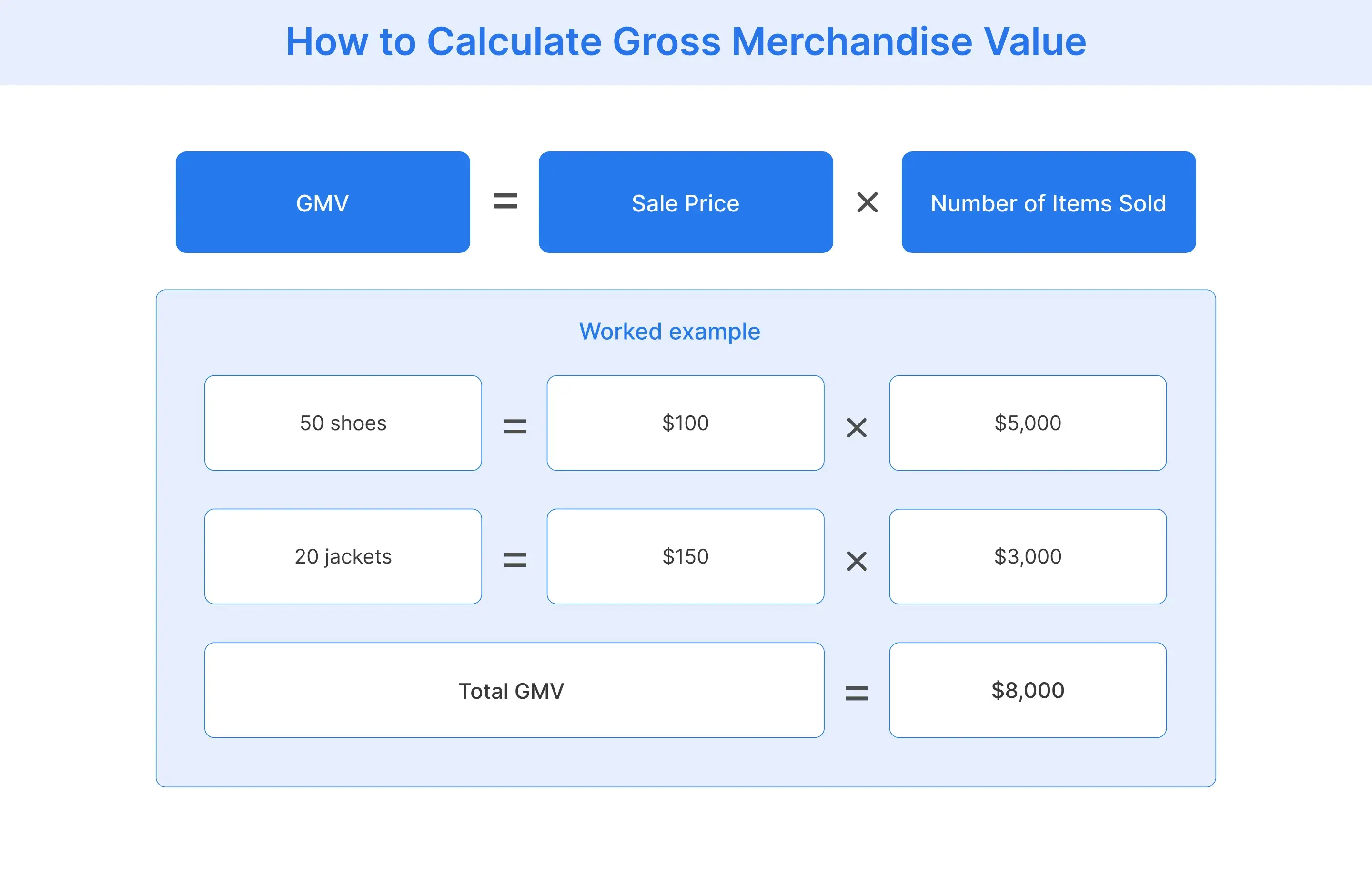
How Do You Calculate Gross Merchandise Value (GMV)?
Gross merchandise value provides a straightforward way to measure the total value of merchandise sold over a specific period.
Why is GMV Important For an E-Commerce Business?
Gross merchandise value gives e-commerce businesses a clear view of the total value of merchandise sold over a specific period, making it useful for tracking sales activity and measuring growth. By monitoring GMV over time, retailers can identify changes in demand, evaluate the performance of their sales strategies, and compare transaction volumes across different periods.
For marketplaces, GMV can also indicate the scale and activity of the platform. A growing GMV may suggest that more transactions are taking place or that customers are spending more through the platform. However, GMV should not be viewed in isolation because a higher transaction value does not necessarily translate into higher revenue or profitability.
Tracking GMV alongside metrics such as revenue, average order value, conversion rate, and customer acquisition costs gives retailers a more complete view of business performance. This allows them to understand not only how much merchandise is being sold, but also how effectively those sales contribute to business growth.
What Is the Difference Between GMV and Revenue?
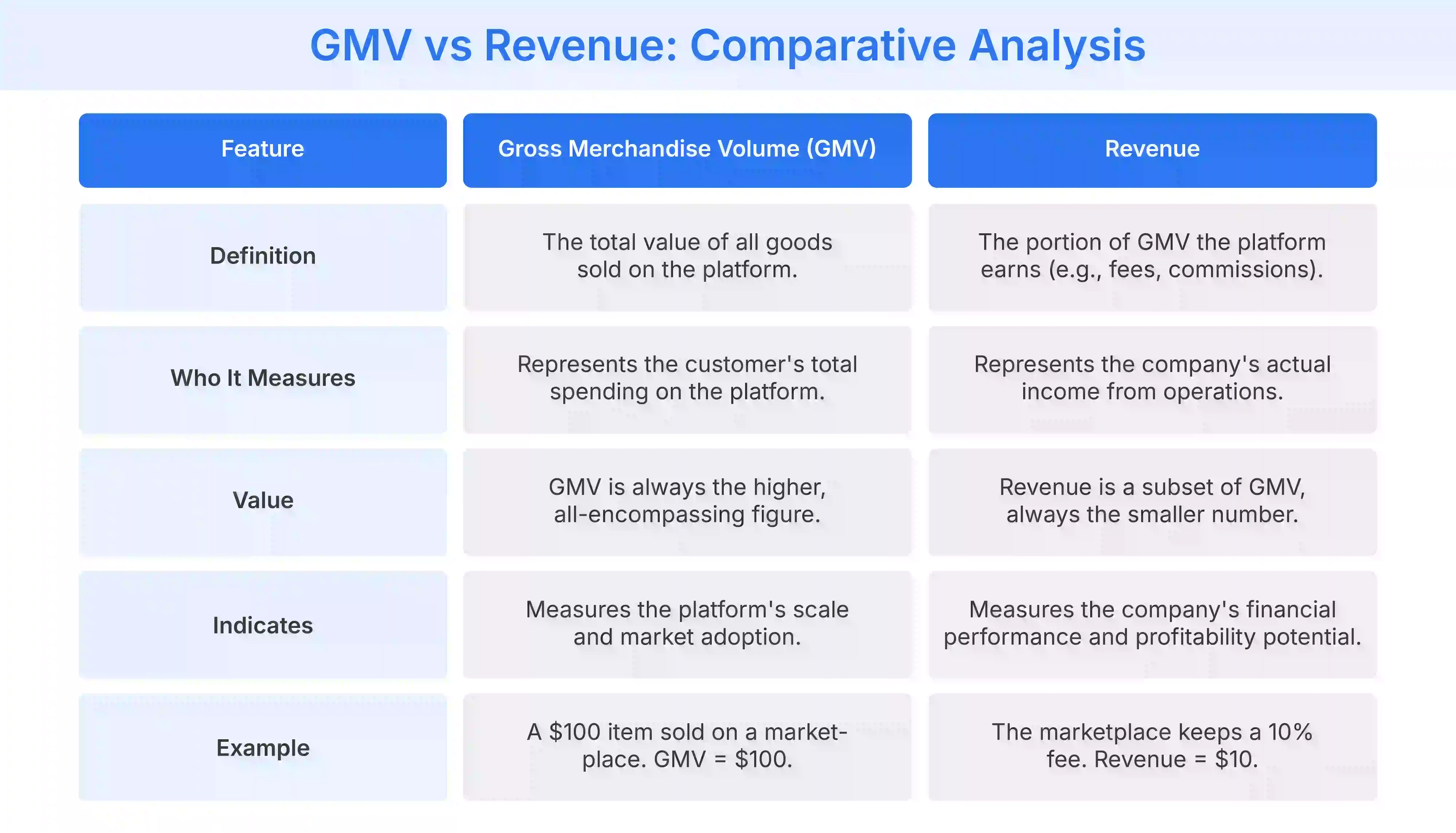
Gross merchandise value and revenue are related but measure different aspects of e-commerce performance. GMV represents the total value of merchandise sold through a platform or marketplace, while revenue represents the income a business earns from its sales or services after applicable deductions.
The difference becomes clearer when the two metrics are compared across factors such as what they measure, how they are calculated, and how they are used to assess business performance.
How Can You Improve Gross Merchandise Value (GMV)?
Businesses can improve gross merchandise value by increasing the number of transactions and the value of each purchase. This can involve improving the customer experience, encouraging larger purchases, and using pricing and promotional strategies that support higher sales volume.
Increase Average Order Value
Encouraging customers to purchase more in a single transaction can directly increase GMV. Retailers can use product bundling, upselling, and cross-selling to increase the value of each order while helping customers discover relevant products.
Improve Conversion Rates
A higher conversion rate means more visitors complete purchases, which can contribute to higher GMV. Retailers can improve conversion by simplifying the shopping and checkout experience, providing relevant product information, and reducing friction throughout the purchase journey.
Encourage Repeat Purchases
Increasing purchase frequency among existing customers can help retailers grow GMV over time. Personalized recommendations, relevant promotions, loyalty programs, and timely customer engagement can encourage customers to return and make additional purchases.
Use Pricing and Promotional Strategies Strategically
Pricing and promotions can influence both purchase decisions and transaction value. Retailers can use approaches such as dynamic pricing, tiered discounts, and targeted promotions to encourage purchases while aligning offers with customer demand and business objectives.

Turn Gross Merchandise Value Insights Into Retail Growth
Tracking gross merchandise value helps retailers understand the value of merchandise sold, but the real value comes from using those insights to improve business performance. By analyzing GMV alongside metrics such as conversion rate, average order value, and customer behavior, retailers can identify opportunities to increase sales and improve the customer experience.
With the right commerce technology, retailers can turn these insights into action. Flipkart Commerce Cloud brings together marketing, discovery, personalization, and commerce capabilities to help retailers reach relevant customers, improve product discovery, and convert more shoppers into buyers.

FAQ
A higher Gross Merchandise Volume generally indicates positive growth and market acceptance. However, it must be analyzed alongside other metrics. High GMV with low revenue or negative profit margins is not a sustainable business model, as it ignores the costs of generating those sales.
The terms are often used interchangeably, but ‘gross sales’ typically refers to the total sales of a traditional retailer before returns. ‘Gross Merchandise Volume’ is the preferred term for e-commerce marketplaces and platforms where the company facilitates, but does not own, the inventory sold.
No, Gross Merchandise Volume is not a measure of profitability. It is a ‘top-line’ metric that shows total sales volume but does not account for any costs, such as marketing, operational expenses, shipping, or cost of goods sold. A company can have high GMV and still be unprofitable.
GMV specifically measures the value of merchandise (goods) sold. Gross Transaction Value (GTV) is a broader term that can include the total value of all transactions, which might include services, processing fees, or other non-merchandise items. The definitions can vary by company.