
October 15, 2025
What is Keystone Pricing?
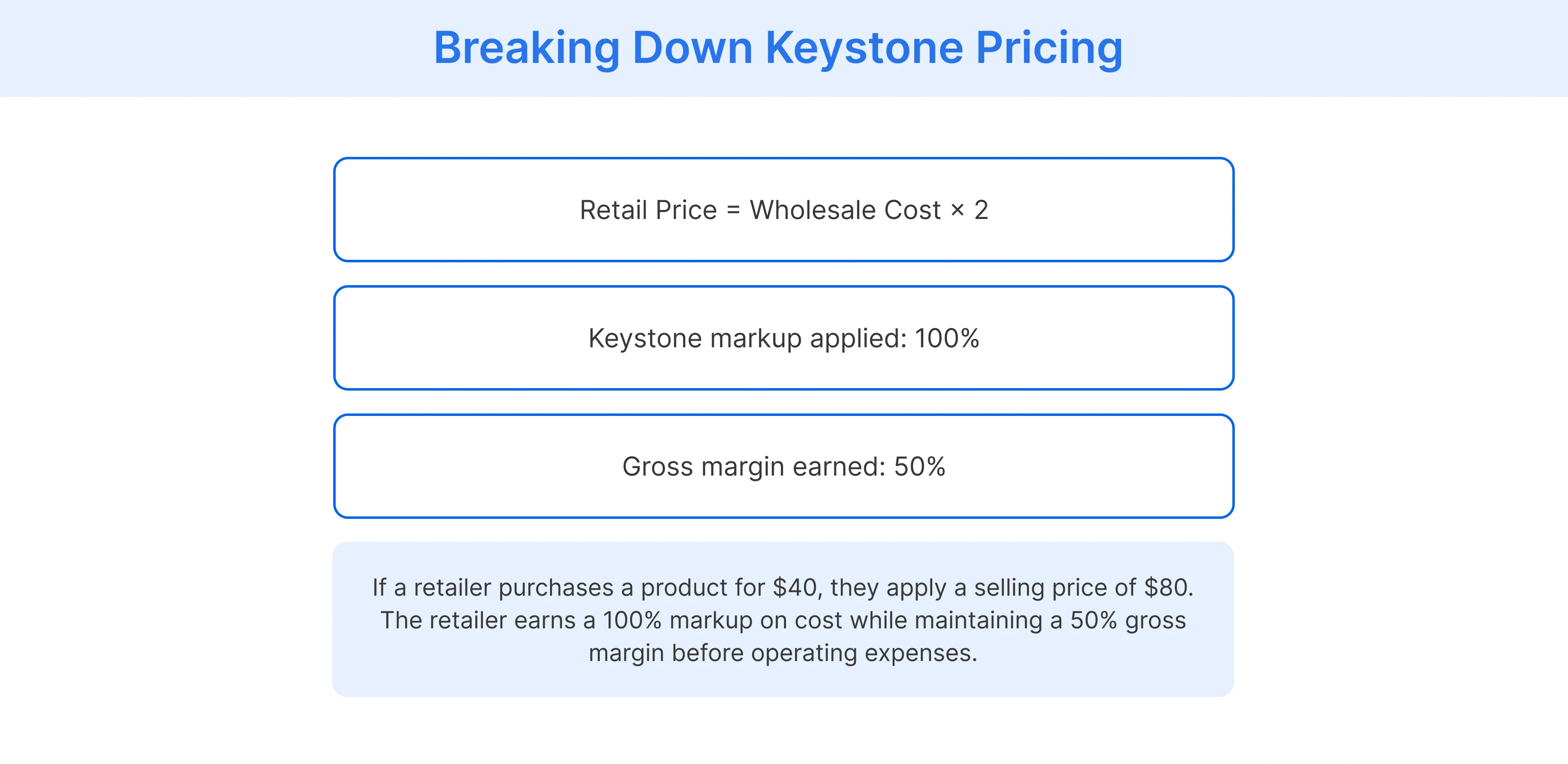
Keystone pricing is a retail pricing method where the retail price of a product is set at double its wholesale cost or cost of goods sold (COGS). This method results in a 100% markup and a 50% gross margin, providing a simple rule of thumb for retailers to ensure profitability.
Drishti, Manager - Digital Marketing

Table of Contents
- What is Keystone Pricing?
- How Did Keystone Pricing Evolve Over Time?
- When is Keystone Pricing Most Commonly Used?
- What are the Advantages and Disadvantages of Keystone Pricing?
- Which Businesses Can Benefit from Keystone Pricing?
- How Does Keystone Pricing Work in Practice?
- What are Some Examples of Keystone Pricing in Retail?
- How is Keystone Pricing Applied in Discount Retail?
- What Alternatives Exist to Keystone Pricing?
- Conclusion
What is Keystone Pricing?
Keystone pricing is a traditional pricing strategy where a retailer doubles the wholesale cost of an item to determine its selling price. This pricing model applies a standard 100% markup to the wholesale cost, resulting in a 50% gross margin on each sale. It has long served as a fundamental benchmark for setting prices across various product categories.
This straightforward approach simplifies the complex task of product pricing for businesses, especially those managing a large and diverse inventory. While modern strategies have evolved, understanding keystone pricing remains essential for any retailer.
- It establishes a consistent 50% profit margin on every product sold.
- The method simplifies price calculations across extensive product catalogs.
- It provides a predictable baseline for covering operational overheads.
- This strategy is easy to implement without the need for complex analytical tools.
- It works best for types of products with stable demand and low competition.
How Did Keystone Pricing Evolve Over Time?
Keystone pricing originated in traditional brick-and-mortar stores in the late 19th century. Doubling the wholesale price was a practical way for merchants to cover overheads and ensure a consistent profit, and it quickly became an accepted industry standard.
With the rise of e-commerce, the retail landscape became far more transparent. Price comparison became simple for shoppers, exposing the limitations of a one-size-fits-all approach that ignored brand value, competition, and changing market dynamics for individual products.
In response, retailers began adapting the formula with variations like "keystone-plus" for popular items. This important shift transformed the concept from a strict rule into a more flexible guideline that could be used for setting initial prices.
Today, the principle continues to influence pricing strategy, often serving as an initial starting point. Modern pricing software may use it as a baseline before applying complex algorithms that consider competitor prices, market demand, and other strategic business goals.
When is Keystone Pricing Most Commonly Used?
This pricing strategy is most effective in specific retail environments where market dynamics allow for standardized markups. It is commonly applied in the following situations:
- Boutiques and Specialty Stores: Retailers with unique, curated product selections and a loyal customer base can use it without facing intense price pressure from competitors.
- Low Volume, High Margin Products: Items that sell infrequently but are expected to yield a significant profit, such as luxury goods or fine furniture, often follow this model.
- Products with Low Brand Recognition: For new or unknown brands, a simple markup provides a baseline for pricing before market feedback is available to refine the strategy.
- Businesses with Limited Pricing Resources: Many small businesses or startups lacking sophisticated analytics tools can implement this method easily to ensure consistent margins.
- Industries with Standardized Costs: In sectors like the gift or souvenir industry, including the jewelry industry, where wholesale costs are relatively uniform, keystone provides a fair and consistent market price.
- Initial Pricing for New Product Lines: Retailers often use it as a baseline to price new luxury items before collecting sales data to inform a more dynamic pricing approach.
What are the Advantages and Disadvantages of Keystone Pricing?
While this method is easy to apply, it is important to weigh its benefits against its potential drawbacks for your business.
Advantages of Keystone Pricing
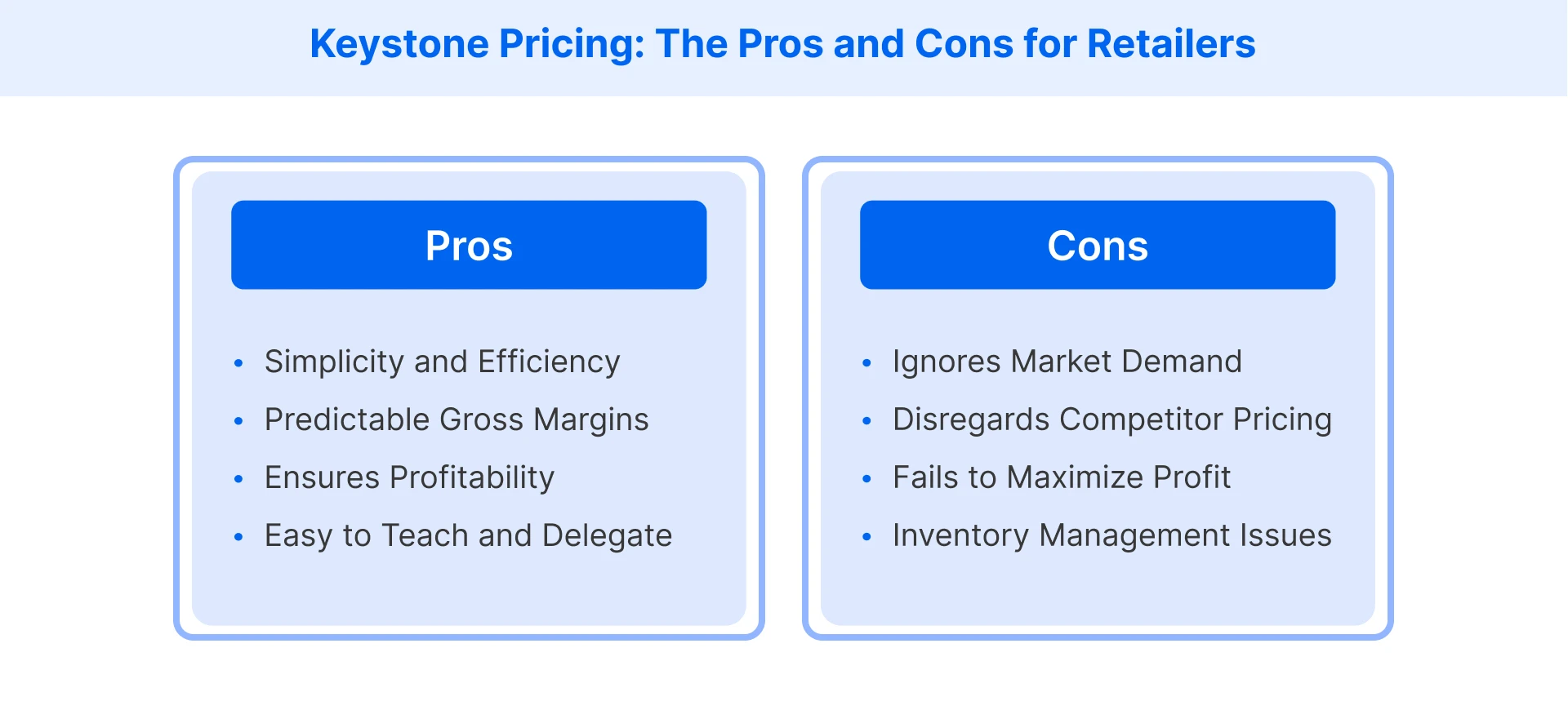
- Simplicity and Efficiency: One of the core advantages of keystone pricing is that it is incredibly easy to calculate, requiring minimal time and resources, without the need for complex software.
- Predictable Gross Margins: By consistently doubling the cost, retailers can easily forecast their gross margin, which simplifies financial planning, budgeting, and performance tracking.
- Ensures Profitability: The 100% markup generally provides a sufficient buffer to cover the product's cost price and operational overhead, and still generate a significant profit margin.
- Easy to Teach and Delegate: The straightforward approach allows business owners to delegate pricing tasks to employees with minimal training, freeing up leadership to focus on more strategic growth activities.
Disadvantages of Keystone Pricing
- Ignores Market Demand: This pricing model fails to consider consumer behavior or what customers are willing to pay, potentially leaving profit opportunities on the table for high-demand items.
- Disregards Competitor Pricing: It does not account for competitor strategies. This can lead to being significantly overpriced on common items or underpriced on unique products where a higher markup is possible.
- Fails to Maximize Profit: A rigid 100% markup is rarely the optimal price. High-value products might support higher margins, while slow-moving inventory may need a lower price to sell.
- Inventory Management Issues: Overpriced, slow-moving products can create issues with inventory management, tying up valuable capital. Underpriced popular items may lead to stockouts.
Which Businesses Can Benefit from Keystone Pricing?
The effectiveness of keystone pricing is highest for businesses where simplicity is more valuable than optimized pricing. Small, independent retailers, such as local gift shops or clothing boutiques, often find this method effective. For these small businesses, the ease of application across a diverse inventory outweighs the need for complex pricing analytics.
Specialty stores that offer unique products can also benefit. Since direct price comparisons are difficult for consumers, these retailers can apply a standard markup without significant risk. This is different from large department stores, which must constantly adjust prices to stay competitive.
New e-commerce businesses can use the keystone pricing strategy as a starting point. When launching, these companies may lack the historical sales data needed for more sophisticated pricing models. Keystone provides a safe, simple framework to ensure costs are covered.
Industries with traditionally high overheads, such as furniture showrooms, may use this approach. The substantial markup helps cover operational expenses. In these cases, the pricing strategy is as much about covering costs as it is about the cost of the goods.
How Does Keystone Pricing Work in Practice?
Understanding how keystone pricing works requires integrating it into core retail operations. Following these best practices can improve its application.
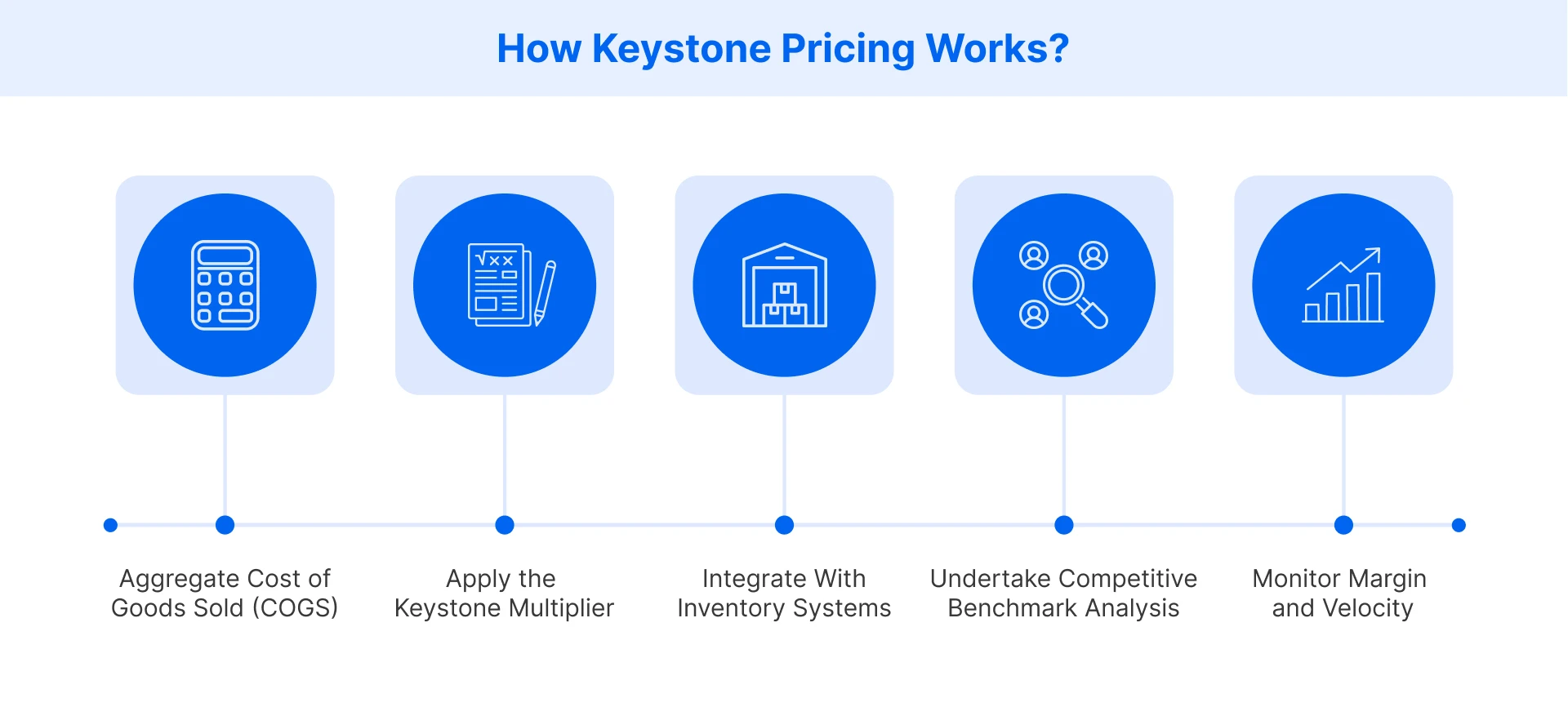
Cost of Goods Sold (COGS) Aggregation
First, you must accurately determine the full landed cost of each product. This includes the supplier's wholesale price plus any additional direct costs such as freight to ensure the markup is applied to the true cost price.
Application of the Keystone Multiplier
Within your retail management system, you set a pricing rule that automatically multiplies the aggregated COGS by two. This rule can be applied universally or assigned to specific product categories.
Integration with Inventory Systems
The pricing rule must be integrated with the inventory module. As new stock is received and its COGS is recorded, the system should automatically calculate and update the retail price, ensuring consistency.
Competitive Benchmark Analysis
Although a cost-plus model, you should periodically run analyses comparing your keystone-derived prices against key competitors. This helps identify SKUs where you may be significantly overpriced or underpriced.
Margin and Velocity Monitoring
You must use analytics to monitor the gross margin and sales velocity of keystone-priced items. Products with high velocity may support a higher markup, while slow-moving items may require a markdown.
What are Some Examples of Keystone Pricing in Retail?
Here are a few common examples showing how this pricing strategy is applied across different retail sectors.
- Apparel and Accessories: A fashion boutique buys a handbag from a designer for $75. Applying keystone pricing, the boutique sets the retail price at $150 to achieve a 50% gross margin.
- Home Goods and Decor: A home decor store purchases a decorative vase for $20. Using the keystone formula, the store prices the vase at $40 for its customers, a standard practice for many items in this category.
- Jewelry and Gifts: A retailer in the jewelry industry buys a necklace for $100. To simplify pricing, it uses keystone to set the price at $200, ensuring a consistent and profitable margin.
How is Keystone Pricing Applied in Discount Retail?
Discount retailers operate in highly competitive markets on a model of high volume and lower margins, making the direct application of traditional keystone pricing unsuitable. However, they often use the keystone price as an external benchmark rather than an internal rule. It represents the full price that traditional competitors might charge, which they can then strategically undercut.
For example, a discount store might acquire products at a much lower cost than a typical wholesale price. Instead of doubling their low cost, they might determine the item's standard keystone price in the market and then price their product significantly below that reference point.
Some discounters apply a modified keystone model. They might use a markup of 60-70% instead of the full 100%, allowing them to offer everyday low prices while maintaining a smaller profit margin. This approach blends cost-plus simplicity with competitive demands.
For discount retailers, keystone pricing is less of a formula to follow and more of a market signal to react to. Their success depends on deviating from it in a way that drives high sales volume and increases market share.
What Alternatives Exist to Keystone Pricing?
While simple, the art of pricing shows that keystone is not always the optimal strategy. Retailers should consider several alternatives to align prices with market conditions better.
- Competitive Pricing: Setting prices based on what competitors are charging. For example, pricing a smartphone $10 lower than a direct competitor to gain a competitive edge.
- Value-Based Pricing: Pricing based on the perceived value to the customer. A premium brand might set higher prices for a jacket because its brand equity justifies that price, even if the production cost is low.
- Dynamic Pricing: Adjusting prices in real-time based on market demand, supply, and competitor behavior. An e-commerce site might automatically lower the price during off-peak hours.
At Flipkart Commerce Cloud, we empower retailers to move beyond simplistic models. Our pricing solutions enable you to implement advanced strategies, such as dynamic and competitive pricing, at scale. We provide the tools to analyze market data, understand customer behavior, and automate price adjustments to protect and maximize your margins.
Conclusion
The essence of keystone pricing is its simplicity and predictability, making it a foundational concept in retail. The keystone pricing method offers a reliable starting point, especially for small businesses. However, its rigidity makes it less effective in today's market. Retailers must recognize its limitations and adopt more dynamic strategies that reflect customer value and competitive pressures to optimize profitability.

FAQ
The keystone pricing formula is: Retail Price = Wholesale Cost × 2. Under this classic rule of thumb, merchants double the original wholesale price of an item to set its final retail cost, ensuring a predictable 50% gross margin that easily covers operational overhead and yields consistent profit margins.
Keystone wholesale pricing is a standard strategy where manufacturers sell items to retailers at double their base production cost. This established wholesale approach helps suppliers maintain clear profit margins, ensuring that both the manufacturer and the distributor cover their operational expenses before products ever reach consumer storefronts.
An example of this method is a retailer purchasing a handbag for $25 and listing it for sale at $50. The retailer earns a 100% markup on cost while maintaining a 50% gross margin before operating expenses.
Businesses should avoid using keystone pricing on high-cost goods, highly competitive items, or low-margin products. Doubling the wholesale cost can make expensive items overpriced for budget-conscious shoppers, while underpricing low-cost goods might destroy profitability. Advanced platforms like FCC help merchants model dynamic pricing strategies instead of relying on a rigid markup.
While it's less common as a final pricing strategy, it remains relevant as a practical starting point. In the transparent e-commerce space, retailers often use it to establish a baseline price before applying more dynamic adjustments based on real-time market demand, competitor actions, and overall business goals.
No, a 50% gross margin does not guarantee profitability. This margin only covers the direct cost of production or acquisition. A business becomes profitable only if that margin is also large enough to cover all other operating expenses, including rent, marketing, salaries, and other variable costs and overhead.
While primarily designed for physical products with a clear wholesale cost, its principles can be adapted for services. You would first calculate the total direct cost of delivering the service (labor, materials, etc.), and then apply a similar cost-plus markup to determine the final price for the client.
Standard keystone pricing involves a 100% markup, where the retail price is double the wholesale cost. In contrast, double keystone pricing uses a 200% markup, setting the price at three times the wholesale cost. This latter method results in higher prices and is typically reserved for exclusive luxury items.