
December 3, 2025
What is Average Order Value?
Average order value tracks the mean dollar amount spent each time a customer places an order. This metric helps ecommerce businesses evaluate overall marketing efficiency and pricing strategy effectiveness within their online store.
Drishti, Manager - Digital Marketing

Table of Contents
- What is Average Order Value?
- How is Average Order Value Calculated and why does it matter?
- 7 Strategies to increase Average Order Value
- How should Average Order Value be really tracked?
- Give your Average Order Value a Big Push with FCC
What is Average Order Value?
Average Order Value (AOV) is a crucial key performance indicator that measures the average dollar amount of every order placed over a defined time period. This metric is calculated by dividing total revenue by the exact number of orders. It is a great way for retailers to understand how much a typical customer is spending in a single transaction on an ecommerce website.
You can consider it the smarter sibling of traffic volume, since the focus with AOV shifts from width to depth. This metric is used to develop strategies that encourage users already on a retail website to add more items to their shopping baskets.
Here are some important aspects of Average Order Value as a crucial ecommerce metric:
- Maximizing the return on investment for every dollar spent on marketing and customer acquisition becomes easier.
- Ecommerce brands gain deeper insights into customer purchasing habits and pricing strategy effectiveness immediately.
- Higher order values directly improve cash flow and overall business profitability for the long term.
- Identifying which products or bundles drive the highest revenue per transaction becomes straightforward.
How is Average Order Value Calculated and why does it matter?
Calculating ecommerce AOV requires two specific data points gathered from sales reports for a set timeframe:
- Total Revenue
- Total Number of Orders
Here is the formula to calculate Average Order Value:
Average Order Value = Total Revenue / Total Number of Orders
Let’s explain this with an example. Consider an online store generating $50,000 in average revenue from 1,000 individual orders during a specific month. Dividing the total revenue by the order count results in an AOV of $50. This baseline figure helps the business set realistic targets for future growth.
A 10% increase in average order value is often more profitable than a 10% increase in traffic. Customer acquisition costs stay the same while revenue climbs effectively. It is pure margin magic because the business generates more money from existing traffic without spending extra on advertisements.

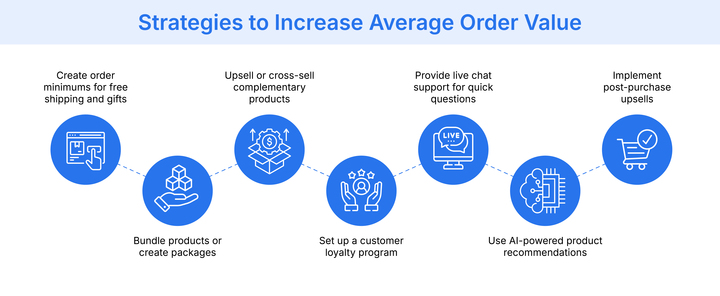
7 Strategies to increase Average Order Value
An ecommerce store can implement specific tactics to encourage customers to spend more during their shopping journey on the website.
Create order minimums for free shipping and gifts
Setting a threshold slightly above the current average order value incentivizes larger purchases effectively. Customers often add extra items to their cart to qualify for free shipping or a complimentary gift. This psychological trigger effectively turns a $40 order into a $60 transaction without friction.
Bundle products or create packages
Grouping related items together creates a perceived value that encourages customers to buy the complete set. Offering a slight discount on the bundle compared to purchasing items individually helps drive the sale. This strategy simplifies the decision process and increases the total purchase amount significantly.
Upsell or cross-sell complementary products
Suggesting a premium version of the chosen item or recommending accessories enhances the main product experience. Showing a customer how a better model or add-on improves utility drives higher spending naturally. It works best when the recommendation feels helpful rather than pushy or aggressive.
Set up a customer loyalty program
Rewarding customers with points or store credit for every purchase motivates them to reach specific spending tiers. This creates a brand loyalty cycle where customers spend more to earn rewards and then return to redeem them. It increases both average amount for the order and customer retention simultaneously.
Provide live chat support for quick questions
Real-time assistance helps remove doubts that might prevent a customer from completing a high-value purchase. Support teams can answer questions about sizing or features to build confidence in the buying decision. They can also recommend additional products that fit the customer needs perfectly.
Use AI-powered product recommendations
Automated algorithms analyze browsing history and purchase data to display items the customer is most likely to buy. Presenting frequently bought together suggestions on product pages or on the checkout page catches attention effectively. This personalized approach makes product discovery easier and naturally increases the basket size.
Implement post-purchase upsells
Presenting exclusive offers immediately after the customer completes the initial checkout process captures attention while intent is high. This tactic works well because it does not add friction to the original sale. Customers can add an item to their existing order with a single click.
How should Average Order Value be really tracked?
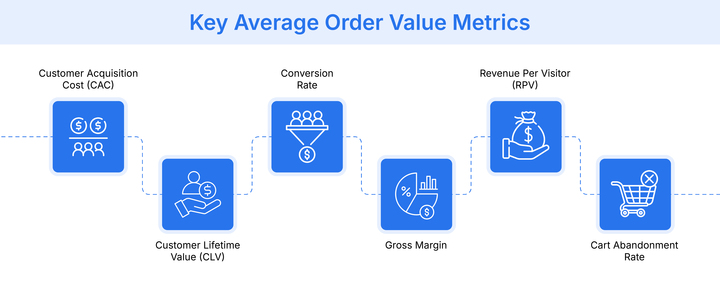
Tracking this metric in isolation creates a limited view of overall business health and performance. It is crucial to analyze it alongside other key indicators to understand the full profit picture.
-
Customer Acquisition Cost (CAC): This measures the total cost of winning a customer to purchase a product or service. Ensuring the average order value remains significantly higher than the acquisition cost is vital for profitability.
-
Customer Lifetime Value (CLV): This predicts the total revenue a business can expect from a single customer account over a period of time. A high average order value contributes to a higher lifetime value and long-term sustainability.
-
Conversion Rate: This tracks the percentage of website visitors who complete a desired action or purchase. Increasing prices to boost order value might lower conversion rates so balancing both metrics is necessary.
-
Gross Margin: This metric reveals the actual profit margins on each order after deducting goods sold costs. A high order value means little if margins on those specific products remain thin.
-
Revenue Per Visitor (RPV): This combines average order value and conversion rate to reveal the actual revenue generated per user. It prevents a narrow focus on AOV that might otherwise negatively impact the total traffic conversion.
-
Cart Abandonment Rate: This indicates the percentage of potential customers who add items to their cart but leave without paying. Aggressive upsell strategies intended to raise order value can sometimes drive this rate higher due to friction.
Give your Average Order Value a Big Push with FCC
Increasing transaction value requires more than just hope or basic manual adjustments to the website. Ecommerce sites need intelligent systems that understand customer behavior to present the right offers at the right time. Data-driven strategies turn casual browsers into repeat buyers without adding friction.
At Flipkart Commerce Cloud (FCC), we understand the challenges of scaling revenue while keeping acquisition costs under control in a competitive market. FCC provides the technological infrastructure needed to optimize every transaction. Our platform seamlessly integrates with your store to unlock hidden revenue potential.
Our Pricing Manager solution utilizes advanced machine learning to recommend the optimal price points for the catalog. We help identify opportunities to bundle products or adjust pricing to maximize basket size. Executing dynamic pricing strategies boosts revenue without sacrificing sales volume effectively.
We also offer a robust Personalization Engine that delivers tailored product recommendations to every unique visitor. Our system analyzes user intent in real-time to suggest relevant cross-sells and upsells automatically. This effectively increases the value of every cart by showing customers exactly what they want.

FAQ
It serves as a vital health check for pricing strategy and marketing efficiency within the business. A higher value means generating higher revenue from the same number of customers and reducing acquisition pressure. It directly impacts the bottom line by improving margins and profitability.
Monitoring this metric weekly or monthly helps identify trends and seasonality effectively. Daily tracking might show too much fluctuation, while annual tracking misses critical opportunities for adjustment. Regular review helps correlate changes in value with specific marketing campaigns or site updates.
Not necessarily because a high order value might come from low-margin products or heavy discounting efforts. Looking at gross margin alongside order value ensures true profitability for the business. Selling more items at a loss increases the order value but hurts financial health.
Average order value measures the total spend per entire transaction including multiple items in the cart. Average selling price measures the average price of a single unit or product sold. A high order value is possible even with a low selling price if customers buy many items.