
March 19, 2026
Sales Conversion Rate
Sales conversion rate is the percentage of visitors or leads who complete a desired purchase action within a given time period. It measures how effectively a business turns potential buyers into paying customers. Retailers use this figure to identify funnel gaps and optimize the purchase journey.
Drishti, Manager - Digital Marketing

Table of Contents
- What is Sales Conversion Rate?
- How Do You Calculate Sales Conversion Rate?
- What Factors Affect Sales Conversion Rate in Retail?
- What is the Difference Between Sales Conversion Rate and Click-Through Rate?
- How Can Retailers Improve Sales Conversion Rate?
- How Do You Use Data to Track and Improve Sales Conversion Rate?
- How Does Pricing Strategy Impact Sales Conversion Rate?
- Improve Your Sales Conversion Rate with Flipkart Commerce Cloud
Sales Conversion Rate
For retail businesses, understanding how many visitors turn into buyers forms the foundation of any effective revenue strategy. Sales conversion rate provides that clarity across both online and in-store channels.
Instead of focusing solely on traffic volume, retailers who track this metric gain a clear view of which parts of their product pages and purchase flow create friction or drive conversions.
- It tracks how many site visitors or prospects go on to complete a purchase within a given period.
- Retailers use it to identify friction and opportunity across the online and in-store purchase journey.
- It helps retail teams assess where their purchase funnel is underperforming and where gains can be made.
- A consistently rising conversion rate reflects strong product-market alignment and a well-optimized purchase journey overall.
What is Sales Conversion Rate?
Sales conversion rate is the percentage of visitors or prospects who complete a desired purchase action within a specific period. In retail, this action most commonly refers to a successfully completed transaction.
The metric measures how effectively a retail business turns potential buyers into paying customers across online and offline channels. It is as relevant for website traffic as it is for physical store footfall.
As a key performance indicator, the sales conversion rate helps retail teams benchmark performance and assess whether changes to the storefront or pricing strategy are driving measurable revenue impact.
How Do You Calculate Sales Conversion Rate?
Calculating the sales conversion rate requires two data points: the total number of conversions and the total number of visitors.
Formula:
Sales Conversion Rate = (Number of Conversions ÷ Total Visitors) × 100
- The total number of conversions refers to completed purchases.
- Total visitors can be measured by unique users or total sessions depending on the reporting goal.
- You can also measure conversions by channel-specific traffic to understand where purchase completion is highest.
Here is an example to explain the concept better.
If a retail website records 10,000 visitors in a month and 400 of those visitors complete a purchase, the sales conversion rate equals 4%. This figure can be segmented by device type or traffic source to identify where the most impactful conversion opportunities exist for the business.
What Factors Affect Sales Conversion Rate in Retail?
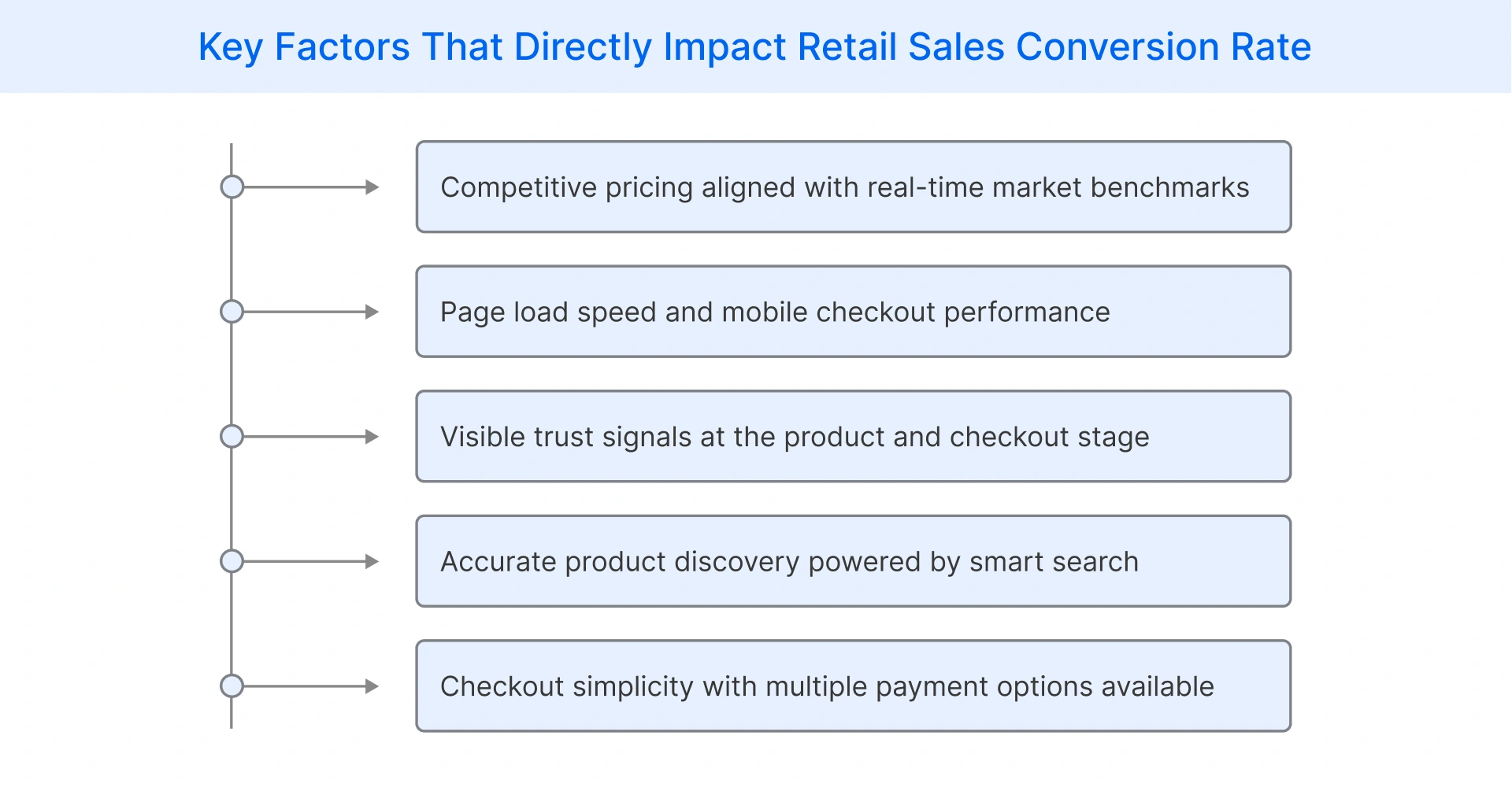
Here are the factors impacting whether a shopper completes a purchase or leaves the funnel entirely:
- Pricing and Promotions: Competitive pricing and time-sensitive offers directly influence shoppers' decisions to complete a purchase. Products priced above market averages often prompt buyers to switch to competing platforms before a transaction completes.
- Page Load Speed: A slow-loading product page significantly increases abandonment rates and reduces the likelihood of conversion. Research shows that even a one-second delay in page load time can measurably reduce purchase completion rates.
- Trust Signals: Visible trust signals, such as customer ratings and secure payment badges, directly reduce hesitation at checkout. Shoppers who encounter missing social proof are more likely to abandon a transaction before it is complete.
- Product Discovery: Accurate search results and relevant product recommendations help customers find the right product faster. Poor search accuracy forces shoppers to browse without direction, increasing the chance they will exit without converting. A strong catalog management solution keeps product data accurate and discoverable across every channel.
- Checkout Experience: A long or complex checkout process is among the most common reasons shoppers exit before completing a purchase. Each additional required step increases abandonment risk, especially for mobile users. Retailers can address this directly through an optimized cart and checkout experience.
What is the Difference Between Sales Conversion Rate and Click-Through Rate?
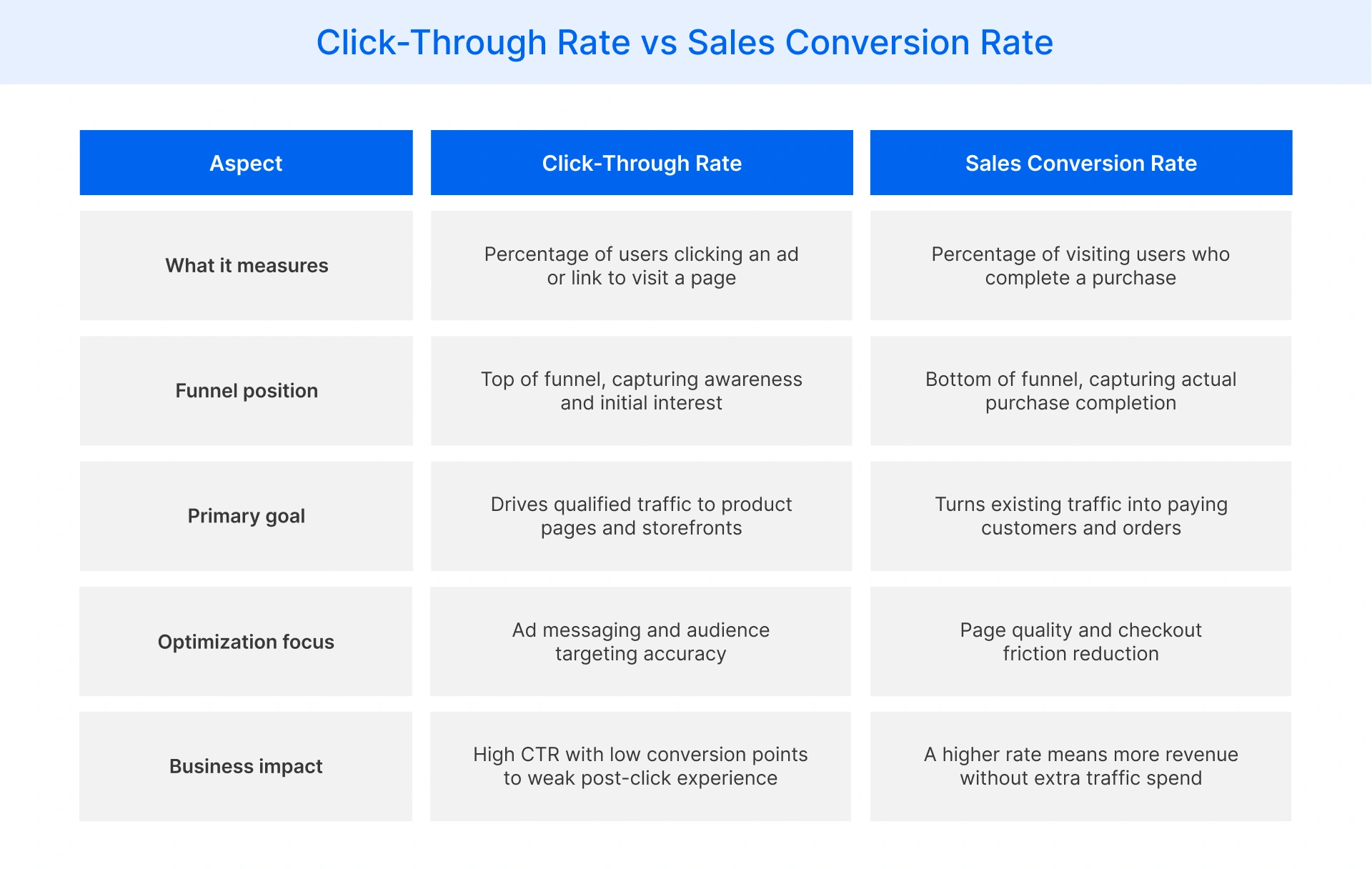
Click-through rate and sales conversion rate measure different stages of the purchase journey. Click-through rate tracks the percentage of users who click an ad or link to visit a product page. The sales conversion rate then measures how many of those visitors complete a purchase, revealing where traffic-to-revenue gaps exist.
How Can Retailers Improve Sales Conversion Rate?
Improving sales conversion rate across an ecommerce or retail platform requires targeted and data-informed actions at every stage of the shopper journey.
- Optimize Product Pages: High-quality images and detailed product descriptions reduce purchase uncertainty and give shoppers the information they need to convert. Clear pricing with no hidden charges ensures the product's value proposition is visible before the checkout stage.
- Streamline Checkout: Reducing the number of steps to complete a transaction lowers abandonment at the final stage of the purchase journey. Offering multiple payment options accommodates different buyer preferences and removes a common barrier to order completion.
- Use Personalization: Showing shoppers relevant product recommendations based on their browsing and purchase history increases the likelihood of finding what they need. A dedicated personalization engine adjusts content and product visibility based on individual shopper signals, accelerating conversion.
- A/B Test Continuously: Regularly testing different page layout and pricing display combinations reveals which combinations drive higher purchase completion rates. Continuous experimentation eliminates guesswork and enables data-backed decisions that consistently improve the sales conversion rate over time.
- Recover Abandoned Carts: Sending timely follow-up messages to shoppers who have added products to their cart but haven't completed the transaction effectively recovers lost conversions. A personalized reminder with a relevant offer can bring buyers back to complete their purchase.
How Do You Use Data to Track and Improve Sales Conversion Rate?
Data turns raw performance numbers into clear signals about where the purchase funnel is succeeding and where it is failing.
- Monitor conversion rate by traffic source and device type to identify where performance gaps exist and which channels are underdelivering for your retail business.
- Use heatmaps and session recordings to observe how shoppers interact with product pages and identify the specific points where they drop off before converting.
- Track funnel drop-off from product views to checkout to prioritize which stages of the journey require the most immediate attention and resource investment.
- Review conversion data alongside average order value and return rate for a more complete view of actual sales quality and its impact on revenue.
The right commerce engine consolidates these data streams, giving retail teams a unified view of performance across the entire purchase funnel.
How Does Pricing Strategy Impact Sales Conversion Rate?
Let’s understand how the pricing strategy directly impacts the sales conversion rate:
- Above-Market Pricing Reduces Purchase Intent: Prices set significantly above market averages reduce purchase intent and consistently direct shoppers toward competing platforms. When a product's price fails to match its perceived value, conversion drop-off typically occurs well before the checkout stage.
- Dynamic Pricing Improves Real-Time Alignment: Dynamic pricing tools help retailers align product prices with real-time demand signals and live competitor activity. This alignment reduces the price-led drop-off that occurs when static pricing fails to reflect current market conditions.
- Transparent Pricing Builds Completion Confidence: Transparent pricing with no hidden fees at checkout significantly reduces cart abandonment and improves purchase completion rates. Shoppers who encounter unexpected charges at the final stage are highly likely to abandon the transaction.
- Precision Promotions Lift Conversion Without Eroding Margins: Promotional pricing, when applied with precision, can lift the sales conversion rate during peak seasons without permanently eroding product margins. Broad or unplanned discounting may increase short-term conversions while reducing long-term pricing integrity and margin health.

Improve Your Sales Conversion Rate with Flipkart Commerce Cloud
Retailers who track and act on conversion data consistently outperform those who rely on traffic volume alone. A higher sales conversion rate delivers more revenue from an existing audience, with no corresponding increase in marketing spend.
Flipkart Commerce Cloud provides retailers with the tools needed to convert more shoppers at every stage of the purchase journey. With AI-powered pricing and a seamless checkout experience, FCC helps retailers close more sales consistently.
Our Pricing Manager uses machine learning to keep product prices competitive in real time, reducing the price-led drop-off that costs retailers conversions every day. FCC personalization engine surfaces relevant products to each shopper, increasing order relevance and purchase likelihood.
FCC's composable commerce architecture allows retailers to independently optimize the storefront and checkout experience, making it easier to address specific conversion gaps. Explore how Flipkart Commerce Cloud's digital commerce solution can help build a higher-converting retail platform.

FAQ
The average ecommerce conversion rate typically falls between 2% and 4%, though this varies significantly by category. Fashion retail tends to sit at the lower end, while health or subscription-based categories often see higher figures. Retailers should benchmark against industry-specific data rather than a single universal number.
Retailers should review this metric at least once a month and more frequently during campaign periods or seasonal peaks. Weekly tracking is advisable for high-volume ecommerce operations, where even small fluctuations can signal meaningful changes in shopper behavior or funnel performance.
Mobile traffic shows a lower sales conversion rate than desktop traffic, often by a significant margin. This gap is largely due to friction in the mobile checkout experience, smaller screens and slower load times. Retailers who optimize for mobile can close much of this conversion gap.
Cart abandonment rate and sales conversion rate are inversely linked. When more shoppers abandon their carts before completing a purchase, the overall conversion rate falls. Reducing abandonment through simplified checkout and timely re-engagement messages is one of the most effective ways to recover lost conversions.
Yes. Strong product content that includes accurate descriptions and high-quality images directly reduces purchase hesitation and improves the sales conversion rate. Shoppers who find the information they need on a product page are significantly more likely to complete a purchase without navigating away from the site.