
March 11, 2026
Seller Defined Audiences
Seller Defined Audiences allow publishers to segment their first-party data into standardized cohorts for privacy-safe advertising. This framework enables retailers to monetize onsite user behavior without sharing raw identity data with external buyers.
Drishti, Manager - Digital Marketing

Table of Contents
- What is Seller Defined Audiences?
- How Do Seller Defined Audiences Work?
- What are the Key Components of SDA?
- How Does SDA Differ from Third-Party Cookies?
- Why Should Publishers and Advertisers Adopt Seller-Defined Audiences?
- What is the Role of Data Transparency Standard in SDA?
- How to Implement Seller-Defined Audiences?
- Drive Ad Revenue with Flipkart Commerce Cloud
Seller Defined Audiences
The digital advertising ecosystem is shifting toward privacy-first solutions that prioritize user anonymity over individual tracking. Seller Defined Audiences offer a robust framework for publishers to leverage their valuable first-party data without relying on deprecating technologies like third-party cookies.
This specification empowers media owners to categorize their site visitors into standardized segments based on demographics or interests. Advertisers can then bid on these high-quality cohorts through programmatic channels while ensuring that sensitive user data never leaves the publisher's controlled environment.
- It enables publishers to monetize their audience data and traffic without exposing individual user identities to open marketplaces.
- Advertisers gain access to relevant audience segments that are standardized across various providers and platforms for consistent targeting.
- The framework supports a privacy-centric internet by removing the need for cross-site tracking or intrusive data collection methods.
- Publishers maintain full ownership of their data strategy and revenue streams by defining their own high-value audience cohorts.
What is Seller Defined Audiences?
Seller Defined Audiences (SDA) is an IAB Tech Lab addressability specification that allows publishers to monetize their first-party data without revealing user identities. It provides a standardized method for sellers to package their user data into buyable segments.
It enables media owners to segment their audience based on onsite behavior and share these segments with advertisers in a privacy-compliant manner. This approach ensures that you can facilitate precise targeting for marketers without relying on external identifiers or third-party cookies.
How Do Seller Defined Audiences Work?
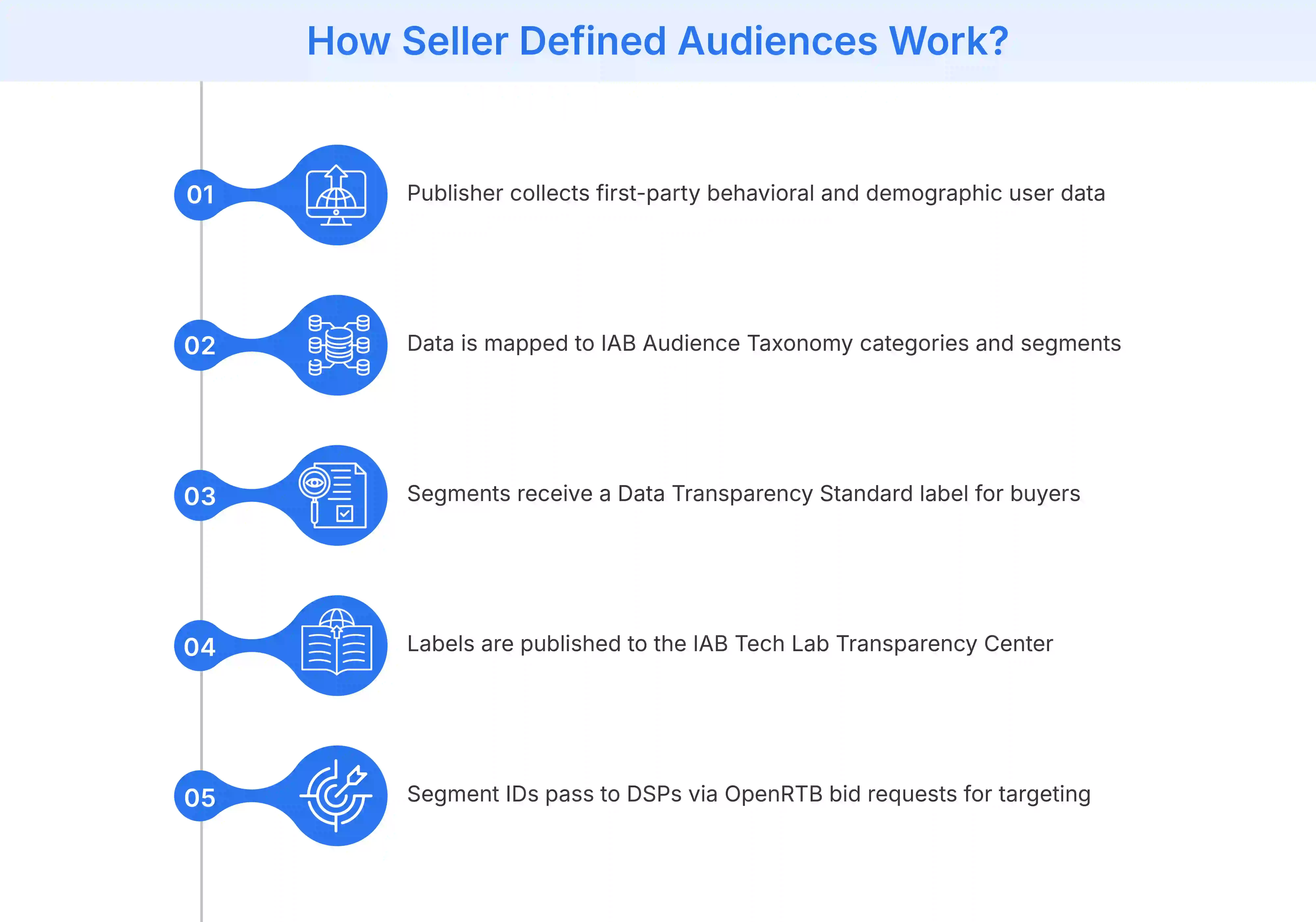
The process begins when a publisher analyzes user activity on their website to create specific audience cohorts based on interest or intent. You might group users who frequently visit product pages into a ‘high-intent shopper’ segment for better monetization.
The publisher labels these cohorts using the standardized IAB Audience Taxonomy to ensure buyers understand the segment nature and value. This universal language allows demand-side platforms to recognize that a segment labeled ‘Sports Enthusiast’ means the same thing across different websites.
These segment IDs are passed to advertisers through OpenRTB bid requests without sharing any personal user identifiers. A Demand-Side Platform (DSP) receives the segment ID alongside an impression opportunity and decides whether to bid based on how well the cohort matches its campaign targeting criteria.
What are the Key Components of SDA?
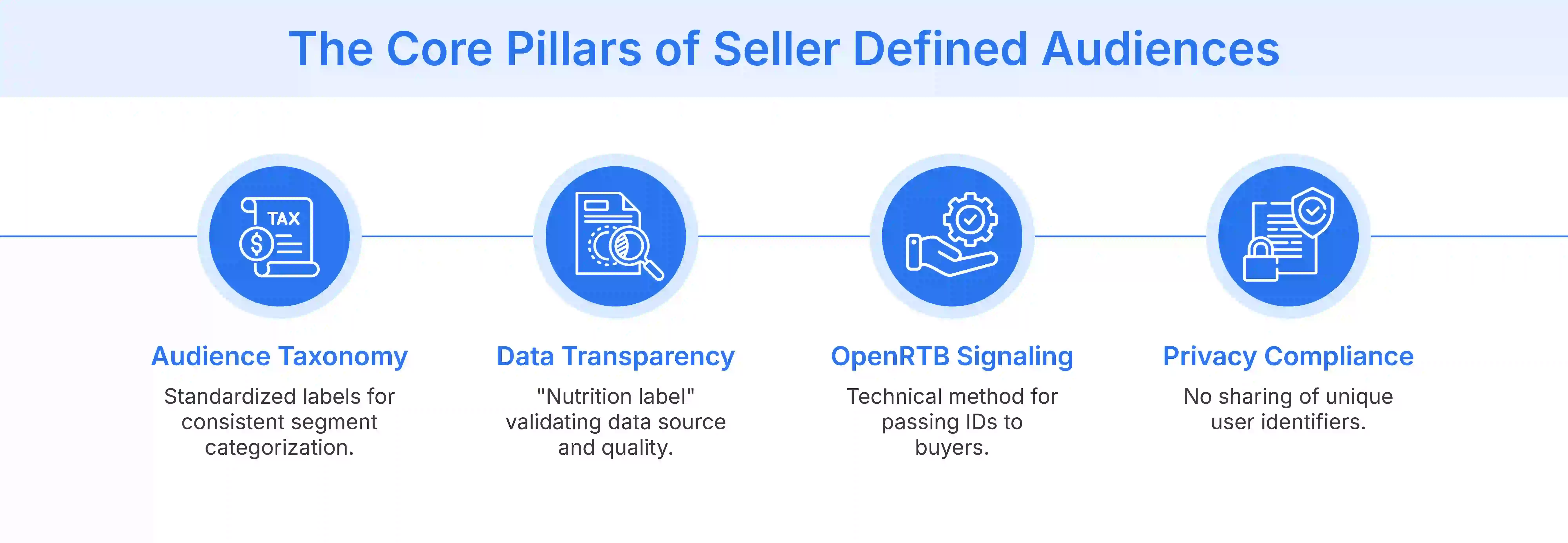
To function effectively as a privacy-preserving standard, the SDA framework relies on three critical technical pillars that ensure consistency and trust.
- Audience Taxonomy: A standardized list of tiered categories that publishers use to consistently label their audience segments. This hierarchy allows buyers to recognize specific user interests and demographic data across different inventory sources without confusion.
- Data Transparency Standard (DTS): This framework validates data sources and quality to build trust between buyers and sellers. It requires publishers to disclose how they built a segment and the age of the data to ensure accuracy.
- OpenRTB Signaling: The technical method of passing segment IDs in the bid stream to Demand Side Platforms. This mechanism ensures that the audience information is readable by the buyer's system during the real-time auction process.
How Does SDA Differ from Third-Party Cookies?
While cookies rely on tracking individuals across the web, SDA focuses on publisher-controlled cohorts that respect user privacy and data ownership.
- Data Source: SDA relies on first-party data owned by the publisher, while cookies rely on third-party trackers placed on a user's browser. This shift empowers you to leverage your direct relationship with visitors for monetization.
- Privacy: SDA does not track users across different websites or share unique user IDs with advertisers. It aggregates users into groups based on similar behaviors and protects their individual actions from external surveillance.
- Control: Publishers maintain full control over their data in the SDA model, whereas cookies often allow third parties to harvest data. You decide how to package your audience and who gets to access it.
Why Should Publishers and Advertisers Adopt Seller-Defined Audiences?
Adopting this standard offers a strategic advantage for both sides of the supply chain by ensuring sustainability and compliance in advertising.
Sellers
- Revenue Protection: It provides a viable monetization alternative as browsers continue to deprecate third-party cookies and restrict tracking. You can sustain your ad revenue by offering addressable inventory that does not depend on external identifiers.
- Data Security: Publishers can sell their audience value without leaking their proprietary data assets to competitors or intermediaries. This closed-loop approach ensures that your unique user insights remain your competitive advantage in the market.
- Direct Relationships: It fosters closer collaboration with advertisers seeking high-quality, transparent audience segments and premium inventory. You can negotiate better deal terms by offering verified cohorts that align directly with buyer KPIs.
Advertisers
- Scale and Reach: Advertisers can target relevant audiences across multiple publishers using a standardized language and taxonomy. This consistency allows you to run broad campaigns without having to integrate with dozens of data providers.
- Brand Safety: Buying directly from publishers ensures that the data is accurate and the inventory is legitimate and high-quality. You reduce the risk of ad fraud and ensure your budget is spent on real users.
- Future-Proofing: It allows brands to maintain addressability and targeting capabilities in a privacy-first digital ecosystem without legal risks. You can continue to reach your target market effectively even as regulations like GDPR and CCPA evolve.
What is the Role of Data Transparency Standard in SDA?
The IAB Tech Lab Data Transparency Standard (DTS) serves as a nutrition label for audience data and segment quality. It tells the buyer exactly how the segment was constructed and validates the methodology behind the audience creation for complete clarity.
It includes details about data recency, provenance, and segmentation logic to help buyers assess the value of the cohort. You can see if a segment is based on declared user data or modeled behaviors and when it was last updated.
This transparency gives advertisers the confidence to bid on cohorts without verifying users' identities themselves or using third-party tools. It creates a trusted environment where sellers are accountable for their data labeling and buyers can purchase with certainty.
How to Implement Seller-Defined Audiences?
Retailers and publishers must follow a structured technical process to categorize their users and signal these segments to programmatic buyers.
- Audit Your Data: You must first organize your first-party data and map your user behaviors to the IAB Audience Taxonomy. This involves identifying key user actions and matching them to standard categories like ‘Shopping’ or ‘Technology.’
- Register with IAB: You need to register your segments and ensure they meet the Data Transparency Standard requirements for validation. This step generates the necessary IDs and labels that you will transmit to buyers in the bid stream.
- Update Bid Requests: You must configure your ad server or supply-side platform to pass the correct SDA IDs in the OpenRTB objects. This technical integration ensures that Demand Side Platforms (DSPs) receive and recognize your audience signals.
Drive Ad Revenue with Flipkart Commerce Cloud
Maximizing the value of your site traffic is essential for retail growth in a post-cookie world where first-party data is king. You need a robust platform that turns your user data into a high-margin revenue stream through intelligent retail media advertising.
Flipkart Commerce Cloud empowers retailers to build their own retail media networks with advanced ad tech solutions and measurement tools. We provide the infrastructure you need to segment audiences effectively and attract premium advertiser budgets to your digital storefronts.
Our Retail Media Solution uses machine learning to deliver relevant ads that enhance the shopping experience while protecting user privacy. You can monetize your digital assets confidently and scale your advertising business with our proven technology.
Schedule a demo today and see our platform in action.

FAQ
Yes, SDA acts as a privacy-preserving alternative to third-party cookies for audience targeting and addressability. It allows publishers to leverage their own audience data to create addressable segments without tracking users across the web. This makes it a sustainable solution for the future of digital advertising.
You do not strictly need a DMP, but having one can simplify the process of segmenting users. A DMP helps you organize your first-party data and map it to the standardized taxonomy efficiently. However, many modern ad servers and SSPs also offer native tools to manage these segments.
Yes, SDA is highly effective for both open auctions and programmatic direct deals like Private Marketplaces (PMP). It allows you to package specific audience segments and offer them to select buyers. This flexibility helps you maximize yield across different sales channels and deal types.
SDA protects privacy by ensuring that no unique user identifiers or email addresses are shared with the advertiser. The buyer only sees a cohort ID representing a group of users with similar interests. This prevents cross-site tracking and keeps the user's personal identity secure within the publisher's domain.
Yes, small publishers can adopt SDA to increase the value of their inventory and attract programmatic buyers. By using the standardized taxonomy, your niche audience becomes easily discoverable by large advertisers. This levels the playing field and allows you to compete for ad budgets based on data quality.